Question
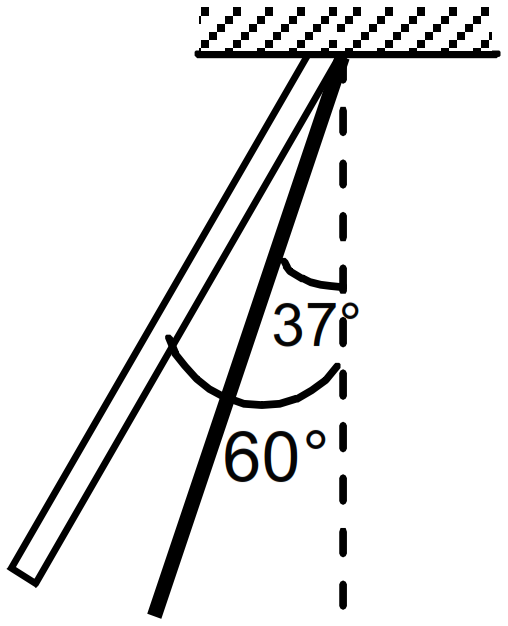
A uniform rod pivoted at its upper end hangs vertically. It is displaced through an angle of 60° and then released. Find the magnitude of the force acting on a particle of mass dm at the tip of the rod when the rod makes an angle of 37° with the vertical.
Answer

Let l = length of the rod, and m = mass of the rod.

Applying energy principle
$\Big(\frac{1}{2}\Big)\text{l}\omega^2-0=\text{mg}\Big(\frac{1}{2}\Big)(\cos37^\circ-\cos60^\circ)$

$\Rightarrow\frac{1}{2}\times\frac{\text{ml}^2}{3}\omega^2$

$=\text{mg}\times\frac{1}{2}\Big(\frac{4}{5}-\frac{1}{2}\Big)\text{t}$

$\Rightarrow\omega^2=\frac{9\text{g}}{10\text{l}}=0.9\Big(\frac{\text{g}}{\text{l}}\Big)$

Again $\Big(\frac{\text{ml}^2}{3}\Big)\alpha=\text{mg}\Big(\frac{1}{2}\Big)\sin37^\circ=\text{mgl}\times\frac{3}{5}$

$\therefore\alpha=0.9\Big(\frac{\text{g}}{\text{l}}\Big)=$ angular acceleration.

So, to find out the force on the particle at the tip of the rod

Fi = centrifugal force $=(\text{dm})\omega^2\text{l}=0.9(\text{dm})\text{g}$

Ft = tangential force $=(\text{dm})\alpha\text{l}=0.9(\text{dm})\text{g}$

So, total force $\text{F}=\sqrt{\big(\text{F}_{\text{i}}^2+\text{F}_{\text{t}}^2\big)}=0.9\sqrt2(\text{dm})\text{g}$

Need a full question paper?

Generate a complete, print-ready paper with questions like this in minutes — across 16+ boards, with answer keys.

Start Generating Free

Similar questions

Define electric dipole moment. Calculate the value of electric potential generated from electric dipole and prove that its value is maximum at the point situated on the axis and zero at the equatorial point? ###Define electric dipole moment of electric dipole. Obtain an expression for the electric potential at a common point due to electric dipole. Also draw necessary diagram.
Consider the situation of the previous problem. The man has to reach the other shore at the point directly opposite to his starting point. If he reaches the other shore somewhere else, he has to walk down to this point. Find the minimum distance that he has to walk.
Two identical pith balls are charged by rubbing against each other. They are suspended from a horizontal rod through two strings of length 20cm each, the separation between the suspension points being 5cm. In equilibrium, the separation between the balls is 3cm. Find the mass of each ball and the tension in the strings. The charge on each ball has a magnitude 2.0 × 10-8C.
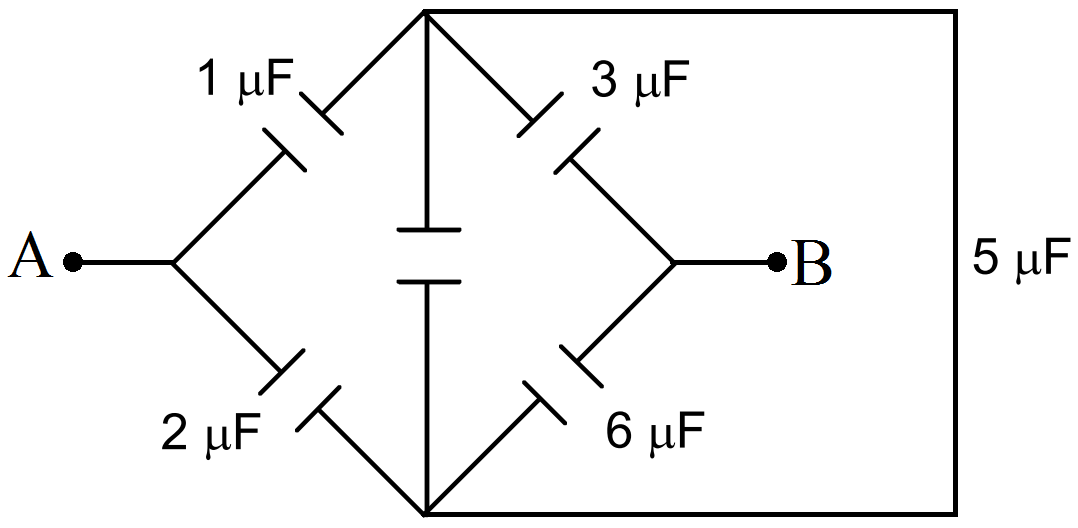
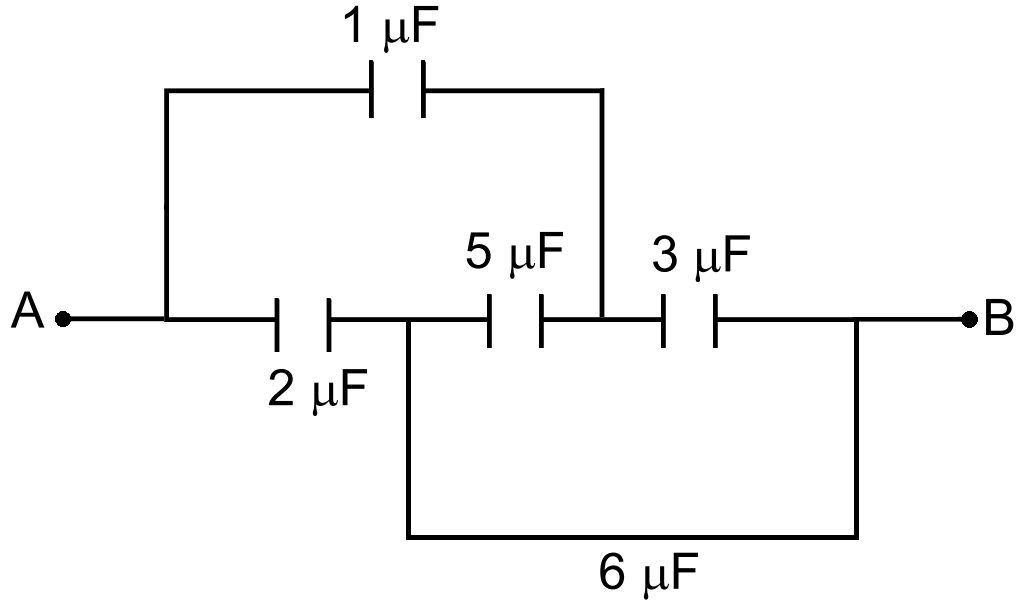
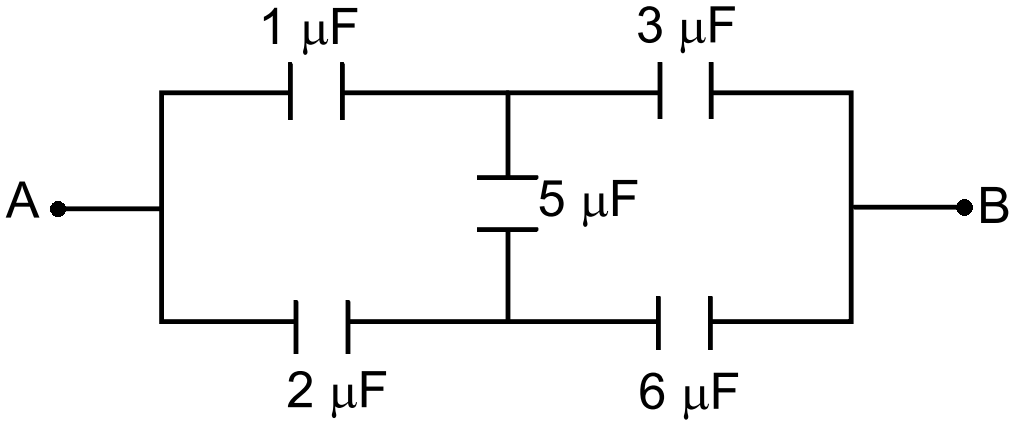
Convince yourself that parts (a), (b) and (c) of figure are identical. Find the capacitance between the points A and B of the assembly.


A point charge causes an electric flux of –1.0 × 10³ Nm2 /C to pass through a spherical Gaussian surface of 10.0 cm radius centred on the charge.
  1. If the radius of the Gaussian surface were doubled, how much flux would pass through the surface?
  2. What is the value of the point charge?
A parallel-plate capacitor of plate area A and plate separation d is charged to a potential difference V and then the battery is disconnected. A slab of dielectric constant K is then inserted between the plates of the capacitor so as to fill the space between the plates. Find the work done on the system in the process of inserting the slab.
A parallel-plate capacitor having plate area 400cm2 and separation between the plates 1.0mm is connected to a power supply of 100V. A dielectric slab of thickness 1.0mm and dielectric constant 5.0 is inserted into the gap:
  1. Find the increase in electrostatic energy.
  2. If the power supply is now disconnected and the dielectric slab is taken out, find the further increase in energy.
  3. Why does the energy increase in inserting the slab as well as in taking it out?
A parallel-plate capacitor of capacitance $5\mu\text{F}$ is connected to a battery of emf 6V. The separation between the plates is 2mm:
  1. Find the charge on the positive plate.
  2. Find the electric field between the plates.
  3. A dielectric slab of thickness 1mm and dielectric constant 5 is inserted into the gap to occupy the lower half of it. Find the capacitance of the new combination.
  4. How much charge has flown through the battery after the slab is inserted?
A radio can tune in to any station in the 7.5 MHz to 12 MHz band. What is the corresponding wavelength band?
The separation between the plates of a parallel-plate capacitor is 0.500cm and its plate area is 100cm2. A 0.400cm thick metal plate is inserted into the gap with its faces parallel to the plates. Show that the capacitance of the assembly is independent of the position of the metal plate within the gap and find its value.