Question
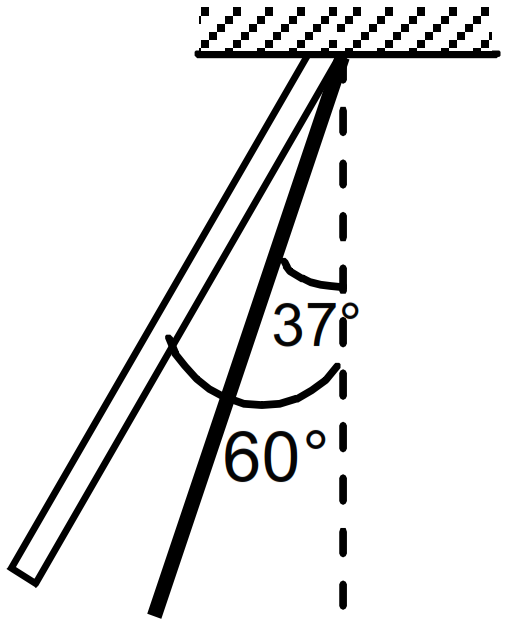
A uniform rod pivoted at its upper end hangs vertically. It is displaced through an angle of 60° and then released. Find the magnitude of the force acting on a particle of mass dm at the tip of the rod when the rod makes an angle of 37° with the vertical.
Answer


Let l = length of the rod, and m = mass of the rod. Applying energy principle$\Big(\frac{1}{2}\Big)\text{l}\omega^2-0=\text{mg}\Big(\frac{1}{2}\Big)(\cos37^\circ-\cos60^\circ)$
$\Rightarrow\frac{1}{2}\times\frac{\text{ml}^2}{3}\omega^2$
$=\text{mg}\times\frac{1}{2}\Big(\frac{4}{5}-\frac{1}{2}\Big)\text{t}$
$\Rightarrow\omega^2=\frac{9\text{g}}{10\text{l}}=0.9\Big(\frac{\text{g}}{\text{l}}\Big)$
Again $\Big(\frac{\text{ml}^2}{3}\Big)\alpha=\text{mg}\Big(\frac{1}{2}\Big)\sin37^\circ=\text{mgl}\times\frac{3}{5}$$\therefore\alpha=0.9\Big(\frac{\text{g}}{\text{l}}\Big)=$ angular acceleration.
So, to find out the force on the particle at the tip of the rod $F_i$ = centrifugal force $=(\text{dm})\omega^2\text{l}=0.9(\text{dm})\text{g}$ $F_t$ = tangential force $=(\text{dm})\alpha\text{l}=0.9(\text{dm})\text{g}$ So, total force $\text{F}=\sqrt{\big(\text{F}_{\text{i}}^2+\text{F}_{\text{t}}^2\big)}=0.9\sqrt2(\text{dm})\text{g}$

Need a full question paper?

Generate a complete, print-ready paper with questions like this in minutes — across 16+ boards, with answer keys.

Start Generating Free

Similar questions

Two bodies of masses $10kg$ and $20kg$ respectively kept on a smooth, horizontal surface are tied to the ends of a light string. A horizontal force $F = 600N$ is applied to (i) A, (ii) B along the direction of string. What is the tension in the string in each case?
In a room, where the temperature is 30°C, a body cools from 61°C to 59°C in 4 minute s. What time will the body take to cool from 51°C to 49°C in the same room?
A train takes $4 min$ to go between stations $2.25km$ apart starting and finishing at rest. The acceleration is uniform for the first $40s$ and the deceleration is uniform for the last $20s$. Assuming the velocity to be constant for the remaining time, calculate the maximum speed, acceleration and retardation, use only the graphical method.
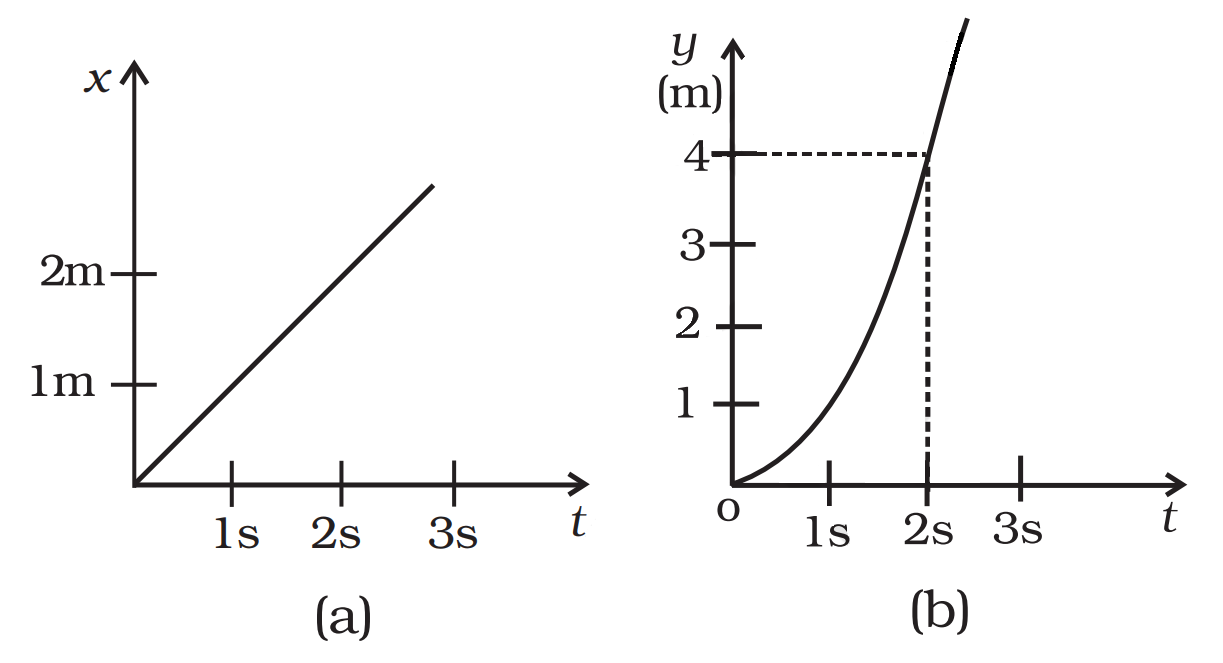
shows (x, t), (y, t) diagram of a particle moving in 2-dimensions.
If the particle has a mass of 500g, find the force (direction and magnitude) acting on the particle.
A $20\mu\text{F}$ capacitor is joined to a battery of emf 6.0V through a resistance of $100\Omega.$ Find the charge on the capacitor 2.0ms after the connections are made.
  1. Define critical velocity of liquid flow and state the factors affecting the critical velocity of liquid.
  2. Define terminal velocity. Establish an expression for it for a spherical body falling through a viscous medium.
The benches of a gallery in a cricket stadium are 1m wide and 1m high. A batsman strikes the ball at a level one metre above the ground and hits a mammoth sixer. The ball starts at 35m/s at an angle of 53° with the horizontal. The benches are perpendicular to the plane of motion and the first bench is 110m from the batsman. On which bench will the ball hit?
A bullet of mass $20g$ travelling horizontally with a speed of 500m/s passes through a wooden block of mass $10.0kg$ initially at rest on a level surface. The bullet emerges with a speed of $100m/s$ and the block slides $20cm$ on the surface before coming to rest. Find the friction coefficient between the block and the surface.
  1. Define streamline.
  2. Write any two properties of streamlines.
  3. Draw streamlines for a clockwise spinning sphere.
  4. Derive equation of continuity.
Use Moseley's law with $b=1$ to find the frequency of the $\mathrm{K}_\alpha \mathrm{X}$-ray of $\mathrm{La}(\mathrm{Z}=57)$ if the frequency of the $\mathrm{K}_\alpha \mathrm{X}$-ray of $\mathrm{Cu}(\mathrm{Z}=29)$ is known to be $1.88 \times 10^{18} \mathrm{~Hz}$.