Question
  1. Define streamline.
  2. Write any two properties of streamlines.
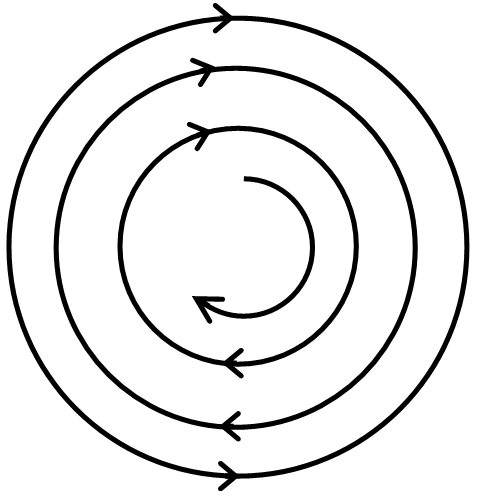
  3. Draw streamlines for a clockwise spinning sphere.
  4. Derive equation of continuity.

Answer

  1. Streamline is the actual path followed by the procession of particles in a steady flow, which may be straight or curved such that tangent to it at any point indicates the direction of flow of a liquid at that point.
  2. Two properties of streamlines are-
  1. Two streamlines can never cross each other.
  2. The greater is the crowding of streamlines at a place, the greater will be the velocity of liquid particles at that place and vice-versa.
  1.  

Due to spinning sphere, concentric streamlines are formed.
  1.  

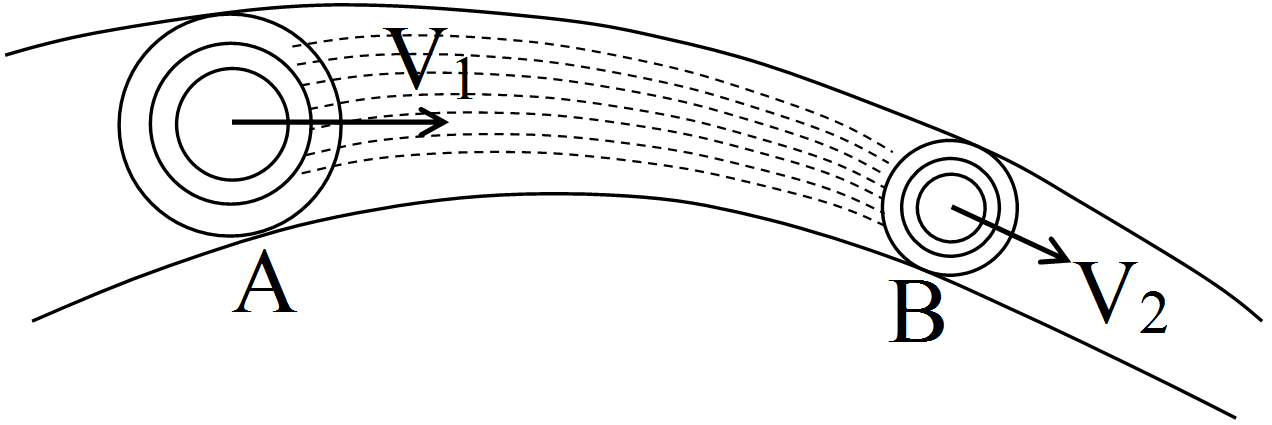
Volume of liquid entering per second at $A = a_1v_1$
Mass of liquid entering per second at $A = a_1v_1p_1$
Similarly, mass of liquid leaving per second at $B = a_2v_2p_2$
If there is no loss of liquid in tube and the flow is steady then,
Mass of liquid entering per second at A = Mass of liquid leaving per second at B $a_1v_1p_1 = a_2v_2p_2$​​​​​​​
If liquid is incompressible then,
$P_1 = P_2$
$a_1v_1 = a_2v_2$​​​​​​​
av = constant
This is the equation of continuity.

Need a full question paper?

Generate a complete, print-ready paper with questions like this in minutes — across 16+ boards, with answer keys.
Start Generating Free

Similar questions

i. Analytically, find the resultant $\vec{R}$ of two vectors $\vec{A}$ and $\vec{B}$ inclined at an angle $\theta$.
ii. Find the angle between two vectors $\vec{P}$ and $\vec{Q}$ if resultant of the vectors is given by $R ^2= P ^2+ Q ^2$.
Calculate the number of degrees of freedom of molecules of hydrogen in $1cc$ of hydrogen gas at NTP.
A narrow sound pulse (for example, a short pip by a whistle) is sent across a medium.
(a) Does the pulse have a definite,
  1. frequency,
  2. wavelength,
  3. speed of propagation?
(b) If the pulse rate is 1 after every 20s, (that is the whistle is blown for a split of second after every 20s), is the frequency of the note produced by the whistle equal to 1/20 or 0.05Hz?
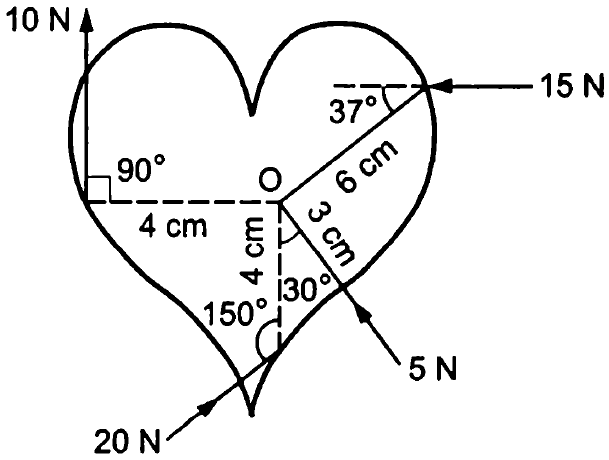
Calculate the total torque acting on the body shown in figure about the point O.
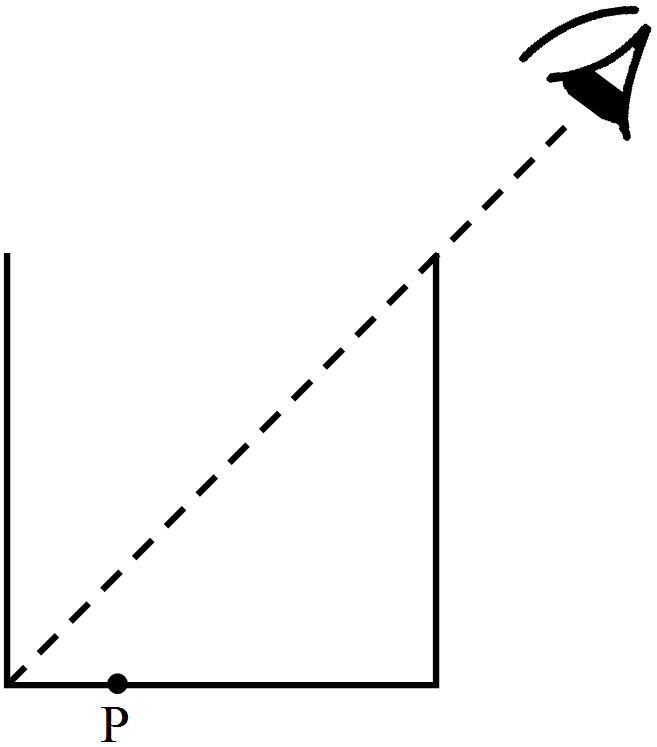
A cylindrical vessel, whose diameter and height both are equal to 30cm, is placed on a horizontal surface and a small particle P is placed in it at a distance of 5.0cm from the centre. An eye is placed at a position such that the edge of the bottom is just visible. The particle P is in the plane of drawing. Up to what minimum height should water be poured in the vessel to make the particle P visible?
The bottom of a dip on a road has a radius of curvature $R$. A rickshaw of mass $M$ left a little away from the bottom oscillates about the dip. Deduce an expression for the period of oscillation.
A girl riding a bicycle with a speed of $5m/ s$ towards north direction, observes rain falling vertically down. If she increases her speed to $10m/ s$, rain appears to meet her at $45°$ to the vertical. What is the speed of the rain? In what direction does rain fall as observed by a ground based observer?
(Hint: Assume north to be $\hat{\text{i}}$ direction and vertically downward to be $-\hat{\text{j}}$. Let the rain velocity $\text{v}_\text{r}$ be $\text{a}\hat{\text{i}}+\text{b}\hat{\text{j}}.$ The velocity of rain as observed by the girl is always $V_r-V_{girl}$. Draw the vector diagram/s for the information given and find a and b. You may draw all vectors in the reference frame of ground based observer)
A tuning fork is in unison with a sonometer wire $73cm$ long. If $4$ beats are heard on shortening the wire by $5mm$, find the frequency of the fork.
A train starts from rest and moves with a constant acceleration of $2.0m/s^2$ for half a minute. The brakes are then applied and the train comes to rest in one minute. Find:
  1. The total distance moved by the train.
  2. The maximum speed attained by the train.
  3. The position(s) of the train at half the maximum speed.
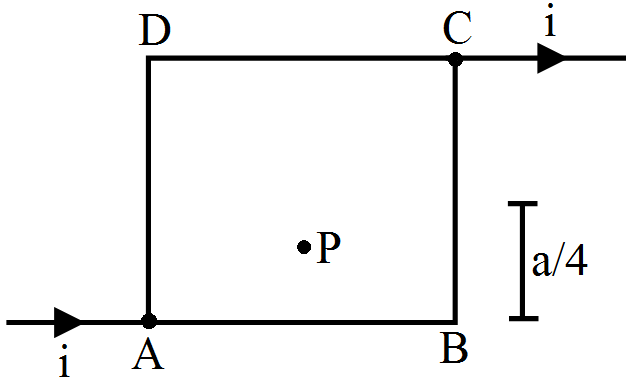
Figure shows a square loop of edge a made of a uniform wire. A current i enters the loop at the point A and leaves it at the point C. Find the magnetic field at the point P which is on the perpendicular bisector of AB at a distance $\frac{\text{a}}{4}$ from it.