Question
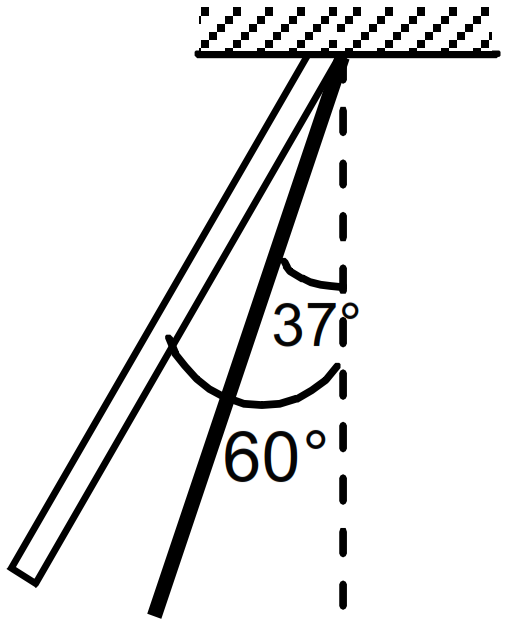
A uniform rod pivoted at its upper end hangs vertically. It is displaced through an angle of 60° and then released. Find the magnitude of the force acting on a particle of mass dm at the tip of the rod when the rod makes an angle of 37° with the vertical.
Answer


Let l = length of the rod, and m = mass of the rod. Applying energy principle$\Big(\frac{1}{2}\Big)\text{l}\omega^2-0=\text{mg}\Big(\frac{1}{2}\Big)(\cos37^\circ-\cos60^\circ)$
$\Rightarrow\frac{1}{2}\times\frac{\text{ml}^2}{3}\omega^2$
$=\text{mg}\times\frac{1}{2}\Big(\frac{4}{5}-\frac{1}{2}\Big)\text{t}$
$\Rightarrow\omega^2=\frac{9\text{g}}{10\text{l}}=0.9\Big(\frac{\text{g}}{\text{l}}\Big)$
Again $\Big(\frac{\text{ml}^2}{3}\Big)\alpha=\text{mg}\Big(\frac{1}{2}\Big)\sin37^\circ=\text{mgl}\times\frac{3}{5}$$\therefore\alpha=0.9\Big(\frac{\text{g}}{\text{l}}\Big)=$ angular acceleration.
So, to find out the force on the particle at the tip of the rod
$F_i =$ centrifugal force
$=(\text{dm})\omega^2\text{l}=0.9(\text{dm})\text{g}$
$F_t =$ tangential force
​​​​​​​$=(\text{dm})\alpha\text{l}=0.9(\text{dm})\text{g}$ So, total force $\text{F}=\sqrt{\big(\text{F}_{\text{i}}^2+\text{F}_{\text{t}}^2\big)}=0.9\sqrt2(\text{dm})\text{g}$

Need a full question paper?

Generate a complete, print-ready paper with questions like this in minutes — across 16+ boards, with answer keys.

Start Generating Free

Similar questions

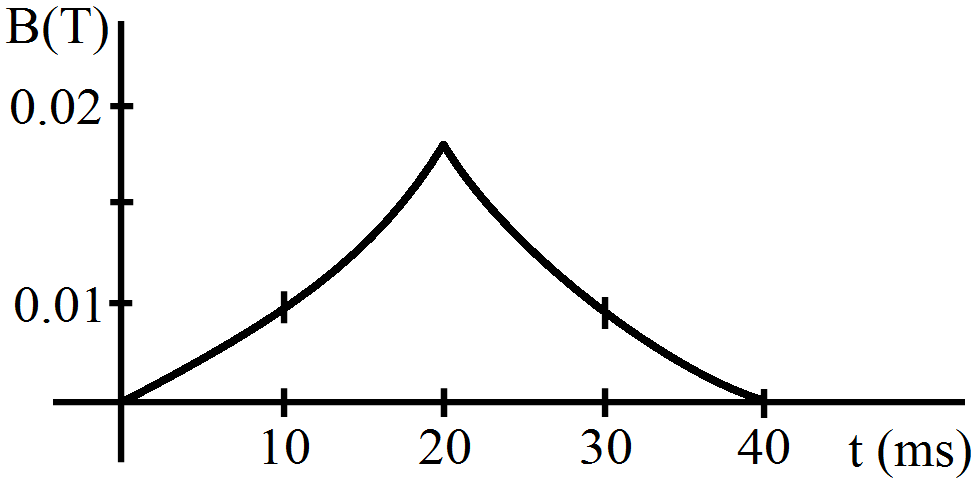
  1. The magnetic field in a region varies as shown in figure. Calculate the average induced emf in a conducting loop of area $2.0 \times 10^{-3}m^2$ placed perpendicular to the field in each of the 10ms intervals shown.
  2. In which intervals is the emf not constant? Neglect the behaviour near the ends of 10ms intervals.
A professor reads a greeting card received on his 50th birthday with +2.5D glasses keeping the card 25cm away. Ten years later, he reads his farewell letter with the same glasses but he has to keep the letter 50cm away. What power of lens should he now use?
Obtain expressions for instantaneous values of alternating emf and current.
What is a voltmeter? How can a galvanometer be converted into a voltmeter of given range? Explain.
The two square faces of a rectangular dielectric slab (dielectric constant 4.0) of dimensions 20cm × 20cm × 1.0mm are metal-coated. Find the capacitance between the coated surfaces.
An ammeter is to be constructed that can read currents up to 2.0A. If the coil has resistance of $25\Omega$ and takes 1mA for full-scale deflection, what should be the resistance of the shunt used?
How many wavelengths are emitted by atomic hydrogen in visible range (380nm-780nm)? In the range 50nm to 100nm?
What do you understand by a solenoid? Obtain an expression for magnetic field of a solenoid of infinite length.###Establish a formula for magnetic field on the axis inside of a straight and long solenoid. Show the direction of magnetic field inside it and what is the magnitude of magnetic field outside the solenoid.###Establish a formula for magnetic field inside a long solenoid. Represent produced force lines by diagram.###Write Ampere's circuital law. Obtain an expression for magnetic field on the axis of a very long current carrying solenoid. Draw necessary diagram also.
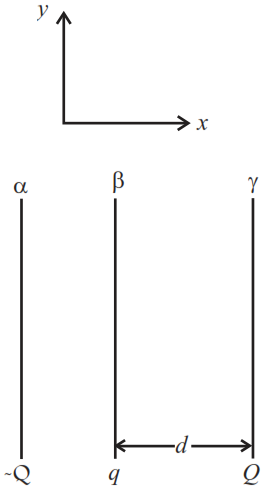
Two fixed, identical conducting plates $(\alpha\ \&\ \beta)$, each of surface area S are charged to -Q and q, respectively, where Q > q > 0. A third identical plate $(\gamma)$, free to move is located on the other side of the plate with charge q at a distance d (Fig.). The third plate is released and collides with the plate $\beta$. Assume the collision is elastic and the time of collision is sufficient to redistribute charge amongst $\beta\ \&\ \gamma$.

Find the electric field acting on the plate $\gamma$ before collision.
A conducting square loop having edges of length 2.0cm is rotated through 180° about a diagonal in 0.20s. A magnetic field B exists in the region which is perpendicular to the loop in its initial position. If the average induced emf during the rotation is 20mV, find the magnitude of the magnetic field.