Question
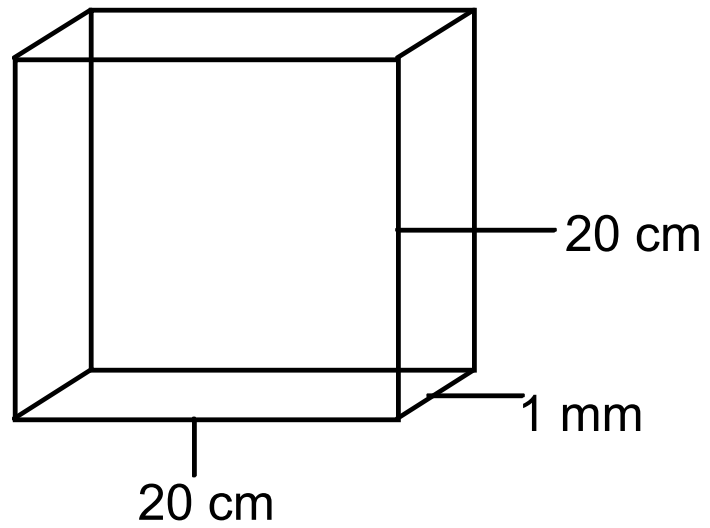
The two square faces of a rectangular dielectric slab (dielectric constant 4.0) of dimensions 20cm × 20cm × 1.0mm are metal-coated. Find the capacitance between the coated surfaces.
Answer


$A = 20cm \times 20cm = 4 \times 10^{-2}m$
$d = 1m = 1 \times 10^{-3}m$
$k = 4$
$t = d$
$\text{C}=\frac{\in_0\text{A}}{\text{d}-\text{t}+\frac{\text{t}}{\text{k}}}=\frac{\in_0\text{A}}{\text{d}-\text{d}+\frac{\text{d}}{\text{k}}}=\frac{\in_0\text{Ak}}{\text{d}}$
$=\frac{8.85\times10^{-12}\times4\times10^{-2}\times4}{1\times10^{-3}}$
$=141.6\times10^{-9}\text{F}=1.42\text{nf}$

Need a full question paper?

Generate a complete, print-ready paper with questions like this in minutes — across 16+ boards, with answer keys.
Start Generating Free

Similar questions

Meeta’s father was driving her to the school. At the traffic signal, she noticed that each traffic light was made of many tiny lights instead of a single bulb. When Meeta asked this question to her father, he explained the reason for this. Answer the following questions based on above information:
  1. What were the values displayed by Meeta and her father?
  2. What answer did Meeta’s father give?
  3. What are the tiny lights in traffic signals called and how do these operate?
A particle A with a mass $m_A$ is moving with a velocity v and hits a particle $B ($mass $m_B) $ at rest (one dimensional motion). Find the change in the de Broglic wavelength of the particle A. Treat the collision as elastic.
Derive a mathematical expression for the force per unit length experienced by each of the two long current carrying conductors placed parallel to each other in air. Hence define one ampere of current.Explain why two parallel straight conductors carrying current in the opposite direction kept near each other in air repel?
A thin prism of angle $6.0^\circ,\omega=0.07$ and $\mu_\text{y}=1.50$ is combined with another thin prism having $\omega=0.08$ and $\mu_\text{y}=1.60.$ The combination produces no deviation in the mean ray.
  1. Find the angle of the second prism.
  2. Find the net angular dispersion produced by the combination when a beam of white light passes through it.
  3. If the prisms are similarly directed, what will be the deviation in the mean ray
  4. Find the angular dispersion in the situation described in (c).
Write first and second postulates of Bohr's Atomic Model. Obtain the expression for radius and velocity of stable orbit of electron.###Explain Bohr's two postulates for hydrogen atom.
A sample of an ideal gas $(\gamma=1.5)$ is compressed adiabatically from a volume of $150cm^3$ to $50cm^3$. The initial pressure and the initial temperature are 150kPa and 300K. Find,
  1. The number of moles of the gas in the sample.
  2. The molar heat capacity at constant volume.
  3. The final pressure and temperature.
  4. The work done by the gas in the process.
  5. The change in internal energy of the gas.
A polariod (I) is placed in front of a monochromatic source. Another polatiod (II) is placed in front of this polaroid (I) and rotated till no light passes. A third polaroid (III) is now placed in between (I) and (II). In this case, will light emerge from (II). Explain.
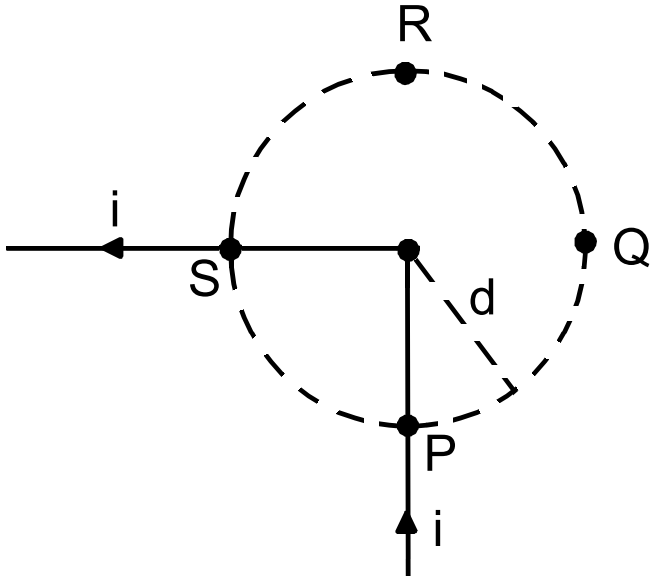
Figure shows a long wire bent at the middle to form a right angle. Show that the magnitudes of the magnetic fields at the points P, Q, R and S are equal and find this magnitude.
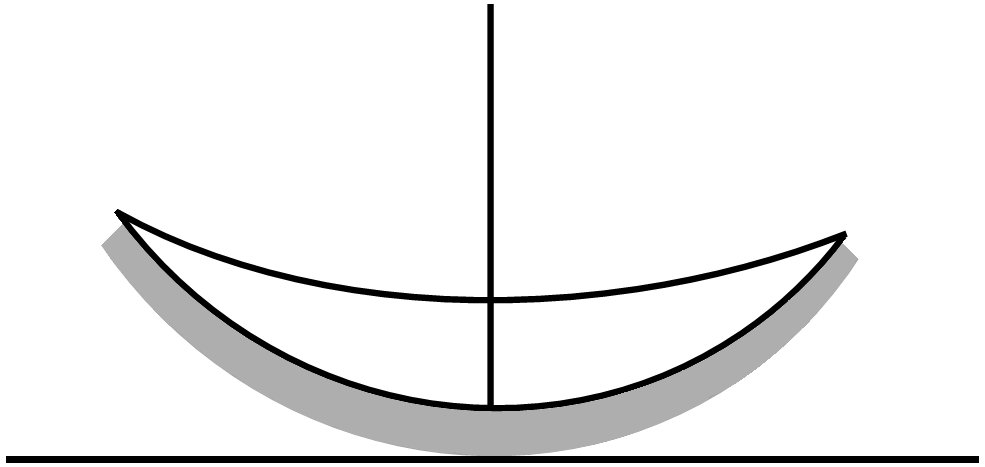
The convex surface of a thin concavo-convex lens of glass of refractive index 1.5 has a radius of curvature 20cm. The concave surface has a radius of curvature 60cm. The convex side is silvered and placed on a horizontal surface as shown in figure.
  1. Where should a pin be placed on the axis so that its image is formed at the same place?
  2. If the concave part is filled with water $\Big(\mu=\frac{4}{3}\Big),$ find the distance through which the pin should be moved so that the image of the pin again coincides with the pin.
An air bubble of radius 2.0mm is formed at the bottom of a 3.3m deep river. Calculate the radius of the bubble as it comes to the surface. Atmospheric pressure $= 1.0 \times 10^5$ Pa and density of water $= 1000kg/m^{-3}.$