A uniform rope of mass $6\,kg$ hangs vertically from a rigid support. A block of mass $2\,kg$ is attached to the free end of the rope. A transverse pulse of wavelength $0.06\,m$ is produced at the lower end of the rope. The wavelength of the pulse when it reaches the top is (in $m$ )
Diffcult
Download our app for free and get started
The speed of transverse waves through a string of linear density $\mathrm{m}$ and tension $\mathrm{T}$ is given by
$\mathrm{v}=\sqrt{\mathrm{T} / \mathrm{m}}=\mathrm{f} \lambda$
Since, $f$ and $m$ are constants, $v$ and hence $\lambda$ is proportional to $\sqrt{\mathrm{T}}$. The tension at the bottom is 2 kg-wt, while at the top is $2+6$ $=8 \mathrm{\,kg}-\mathrm{wt} .$ If $\lambda_{1}$ and $\lambda_{2}$ are the wavelength at the bottom and the top respectively, we have:
$\left(\lambda_{2} / \lambda_{1}\right)=\sqrt{8 / 2}=2$
The wavelength at the top will be $=0.12 \mathrm{\,m}$

Download our appand get started for free
Experience the future of education. Simply download our apps or reach out to us for more information. Let's shape the future of learning together!No signup needed.*
Similar Questions
- 1A source of sound is travelling with a velocity $40\, km/hour$ towards observer and emits sound of frequency $2000 Hz$. If velocity of sound is $1220 \,km/hour$, then what is the apparent frequency heard by an observer .... $Hz$View Solution
- 2The equation of a wave on a string of linear mass density $0.04\, kgm^{-1}$ is given by : $y = 0.02\,\left( m \right)\,\sin \,\left[ {2\pi \left( {\frac{t}{{0.04\left( s \right)}} - \frac{x}{{0.50\left( m \right)}}} \right)} \right]$. The tension in the string is ..... $N$View Solution
- 3A source of frequency $\nu$ gives $5$ beats/second when sounded with a source of frequency $200 \;Hz$. The second harmonic of frequency $2\nu$ of source gives $10$ beats/second when sounded with a source of frequency $420\; Hz$. The value of $v$ is .... $Hz$View Solution
- 4A steel rod $100 \,cm$ long is clamped at its middle. The fundamental frequency of longitudinal vibrations of the rod are given to be $2.53\,kHz$. What is the speed of sound in steel ..... $km/sec$View Solution
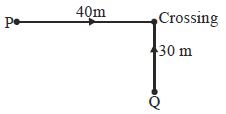
- 5A car $P$ approaching a crossing at a speed of $10\, m/s$ sounds a horn of frequency $700\, Hz$ when $40\, m$ in front of the crossing. Speed of sound in air is $340\, m/s$. Another car $Q$ is at rest on a road which is perpendicular to the road on which car $P$ is reaching the crossing (see figure). The driver of car $Q$ hears the sound of the horn of car $P$ when he is $30\, m$ in front of the crossing. The apparent frequency heard by the driver of car $Q$ is .... $Hz$View Solution
- 6Two travelling waves produces a standing wave represented by equation,View Solution
${y}=1.0\, {mm} \cos \left(1.57 \,{cm}^{-1}\right) {x} \sin \left(78.5\, {s}^{-1}\right) {t}$
The node closest to the origin in the region ${x}>0$ will be at ${x}=\ldots \ldots \ldots\, {cm}$
- 7A tuning fork and an air column whose temperature is $51^{\circ} C$ produce $4$ beats in one second, when sounded together. When the temperature of air column decreases the number of beats per second decreases. When the temperature remains $16^{\circ} C$ only one beat per second is produced. The frequency of the tuning fork is ........... $Hz$View Solution
- 8Two sound waves of intensity $2 \,W / m ^2$ and $3 \,W / m ^2$ meet at a point to produce a resultant intensity $5 \,W / m ^2$. The phase difference between two waves is ......View Solution
- 9A wave represented by the given equation $y = a\cos (kx - \omega \,t)$ is superposed with another wave to form a stationary wave such that the point $x = 0$ is a node. The equation for the other wave isView Solution
- 10When a car is approaching the observer, the frequency of horn is $100 Hz$. After passing the observer, it is $50\,Hz$. If the observer moves with the car, the frequency will be $\frac{ x }{3} Hz$ where $x =.....$View Solution