Question
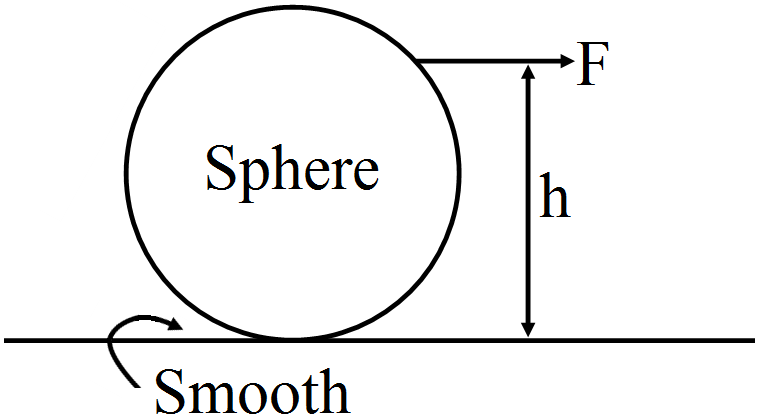
A uniform sphere is placed on a smooth horizontal surface and a horizontal force F is applied on it at a distance h above the surface. The acceleration of the centre:
  1. Is maximum when h = 0.
  2. Is maximum when h = R.
  3. Is maximum when h = 2R.
  4. Is independent of h.

Answer

  1. Is independent of h.

Explanation:

As the uniform sphere is placed on a smooth surface, the sphere only slips.

The acceleration of the centre of the sphere is given by,

$\frac{\text{Applied force}}{\text{Mass of the sphere}},$ which is independent of height h.

Need a full question paper?

Generate a complete, print-ready paper with questions like this in minutes — across 16+ boards, with answer keys.

Start Generating Free

Similar questions

In an n-type silicon, which of the following statement is true :
An intrinsic semiconductor is:

Consider the following statements A to B  and identify the correct answer

A. Polarised light can be used to study the helical surface of nucleic acids.

B. Optics axis is a direction and not any particular line in the crystal

(a) A and B are correct

(b) A and B are wrong

(c) A is correct but B is wrong

(d) A is wrong but B is correct

​​​​50% of the X-rays coming from a Coolidge tube are able to pass through a 0.1mm thick aluminium foil. If the potential difference between the target and the filament is increased, the fraction of the X-rays passing through the same foil will be:
  1. 0%
  2. < 50%
  3. 50%
  4. > 50%
In an AC circuit containing only capacitance, the current:

The focal length of a concave mirror is 50 cm. Where an object be placed so that its image is two times and inverted

(a) 75 cm

(b) 72 cm

(c) 63 cm

(d) 50 cm

The unit of magnetic flux is

(a)  

(b) Weber

(c) Henry  

(d) Ampere/m

To obtain P-type Si semiconductor, we need to dope pure Si  with

(a) Aluminium

(b) Phosphorous

(c) Oxygen

(d) Germanium

The following four wires are made of the same material and are at the same temperature. Which one of them has highest electrical resistance

(a) Length = 50 cm, diameter = 0.5 mm

(b) Length = 100 cm, diameter = 1 mm

(c) Length = 200 cm, diameter = 2 mm

(d) Length = 300 cm, diameter = 3 mm

When a dielectric material is introduced between the plates of a charged condenser then electric field between the plates

(a) Decreases

(b) Increases

(c) Remain constant

(d) First (b) then (a)