MCQ
In an n-type silicon, which of the following statement is true :
  • A
    Electrons are majority carriers and trivalent atoms are the dopants.
  • B
    Electrons are minority carriers and pentavalent atoms are the dopants.
  • Holes are minority carriers and pentavalent atoms are the dopants.
  • D
    Holes are majority carriers and trivalent atoms are the dopants.
Answer

Correct option: C.
Holes are minority carriers and pentavalent atoms are the dopants.
C

Need a full question paper?

Generate a complete, print-ready paper with questions like this in minutes — across 16+ boards, with answer keys.

Start Generating Free

Similar questions

In the following atoms and moleculates for the transition from n = 2  to n = 1, the spectral line of minimum wavelength will be produced by

(a) Hydrogen atom

(b) Deuterium atom

(c) Uni-ionized helium

(d) di-ionized lithium

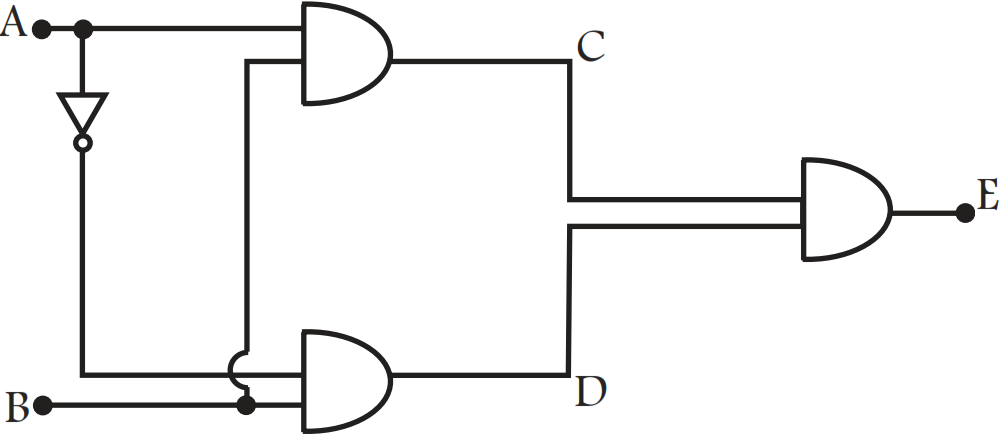
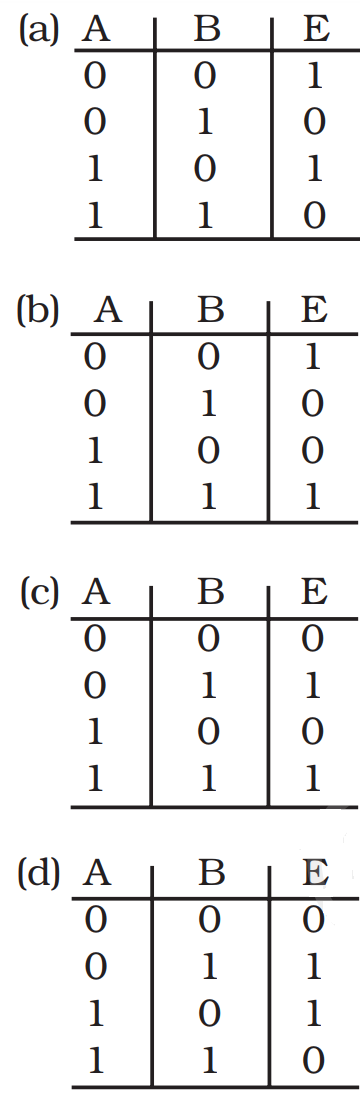
Truth table for the given circuit (Fig.) is:

The difference between the sum of the masses of the constituent particles and the mass of an atom is called ___________.

The order of the size of nucleus and Bohr radius of an atom respectively are

(a)  

(b)  

(c)  

(d)  

An electron and a proton are both released from rest 1 meter from a large stationary negative charge, considering only the force from the large stationary negative charge on the proton and electron. Which of the following is true?

A biconvex lens forms a real image of an object placed perpendicular to its principal axis. Suppose the radii of curvature of the lens tend to infinity. Then the image would

(a) Disappear

(b) Remain as real image still

(c) Be virtual and of the same size as the object

(d) Suffer from aberrations

A convex lens of crown glass (n =1.525) will behave as a divergent lens if immersed in

(a) Water (n = 1.33)

(b) In a medium of n = 1.525

(c) Carbon disulphide n = 1.66

(d) It cannot act as a divergent lens

Two charges of $+1 μ\text{C} +5 μ\text{C}$ are placed 4cm apart, the ratio of the force exerted by both charges on each other will be-

Spherical aberration in a lens

(a) Is minimum when most of the deviation is at the first surface

(b) Is minimum when most of the deviation is at the second surface

(c) Is minimum when the total deviation is equally distributed over the two surface

(d) Does not depend on the above consideration

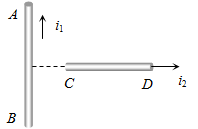
An infinitely long, straight conductor AB is fixed and a current is passed through it. Another movable straight wire CD of finite length and carrying current is held perpendicular to it and released. Neglect weight of the wire

(a) The rod CD will move upwards parallel to itself

(b) The rod CD will move downward parallel to itself

(c) The rod CD will move upward and turn clockwise at the same time

(d) The rod CD will move upward and turn anti –clockwise at the same time