Question
A uniform spherical shell gradually shrinks maintaining its shape. The gravitational potential at the centre:
  1. Increases.
  2. Decreases.
  3. Remains constant.
  4. Oscillates.

Answer

  1. Decreases.
Explanation:
AS it is maintaining its shape so its mass will remain constant which implies that if it shrinks then its volume decreases and to keep the mass constant, its density increases. Also the gravitational potential at the centre of a uniform spherical shell is inversely proportional to the radius of the shell with a negative sign. When a uniform spherical shell gradually shrinks, the gravitational potential at the centre decreases (because of the negative sign in the formula of potential).

Need a full question paper?

Generate a complete, print-ready paper with questions like this in minutes — across 16+ boards, with answer keys.
Start Generating Free

Similar questions

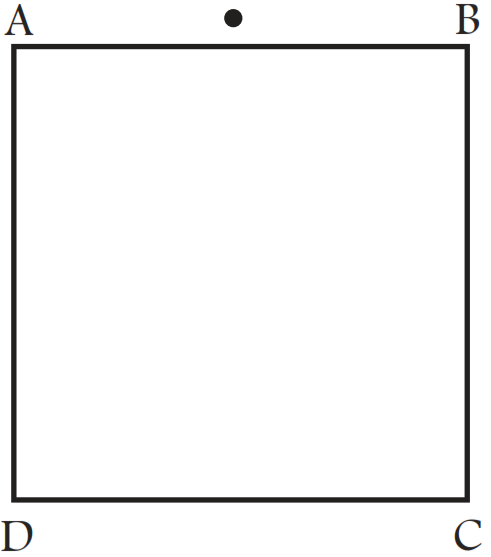
A rectangular block of glass ABCD has a refractive index 1.6. A pin is placed midway on the face AB (Fig). When observed from the face AD, the pin shall:
According to Joule's law, if potential difference across a conductor of material of resistivity remains constant, then heat produced in the conductor is directly proportional to
Assertion :   A pulsor is a source of radio waves which change in terms of intensity at regular interval of time
Reason     : A pulsor is a rotating neutron star(a) If both assertion and reason are true and the reason is the correct explanation of the assertion.(b) If both assertion and reason are true but reason is not the correct explanation of the assertion.(c) If assertion is true but reason is false.(d) If the assertion and reason both are false.


The mass equivalent of $931\ \text{MeV}$ energy is
A solid floats in a liquid in a partially dipped position.
  1. The solid exerts a force equal to its weight on the liquid.
  2. The liquid exerts a force of buoyancy on the solid which is equal to the weight of the solid.
  3. The weight of the displaced liquid equals the weight of the solid.
  4. The weight of the dipped part of the solid is equal to the weight of the displaced liquid.
If a dielectric substance is introduced between the plates of a charged air-gap capacitor. The energy of the capacitor will(a) Increase(b) Decrease(c) Remain unchanged(d) First decrease and then increase
   
   
In order to stop a car in shortest distance on a horizontal road, one should:
  1. Apply the brakes very hard so that the wheels stop rotating.
  2. Apply the brakes hard enough to just prevent slipping.
  3. Pump the brakes (press and release).
  4. Shut the engine off and not apply brakes.
Ratio between intensities of magnetic fields due to points situated on axial and non-axial positions of a small magnet at distance from it is:
The capacitance of a capacitor is C. It is charged at a potential difference V. If now it is related to resistance, the amount of energy dilapidation will be:
An electromagnetic wave going through vacuum is described by $\text{E}=\text{E}_0\sin(\text{kx}-\omega\text{t}),\text{ B}=\text{B}_0\sin(\text{kx}-\omega\text{t})$ Then$:$