Questions

M.C.Q (1 Marks)

Take a timed test

23 questions · 8 auto-graded MCQ + 15 self-marked written.

MCQ 11 Mark
The acceleration of the moon just before it strikes the earth in the previous question is :
  • A
    $10ms^{-2}$
  • B
    $0.0027ms^{-2}$
  • $6.4ms^{-2}$
  • D
    $5.0ms^{-2}$
Answer
Correct option: C.
$6.4ms^{-2}$
According to the previous question, we have :
Radius of the moon, $\text{R}_\text{m}=-\frac{\text{R}_\text{e}}{4}=\frac{6400000}{4}1600000\text{m}$
So, when the Moon is just about to hit the surface of the Earth, its centre of mass is at a distance of $(R_e + R_m)$ from the centre of the Earth.
Acceleration of the Moon just before hitting the surface of the earth is given by,
$\text{g'}=\frac{\text{GM}}{(\text{R}_\text{e}+\text{R}_\text{m})^2}=\frac{\text{GM}}{\text{R}^2_\text{e}\Big(1+\frac{\text{Rm}}{\text{Re}}\Big)^2}$
$\Rightarrow\text{g'}=\frac{\text{g}}{\Big(1+\frac{\text{Rm}}{\text{Re}}\Big)^2}=\frac{10}{\Big(1+\frac{1}{4}\Big)^2}=\frac{10\times16}{25}$
$\Rightarrow\text{g'}=6.4\ \text{m/s}^2$
View full question & answer
Question 21 Mark
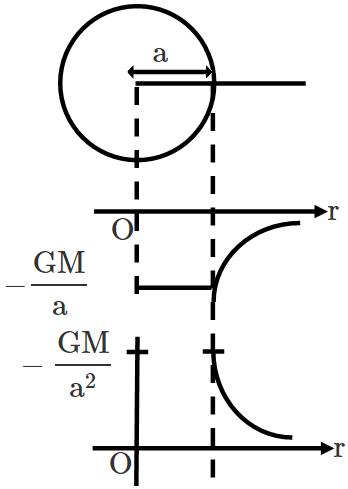
Let V and E represent the gravitational potential and field at a distance r from the centre of a uniform solid sphere. Consider the two statements:
  1. The plot of V against r is discontinuous.
  2. The plot of E against r is discontinuous.
  1. Both A and B are correct.
  2. A is correct but B is wrong.
  3. B is correct but A is wrong.
  4. Both A and B are wrong.
Answer
  1. Both A and B are wrong.
Explanation:
Both the plots (i.e., V against r and E against r) are continuous curves for a uniform solid sphere.
View full question & answer
Question 31 Mark
Inside a uniform spherical shell:
  1. The gravitational potential is zero.
  2. The gravitational field is zero.
  3. The gravitational potential is same everywhere.
  4. The gravitational field is same everywhere.
Answer
  1. The gravitational field is zero.
  2. The gravitational potential is same everywhere.
  3. The gravitational field is same everywhere.
Explanation:

Inside a uniform spherical shell, the gravitational field is the same everywhere and is equal to zero. The gravitational potential has a constant value inside a uniform spherical shell.
View full question & answer
MCQ 41 Mark
A body is suspended from a spring balance kept in a satellite. The reading of the balance is $W_{1 }$when the satellite goes in an orbit of radius $R$ and is $W_2$ when it goes in an orbit of radius $2R.$
  • $W_1 = W_2$
  • B
    $W_1 < W_2$
  • C
    $W_1 > W_2$
  • D
    $W_1 \neq W_2$
Answer
Correct option: A.
$W_1 = W_2$
The gravitational pull on the satellite in both cases is used up in providing the necessary centripetal force required for its revolution around the earth.
This means that there is no net force acting on the body which has been suspended from a spring balance in the satellite.
So, the readings of the spring balance in both the cases are the same and is equal to zero.
View full question & answer
Question 51 Mark
The magnitude of gravitational potential energy of the moon-earth system is U with zero potential energy at infinite separation. The kinetic energy of the moon with respect to the earth is K.
  1. U < K
  2. U > K
  3. U = K
Answer
  1. U > K
Explanation:
For a system to be bound, total energy of the system should be negative.As we know that kinetic energy can never be negative.
E < 0 & K > 0 & E = K + U it gives that U > K.
View full question & answer
Question 61 Mark
A uniform spherical shell gradually shrinks maintaining its shape. The gravitational potential at the centre:
  1. Increases.
  2. Decreases.
  3. Remains constant.
  4. Oscillates.
Answer
  1. Decreases.
Explanation:
AS it is maintaining its shape so its mass will remain constant which implies that if it shrinks then its volume decreases and to keep the mass constant, its density increases. Also the gravitational potential at the centre of a uniform spherical shell is inversely proportional to the radius of the shell with a negative sign. When a uniform spherical shell gradually shrinks, the gravitational potential at the centre decreases (because of the negative sign in the formula of potential).
View full question & answer
MCQ 71 Mark
The acceleration of moon with respect to earth is $0⋅0027\ ms^{-2}$ and the acceleration of an apple falling on earth's surface is about $10\ ms^{-2}.$ Assume that the radius of the moon is one fourth of the earth's radius. If the moon is stopped for an instant and then released, it will fall towards the earth. The initial acceleration of the moon towards the earth will be:
  • A
    $10\ ms^{-2}$
  • $0.0027\ ms^{-2}$
  • C
    $6.4\ ms^{-2}$
  • D
    $5.0\ ms^{-2}$
Answer
Correct option: B.
$0.0027\ ms^{-2}$
We know that the distance of the Moon from the Earth is about $60$ times the radius of the earth.
So, acceleration due to gravity at that distance is $0.0027\ m/s^2.$
When the Moon is stopped for an instant and then released,
it will fall towards the Earth with an initial acceleration of $0.0027\ m/s^2.$
View full question & answer
Question 81 Mark
Let V and E denote the gravitational potential and gravitational field at a point. It is possible to have:
  1. V = 0 and E = 0
  2. V = 0 and E ≠ 0
  3. V ≠ 0 and E = 0
  4. V ≠ 0 and E ≠ 0
Answer
  1. V = 0 and E = 0
  2. V = 0 and E ≠ 0
  3. V ≠ 0 and E = 0
  4. V ≠ 0 and E ≠ 0
Explanation:
All thr given conditions for gravitationnal field at a point are possible.
View full question & answer
MCQ 91 Mark
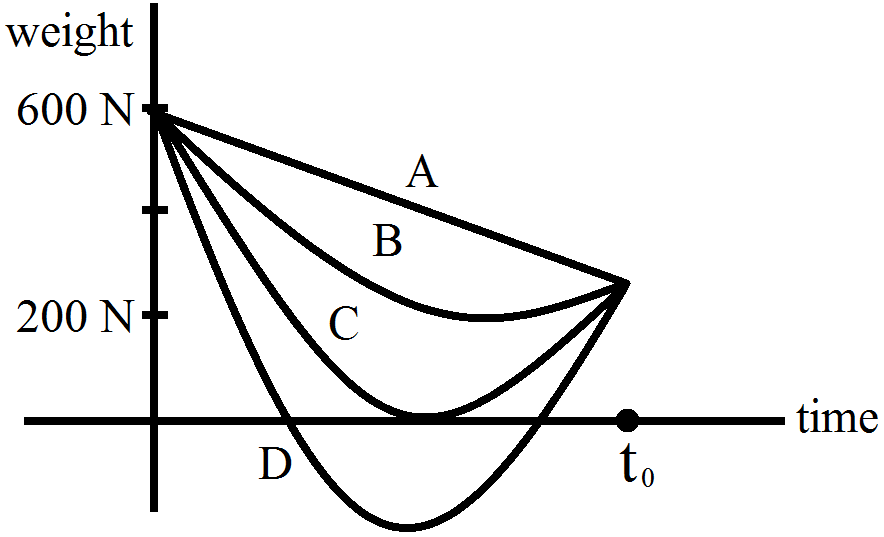
Suppose, the acceleration due to gravity at the earth's surface is $10\ ms^{-2}$ and at the surface of Mars it is $40ms^{-2}.$ A $60\ kg$ passenger goes from the earth to the Mars in a spaceship moving with a constant velocity. Neglect all other objects in the sky. Which part of best represents the weight $($net gravitational force$)$ of the passenger as a function of time?
  • A
    $A$
  • B
    $B$
  • $C$
  • D
    $D$
Answer
Correct option: C.
$C$
At one point between the Earth and Mars, the gravitational field intensity is zero.
So, at that point, the weight of the passenger is zero.
The curve $C$ indicates that the weight of the passenger is zero at a point between the Earth and Mars.
View full question & answer
Question 101 Mark
Consider a planet moving in an elliptical orbit round the sun. The work done on the planet by the gravitational force of the sun:
  1. Is zero in any small part of the orbit.
  2. Is zero in some parts of the orbit.
  3. Is zero in one complete revolution.
  4. Is zero in no part of the motion.
Answer
  1. Is zero in some parts of the orbit.
  2. Is zero in one complete revolution.
Explanation:
When a planet is moving in an elliptical orbit, at some point, the line joining the centre of the Sun and the planet is perpendicular to the velocity of the planet. For that instant, work done by the gravitational force on the planet becomes zero. As there is no net increase in the speed of the planet after one complete revolution about the Sun, the work done by the gravitational force on the planet in one complete revolution is zero.
Note: For elliptical orbits angle between force ans velocity is always 90 so there the work done is zero in any small part of the orbit.
View full question & answer
Question 111 Mark
The time period of an earth-satellite in circular orbit is independent of:
  1. The mass of the satellite.
  2. Radius of the orbit.
  3. None of them.
  4. Both of them.
Answer
  1. The mass of the satellite.
Explanation:
The time period of an earth-satellite in circular orbit is independent of the mass of the satellite, but depends on the radius of the orbit.
View full question & answer
Question 121 Mark
Take the effect of bulging of earth and its rotation in account. Consider the following statements:
  1. There are points outside the earth where the value of g is equal to its value at the equator.
  2. There are points outside the earth where the value of g is equal to its value at the poles.
  1. Both A and B are correct.
  2. A is correct but B is wrong.
  3. B is correct but A is wrong.
  4. Both A and B are wrong.
Answer
  1. A is correct but B is wrong.
Explanation:
We know that the value of acceleration due to gravity decreases when we go up from the surface of the Earth. If we take the into account the effect of bulging of the Earth due to its rotation, we can say that acceleration due to gravity is maximum at the poles and minimum at the equator,
So, there are points above both the poles where the value of g is equal to its value at the equator.
View full question & answer
Question 131 Mark
Let V and E be the gravitational potential and gravitational field at a distance r from the centre of a uniform spherical shell. Consider the following two statements:
  1. The plot of V against r is discontinuous.
  2. The plot of E against r is discontinuous.
  1. Both A and B are correct.
  2. A is correct but B is wrong.
  3. B is correct but A is wrong.
  4. Both A and B are wrong.
Answer
  1. B is correct but A is wrong.
Explanation:
The plot of E against r is discontinuous as gravitational field inside the spherical shell is zero (r < R). The plot of V against r is a continuous curve for a uniform spherical shell.
View full question & answer
Question 141 Mark
Which of the following quantities remain constant in a planetary motion (consider elliptical orbits) as seen from the sun?
  1. Speed.
  2. Angular speed.
  3. Kinetic Energy.
  4. Angular momentum.
Answer
  1. Angular momentum.
Explanation:
In planetary motion, the net external torque on the planet is zero. Therefore, angular momentum will remain constant.
View full question & answer
Question 151 Mark
Two satellites A and B move round the earth in the same orbit. The mass of B is twice the mass of A:
  1. Speeds of A and B are equal.
  2. The potential energy of earth +A is same as that of earth +B.
  3. The kinetic energy of A and B are equal.
  4. The total energy of earth +A is same as that of earth +B.
Answer
  1. Speeds of A and B are equal.
Explanation:
The orbital speed of a satellite is independent of the mass of the satellite, but it depends on the radius of the orbit. Potential energy, kinetic energy and total energy depend on the mass of the the satellite. 
View full question & answer
MCQ 161 Mark
A person brings a mass of $1\ kg$ from infinity to a point $A$. Initially the mass was at rest but it moves at a speed of $2ms^{-1}$ as it reaches $A.$ The work done by the person on the mass is $-3J.$ The potential at $A$ is:
  • A
    $-3J \ kg^{-1}$
  • B
    $-2J \ kg^{-1}$
  • $-5J \ kg^{-4}$
  • D
    None of these.
Answer
Correct option: C.
$-5J \ kg^{-4}$
The work done by the person is equal to the kinetic energy and the potential energy of the mass of $1\ kg$ at point A.Let $V_A$ be the potential at point$ A.$
Now, $\text{W}=\frac{1}{2}\text{ mv}^2+(\text{P.E}.)_{\text{A}}$
$\Rightarrow\text{W}=\frac{1}{2}\text{ mv}^2+\text{V}_{\text{A}}\times\text{m}$
$\Rightarrow-3=\frac{1}{3}\times1(2)^2+\text{V}_{\text{A}}\times1$
$\Rightarrow\text{V}_\text{A}=-5\text{J}\ \text{Kg}^{-4}$
View full question & answer
MCQ 171 Mark
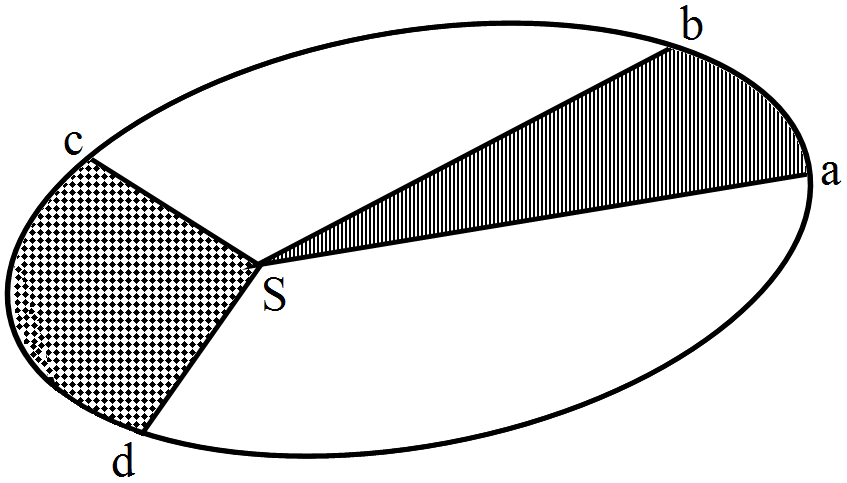
Shows the elliptical path of a planet about the sun. The two shaded parts have equal area. If $t_1$ and $t_2$ be the time taken by the planet to go from $a$ to $ b$ and from $c$ to $d$ respectively$:$
  • A
    $t_1 < t_2$
  • $t_1 = t_2$
  • C
    $t_1 > t_2$
  • D
    Insufficient information to deduce the relation between $t_1$ and $t_2.$
Answer
Correct option: B.
$t_1 = t_2$
Kepler's second law states that the line joining a planet to the Sun sweeps out equal areas in equal intervals of time,
i.e., areal velocity of a planet about the Sun is constant.
The given areas swept by the planet are equal, so $t_1 = t_2$
View full question & answer
Question 181 Mark
A person sitting in a chair in a satellite feels weightless because:
  1. The earth does not attract the objects in a satellite.
  2. The normal force by the chair on the person balances the earth's attraction.
  3. The normal force is zero.
  4. The person in satellite is not accelerated.
Answer
  1. The normal force is zero.
Explanation:
The gravitational pull on the satellite is used up in providing the necessary centripetal force required for its revolution around the earth. This means that there is no net force on the person sitting in a chair in the satellite. So, the normal reaction of the chair on the person is zero and he will feel weightless.
View full question & answer
Question 191 Mark
The kinetic energy needed to project a body of mass m from the earth's surface to infinity is:
  1. $\frac{1}{4}\text{mgR}$
  2. $\frac{1}{2}\text{mgR}$
  3. $\text{mgR}$
  4. $2\text{mgR}$
Answer
  1. $\text{mgR}$
Explanation:
The kinetic energy needed to project a body of mass m from the Earth's surface to infinity is equal to the negative of the change in potential energy of the body.
i.e., kinetic energy = -(final potential energy - initial potential energy)
$\Rightarrow\text{K}=-\Big(\frac{\text{GMm}}{\text{R'}}\frac{\text{GMm}}{\text{R}}\Big)$
$\Rightarrow\text{K}=-\Big(\frac{\text{GMm}}{\infty}-\frac{\text{GMm}}{\text{R}}\Big)=\frac{\text{GMm}}{\text{R}}$
$\Rightarrow\text{K}=\text{mR}\times\Big(\frac{\text{GM}}{\text{R}^2}\Big)$
$\Rightarrow\text{K}=\text{m}\text{Rg}$ $\Big[\therefore\text{g}=\frac{\text{GM}}{\text{R}^2}\Big]$
View full question & answer
MCQ 201 Mark
A satellite is orbiting the earth close to its surface. A particle is to be projected from the satellite to just escape from the earth. The escape speed from the earth is $νe.$ Its speed with respect to the satellite$:$
  • A
    Will be less than $ν_e.$
  • B
    Will be more than $ν_e.$
  • C
    Will be equal to $ν_e.$
  • Will depend on the direction of projection.
Answer
Correct option: D.
Will depend on the direction of projection.
For example a body projected vertically requires less escape velocity than a body projected at an angle with the vertical.
View full question & answer
Question 211 Mark
If the acceleration due to gravity at the surface of the earth is g, the work done in slowly lifting a body of mass m from the earth's surface to a height R equal to the radius of the earth is:
  1. $\frac{1}{2}\text{mgR}$
  2. $2\text{mgR}$
  3. $\text{mgR}$
  4. $\frac{1}{4}\text{mgR}$
Answer
  1. $\frac{1}{2}\text{mgR}$
Explanation:
Work done = -(final potential energy - initial potential energy)
$\Rightarrow\text{W}=-\Big(\frac{\text{GMm}}{2\text{R}}-\frac{\text{GMm}}{\text{R}}\Big)$
$\Rightarrow\text{W}=\frac{1}{2}\frac{\text{GMm}}{\text{R}}=\frac{1}{2}\text{mR}\times\Big(\frac{\text{GM}}{\text{R}^2}\Big)$
$\Rightarrow\text{W}=\frac{1}{2}\text{mRg}\Big[\because\text{g}=\frac{\text{GM}}{R}^2\Big]$
View full question & answer
Question 221 Mark
A particle is kept at rest at a distance R (earth's radius) above the earth's surface. The minimum speed with which it should be projected so that it does not return is:
  1. $\sqrt{\frac{\text{GM}}{4\text{R}}}$
  2. $\sqrt{\frac{\text{RM}}{2\text{R}}}$
  3. $\sqrt{\frac{\text{GM}}{\text{R}}}$
  4. $\sqrt{\frac{2\text{GM}}{\text{R}}}$
Answer
  1.  $\sqrt{\frac{\text{GM}}{\text{R}}}$
Explanation:
Potential energy of the particle at a distance R from the surface of the Earth is $(\text{P.E.)}_\text{i}=\frac{\text{GMm}}{(\text{R+R})}=\frac{1}{2}\frac{\text{GMm}}{\text{R}}.$
Here, M is the mass of the earth; R is the radius of the earth and m is the mass of the body.

Let the particle be projected with speed v so that it just escapes the gravitational pull of the earth.
So, kinetic energy of the body = -[change in the potential energy of the body]

Now, kinetic energy of the body = -[final potential energy - initial potential energy]
$\Rightarrow\frac{1}{2}\text{mv}^2=-\Big[\frac{\text{GMm}}{\infty}-\frac{\text{GMm}}{2\text{R}}\Big]$ 
$\Rightarrow\text{v}=\sqrt{\frac{\text{GMm}}{\text{R}}}$
View full question & answer
MCQ 231 Mark
Consider a planet in some solar system which has a mass double the mass of the earth and density equal to the average density of the earth. An object weighing $W$ on the earth will weight.
  • A
    $W$
  • B
    $2W$
  • C
    $\frac{\text{W}}{2}$
  • $2^{\frac{1}{3}} W$ at the planet.
Answer
Correct option: D.
$2^{\frac{1}{3}} W$ at the planet.
The weight of the object on the Earth is $\text{W}=\text{m}\frac{\text{GM}_\text{e}}{\text{R}_\text{e}^2}.$
Here, $m$ is the actual mass of the object; $M_{e }$ is the mass of the earth and $R_e$ is the radius of the earth.
Let $R_p$ be the radius of the planet.
Mass of the planet, $\text{M}_\text{p}=2\text{M}\text{e}$
If $\rho$ is the average density of the planet then.
$\frac{4}{3}\pi\text{R}_{\text{p}}^3\times\rho=2\times\Big(\frac{4}{3}\pi\text{R}_\text{e}^3\times\rho\Big)$
$\Rightarrow\text{R}_\text{p}=(2)^{\frac{1}{3}}\text{R}_\text{e}$
Now, weight of the body on the planet is given by,
$\text{W}_\text{p}=\text{m}\Big(\frac{\text{GM}_\text{p}}{\text{R}_\text{p}^2}\Big)=\text{m}\Bigg(\frac{2\text{GM}_\text{e}}{2^{\frac{2}{3}}\text{R}^2_\text{e}}\Bigg)$
$\Rightarrow\text{W}_\text{p}=2^{\frac{1}{3}}=\text{m}\Big(\frac{\text{GM}_\text{e}}{\text{R}_\text{e}^2}\Big)$
$\Rightarrow\text{W}_{\text{p}}=2^\frac{1}{3}\times\text{W}$
View full question & answer