MCQ
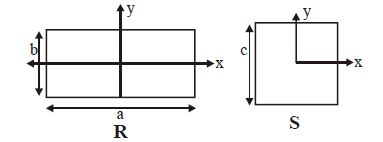
A uniform square plate $S$ (side $c$) and a uniform rectangular plate $R$ (sides $b$, $a$) ($a > b$) have identical areas and masses figure. Which of the following is correct

$(a)\ I_{xR}/I_{xS} <1;\  (b)\ I_{yR}/I_{yS}  >1; \  (c)\ I_{zR}/I_{zS} >1$
  • A
    $a$,$b$
  • B
    $b$,$c$
  • $a$,$b$,$c$
  • D
    None

Answer

Correct option: C.
$a$,$b$,$c$
c
$a b=c^{2}$           $a>c>b$

$\mathrm{I}_{\mathrm{XR}}=\frac{\mathrm{Mb}^{2}}{12}, \mathrm{I}_{\mathrm{YR}}=\frac{\mathrm{Ma}^{2}}{12}, \mathrm{I}_{\mathrm{ZR}}=\frac{\mathrm{M}\left(\mathrm{a}^{2}+\mathrm{b}^{2}\right)}{12}$

$\mathrm{I}_{\mathrm{XS}}=\frac{\mathrm{Mc}^{2}}{12}, \mathrm{I}_{\mathrm{YS}}=\frac{\mathrm{Mc}^{2}}{12}, \mathrm{I}_{\mathrm{zs}}=\frac{\mathrm{Mc}^{2}}{6}$

$\frac{\mathrm{I}_{\mathrm{ZR}}}{\mathrm{I}_{\mathrm{ZS}}}=\frac{1}{2}\left(\left(\frac{\mathrm{a}}{\mathrm{c}}\right)^{2}+\left(\frac{\mathrm{b}}{\mathrm{c}}\right)^{2}\right)$

$=\frac{1}{2}\left(\left(\frac{\mathrm{a}}{\mathrm{c}}\right)^{2}+\left(\frac{\mathrm{c}}{\mathrm{a}}\right)^{2}\right)$

$\frac{I_{\mathbb{Z R}}}{I_{Z S}}>1$

$x+\frac{1}{x}>2$ if $x>0$

Need a full question paper?

Generate a complete, print-ready paper with questions like this in minutes — across 16+ boards, with answer keys.

Start Generating Free

Similar questions

A particle moves along a circle of radius $\left( {\frac{{20}}{\pi }} \right)\,m$ with constant tangential acceleration. If the velocity of the particle is $80 \,m/s$ at the end of the second revolution after motion has begin, the tangential acceleration is
An organ pipe, open at both ends, contains
Two steel wires of same length but radii $r$ and $2r$ are connected together end to end and tied to a wall as shown. The force stretches the combination by $10\ mm$ . How far does the midpoint $A$ move ......... $mm$
When two harmonic sound waves of close $($but not equal$)$ frequencies are heard at the same time, we hear:
The stationary wave produced on a string is represented by the equation $y = 5\cos (\pi x/3)\sin 40\pi \,t$. Where $x$ and $y$ are in cm and $t$ is in seconds. The distance between consecutive nodes is .... $cm$
In case of damped oscillation frequency of oscillation is ............
The bob of simple pendulum having length $l$, is displaced from mean position to an angular position $\theta$ with respect to vertical. If it is released, then velocity of bob at lowest position
Given below are two statements :

Statement $I$ : When speed of liquid is zero everywhere, pressure difference at any two points depends on equation $\mathrm{P}_1-\mathrm{P}_2=\rho \mathrm{g}\left(\mathrm{h}_2-\mathrm{h}_1\right)$

Statement $II$ : In ventury tube shown $2 \mathrm{gh}=v_1^2-v_2^2$

In the light of the above statements, choose the most appropriate answer from the options given below.

A uniform rod of mass $m$ and length $l$ rotates in a horizontal plane with an angular velocity $\omega $ about a vertical axis passing through one end. The tension in the rod at a distance $x$ from the axis is
The volume of the bulb of a mercury thermometer at $0^o C$ is $V_0$and cross section of the capillary is $A_0$. The coefficient of linear expansion of glass is $a_g$ $per ^o C$ and the cubical expansion of mercury $\gamma_m$ $per ^o C$. If the mercury just fills the bulb at $0^o C$, what is the length of mercury column in capillary at $T^o C.$