Question
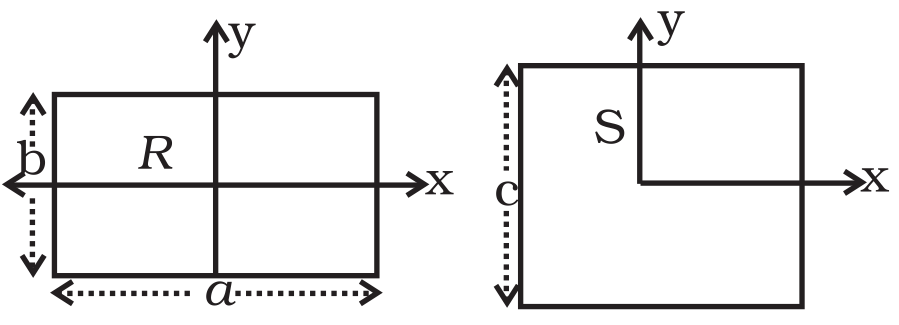
A uniform square plate S(side c) and a uniform rectangular plate R(sides b, a) have identical areas and masses:
Show that:
  1. $\frac{\text{I}_\text{xR}}{\text{I}_\text{xS}}<1$
  2. $\frac{\text{I}_\text{ys}}{\text{I}_\text{ys}}>1$
  3. $\frac{\text{I}_{2\text{R}}}{\text{I}_{2\text{s}}}>1$
Answer

According to the problem,
Area of square = Area of rectangular plate
$\Rightarrow c^2 = a \times b$
$\Rightarrow c^2 = ab$
  1. $\frac{\text{I}_\text{XR}}{\text{I}_\text{XS}}=\frac{\text{b}^2}{\text{c}^2}$
It is clear from diagram that b < c.
$\Rightarrow\ \frac{\text{I}_\text{XR}}{\text{I}_\text{XS}}=\Big(\frac{\text{b}}{\text{c}}\Big)^2<1$
$\Rightarrow{\text{I}_\text{XR}}<{\text{I}_\text{XS}}$
  1. $\frac{\text{I}_\text{YR}}{\text{I}_\text{RS}}=\frac{\text{a}^2}{\text{c}^2}$ (It is clear that a > c)
$\Rightarrow\ \frac{\text{I}_\text{YR}}{\text{I}_\text{RS}}=\Big(\frac{\text{a}}{\text{c}}\Big)^2>1$
  1. $\text{I}_\text{zR}=\frac{1}{12}\text{M}(\text{a}^2+\text{b}^2)$
$\Rightarrow\ \text{I}_\text{zS}=\frac{1}{12}\text{M}(\text{c}^2+\text{c}^2)$
Now, $\text{I}_\text{zR}-\text{I}_\text{zS}=\frac{1}{12}\text{M}\big[\text{a}^2+\text{b}^2-2\text{c}^2\big]$
$\Rightarrow\ \text{I}_\text{zR}-\text{I}_\text{zS}=\frac{1}{12}\text{M}\big(\text{a}^2+\text{b}^2-2\text{ab}\big)$
$\Rightarrow\ \text{I}_\text{zR}-\text{I}_\text{zS}=\frac{1}{12}\text{M}\big(\text{a}-\text{b}\big)^2>0$
$\Rightarrow\ \frac{\text{I}_\text{zR}}{\text{I}_\text{zS}}>1$

Need a full question paper?

Generate a complete, print-ready paper with questions like this in minutes — across 16+ boards, with answer keys.

Start Generating Free

Similar questions

An apple falls from a tree. An insect in the apple finds that the earth is falling towards it with an acceleration g. Who exerts the force needed to accelerate the earth with this acceleration g?
For the motion of a body due to external force, prove that its entire mass can be considered concentrated at the center of mass.
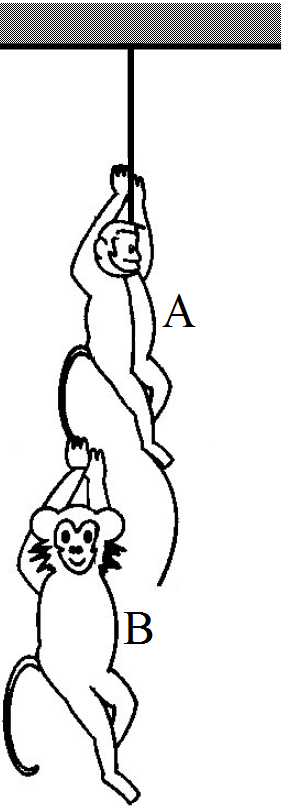
The monkey B shown in figure is holding on to the tail of the monkey A which is climbing up a rope. The masses of the monkeys A and B are 5kg and 2kg respectively. If A can tolerate a tension of 30N in its tail, what force should it apply on the rope in order to carry the monkey B with it? Take $g = 10m/s^2$​​​​​​​
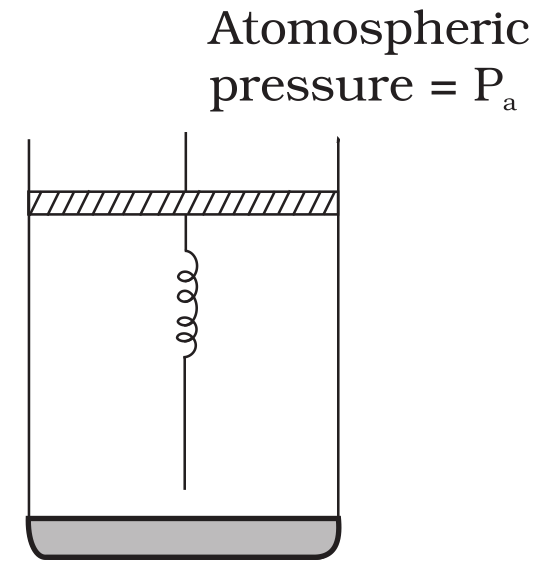
Consider one mole of perfect gas in a cylinder of unit cross section with a piston attached (Fig.) A spring (spring constant k) is attached (unstretched length L) to the piston and to the bottom of the cylinder. Initially the spring is unstretched and the gas is in equilibrium. A certain amount of heat Q is supplied to the gas causing an increase of volume from $V_o$ to $V_1$.
  1. What is the initial pressure of the system.
  2. What is the final pressure of the system.
  3. Uing the first law of thermodynamics, write down a relation between $Q, P_a, V, V_o$ and $k$.
A metal ball of mass 1 kg is heated by means of a 20 W heater in a room at $20^{\circ} \mathrm{C}$. The temperature of the ball becomes steady at $50^{\circ} \mathrm{C}$.
a. Find the rate of loss of heat to the surrounding when the ball is at $50^{\circ} \mathrm{C}$.
b. Assuming Newton's law of cooling, calculate the rate of loss of heat to the surrounding when the ball is at $30^{\circ} \mathrm{C}$.
c. Assume that the temperature of the ball rises uniformly from $20^{\circ} \mathrm{C}$ to $30^{\circ} \mathrm{C}$ in 5 minutes. Find the total loss of heat to the surrounding during this period.
d. Calculate the specific heat capacity of the metal.
An ideal gas is trapped between a mercury column and the closed-end of a narrow vertical tube of uniform base containing the column. The upper end of the tube is open to the atmosphere. The atmospheric pressure equals 76cm of mercury. The lengths of the mercury column and the trapped air column are 20cm and 43cm respectively. What will be the length of the air column when the tube is tilted slowly in a vertical plane through an angle of 60°? Assume the temperature to remain constant.
Two particles, each of mass m and speed v, travel in opposite directions along parallel lines separated by a distance d. Show that the angular momentum vector of the two particle system is the same whatever be the point about which the angular momentum is taken.
In a Young's double slit experiment using monochromatic light, the fringe pattern shifts by a certain distance on the screen when a mica sheet of refractive index $1.6$ and thickness $1.964$ micron ($1\ micron = 10^{-6}m$) is introduced in the path of one of the interfering waves. The mica sheet is then removed and the distance between the screen and the slits is doubled. It is found that the distance between the successive maxima now is the same as the observed fringe-shift upon the introduction of the mica sheet. Calculate the wavelength of the monochromatic light used in the experiment.
Use the formula $\text{v}=\sqrt{\frac{\gamma\text{P}}{\rho}}$ to explain why the speed of sound in air:
Is independent of pressure,
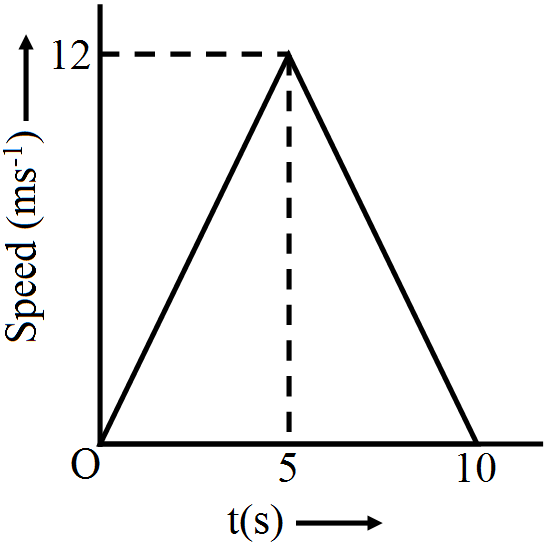
The speed time graph of a particle moving along a fixed direction is as shown below. Obtain the distance traversed by the particle between:
  1. $t = 0s$ to $5s$
  2. $t = 2s$ to $6s$