Question
For the motion of a body due to external force, prove that its entire mass can be considered concentrated at the center of mass.

Answer

self

Need a full question paper?

Generate a complete, print-ready paper with questions like this in minutes — across 16+ boards, with answer keys.
Start Generating Free

Similar questions

A block of mass m is kept on a horizontal ruler. The friction coefficient between the ruler and the block is g. The ruler is fixed at one end and the block is at a distance L from the fixed end. The ruler is rotated about the fixed end in the horizontal plane through the fixed end.
  1. What can the maximum angular speed be for which the block does not slip?
  2. If the angular speed of the ruler is uniformly increased from zero at an angular acceleration $\alpha,$ at what angular speed will the block slip?
(i) What is escape velocity? Prove that the velocity required to escape from earth's gravity is 11.2 km/s. Find the value of escape velocity for the moon.
(ii) Calculate the value of escape velocity required to make an object situated at a height h above the earth's surface
Answer the following:
What is the temperature of the triple-point of water on an absolute scale whose unit interval size is equal to that of the Fahrenheit scale?
What are geostationary satellites? Find the expression of total energy of a satellite revolving around the surface of the earth. What is the significance of negative sign in the expression? Write the expression of angular momentum of a satellite.
Find the minimum colatitude which can directly receive a signal from a geostationary satellite.
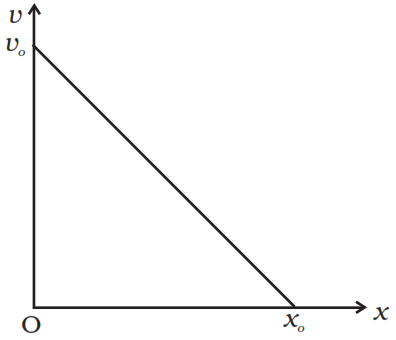
The velocity$-$displacement graph of a particle is shown in Fig.
  1. Write the relation between $v$ and $x$.
  2. Obtain the relation between acceleration and displacement and plot it.
A block whose mass is $1 \ kg$ is fastened to a spring. The spring has a spring constant of $50 N m ^{-1}$. The block is pulled to a distance $x=10 \ cm$ from its equilibrium position at $x=0$ on a frictionless surface from rest at $t=0$. Calculate the kinetic, potential and total energies of the block when it is $5 \ cm$ away from the mean position.
The refractive index of a material $M_1$ changes by $0.014$ and that of another material $M_2$ changes by $0.024$ as the colour of the light is changed from red to violet. Two thin prisms one made of $M_1(A = 5.3^\circ)$ and other made of $M_2(A = 3.7^\circ)$ are combined with their refracting angles oppositely directed.
  1. Find the angular dispersion produced by the combination.
  2. The prisms are now combined with their refracting angles similarly directed. Find the angular dispersion produced by the combination.
State the assumptions of the kinetic theory of gases. The density of carbon dioxide gas at $0^{\circ} \mathrm{C}$ and at a pressure of $1.0 \times 10^5$ newton/ metre ${ }^2$ is $1.98 \mathrm{~kg} / \mathrm{m}^3$. Find the root mean square velocity of its molecules at $0^{\circ} \mathrm{C}$ and $30^{\circ} \mathrm{C}$. Pressure is constant.
A block of mass $2.0kg$ is pushed down an inclined plane of inclination $37°$ with a force of $20N$ acting parallel to the incline. It is found that the block moves on the incline with an acceleration of $10m/s^2$. If the block started from rest, find the work done.
  1. By the applied force in the first second.
  2. By the weight of the block in the first second.
  3. By the frictional force acting on the block in the first second. Take $g = 10m/s^2$.