A uniform wire of length $L$ and mass $M$ is stretched between two fixed points, keeping tension $F$. A sound of frequency $m$ is impressed on it. Then the maximum vibrational energy is existing in the wire when $\mu $ =
Diffcult
Download our app for free and get started
The frequency of the wire depends on the length of the string $(L),$ tension $(F)$ and the mass per unit length
of the wire $(\mathrm{m}=\mathrm{M} / \mathrm{L})$
Let $\left.A \propto L^{a} F^{b} m^{c} \quad \text { ……….. } \quad \text { (Equation } 1\right)$
Writing the dimensions of each in the above equation, we get
$\left[\mathrm{M}^{0} \mathrm{L}^{0} \mathrm{T}^{-1}\right]=\mathrm{L}^{\mathrm{a}}\left[\mathrm{M}^{1} \mathrm{L}^{1} \mathrm{T}^{-2}\right]^{\mathrm{b}}\left[\mathrm{M}^{0} \mathrm{L}^{-1}\right]^{\mathrm{C}}$
$=M^{b+c} L^{a+b-c} T^{-2 b}$
Here, $b+c=0$
$a+b-c=0 \text { and }$
$-2 b=-1$
On solving, we get
$a=-1, b=1 / 2$ and $c=-1 / 2$
Substituting these values in equation $(1),$ we get
$A=k L^{-1} F^{1 / 2} m^{-1 / 2}$
$=k \frac{1}{L} \sqrt{\frac{F}{m}}$
or $A=k \frac{1}{L} \sqrt{\frac{F}{(M / L)}}$
or $A=k \sqrt{\frac{F}{M L}}$
Experimentally $\mathrm{k}=1 / 2$ $\therefore A=\frac{1}{2} \sqrt{\frac{F}{M L}}$

Download our appand get started for free
Experience the future of education. Simply download our apps or reach out to us for more information. Let's shape the future of learning together!No signup needed.*
Similar Questions
- 1A string of $7 \;m$ length has a mass of $0.035\,kg$. If tension in the string is $60.5\; N,$ then speed of a wave on the string is .... $m/s$View Solution
- 2If separation between screen and source is increased by $2\%$ what would be the effect on the intensityView Solution
- 3Two trains $A$ and $B$ are moving with speeds $20 \mathrm{~m} / \mathrm{s}$ and $30 \mathrm{~m} / \mathrm{s}$ respectively in the same direction on the same straight track, with $B$ ahead of $A$. The engines are at the front ends. The engine of train $A$ blows a long whistle.View Solution
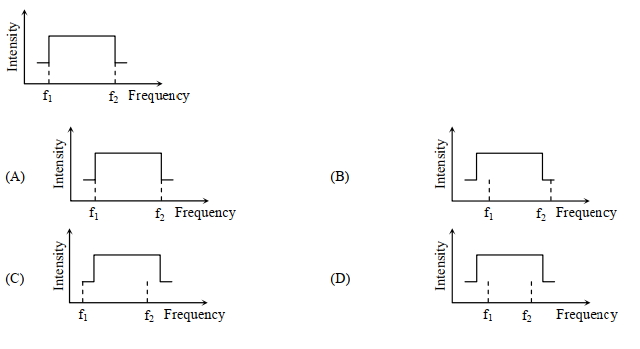
Assume that the sound of the whistle is composed of components varying in frequency from $f_1=800 \mathrm{~Hz}$ to $f_2=1120 \mathrm{~Hz}$, as shown in the figure. The spread in the frequency (highest frequency - lowest frequency) is thus $320 \mathrm{~Hz}$. The speed of sound in still air is $340 \mathrm{~m} / \mathrm{s}$.
$1.$ The speed of sound of the whistle is
$(A)$ $340 \mathrm{~m} / \mathrm{s}$ for passengers in $A$ and $310 \mathrm{~m} / \mathrm{s}$ for passengers in $B$
$(B)$ $360 \mathrm{~m} / \mathrm{s}$ for passengers in $A$ and $310 \mathrm{~m} / \mathrm{s}$ for passengers in $B$
$(C)$ $310 \mathrm{~m} / \mathrm{s}$ for passengers in $A$ and $360 \mathrm{~m} / \mathrm{s}$ for passengers in $B$
$(D)$ $340 \mathrm{~m} / \mathrm{s}$ for passengers in both the trains
$2.$ The distribution of the sound intensity of the whistle as observed by the passengers in train $\mathrm{A}$ is best represented by
$Image$
$3.$ The spread of frequency as observed by the passengers in train $B$ is
$(A)$ $310 \mathrm{~Hz}$ $(B)$ $330 \mathrm{~Hz}$ $(C)$ $350 \mathrm{~Hz}$ $(D)$ $290 \mathrm{~Hz}$
Give the answer question $1,2$ and $3.$
- 4In a closed organ pipe, the frequency of fundamental note is $30 \mathrm{~Hz}$. A certain amount of water is now poured in the organ pipe so that the fundamental frequency is increased to $110 \mathrm{~Hz}$. If the organ pipe has a cross-sectional area of $2 \mathrm{~cm}^2$, the amount of water poured in the organ tube is _____________$g.$ (Take speed of sound in air is $330 \mathrm{~m} / \mathrm{s}$ )View Solution
- 5The number of beats produced per second by two vibrations: $x_1 =x_0$ sin $646\pi t$ and $x_2 = x_0 sin 652 \pi t$ isView Solution
- 6The ratio of intensities between two coherent soud sources is $4 : 1$. The differenmce of loudness in $dB$ between maximum and minimum intensities when they interfere in space is:View Solution
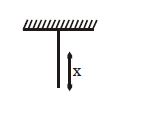
- 7A wire of variable mass per unit length $\mu = \mu _0x$ , is hanging from the ceiling as shown in figure. The length of wire is $l_0$ . A small transverse disturbance is produced at its lower end. Find the time after which the disturbance will reach to the other endsView Solution
- 8The frequencies of two sound sources are $256 Hz$ and $260 Hz$. At $t = 0,$ the intensity of sound is maximum. Then the phase difference at the time $t = \frac{1}{16}\, sec$ will beView Solution
- 9An open pipe of length $l$ vibrates in fundamental mode. The pressure variation is maximum atView Solution
- 10A person blows into open-end of a long pipe. As a result, a high-pressure pulse of air travels down the pipe. When this pulse reaches the other end of the pipe.View Solution
$(A)$ a high-pressure pulse starts traveling up the pipe, if the other end of the pipe is open.
$(B)$ a low-pressure pulse starts traveling up the pipe, if the other end of the pipe is open.
$(C)$ a low-pressure pulse starts traveling up the pipe, if the other end of the pipe is closed.
$(D)$ a high-pressure pulse starts traveling up the pipe, if the other end of the pipe is closed.