A uniform wire of resistance $R$ is uniformly compressed along its length, until its radius becomes $n$ times the original radius. Now resistance of the wire becomes
Easy
Download our app for free and get started
(a) $\frac{{{R_1}}}{{{R_2}}} = {\left( {\frac{{{r_2}}}{{{r_1}}}} \right)^4} \Rightarrow \frac{R}{{{R_2}}} = {\left( {\frac{{nr}}{r}} \right)^4} \Rightarrow {R_2} = \frac{R}{{{n^4}}}$.

Download our appand get started for free
Experience the future of education. Simply download our apps or reach out to us for more information. Let's shape the future of learning together!No signup needed.*
Similar Questions
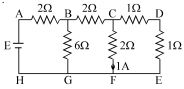
- 1The figure shows a network of resistors and $a$ battery. If $1\,A$ current flowsthrough the branch $CF$, then answer the following questions The current throughView Solution
- 2When the current $i$ is flowing through a conductor, the drift velocity is $v$. If $2i$ current is flowed through the same metal but having double the area of cross-section, then the drift velocity will beView Solution
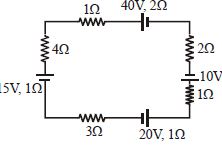
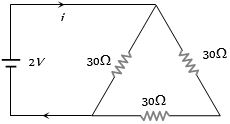
- 3View SolutionFind the current in the loop.
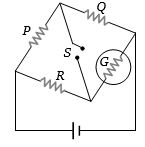
- 4The figure shows a circuit diagram of a ‘Wheatstone Bridge’ to measure the resistance $G$ of the galvanometer. The relation $\frac{P}{Q} = \frac{R}{G}$ will be satisfied only whenView Solution
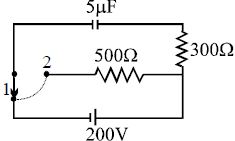
- 5A capacitor of capacitance $5\,\mu F$ is connected to a source of constant $emf$ of $200\,V$ for a long time, then the switch was shifted to contact $2$ from contact $1$ . The total amount of heat generated in the $500\,\Omega $ resistance, thereafter isView Solution
- 6Three $60\, W$ light bulbs are mistakenly wired in series and connected to a $120\,V$ power supply. Assume the light bulbs are rated for single connection to $120\,V$. With the mistaken connection, the power dissipated by each bulb is: .................. $W$View Solution
- 7View SolutionThe current in the adjoining circuit will be
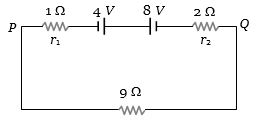
- 8Two batteries of $e.m.f.$ $4\,V$ and $8 \,V$ with internal resistances $1\, \Omega$ and $2\,\Omega$ are connected in a circuit with a resistance of $9 \,\Omega$ as shown in figure. The current and potential difference between the points $P$ and $Q$ areView Solution
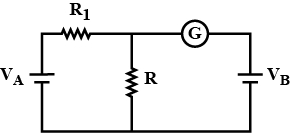
- 9In the circuit shown the cells $A$ and $B$ have negligible resistance. For $V _{ A }=12\; V , R _{1}=500\; \Omega$ and $R =100\; \Omega$ the galvanometer $(G)$ shows no deflection. The value of $V_{B}$ is .... $V$View Solution
- 10The capacitor $C$ is initially without charge.$X$ is now j oined to $Y$ for a long time, during which $H_1$ heat is produced in the resistance $R$. $X-Y$ connection is removed and $X$ is now joined to $Z$ for a long time, during which heat $H_2$ is produced in $R$.View Solution