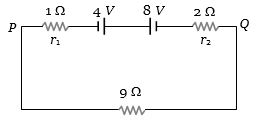
Two batteries of $e.m.f.$ $4\,V$ and $8 \,V$ with internal resistances $1\, \Omega$ and $2\,\Omega$ are connected in a circuit with a resistance of $9 \,\Omega$ as shown in figure. The current and potential difference between the points $P$ and $Q$ are
AIPMT 1988, Medium


Download our appand get started for free
Experience the future of education. Simply download our apps or reach out to us for more information. Let's shape the future of learning together!No signup needed.*
Similar Questions
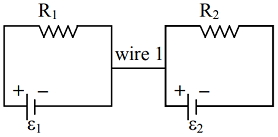
- 1In the circuit, wire $1$ is of negligible resistance. Then,View Solution
- 2View SolutionIf an observer is moving with respect to a stationary electron, then he observes
- 3Four wires of equal length and of resistances $10$ $ ohms$ each are connected in the form of a square. The equivalent resistance between two opposite corners of the square is ............. $ohm$View Solution
- 4View SolutionTo draw maximum current from a combination of cells, how should the cells be grouped
- 5The resistance of $10\, metre$ long potentiometer wire is $1\,ohm/meter$. A cell of $e.m.f.$ $2.2\, volts$ and a high resistance box are connected in series to this wire. The value of resistance taken from resistance box for getting potential gradient of $2.2\, millivolt/metre$ will be ............... $\Omega $View Solution
- 6A current of $2.0$ ampere passes through a cell of $e.m.f$. $1.5\, volts$ having internal resistance of $0.15\, ohm$. The potential difference measured, in $volts$, across both the ends of the cell will beView Solution
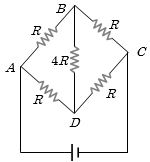
- 7Five resistors of given values are connected together as shown in the figure. The current in the arm $BD$ will beView Solution
- 8A platinum resistance thermometer has a resistance of $50\,\Omega $ at $20\,^o C$. When dipped in a liquid the resistance becomes $76.8\,\Omega $. The temperature coefficient of resistance for platinum is $\alpha = 3.92 \times {10^{ - 3}}\,^o C$. The temperature of the liquid is .............. $^o C$View Solution
- 9Two wires have resistance of $2$ $\Omega$ and $4$ $\Omega$ connected to same voltage, ratio of heat dissipated at resistance isView Solution
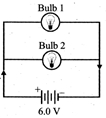
- 10A $6.0\,volt$ battery is connected to two light bulbs as shown in figure. Light bulb $1$ has resistance $3\,ohm$ while light bulb $2$ has resistance $6\,ohm.$ Battery has negligible internal resistance. Which bulb will glow brighter?View Solution