MCQ
A uniformly charged dielectric ring rotating with constant angular velocity $'\omega '$ about its geometrical axis then it produces
  • A
    electrostatic field
  • B
    magnetic field
  • C
    magnetic moment
  • D
    all of these

Answer

Need a full question paper?

Generate a complete, print-ready paper with questions like this in minutes — across 16+ boards, with answer keys.
Start Generating Free

Similar questions

Two sound waves of wavelengths $5 \mathrm{~m}$ and $6 \mathrm{~m}$ formed 30 beats in 3 seconds. The velocity of sound is
A particle executing S.H.M. of amplitude $4 cm$ and $T=4 sec$. The time taken by it to move from positive extreme position to half the amplitude is
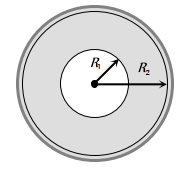
A sphere of mass $M$ and radius $R$ has a concentric cavity of radius $R$ as shown in figure. The force $F$ exerted by the sphere on a particle of mass $\mathrm{m}$ located at a distance $r$ from the centre of sphere varies as $(0 \leq r \leq \infty)$
Image
A container of volume $1 \mathrm{~m}^3$ is divided into two equal compartments by a partition. One of these compartments contains an ideal gas at $300 K$. The other compartment is vacuum. The whole system is thermally isolated from its surroundings. The partition is removed and the gas expands to occupy the whole volume of the container. lts temperature now would be
A $1\  \mu \mathrm{A}$ beam of protons with a cross-sectional area of $0.5 \ \mathrm{sq} . \mathrm{mm}$ is moving with a velocity of $3 \times 10^4 \mathrm{~ms}^{-1}$. Then charge density of beam is
$4200 /$ of work is required for
Newton-second is the unit of
Unpolarized light falls on two polarizing sheets placed one on top of the other. What must be the angle between the characteristic directions of the sheets if the intensity of the final transmitted light is one-third the maximum intensity of the first transmitted beam
An electric motor exerts a force of $40 \mathrm{~N}$ on a cable and pulls it by a distance of $30 \mathrm{~m}$ in one minute. The power supplied by the motor (in Watts) is
A monoatomic ideal gas, initially at temperature $T_1$, is enclosed in a cylinder fitted with a frictionless piston. The gas is allowed to expand adiabatically to a temperature. $T_2$ by releasing the piston suddenly. If $L_1$ and $L_2$ are the lengths of the gas column before and after expansion respectively, then $T_1 / T_2$ is given by