MCQ 11 Mark
In a uniform magnetic field of $0.049 \mathrm{~T}$, a magnetic needle performs $20$ complete oscillations in $5$ seconds as shown. The moment of inertia of the needle is $9.8 \times 10^{-5} \mathrm{~kg} \mathrm{~m}^2$. If the magnitude of magnetic moment of the needle is $x \times 10^{-5} \mathrm{Am}^2$, then the value of ' $x$ ' is :
- A
$128 \pi^2$
- B
$50 \pi^2$
- C
$1280 \pi^2$
- D
$5 \pi^2$
AnswerTime period of Oscillation, $T=2 \pi \sqrt{\frac{1}{M B}}$
$\Rightarrow \frac{1}{4}=2 \pi \sqrt{\frac{9.8 \times 10^{-6}}{M \times 0.049}}$
$\Rightarrow \frac{1}{16}=4 \pi^2 \times \frac{9.8 \times 10^{-6}}{M \times 49 \times 10^{-3}}$
$\Rightarrow M=\frac{4 \pi^2 \times 9.8 \times 10^{-6}}{49 \times 10^{-3}} \times 16$
$\frac{4 \pi^2 \times 9.8 \times 16 \times 10^{-3}}{49}$
$\quad=12.8 \pi^2 \times 10^{-3} \times 10^{-2} \times 10^2$
$=1280 \pi^2 \times 10^{-5} \mathrm{Am}^2$
View full question & answer→MCQ 21 Mark
A uniform conducting wire of length $12 \mathrm{a}$ and resistance $'R'$ is wound up as a current carrying coil in the shape of,
$(i)$ an equilateral triangle of side $'a'.$
$(ii)$ a square of side $'a'.$
The magnetic dipole moments of the coil in each case respectively are:
- A
$\sqrt{3} \mathrm{Ia}^{2}$ and $3 \mathrm{Ia}^{2}$
- B
$3 \mathrm{Ia}^{2}$ and $\mathrm{Ia}^{2}$
- C
$3 \mathrm{Ia}^{2}$ and $4 \mathrm{Ia}^{2}$
- D
$4 \mathrm{Ia}^{2}$ and $3 \mathrm{Ia}^{2}$
Answer$x=\sqrt{a^{2}-\frac{a^{2}}{4}}=\sqrt{\frac{3 a^{2}}{4}}=\sqrt{\frac{3 a^{2}}{4}}=\frac{\sqrt{3}}{2} a$
$\mathrm{A}_{1}=\frac{1}{2} \times \mathrm{a} \times \frac{\sqrt{3}}{2} \mathrm{a}$
$\mathrm{A}_{1}=\frac{\sqrt{3}}{4} \mathrm{a}^{2}$
$\mu_{1}=\mathrm{N}_{1} \mathrm{IA}_{1}$
$\mu_{1}=\frac{4 \mathrm{I} \sqrt{3}}{4} \mathrm{a}^{2}$
$\mu_{1}=\sqrt{3} \mathrm{I} a^{2}$
$A_{2}=a^{2}$
$\mu_{2}=N_{2} I A_{2}$
$=3 \times I \times a^{2}$
$\mu_{2}=3 \mathrm{Ia}^{2}$
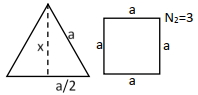
View full question & answer→MCQ 31 Mark
A wire of length $L$ metre carrying a current of $I$ ampere is bent in the form of circle. Its magnetic moment is
- A
$\frac{I L^{2}}{4 \pi} A \;m^{2}$
- B
$\frac{I L^{2}}{4} A \;m^{2}$
- C
$\frac{I \pi L^{2}}{4} A \;m^{2}$
- D
$\frac{2 I L^{2}}{\pi} A \;m^{2}$
AnswerLength of wire, $L =2 \pi R$
Radius of loop, $R=\frac{L}{2 \pi}$
Magnetic moment, $M =I A$
$=I\left(\frac{\pi L^{2}}{4 \pi^{2}}\right)$
$=\frac{I L^{2}}{4 \pi} A \;m^{2}$
View full question & answer→MCQ 41 Mark
Current sensitivity of a moving coil galvanometer is $5\,div/mA$ and its voltage sensitivity (angular deflection per unit voltage applied) is $20\,div/V$. The resistance of the galvanometer is ................. $\Omega$
AnswerCurrent sensitivity
$\mathrm{I}_{\mathrm{s}}=\frac{\mathrm{NBA}}{\mathrm{c}}$
Voltage sensitivity
$\mathrm{v}_{\mathrm{s}}=\frac{\mathrm{NBA}}{\mathrm{CR}_{\mathrm{G}}}$
So, resistance of galvanometer
$R_{G}=\frac{l_{s}}{V_{s}}=\frac{5 \times 1}{20 \times 10^{-3}}=\frac{5000}{20}=250\, \Omega$
View full question & answer→MCQ 51 Mark
A uniform magnetic field of $0.3\; T$ is established along the positive $Z$ -direction. A rectangular loop in $XY$ plane of sides $10 \;cm$ and $5 \;cm$ carries a current of $I =12\; A$ as shown. The torque on the loop is
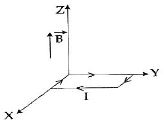
- A
$-1.8 \times 10^{-2}$$\hat j\;Nm$
- B
$0$
- C
$-1.8 \times 10^{-2}$ $\hat i\;Nm$
- D
$+1.8 \times 10^{-2}$ $\hat i\;Nm$
Answer$\vec{\tau}= NIA \times \overline{ B }$
Here $\overrightarrow{ A } \| \overrightarrow{ B }$
$\theta=0$
$\vec{\tau}= NIAB \sin \theta$
$\vec{\tau}=0$
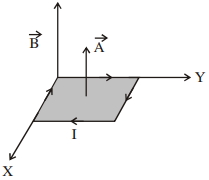
View full question & answer→MCQ 61 Mark
A galvanmeter has a coil of resistance $200 \Omega$ with a full scale deflection at $20 \mu \mathrm{A}$. The value of resistance to be added to use it as an ammeter of range $(0-20) \mathrm{mA}$ is:
- A
$0.40 \Omega$
- B
$0.20 \Omega$
- C
$0.50 \Omega$
- D
$0.10 \Omega$
Answer$\mathrm{G}=200 \Omega$
$\mathrm{i}_{\mathrm{g}}=20 \mu \mathrm{A}$
$\mathrm{i}=\mathrm{i}_{\mathrm{g}}\left(\frac{\mathrm{G}}{\mathrm{S}}+1\right)$
$\Rightarrow 20 \times 10^{-3}=20 \times 10^{-6}\left(\frac{200}{\mathrm{~S}}+1\right)$
$\Rightarrow \frac{200}{\mathrm{~S}}=999$
$\Rightarrow \mathrm{S} \approx 0.2 \Omega$
View full question & answer→MCQ 71 Mark
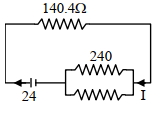
In the given figure an ammeter $A$ consists of a $240 \Omega$ coil connected in parallel to a $10 \Omega$ shunt. The reading of the ammeter is . . . . . . $\mathrm{mA}$.
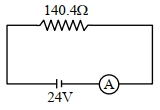
Answer$\text { Req }$
$=140.4+\frac{240 \times 10}{240+10}$
$\text { Req }=140.4+\frac{2400}{250}$
$\text { Req. }=150 \Omega$
$\therefore$ Current in ammeter$ =\frac{24}{150}$
$=160 \mathrm{~mA}$
View full question & answer→MCQ 81 Mark
A galvanometer of resistance $100 \Omega$ when connected in series with $400 \Omega$ measures a voltage of upto $10 \mathrm{~V}$. The value of resistance required to convert the galvanometer into ammeter to read upto $10 \mathrm{~A}$ is $\mathrm{x} \times 10^{-2} \Omega$. The value of $\mathrm{x}$ is :
Answer$\mathrm{i}_{\mathrm{g}}=\frac{10}{400+100}=20 \times 10^{-3} \mathrm{~A}$
For ammeter
Let shunt resistance $=\mathrm{S}$
$i_g R=\left(i-i_g\right) S$
$20 \times 10^{-3} \times 100=10 S$
$S=20 \times 10^{-2} \Omega$
View full question & answer→MCQ 91 Mark
In the experiment to determine the galvanometer resistance by half-deflection method, the plot of $\frac{1}{\theta}$ vs the resistance $(R)$ of the resistance box is shown in the figure. The figure of merit of the galvanometer is .............. $\times 10^{-1} \mathrm{~A} /$ division. [The source has emf 2V]
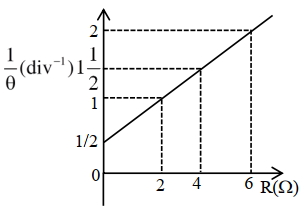
Answer$i=K \theta$
$\frac{2}{G+R}=K \theta$
$\Rightarrow \frac{1}{\theta}=\frac{(G+R) K}{2}=R\left(\frac{K}{2}\right)+\frac{K G}{2}$
$\text { Slope }=\frac{K}{2}=\frac{1}{4} \Rightarrow K=0.5=5 \times 10^{-1} A$
View full question & answer→MCQ 101 Mark
A moving coil galvanometer has $100$ turns and each turn has an area of $2.0 \mathrm{~cm}^2$. The magnetic field produced by the magnet is $0.01 \mathrm{~T}$ and the deflection in the coil is $0.05$ radian when a current of $10 \mathrm{~mA}$ is passed through it. The torsional constant of the suspension wire is $\mathrm{x} \times 10^{-5} \mathrm{~N}-\mathrm{m} / \mathrm{rad}$. The value of $\mathrm{x}$ is____.
Answer$\tau=\text { BINAsin } \phi$
$\mathrm{C} \theta=\mathrm{BINA} \sin 90^{\circ}$
$\mathrm{C}=\frac{\mathrm{BINA}}{\theta}=\frac{0.01 \times 10 \times 10^{-3} \times 100 \times 2 \times 10^{-4}}{0.05}$
$=4 \times 10^{-5} \mathrm{~N}-\mathrm{m} / \mathrm{rad} .$
$\mathrm{x}=4$
View full question & answer→MCQ 111 Mark
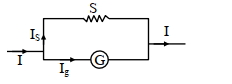
In an ammeter, $5 \%$ of the main current passes through the galvanometer. If resistance of the galvanometer is G, the resistance of ammeter will be :
- A
$\frac{G}{20}$
- B
$\frac{G}{199}$
- C
$199 \mathrm{G}$
- D
$200 \mathrm{G}$
Answer$\mathrm{I}_{\mathrm{S}} \mathrm{S}=\mathrm{I}_{\mathrm{g}} \mathrm{G}$
$\frac{95}{100} \mathrm{IS}=\frac{5 \mathrm{I}}{100} \mathrm{G}$
$\mathrm{S}=\frac{\mathrm{G}}{19}$
$\mathrm{R}_{\mathrm{A}}=\frac{\mathrm{SG}}{\mathrm{S}+\mathrm{G}}=\frac{\frac{\mathrm{G}^2}{19}}{\frac{20 \mathrm{G}}{19}}$
$\mathrm{R}_{\mathrm{A}}=\frac{\mathrm{G}}{20}$
View full question & answer→MCQ 121 Mark
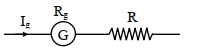
A galvanometer has a resistance of $50\ \Omega$ and it allows maximum current of $5 \mathrm{~mA}$. It can be converted into voltmeter to measure upto $100 \mathrm{~V}$ by connecting in series a resistor of resistance
- A
$5975 \Omega$
- B
$20050 \Omega$
- C
$19950 \Omega$
- D
$19500 \Omega$
AnswerR= $\frac{V}{I_g}-R_g=\frac{100}{5 \times 10^{-3}}-50$
$=20000-50$
$=19950 \Omega$
View full question & answer→MCQ 131 Mark
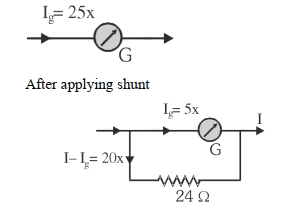
The deflection in moving coil galvanometer falls from $25$ divisions to $5$ division when a shunt of $24\ \Omega$ is applied. The resistance of galvanometer coil will be :
- A
$12\ \Omega$
- B
$96\ \Omega$
- C
$48\ \Omega$
- D
$100 \ \Omega$
AnswerLet $\mathrm{x}=$ current/division
Now $5 \mathrm{x} \times \mathrm{G}=20 \mathrm{x} \times 24$
$ \mathrm{G}=4 \times 24 $
$ \mathrm{G}=96 \ \Omega$
View full question & answer→MCQ 141 Mark
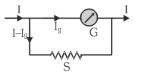
A galvanometer having coil resistance $10 \ \Omega$ shows a full scale deflection for a current of $3 \mathrm{~mA}$. For it to measure a current of $8 \mathrm{~A}$, the value of the shunt should be:
- A
$3 \times 10^{-3}\ \Omega$
- B
$4.85 \times 10^{-3} \ \Omega$
- C
$3.75 \times 10^{-3} \ \Omega$
- D
$2.75 \times 10^{-3} \ \Omega$
AnswerGiven $\mathrm{G}=10\ \Omega$
$ \mathrm{I}_{\mathrm{g}}=3 \mathrm{~mA} $
$ \mathrm{I}=8 \mathrm{~A}$
In case of conversion of galvanometer into ammeter.
We have $\mathrm{I}_{\mathrm{g}} \mathrm{G}=\left(\mathrm{I}-\mathrm{I}_{\mathrm{g}}\right) \mathrm{S}$
$ S=\frac{I_g G}{I-I_g} $
$ S=\frac{\left(3 \times 10^{-3}\right) 10}{8-0.003}=3.75 \times 10^{-5} \Omega$
View full question & answer→MCQ 151 Mark
A current of $200\ \mu \mathrm{A}$ deflects the coil of a moving coil galvanometer through $60^{\circ}$. The current to cause deflection through $\frac{\pi}{10}$ radian is:
- A
$30 \ \mu \mathrm{A}$
- B
$120\ \mu \mathrm{A}$
- C
$60 \ \mu \mathrm{A}$
- D
$180\ \mu \mathrm{A}$
Answer$i \propto \theta$ (angle of deflection)
$ \therefore \frac{i_2}{i_1}=\frac{\theta_2}{\theta_1} \Rightarrow \frac{i_2}{200 \mu \mathrm{A}}=\frac{\pi / 10}{\pi / 3}=\frac{3}{10}$
$ \Rightarrow \mathrm{i}_2=60\ \mu \mathrm{A}$
View full question & answer→MCQ 161 Mark
A coil having $100$ turns, area of $5 \times 10^{-3} \mathrm{~m}^2$, carrying current of $1 \mathrm{~mA}$ is placed in uniform magnetic field of $0.20 \mathrm{~T}$ such a way that plane of coil is perpendicular to the magnetic field. The work done in turning the coil through $90^{\circ}$ is . . . . . . $\mu \mathrm{J}$.
Answer$W=\Delta \mathrm{U}=\mathrm{U}_{\mathrm{f}}-\mathrm{U}_{\mathrm{i}}$
$\mathrm{W}=(-\vec{\mu} \cdot \overrightarrow{\mathrm{B}})_{\mathrm{f}}-(-\vec{\mu} \cdot \overrightarrow{\mathrm{B}})_i$
$=0+(\vec{\mu} \cdot \overrightarrow{\mathrm{B}})_i$
$=\left(100 \times 5 \times 10^{-3} \times 1 \times 10^{-3}\right) \times 0.2 \mathrm{~J}$
$=1 \times 10^{-4} \mathrm{~J}=100 \mu \mathrm{J}$
View full question & answer→MCQ 171 Mark
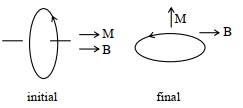
A circular coil having $200$ turns, $2.5 \times 10^{-4} \mathrm{~m}^2$ area and carrying $100 \mu \mathrm{A}$ current is placed in a uniform magnetic field of $1 \mathrm{~T}$. Initially the magnetic dipole moment $(\vec{M})$ was directed along $\vec{B}$. Amount of work, required to rotate the coil through $90^{\circ}$ from its initial orientation such that $\overrightarrow{\mathrm{M}}$ becomes perpendicular to $\vec{B}$, is. . . . $\mu \mathrm{J}$.
AnswerWe know
$\mathrm{W}_{\text {ext }} =\Delta \mathrm{U}+\Delta \mathrm{KE} \quad(\mathrm{P} . \mathrm{E} .=-\overrightarrow{\mathrm{M}} \cdot \overrightarrow{\mathrm{B}})$
$=-\overrightarrow{\mathrm{M}} \cdot \overrightarrow{\mathrm{B}}_{\mathrm{f}}+\overrightarrow{\mathrm{M}} \cdot \overrightarrow{\mathrm{B}}_{\mathrm{i}}+0$
$=-\mathrm{MB} \cos 90+\mathrm{MB} \cos 0$
$=\mathrm{MB}$
$=\mathrm{NIAB}$
$=200 \times 100 \times 10^{-6} \times \frac{5}{2} \times 10^{-4} \times 1=5 \mu$
View full question & answer→MCQ 181 Mark
The magnetic moment of a bar magnet is $0.5 \mathrm{Am}^2$. It is suspended in a uniform magnetic field of $8 \times 10^{-2} \mathrm{~T}$. The work done in rotating it from its most stable to most unstable position is:
- A
$16 \times 10^{-2} \mathrm{~J}$
- B
$8 \times 10^{-2} \mathrm{~J}$
- C
$4 \times 10^{-2} \mathrm{~J}$
- D
AnswerAt stable equilibrium
$\mathrm{U}=-\mathrm{mB} \cos 0^{\circ}=-\mathrm{mB}$
At unstable equilibrium
$\mathrm{U}=-\mathrm{mB} \cos 180^{\circ}=+\mathrm{mB}$
$\mathrm{W}=\Delta \mathrm{U}$
$\text { W.D. }=2 \mathrm{mB}$
$=2(0.5) 8 \times 10^{-2}=8 \times 10^{-2} \mathrm{~J}$
View full question & answer→MCQ 191 Mark
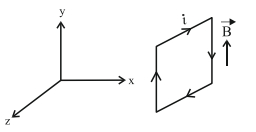
A uniform magnetic field of $2 \times 10^{-3} \mathrm{~T}$ acts along positive $\mathrm{Y}$-direction. A rectangular loop of sides $20$ $\mathrm{cm}$ and $10 \mathrm{~cm}$ with current of $5 \mathrm{~A}$ is $\mathrm{Y}-\mathrm{Z}$ plane. The current is in anticlockwise sense with reference to negative $\mathrm{X}$ axis. Magnitude and direction of the torque is :
- A
$2 \times 10^{-4} \mathrm{~N}-\mathrm{m}$ along positive $\mathrm{Z}$-direction
- B
$2 \times 10^{-4} \mathrm{~N}-\mathrm{m}$ along negative $Z$-direction
- C
$2 \times 10^{-4} \mathrm{~N}-\mathrm{m}$ along positive $\mathrm{X}$-direction
- D
$2 \times 10^{-4} \mathrm{~N}-\mathrm{m}$ along positive $\mathrm{Y}$-direction
Answer$\overrightarrow{\mathrm{M}}=\mathrm{iA}$
$=5 \times(0.2) \times(0.1)(-\hat{\mathrm{i}})$
$=0.1(-\hat{\mathrm{i}})$
$\vec{\tau}=\overrightarrow{\mathrm{M}} \times \overrightarrow{\mathrm{B}}=0.1(-\hat{\mathrm{i}}) \times\left(2 \times 10^{-3}\right)(\hat{\mathrm{j}})$
$=2 \times 10^{-4}(-\hat{\mathrm{k}}) \mathrm{N}-\mathrm{m}$
View full question & answer→MCQ 201 Mark
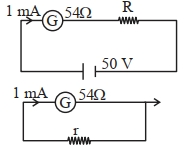
For designing a voltmeter of range $50\,V$ and an ammeter of range $10\,mA$ using a galvanometer which has a coil of resistance $54\,\Omega$ showing a full scale deflection for $1\,mA$ as in figure.
$(A)$ for voltmeter $R \approx 50\,k\Omega$
$(B)$ for ammeter $r \approx 0.2\,\Omega$
$(C)$ for ammeter $r \approx 6\,\Omega$
$(D)$ for voltmeter $R \approx 5\,k \Omega$
$(E)$ for voltmeter $R \approx 500 \Omega$
Choose the correct answer from the options given below
- A
$(C)$ and $(E)$
- B
$(C)$ and $(D)$
- C
$(A)$ and $(C)$
- D
$(A)$ and $(B)$
AnswerFor voltmeter
$R =\frac{ V }{ I _{ g }}- G$
$=\frac{50}{10^{-3}}-54 \approx 50\,k \Omega$
For ammeter
$S=\frac{I_g G}{I-I_g}=\frac{10^{-3} \times 54}{(10-1) \times 10^{-3}}=6 \Omega( C )$
View full question & answer→MCQ 211 Mark
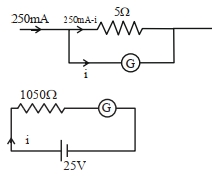
When a resistance of $5\,\Omega$ is shunted with a moving coil galvanometer, it shows a full scale deflection for a current of $250\,mA$, however when $1050\,\Omega$ resistance is connected with it in series, it gives full scale deflection for $25$ volt. The resistance of galvanometer is $......\,\Omega$.
Answer$\frac{250\,mA \times 5}{5+R_G}=i \dots(i)$
$i=\frac{25}{1050+R_G} \dots(ii)$
From $(i)$ and $(ii)$
$\frac{25}{1050+R_G}=\frac{5}{4\left(5+R_G\right)}$
$100\left(5+R_G\right)=1050 \times 5+R_G \times 5$
$95 R_G=4750$
$R_G=50\,\Omega$
View full question & answer→MCQ 221 Mark
The current sensitivity of moving coil galvanometer is increased by $25 \%$. This increase is achieved only by changing in the number of turns of coils and area of cross section of the wire while keeping the resistance of galvanometer coil constant. The percentage change in the voltage sensitivity will be $...........\%$
Answer$I _{ s }=\frac{ NBA }{ C } \& V _{ s }=\frac{ NBA }{ CG }$
$\Rightarrow V_{ s }=\frac{I_s}{G}$, If $G$ (galvanometer resistance) is constant, then $V _{ S } \propto I_S$
so percentage change in $V_S$ is also $25 \%$.
View full question & answer→MCQ 231 Mark
Given below are two statement :
Statement $I :$ If the number of turns in the coil of a moving coil galvanometer is doubled then the current sensitivity becomes double.
Statement $II :$ Increasing current sensitivity of a moving coil galvanometer by only increasing the number of turns in the coil will also increase its voltage sensitivity in the same ratio:
In the light of the above statement, choose the correct answer from the options given below :
- A
Statement $I$ is false but Statement $II$ is true
- B
Both Statement $I$ and Statement $II$ are true
- C
Both Statement $I$ and Statement $II$ are false
- D
Statement $I$ is true but Statement $II$ is false
AnswerFor a moving coil galvanometer
$\text { BiNA }= k \theta$
$\theta=\left(\frac{ BNA }{ k }\right) i ; \text { Current sensitive }=\frac{ BNA }{ k }$
So, if $N$ is doubled then current sensitivity is doubled.
Voltage sensitivity
$B \frac{ V }{ R } NA = k \theta$
$V =\frac{ BNA }{ Rk } \theta, \text { as } N \text { is doubled } R \text { is also doubled. }$
So, no change in voltage sensitivity.
View full question & answer→MCQ 241 Mark
Given below are two statements: One is labelled as Assertion $A$ and the other is labelled as Reason $R$.
Assertion $A:$ For measuring the potential difference across a resistance of $600\,\Omega$, the voltmeter with resistance $1000\,\Omega$ will be preferred over voltmeter with resistance $4000\,\Omega$.
Reason $R:$ Voltmeter with higher resistance will draw smaller current than voltmeter with lower resistance.
In the light of the above statements, choose the most appropriate answer from the options given below.
- A
$A$ is not correct but $R$ is correct
- B
Both $A$ and $R$ are correct and $R$ is the correct explanation of $A$
- C
Both $A$ and $R$ are correct but $R$ is not the correct explanation of $A$
- D
$A$ is correct but $R$ is not correct
AnswerError of voltmeter decreases with increase in its resistance.
View full question & answer→MCQ 251 Mark
The number of turns of the coil of a moving coil galvanometer is increased in order to increase current sensitivity by $50 \%$. The percentage change in voltage sensitivity of the galvanometer will be $..........\%$
View full question & answer→MCQ 261 Mark
For a moving coil galvanometer, the deflection in the coil is $0.05\,rad$ when a current of $10\,mA$ is passed through it. If the torsional constant of suspension wire is $4.0 \times 10^{-5}\,Nm\,rad ^{-1}$, the magnetic field is $0.01\,T$ and the number of turns in the coil is $200$,the area of each turn (in $cm ^2$ ) is :
Answer$\tau= K \theta$
$NiAB = K \theta$
$A =\frac{ K \theta}{ NiB }=\frac{4 \times 10^{-5} \times 0.05}{200 \times 10 \times 10^{-3} \times 0.01}$
On solving $A =10^{-4}\,m ^2=1\,cm ^2$
View full question & answer→MCQ 271 Mark
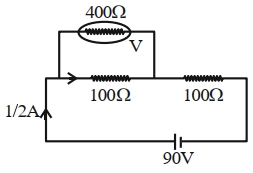
A cell of emf $90\,V$ is connected across series combination of two resistors each of $100\,\Omega$ resistance. A voltmeter of resistance $400\,\Omega$ is used to measure the potential difference across each resistor. The reading of the voltmeter will be $.........\,V$
Answer$R _{ eq }=\frac{400 \times 100}{500}+100$
$=180\,\Omega$
$i =\frac{90}{180}=\frac{1}{2}\,A$
$\text { Reading }=\frac{1}{2} \times \frac{400}{500} \times 100$
$=40\,volt$
View full question & answer→MCQ 281 Mark
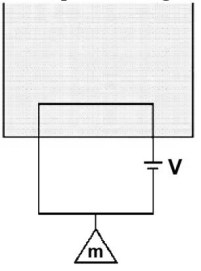
A massless square loop, of wire of resistance $10\,\Omega$. supporting a mass of $1\,g$. hangs vertically with one of its sides in a uniform magnetic field of $10^3\, G$, directed outwards in the shaded region. A dc voltage $V$ is applied to the loop. For what value of V. the magnetic force will exactly balance the weight of the supporting mass of $1\,g$ ? (If sides of the loop $=10\,cm , g =10\,ms ^{-2}$ )
- A
$\frac{1}{10}\,V$
- B
$1\,V$
- C
$100\,V$
- D
$10\,V$
Answer$F _{ m }= mg$
$\therefore \quad ILB = mg$
$\therefore \quad\left(\frac{ V }{ R }\right) LB = mg$
$\therefore \quad V =\frac{ mgR }{ LB }$
$=\frac{\left(1 \times 10^{-3}\,kg \right)\left(10\,m / s ^2\right)(10 \Omega)}{(0.1\,m )\left(10^3 \times 10^{-4}\,T \right)}=10\,V$
View full question & answer→MCQ 291 Mark
A cyclotron is used to accelerate protons. If the operating magnetic field is $1.0\,T$ and the radius of the cyclotron 'dees' is $60 cm$, the kinetic energy of the accelerated protons in $MeV$ will be.
[use $m _{p}=1.6 \times 10^{-27} kg , e =1.6 \times 10^{-19} C$ ]
AnswerKinetic energy of electron in cyclotron
$=\left[\frac{ q ^{2} B ^{2} r _{0}^{2}}{2 m }\right]$
$=18\,MeV$
View full question & answer→MCQ 301 Mark
The current sensitivity of a galvanometer can be increased by:
$(A)$ decreasing the number of turns
$(B)$ increasing the magnetic field
$(C)$ decreasing the area of the coil
$(D)$ decreasing the torsional constant of the spring
Choose the most appropriate answer from the options given below.
- A
$(B)$ and $(C)$ only
- B
$(C)$ and $(D)$ only
- C
$(A)$ and $(C)$ only
- D
$(B)$ and $(D)$ only
Answer$i=\left(\frac{ K }{ NAB }\right) \theta$
$\therefore \frac{ d \theta}{ di }=\frac{ NAB }{ K }$
View full question & answer→MCQ 311 Mark
A $72 \; \Omega$ galvanometer is shunted by a resistance of $8 \; \Omega$. The percentage of the total current which passes through the galvanometer is $.....$
Answer$S=\frac{R_{G}}{\frac{I}{I_{g}}-1}$
$8=\frac{72}{\frac{I}{I_{g}}-1}$
$\frac{I}{I_{g}}-1=9$
$\frac{I}{I_{g}}=10 \Rightarrow \frac{I_{g}}{I}=\frac{1}{10} \quad \% I=\frac{I_{g}}{I} \times 100=10 \%$
View full question & answer→MCQ 321 Mark
A teacher in his physics laboratory allotted an experiment to determine the resistance $(G)$ of a galvanometer. Students took the observations for $\frac{1}{3}$ deflection in the galvanometer. Which of the below is true for measuring value of $G$ $?$
- A
$\frac{1}{3}$ deflection method cannot be used for determining the resistance of the galvanometer.
- B
$\frac{1}{3}$ deflection method can be used and in this case the $G$ equals to twice the value of shunt resistance$(s).$
- C
$\frac{1}{3}$ deflection method can be used and in this case, the $G$ equals to three times the value of shunt resistance$(s)$
- D
$\frac{1}{3}$ deflection method can be used and in this case the $G$ value equals to the shunt resistance$(s).$
Answer$\Rightarrow\left( I - I _{ g }\right) S = I _{ g } G$
$\frac{I_{g}}{I}=\frac{S}{S+G}$
$\Rightarrow \frac{1}{3}=\frac{S}{S+G} \Rightarrow S+G=3 S \Rightarrow G=2 S$
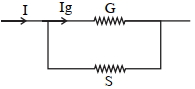
View full question & answer→MCQ 331 Mark
If $n$ represents the actual number of deflections in a converted galvanometer of resistance $G$ and shunt resistance $S$. Then the total current I when its figure of merit is $K$ will be
- A
$\frac{ KS }{( S + G )}$
- B
$\frac{( G + S )}{ nKS }$
- C
$\frac{ nKS }{( G + S )}$
- D
$\frac{n K ( G + S )}{ S }$
AnswerFigure of merit $\frac{ I _{ g }}{\theta}= K$
$I _{ g }= Kn$
$I =\frac{ I _{ g }}{ s }( G + S )$
$I =\frac{ nK }{ S }( G + S )$
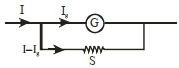
View full question & answer→MCQ 341 Mark
A wire of length $314\,cm$ carrying current of $14\,A$ is bent to form a circle. The magnetic moment of the coil is $........A- m ^{2}$. [Given $\left.\pi=3.14\right]$
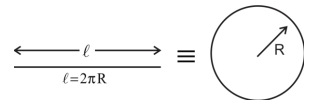
Answer$\frac{314}{100}=2 \pi R \quad R =0.5 m$
$\text { Magnetic Moment }= IA$
$=14 \times \pi R ^{2}$
$= 14 \times(3.14) \times \frac{1}{4}$3
$=10.99 \approx 11.00$
View full question & answer→MCQ 351 Mark
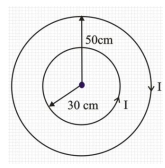
Two concentric circular loops of radii $r _{1}=30\,cm$ and $r_{2}=50\,cm$ are placed in $X - Y$ plane as shown in the figure. $A$ current $I=7\,A$ is flowing through them in the direction as shown in figure. The net magnetic moment of this system of two circular loops is approximately.
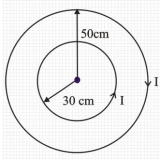
Answer$\overrightarrow{ M }=- i \pi(0.5)^{2} \hat{ k }+ i \pi(0.3)^{2} \hat{ k }$
$\overrightarrow{ M }=-7 \times \frac{22}{7}\left(\frac{25}{100}-\frac{9}{100}\right) \hat{ k }$
$=-22\left(\frac{16}{100}\right) \hat{ k }$
$\overrightarrow{ M }=-3.52 \hat{ k }\,Am ^{2}$
$=-\frac{7}{2} \hat{ k }\,Am ^{2}$
View full question & answer→MCQ 361 Mark
The magnetic moment of an electron $(e)$ revolving in an orbit around nucleus with an orbital angular momentum is given by :
- A
$\vec{\mu}_{ L }=\frac{ e \overrightarrow{ L }}{2 m }$
- B
$\vec{\mu}_{ L }=-\frac{ e \overrightarrow{ L }}{2 m }$
- C
$\vec{\mu}_{1}=-\frac{e \vec{L}}{m}$
- D
$\vec{\mu}_{1}=\frac{2 e \overrightarrow{ L }}{ m }$
AnswerRatio of magnetic moment and angular momentum
$\frac{\vec{\mu}}{\vec{L}}=\frac{q}{2 m}$
For $e^{-}$
$\vec{\mu}=-\frac{e}{2 m} \vec{L}$
View full question & answer→MCQ 371 Mark
If the maximum value of accelerating potential provided by a ratio frequency oscillator is $12\, {kV}$. The number of revolution made by a proton in a cyclotron to achieve one sixth of the speed of light is ....... .
$\left[{m}_{{p}}=1.67 \times 10^{-27} {kg}, {e}=1.6 \times 10^{-19} {C},\right.$ Speed of light $\left.=3 \times 10^{8} {m} / {s}\right]$
Answer${V}=12\, {kV}$
Number of revolution $={n}$
${n}\left[2 \times {q}_{{P}} \times {V}\right]=\frac{1}{2} {m}_{{p}} \times {v}_{{P}}^{2}$
${n}\left[2 \times 1.6 \times 10^{-19} \times 12 \times 10^{3}\right.$
$=\frac{1}{2} \times 1.67 \times 10^{-27} \times\left[\frac{3 \times 10^{8}}{6}\right]^{2}$
${n}\left(38.4 \times 10^{-16}\right)=0.2087 \times 10^{-11}$
${n}=543.4$
View full question & answer→MCQ 381 Mark
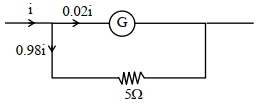
Consider a galvanometer shunted with $5\, \Omega$ resistance and $2\, \%$ of current passes through it.
What is the resistance of the given galvanometer? (In $\Omega$)
Answer$0.02 {i} {Rg}=0.98 {i} \times 5$
${Rg}=245 \,\Omega$
View full question & answer→MCQ 391 Mark
For full scale deflection of total $50$ divisions, $50\,{mV}$ voltage is required in galvanometer. The resistance of galvanometer if its current sensitivity is $2\, {div} / {mA}$ will be $.....\Omega$
Answer${I}_{\max }=\frac{50}{2}=25\, {mA}$
$R=\frac{V}{{I}}=\frac{50\, {mV}}{25\, {mA}}=2\, \Omega$
View full question & answer→MCQ 401 Mark
A uniform conducting wire of length is $24 {a}$, and resistance ${R}$ is wound up as a current carrying coil in the shape of an equilateral triangle of side $'a'$ and then in the form of a square of side $'a'.$ The coil is connected to a voltage source ${V}_{0}$. The ratio of magnetic moment of the coils in case of equilateral triangle to that for square is $1: \sqrt{y}$ where $y$ is ..... .
AnswerIn triangle shape ${N}_{{t}}=\frac{24 {a}}{3 {a}}=8$
In square ${N}_{{s}}=\frac{24 {a}}{4 {a}}=6$
$\frac{{M}_{{t}}}{{M}_{3}}=\frac{{N}_{{t}} {IA}_{{t}}}{{N}_{{s}} {I}_{{s}}}[{I}$ will be same in both $]$
$=\frac{8 \times \frac{\sqrt{3}}{4} \times a^{2}}{6 \times a^{2}}$
$\frac{{M}_{{t}}}{{M}_{{s}}}=\frac{1}{\sqrt{3}}$
${y}=3$
View full question & answer→MCQ 411 Mark
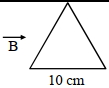
A coil in the shape of an equilateral triangle of side $10\, {cm}$ lies in a vertical plane between the pole pieces of permanent magnet producing a horizontal magnetic field $20\, {mT}$. The torque acting on the coil when a current of $0.2\, {A}$ is passed through it and its plane becomes parallel to the magnetic field will be $\sqrt{{x}} \times 10^{-5} \,{Nm}$. The value of ${x}$ is ..... .
Answer$\vec{\tau}=\vec{M} \times \vec{B}=M B \sin 90^{\circ}$
$=M B=\frac{i \sqrt{3} \ell^{2}}{4} B$
$=\sqrt{3} \times 10^{-5} {N}-{m}$
View full question & answer→MCQ 421 Mark
A charge $Q$ is moving $\overrightarrow{dl}$ distance in the magnetic field $\overrightarrow{ B }$. Find the value of work done by $\overrightarrow{ B }$.
AnswerSince force on a point charge by magnetic field is always perpendicular to $\overrightarrow{ v }[\overrightarrow{ F }= q \overrightarrow{ V } \times \overrightarrow{ B }]$
$\therefore$ Work by magnetic force on the point charge is zero.
View full question & answer→MCQ 431 Mark
A circuit to verify $Ohm's$ law uses ammeter and voltmeter in series or parallel connected correctly to the resistor. In the circuit
- A
ammeter is always connected series and voltmeter in parallel.
- B
Both, ammeter and voltmeter mast be connected in series.
- C
Both ammeter and voltmeter must be connected in parallel.
- D
ammeter is always used in parallel and voltmeter is series.
AnswerConceptual
Option $(1)$ is correct
Ammeter :- In series connection, the same current flows through all the components. It aims at measuring the curent flowing through the circuit and hence, it is connected in series.
Voltmeter :- A voltmeter measures voltage change between two points in a circuit, So we have to place the voltmeter in parallal with the circuit component.
View full question & answer→MCQ 441 Mark
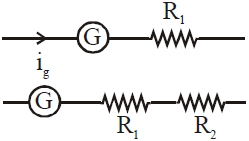
A galvanometer of resistance $G$ is converted into a voltmeter of range $0-1\, V$ by connecting a resistance $R _{1}$ in series with it. The additional resistance that should be connected in series with $R _{1}$ to increase the range of the voltmeter to $0-2\, V$ will be
- A
$R_{1}$
- B
$R_{1}+G$
- C
$R_{1}-G$
- D
$G$
Answer$\Rightarrow 1=i_{g}\left(G+R_{1}\right) \quad \ldots(1)$
$\Rightarrow 2= i _{ g }\left( R _{1}+ R _{2}+ G \right)$$...(2)$
$(1)/(2)$
$\Rightarrow \frac{1}{2}=\frac{G+R_{1}}{G+R_{1}+R_{2}}$
$G + R _{1}+ R _{2}=2 G +2 h _{1}$
$\left( R _{2}= G + R _{1}\right)$
View full question & answer→MCQ 451 Mark
A galvanometer is used in laboratory for the null point in electrical experiments. If, on passing a current of $6 \,m A$ it produces a deflection of $2^{\circ},$ its figure of merit is close to :
AnswerFigure of Merit $= C =\frac{ i }{\theta}$
$= C =\frac{6 \times 10^{-3}}{2}=3 \times 10^{-3} Am ^{2}$
View full question & answer→MCQ 461 Mark
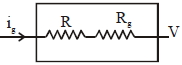
A galvanometer having a coil resistance $100 \;\Omega$ gives a full scale deflection when a current of $1 \;\mathrm{mA}$ is passed through it. What is the value of the resistance which can convert this galvanometer into a voltmeter giving full scale deflection for a potential difference of $10\; \mathrm{V} ?$......$k\Omega$
Answer$\mathrm{i}_{\mathrm{g}}=1 \mathrm{mA}, \mathrm{R}_{\mathrm{g}}=100 \Omega$
$\mathrm{V}=\mathrm{i}_{\mathrm{g}}\left(\mathrm{R}+\mathrm{R}_{\mathrm{g}}\right)$
$10=1 \times 10^{-3}(\mathrm{R}+100)$
$\mathrm{R}=9.9 \mathrm{k} \Omega$
View full question & answer→MCQ 471 Mark
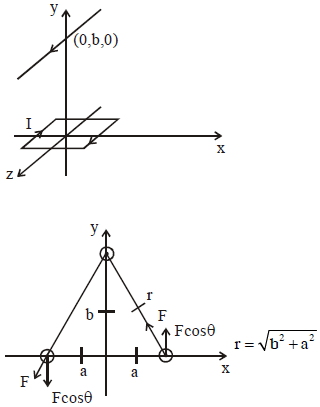
A square loop of side $2a$ and carrying current I is kept in $xz$ plane with its centre at origin. A long wire carrying the same current I is placed parallel to $z-$axis and passing through point $(0, b , 0),( b >> a ) .$ The magnitude of torque on the loop about $z-$ax is will be
- A
$\frac{2 \mu_{0} I^{2} a^{2} b}{\pi\left(a^{2}+b^{2}\right)}$
- B
$\frac{\mu_{0} I^{2} a^{2} b}{2 \pi\left(a^{2}+b^{2}\right)}$
- C
$\frac{\mu_{0} I^{2} a^{2}}{2 \pi b}$
- D
$\frac{2 \mu_{0} I^{2} a^{2}}{\pi b}$
Answer$F = BI 2 a =\frac{\mu_{0} I }{2 \pi r } I \times 2 a$
$F =\frac{\mu_{0} I ^{2} a }{\pi \sqrt{ b ^{2}+ a ^{2}}}$
$\tau= F \cos \theta \times 2 a$
$=\frac{\mu_{0} I^{2} a}{\pi \sqrt{b^{2}+a^{2}}} \times \frac{b}{\sqrt{b^{2}+a^{2}}} \times 2 a$
$\tau=\frac{2 \mu_{0} I^{2} a^{2} b}{\pi\left(a^{2}+b^{2}\right)}$
If $b \gg a$ then $\tau=\frac{2 \mu_{0} I ^{2} a ^{2}}{\pi b }$
But among the given options $(1)$ is most appropriate
View full question & answer→MCQ 481 Mark
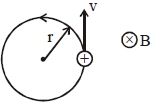
A charged particle going around in a circle can be considered to be a current loop. A particle of mass $m$ carrying charge $q$ is moving in a plane with speed $v$ under the influence of magnetic field $\overrightarrow{ B }$. The magnetic moment of this moving particle
- A
$-\frac{ mv ^{2} \overrightarrow{ B }}{ B ^{2}}$
- B
$-\frac{m v^{2} \vec{B}}{2 \pi B^{2}}$
- C
$\frac{m v^{2} \vec{B}}{2 B^{2}}$
- D
$-\frac{m v^{2} \vec{B}}{2 B^{2}}$
AnswerMagnetic moment
$M=i A$
$M=\left(\frac{q}{T}\right) \times \pi r^{2}=\frac{q \pi r^{2}}{\left(\frac{2 \pi r}{v}\right)}=\frac{q v r}{2}$
$M=\frac{q v}{2} \times \frac{v m}{q B}$
$M =\frac{ mv ^{2}}{2 B }$
As we can see from the figure, direction of magnetic moment $(M)$ is opposite to magnetic field.
$\overrightarrow{ M }=-\frac{ mv ^{2}}{2 B } \hat{ B }$
$=-\frac{m v^{2}}{2 B^{2}} \vec{B}$
View full question & answer→MCQ 491 Mark
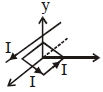
A square loop of side $2\, a ,$ and carrying current I, is kept in $XZ$ plane with its centre at origin. A long wire carrying the same current $I$ is placed parallel to the $z-$axis and passing through the point $(0, b, 0),(b>>a)$. The magnitude of the torque on the loop about $z-$axis is given by:
- A
$\frac{2 \mu_{0} I^{2} a^{2}}{\pi b}$
- B
$\frac{\mu_{0} I^{2} a^{3}}{2 \pi b^{2}}$
- C
$\frac{\mu_{0} I^{2} a^{2}}{2 \pi b}$Z
- D
$\frac{2 \mu_{0} I^{2} a^{3}}{\pi b^{2}}$
Answer$\overrightarrow{\tau}=\overrightarrow{ M } \times \overrightarrow{ B }$
$=4 a ^{2} I \times \frac{\mu_{0} I }{2 \pi b }$
View full question & answer→MCQ 501 Mark
A circular coil has moment of inertia $0.8 \,kg m ^{2}$ around any diameter and is carrying current to roduce a magnetic moment of $20\, Am ^{2}$. The coil is kept initially in a vertical position and it can rotate freely around a horizontal diameter. When a uniform magnetic field of $4\, T$ is applied along the vertical, it starts rotating around its horizontal diameter. The angular speed the coil acquires after rotating by $60^{\circ}$ will be
- A
$10\, rad \,s ^{-1}$
- B
$20\, \pi \operatorname{rad}\, s^{-1}$
- C
$10\, \pi\, rad\, s ^{-1}$
- D
$20\, rad\, s ^{-1}$
Answer$I _{ dia }=0.8 kg / m ^{2}$
$M =20 Am ^{2}$
$U _{ i }+ K _{ i }= U _{ f }+ K _{ f }$
$0+0=- MB \cos 30^{\circ}+\frac{1}{2} I \omega^{2}$
$20 \times 4 \times \frac{\sqrt{3}}{2}=\frac{1}{2}(0.8) \omega^{2}$
$\omega=\sqrt{100 \sqrt{3}}=10(3)^{1 / 4}$
View full question & answer→