MCQ
A uniformly charged dielectric ring rotating with constant angular velocity $'\omega '$ about its geometrical axis then it produces
  • A
    electrostatic field
  • B
    magnetic field
  • C
    magnetic moment
  • all of these

Answer

Correct option: D.
all of these
d

Need a full question paper?

Generate a complete, print-ready paper with questions like this in minutes — across 16+ boards, with answer keys.
Start Generating Free

Similar questions

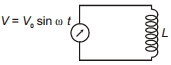
There is no resistance in the inductive circuit. Kirchhoff 's voltage law for the circuit is
The electric field in a region of space is given by, $\overrightarrow E  = {E_0}\hat i + 2{E_0}\hat j$ where $E_0\, = 100\, N/C$. The flux of the field through a circular surface of radius $0.02\, m$ parallel to the $Y-Z$ plane is nearly
A charge of 10 e.s.u. is placed at a distance of 2 cm from a charge of 40 e.s.u. and 4 cm from another charge of 20 e.s.u. The potential energy of the charge 10 e.s.u. is (in ergs)
An atom of nuclean change q is placed on a line. There particles A$($mass $= m$, change $= q), B($mass $= 2$, change $=q)$ and $C($mass $= 3m$, change $= 3q)$ are shot towards the atom, a distance $r$ away from the line and parallel to it. The particle that would be deflected the most would be?
If in nature there may not be an element for which the principal quantum number $n > 4,$ then the total possible number of elements will be
When wavelength of incident photon is decreased then
An open organ pipe of length L vibrates in its fundamental mode. The pressure variation is maximum.
The sun subtends an angle of $(1/2)^o$ at the surface of the earth. A converging lens of focal length $100\, cm$ is used to obtain an image of the sun on a screen. The diameter of the image formed is about.....$mm$
In which of the following, emission of electrons does not take place?
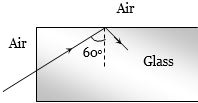
A light ray from air is incident (as shown in figure) at one end of a glass fiber (refractive index $\mu = 1.5$) making an incidence angle of $60^o$ on the lateral surface, so that it undergoes a total internal reflection. How much time would it take to traverse the straight fiber of length $1 km$