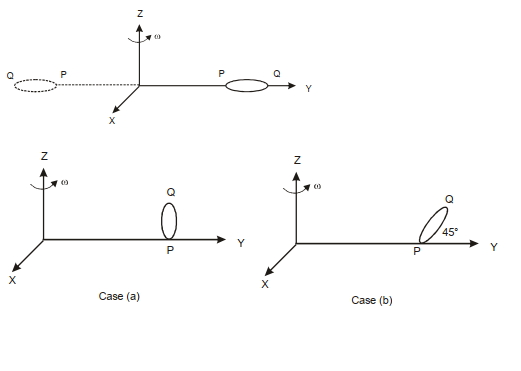
The general motion of a rigid body can be considered to be a combination of $(i)$ a motioon --- centre of mass about an axis, and $(ii)$ its motion about an instantanneous axis passing through center of mass. These axes need not be stationary. Consider, for example, a thin uniform welded (rigidly fixed) horizontally at its rim to a massless stick, as shown in the figure. Where disc-stick system is rotated about the origin ona horizontal frictionless plane with angular sp--- $\omega$, the motion at any instant can be taken as a combination of $(i)$ a rotation of the centre of mass the disc about the $z$-axis, and $(ii)$ a rotation of the disc through an instantaneous vertical axis pass through its centre of mass (as is seen from the changed orientation of points $P$ and $Q$). Both the motions have the same angular speed $\omega$ in the case. $Image$ Now consider two similar systems as shown in the figure: case $(a)$ the disc with its face ver--- and parallel to $x - z$ plane; Case $(b)$ the disc with its face making an angle of $45^{\circ}$ with $x$-y plane its horizontal diameter parallel to $x$-axis. In both the cases, the disc is weleded at point $P$, and systems are rotated with constant angular speed $\omega$ about the $z$-axis.$Image$
$1.$ Which of the following statement regarding the angular speed about the istantaneous axis (passing through the centre of mass) is correct?
$(A)$ It is $\sqrt{2} \omega$ for boht the cases
$(B)$ it is $\omega$ for case $(a)$; and $\frac{w}{\sqrt{2}}$ for case $(b)$.
$(C)$ It is $\omega$ for case $(a)$; and $\sqrt{2} \omega$ for case $(b)$.
$(D)$ It is $\omega$ for both the cases
$2.$ Which of the following statements about the instantaneous axis (passing through the centre of mass) is correct?
$(A)$ It is vertical for both the cases $(a)$ and $(b)$.
$(B)$ It is verticle for case $(a)$; and is at $45^{\circ}$ to the $x-z$ plane and lies in the plane of the disc for case $(b)$
$(C)$ It is horizontal ofr case $(a)$; and is at $45^{\circ}$ to the $x - z$ plane and is normal to the plane of the disc for case $(b)$.
$(D)$ It is vertical of case $(a)$; and is at $45^{\circ}$ to the $x - z$ plane and is normal to the plane of the disc for case $(b)$.
Give the answer question $1$ and $2.$