Question
$(a).$ Using, Valence Bond Theory identify $A, B, C, D, E$ and $F$ in the following table:
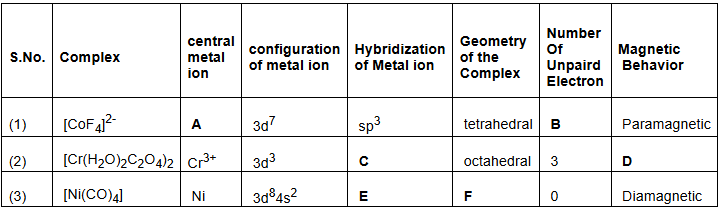
Image
$(b).$ Write the ionic equations for the reaction of acidified $K_2Cr_2O_7$ with
$(i) \ H_2S$ and $(ii) \ FeSO_4$

Answer

$(a).A = Co^{2+}$
$B = 3$
$C = d^2sp^3$
$D =$ Paramagnetic
$E = sp^3$
$F =$ tetrahedral
$(b). (i) \ Cr_2O_7^{2-} + 8 H^+ + 3 H_2S \rightarrow 2 Cr^{3+} + 3S + 7 H_2O$
$(ii) \ Cr_2O_7^{2-} + 14 H^+ 6 Fe^{2+} 2 Cr³^+ + 6 Fe^{3+} + 7 H_2O$

Need a full question paper?

Generate a complete, print-ready paper with questions like this in minutes — across 16+ boards, with answer keys.

Start Generating Free

Similar questions

What are the classification of proteins on the basis of molecular shape?
  1. Answer the following questions briefly:
  1. What are any two good sources of vitamin A?
  2. What are nucleotides?
  3. Give an example of simple lipids.
  1. How are carbohydrates classified?
  1. Account for the following:
  1. The acidic strength decreases in the order $HCl > H_2S > PH_3$.
  2. Tendency to form pentahalides decreases down the group in group $15$ of the periodic table.
  1. Complete the following chemical equations:
  1. $P_4+ SO_2Cl_2 \rightarrow $
  2. $XeF_2 + H_2O\rightarrow $
  3. $I_2 + HNO_3 \rightarrow $
(conc.)
  1. Identify the type of magnetism. What happens when these substances are heated?
  1. If the radius of the octahedral void is ‘r’ and radius of the atoms in close packing is ‘R’. What is the relation between ‘r’ and ‘R’?
  2. Tungsten crystallizes in body centred cubic unit cell. If the edge of the unit cell is 316.5pm. What is the radius of tungsten atom?
A voltaic cell is set up at $25°C$ with the followinng half-cell: $Al | Al^{3+} (0.001M)$ and $Ni | Ni^{2+} (0.50M)$ Calculate the cell voltage $\text{E}^{\circ}_{\text{Ni}^{2+}/\text{Ni}}\Big[=-0.25\text{V,E}^{\circ}_{\text{Al}^{3+}/\text{Al}}=-1.66\text{V}\Big]$
Match the items given in Column I with the type of solutions given in Column II.
 
Column I
 
Column II
i.
Soda water
a.
A solution of gas in solid.
ii.
Sugar solution
b.
A solution of gas in gas.
iii.
German silver
c.
A solution of solid in liquid.
iv.
Air
d.
A solution of solid in solid.
v.
Hydrogen gas in palladium
e.
A solution of gas in liquid.
 
 
f.
A solution of liquid in solid.
Match the complex ions given in Column I with the hybridisation and number of unpaired electrons given in Column II and assign the correct code:
 
Column I (Complex ion)
 
Column II (Hybridisation, number of unpaired electrons)
$a.$
$[Cr(H_2O)_6]^{3+}$
$1.$
$dsp^2, 1$
$b.$
$[Co(CN)_4]^{2-}$
$2.$
$sp^3d^2, 5$
$c.$
$[Ni(NH_3)_6]^{2+}$
$3.$
$d^2sp^3, 3$
$d.$
$[MnF_6]^{4-}$
$4.$
$sp^3, 4$
 
 
$5.$
$sp^3d^2, 2$
Code:
  1. $A (3), B (1), C (5), D (2).$
  2. $A (4), B (3), C (2), D (1).$
  3. $A (3), B (2), C (4), D (1).$
  4. $A (4), B (1), C (2), D (3).$
Explain the collision principle of any chemical reaction.
(a) Differentiate between
a. Nucleotide and Nucleoside
b. Amylose and Amylopectin
(b) Write a reaction which shows that all the carbon atoms in glucose are linked in a straight chain.
(c) Write two differences between DNA and RNA.
(d) Amino acids can be classified as $\alpha-, \beta-, \gamma-, \delta-$ and so on depending upon the relative position of the amino group with respect to the carboxyl group. Which type of amino acids forms a polypeptide chain in proteins?
(e) What are any two good sources of vitamin A?
(f) What is anomeric carbon?
(g) What is the difference between a glycosidic linkage and a peptide linkage?
Match the items of Column I with items of Column II and assign the correct code:
 
Column I
 
Column II
(A)
Coloured bands
(1)
Zone refining
(B)
LImpure matal to volatie complex
(2)
Fractional distillation
(C)
Purification of Ge and Si
(3)
Mond process
(D)
Purification of mercury
(4)
Chromatophy
 
 
(5)
Liquation
  1. A (1) B (2) C (4) D (5)
  2. A (4) B (3) C (1) D (2)
  3. A (3) B (4) C (2) D (1)
  4. A (5) B (4) C (3) D (2)