Question
A vector $\overrightarrow{ A }$ points vertically upward and $\overrightarrow{ B }$ points towards north. The vector product $\overrightarrow{ A } \times \overrightarrow{ B }$ is

Answer

Here $z$-axis is vertically upward means normal to plane of paper as shown in figure.

Thus, $\vec{A}=A \hat{k}$ and $\vec{B}=B \hat{j}$

So, $\overrightarrow{ A } \times \overrightarrow{ B }= A \hat{ k } \times \overrightarrow{ Bj }=- AB \hat{ i }$

Thus, it is along negative $x$-axis means along west.

Need a full question paper?

Generate a complete, print-ready paper with questions like this in minutes — across 16+ boards, with answer keys.
Start Generating Free

Similar questions

Fusion reaction takes place at high temperature because 
When a $_4B{e^9}$ atom is bombarded with $\alpha - $ particles, one of the product of nuclear transmutation is $_6{C^{12}}$. The other is
Magnitude of magnetic field (in $SI$ units) at the centre of a hexagonal shape coil of side $10\, cm$, $50$ turns and carrying current $I$ (Ampere) in units of $\frac{\mu_{0} I}{\pi}$ is
In a transistor the base is very lightly doped as compared to the emitter because by doing so
A $4 \,kg$ mass and a $1\, kg$ mass are moving with equal kinetic energies. The ratio of the magnitudes of their linear momenta is
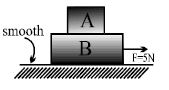
In the shown arrangement mass of $A = 1\,\,kg$  mass of  $B = 2\,\,kg.$  Coefficient of friction between $A $ and $B = 0.2.$  There is no friction between $B$  and ground. The frictional force exerted by $A$ on $B$ equals to
Hot water cools from $60\,^oC$ to $50\,^oC$ in the first $10\,minutes$ and to $42\,^oC$ in the next $10\,minutes.$ The temperature of the surroundings is ...... $^oC$
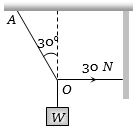
As shown in figure the tension in the horizontal cord is $30 \,N$. The weight $W$ and tension in the string $OA$  in Newton are
A wave travelling in the $+ve$ $x-$ direction having displacement along $y-$ direction as $1\,\, m,$ wavelength $2\pi\,\, m$ and frequency of $\frac{1}{\pi}$ $Hz$ is represented by
A hollow cone floats with its axis vertical upto one-third of its height in a liquid of relative density $0.8$ and with its vertex submerged. When another liquid of relative density $\rho$ is filled in it upto one-third of its height, the cone floats upto half its vertical height. The height of the cone is $0.10$ $m$ and the radius of the circular base is $0.05$ $m$. The specific gravity $\rho$ is given by