MCQ
A vector $\overrightarrow A $ points vertically upward and $\overrightarrow B $points towards north. The vector product $\overrightarrow A \times \overrightarrow B $ is
  • A
    Zero
  • Along west
  • C
    Along east
  • D
    Vertically downward

Answer

Correct option: B.
Along west
b
(b) Direction of vector $A$ is along $Z-a$axis $⇒$ $\vec A = a\hat k$

Direction of vector $B$ is towards north $⇒$ $\vec B = b\hat j$

Now $\vec A \times \vec B = a\hat k \times b\hat j = ab( - \hat j)$

$\therefore$ The direction is $\vec A \times \vec B$ is along west.

Need a full question paper?

Generate a complete, print-ready paper with questions like this in minutes — across 16+ boards, with answer keys.
Start Generating Free

Similar questions

If two identical mercury drops are combined to form a single drop, then its temperature will
A body is dropped from a satellite in parking orbit. Which of the following describes its behaviour correctly?
The equation of travelling wave is $y=a \sin 2 \pi\left(p t-\frac{x}{5}\right)$. Then the ratio of maximum particle velocity to wave velocity is ...........
Static friction between two surfaces
A steel wire can sustain $100\,kg$ weight without breaking. If the wire is cut into two equal parts, each part can sustain a weight of ......... $kg$
Two vectors $\overrightarrow{ A }$ and $\overrightarrow{ B }$ have equal magnitudes. If magnitude of $\overrightarrow{ A }+\overrightarrow{ B }$ is equal to two times the magnitude of $\overrightarrow{ A }-\overrightarrow{ B }$, then the angle between $\overrightarrow{ A }$ and $\overrightarrow{ B }$ will be .......................
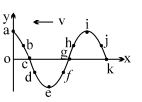
The figure represents the instantaneous picture of a longitudinal harmonic wave travelling along the negative $x$-axis. Identify the correct statement $(s)$ related to the movement of the points shown in the figure. The points moving in the direction of wave are
A ball is projected from the ground at an angle of $45^{\circ}$ with the horizontal surface. It reaches a maximum height of $120 m$ and returns to the ground. Upon hitting the ground for the first time, it loses half of its kinetic energy. Immediately after the bounce, the velocity of the ball makes an angle of $30^{\circ}$ with the horizontal surface. The maximum height it reaches after the bounce, in metres, is. . . . .
The frequency at which its kinetic energy change into potential energy is
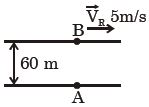
A man is crossing a river flowing with velocity of $5\, m/s$. He reaches a point directly across at a distance of $60\, m$ in $5\, sec$. His velocity in still water should be........$m/s$