MCQ
Static friction between two surfaces
  • Prevents the relative motion between them
  • B
    Opposite to the direction of motion of them
  • C
    Acts in opposite direction of applied force
  • D
    Both $(a)$ and $(b)$

Answer

Correct option: A.
Prevents the relative motion between them
a
(a)

Need a full question paper?

Generate a complete, print-ready paper with questions like this in minutes — across 16+ boards, with answer keys.
Start Generating Free

Similar questions

A pendulume clock loses $12\;s$ a day if the temperature is $40^oC$ and gains $4\;s$ a day if the temperature is $20^oC$. The temperature at which the clock will show correct time, and the coeffecient of linear expansion $(\alpha)$ of the metal of the pendulum shaft are respectively
If a particle takes $t$ second less and acquires a velocity of $v ms ^{-1}$ more in falling through the same distance on two planets, where the accelerations due to gravity are $2\,g$ and $8\,g$ respectively, then
A particle is revolving in a circle of radius $2\ m$ with angular velocity $\omega = t^2 -4t + 8\ rad/s$ . The time when speed of the particle becomes $8\ m/s$ is    ......... $\sec$
If a satellite of mass $400 \,kg$ revolves around the earth in an orbit with speed $200 \,m / s$ then its potential energy is .......... $MJ$
A thin uniform bar lies on a frictionless horizontal surface and is free to move in any way on the surface. Its mass is $0.300\, kg$ and length is $2 \,m$ . Two particles each of mass $0.100\, kg$ are moving on the same surface and towards the two ends of the bar in the direction perpendicular to the bar such that one with velocity $10\, m/s$ towards one end and the other with velocity $5\, m/s$ towards the other end. If collision between particles and bar is completely elastic and both particles strike with the bar simultaneously. The velocity of centre of mass of the bar after the collision is ...... $m/s$
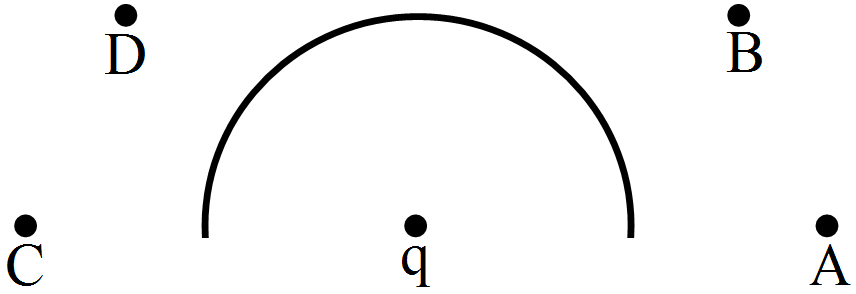
Figure shows a charge q placed at the centre of a hemisphere. A second charge Q is placed at one of the positions A, B, C and D. In which position(s) of this second charge, the flux of the electric field through the hemisphere remains unchanged?

  1. A
  2. B
  3. C
  4. D
The displacement of the wave given by equation $y ( x , t )= a \sin ( kx -\omega t +\phi)$, where $\phi=0$ at point x and $t =0$ is same as that at point
The product of the pressure and volume of an ideal gas is
Pressure exerted by a gas is found to be $50\, N/m^2$ , then the value of pressure in $CGS$ system is
The rate of radiation of energy from a hot object is maximum, if its surface is ...........