MCQ
A vector $\overrightarrow{\text{A}}$ points vertically upward and $\overrightarrow{\text{B}}$ points towards north. The vector product $\overrightarrow{\text{A}}\times\overrightarrow{\text{B}}$ is:
  • Along west.
  • B
    Along east.
  • C
    Zero.
  • D
    Vertically downward.

Answer

Correct option: A.
Along west.
Explanation:

The vector product $\overrightarrow{\text{A}}\times\overrightarrow{\text{B}}$ will point towards the west. We can determine this direction using the right hand thumb rule.

Need a full question paper?

Generate a complete, print-ready paper with questions like this in minutes — across 16+ boards, with answer keys.

Start Generating Free

Similar questions

What is the study of electric charges in motion called?
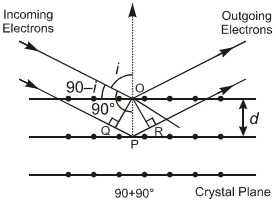
Wave property of electrons implies that they will show diffraction effects. Davisson and Germer demonstrated this by diffracting electrons from crystals. The law governing the diffraction from a crystal is obtained by requiring that electron waves reflected from the planes of atoms in a crystal interfere constructively (see figure).
Electromagnetic waves are transverse in nature is evident by.
In double slit experiment, the wavelength $\lambda $ of the light source $400\ nm$ , the slit seperation $d$ is $20\ \mu m$ and the individual slit width a is $4\ \mu m$ . Consider the interference of the light from the two slits and also the diffraction of light through each slit. Find number bright interference fringes are within the central peak of diffraction envelope
A parallel plate air-core capacitor is connected across a source of constant potential difference. When a dielectric plate is introduced between the two plates then :
If the electric potential at any point $(x, y, z) \,m$ in space is given by $V =3 x ^{2}$ volt. The electric field at the point $(1,0,3) \,m$ will be ............
Unpolarised red light is incident on the surface of a lake at incident angle $\theta_{R}$. An observer seeing the light reflected from the water surface through a polariser notices that on rotating the polariser, the intensity of light drops to zero at a certain orientation. The red light is replaced by unpolarised blue light. The observer sees the same effect with reflected blue light at incident angle $\theta_{B}$. Then,
Two parallel infinite line charges with linear charge densities $+\lambda\; \mathrm{C} / \mathrm{m}$ and $-\lambda\; \mathrm{C} / \mathrm{m}$ are placed at a distance of $2 \mathrm{R}$ in free space. What is the electric field mid-way between the two line charges?
A $5\;ampere$ fuse wire can withstand a maximum power of $1\; watt$ in the circuit. The resistance of the fuse wire is
In a step up transformer, if ratio of turns of primary to secondary is $1 : 10$ and primary voltage is $230 \,V$. If the load current is $2\,A$, then the current in primary is.......$A$