MCQ
A parallel plate air-core capacitor is connected across a source of constant potential difference. When a dielectric plate is introduced between the two plates then :
  • A
    some charge from the capacitor will flow back into the source.
  • B
    some extra charge from the source will flow back into the capacitor.
  • C
    the electric field intensity between the two plate does not change.
  • $B$ and $C$ both

Answer

Correct option: D.
$B$ and $C$ both
d
$\underset{\text { same }}{\mathrm{V}}=\underset{\text { same }}{\mathrm{E}}$ $d$ $,$ so $\mathrm{E}=$ same

Need a full question paper?

Generate a complete, print-ready paper with questions like this in minutes — across 16+ boards, with answer keys.

Start Generating Free

Similar questions

$^{22}$Ne nucleus, after absorbing energy, decays into two $\alpha-$particles and an unknown nucleus. The unknown nucleus is:
Total internal reflection of light is possible when light enters from
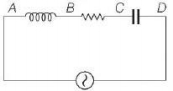
An $AC$ voltmeter connected between points $A$ and $B$ in the circuit below reads $36 \,V$. If it is connected between $A$ and $C$, the reading is $39 \,V$. The reading when it is connected between $B$ and $D$ is $25 \,V$. the voltmeter read when it is connected between $A$ and $D$ are ...........$V$ (Assume that, the voltmeter reads true rms voltage values and that the source generates a pure $AC$ )
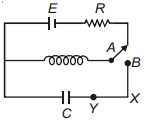
Switch is in position $A$ for long time. At time $t=0$ it is shifted to position $B$. Find the maximum charge that will accumulate on capacitor
If a dielectric introduced between the plates of a parallel plate condenser, then which of the following is possible:
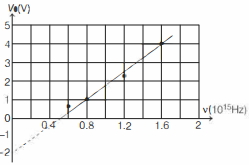
In a photocell circuit the stopping potential $V_0$ is a measure of the maximum kinetic energy of the photoelectrons. The following graph shows experimentally measured values of stopping potential versus frequency $v$ of incident light. The values of Planck's constant and the work function as determined from the graph are (taking, the magnitude of electronic charge to be $e=1.6 \times 10^{-19} C$ )
Three specimens $\text{A, B, C}$ of same radioactive element has activities $1$ microcurie, $1$ rutherford and $1$ becquerel respectively. Which specimen has maximum mass?
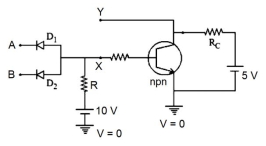
In the following circuit, the correct relation between output $( Y )$ and inputs $A$ and $B$ will be
Find the maximum magnitude of the linear momentum of a photoelectron emitted when light of wave length $400\, nm$ falls on a metal having work function $2.5\, eV$
A current of $5\, A$ passes through a copper conductor (resistivity $= 1.7\times10^{-8}\,\Omega \,m$) of radius of cross-section $5\, mm$. Find the mobility of the charges if their drift velocity is $1.1\times10^{-3}\, m/s$ ................ $m^2/Vs$