MCQ
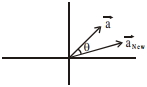
A vector $\vec a$ has components $3 p$ and $1$ with respect to a rectangular cartesian system. This system is rotated through a certain angle about the origin in the counter clockwise sense. If, with respect to new system, $\overrightarrow{\text { a }}$ has components $p +1$ and $\sqrt{10},$ then a value of $p$ is equal to
  • A
    $1$
  • B
    $-\frac{5}{4}$
  • C
    $\frac{4}{5}$
  • $-1$

Answer

Correct option: D.
$-1$
d
$\overrightarrow{ a }_{ Old }=3 p \hat{ i }+\hat{ j }$

$\overrightarrow{ a }_{ New }=( p +1) \hat{ i }+\sqrt{10} \hat{ j }$

$\Rightarrow\left|\overrightarrow{ a }_{ Od }\right|=\left|\overrightarrow{ a }_{ New }\right|$

$\Rightarrow 9 p^{2}+1=p^{2}+2 p+1+10$

$8 p^{2}-2 p-10=0$

$4 p^{2}-p-5=0$

$(4 p-5)(p+1)=0 \rightarrow p=\frac{5}{4},-1$


Need a full question paper?

Generate a complete, print-ready paper with questions like this in minutes — across 16+ boards, with answer keys.

Start Generating Free

Similar questions

If $\sin 6\theta = 32{\cos ^5}\theta \sin \theta - 32{\cos ^3}\theta \sin \theta + 3x,$ then $x = $
If $1,\,\omega ,\,{\omega ^2}$ are the roots of unity, then ${(1 - 2\omega + {\omega ^2})^6}$ is equal to
The urns $A, B$ and $C$ contain $4$ red, $6$ black;$5$ red,$5$ black and $\lambda$ red,$4$ black balls respectively. One of the urns is selected at random and a ball is drawn. If the ball drawn is red and the probability that it is drawn from urn $C$ is $0.4$ then the square of the length of the side of the largest equilateral triangle, inscribed in the parabola $y^2=\lambda x$ with one vertex at the vertex of the parabola is
If $M.D.$ is $12$, the value of $S.D.$ will be
A circle in inscribed in an equilateral triangle of side of length $12.$ If the area and perimeter of any square inscribed in this circle are $m$ and $n,$ respectively, then $m + n^2$ is equal to
If $\tan \left( {\frac{\pi }{4} + \theta } \right) + \tan \left( {\frac{\pi }{4} - \theta } \right) = \lambda \sec 2\theta ,$ $\lambda$ =
Let $\mathrm{P}$ be a point on the hyperbola $\mathrm{H}: \frac{\mathrm{x}^2}{9}-\frac{\mathrm{y}^2}{4}=1$, in the first quadrant such that the area of triangle formed by $\mathrm{P}$ and the two foci of $\mathrm{H}$ is $2 \sqrt{13}$. Then, the square of the distance of $\mathrm{P}$ from the origin is
The function, $f(x)=(3 x-7) x^{2 / 3}, x \in R,$ is increasing for all $x$ lying in
If the sum of the first $20$ terms of the series

$\log _{\left(7^{\frac{1}{2}}\right)} x+\log _{\left(7^{\frac{1}{3}}\right)} x+\log _{\left(7^{\frac{1}{4}}\right)} x+\ldots$ is $460,$ then $x$ is equal to

The tangent at $P$, any point on the circle ${x^2} + {y^2} = 4$, meets the coordinate axes in $A$ and $B$, then