MCQ
The function, $f(x)=(3 x-7) x^{2 / 3}, x \in R,$ is increasing for all $x$ lying in
  • A
    $(-\infty, 0) \cup\left(\frac{3}{7}, \infty\right)$
  • $(-\infty, 0) \cup\left(\frac{14}{15}, \infty\right)$
  • C
    $\left(-\infty, \frac{14}{15}\right)$
  • D
    $\left(-\infty,-\frac{14}{15}\right) \cup(0, \infty)$
Answer

Correct option: B.
$(-\infty, 0) \cup\left(\frac{14}{15}, \infty\right)$
b
$f(x)=(3 x-7) x^{2 / 3}$

$\Rightarrow \quad f(x)=3 x^{5 / 3}-7 x^{2 / 3}$

$\Rightarrow \quad f^{\prime}(x)=5 x^{2 / 3}-\frac{14}{3 x^{1 / 3}}$

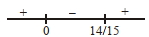
$=\frac{15 x-14}{3 x^{1 / 3}}>0$

$\therefore \quad f ^{\prime}( x )>0 \forall x \in(-\infty, 0) \cup\left(\frac{14}{15}, \infty\right)$

Need a full question paper?

Generate a complete, print-ready paper with questions like this in minutes — across 16+ boards, with answer keys.

Start Generating Free

Similar questions

${x^2} = xy$ is a relation which is
An anti-aircraft gun take a maximum of four shots at an enemy plane moving away from it. The probability of hitting the plane at the first, second, third and fourth shot are $0.4, 0.3, 0.2$ and $0.1$ respectively. The probability that the gun hits the plane is
The coefficients of three successive terms in the expansion of ${(1 + x)^n}$ are $165, 330$ and $462$ respectively, then the value of n will be
An ellipse inscribed in a semi-circle touches the circular arc at two distinct points and also touches the bounding diameter. Its major axis is parallel to the bounding diameter. When the ellipse has the maximum possible area, its eccentricity is
Let $R$ be a rectangle, $C$ be a circle, and $T$ be a triangle in the plane. The maximum possible number of points common to the perimeters of $R, C$ and $T$ is
The solution of the differential equation $\frac{{dy}}{{dx}} + \frac{{1 + {x^2}}}{x} = 0$ is
If $\int\limits_0^{\frac{\pi }{3}} {\frac{{\tan \,\,\theta }}{{\sqrt {2k\,\sec \,\theta } }}} \,d\theta \, = \,1 - \frac{1}{{\sqrt 2 }},(k > 0),$ then the value of $k$ is
If the ratio of the roots of ${x^2} + bx + c = 0$ and ${x^2} + qx + r = 0$ be the same, then
If $\left| {\begin{array}{*{20}{c}}{x - 4}&{2x}&{2x}\\{2x}&{x - 4}&{2x}\\{2x}&{2x}&{x - 4}\end{array}} \right| = \left( {A + Bx} \right){\left( {x - A} \right)^2},$ then the ordered pair $\left( {A,B} \right) = $. . . . .
If $a$ and $b$ are chosen randomly from set $\{1,2 ,3,4,5,6\}$ with replacement. Then probability that $\mathop {\lim }\limits_{x \to 0} {\left( {\frac{{{a^x} + {b^x}}}{2}} \right)^{\frac{2}{x}}}=6$ is