MCQ
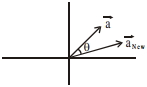
A vector $\vec a$ has components $3 p$ and $1$ with respect to a rectangular cartesian system. This system is rotated through a certain angle about the origin in the counter clockwise sense. If, with respect to new system, $\overrightarrow{\text { a }}$ has components $p +1$ and $\sqrt{10},$ then a value of $p$ is equal to
  • A
    $1$
  • B
    $-\frac{5}{4}$
  • C
    $\frac{4}{5}$
  • $-1$

Answer

Correct option: D.
$-1$
d
$\overrightarrow{ a }_{ Old }=3 p \hat{ i }+\hat{ j }$

$\overrightarrow{ a }_{ New }=( p +1) \hat{ i }+\sqrt{10} \hat{ j }$

$\Rightarrow\left|\overrightarrow{ a }_{ Od }\right|=\left|\overrightarrow{ a }_{ New }\right|$

$\Rightarrow 9 p^{2}+1=p^{2}+2 p+1+10$

$8 p^{2}-2 p-10=0$

$4 p^{2}-p-5=0$

$(4 p-5)(p+1)=0 \rightarrow p=\frac{5}{4},-1$


Need a full question paper?

Generate a complete, print-ready paper with questions like this in minutes — across 16+ boards, with answer keys.

Start Generating Free

Similar questions

The centre of the circle $x^2+ y^2+ 10x - 20y + 100 = 0$ is:
The coordinates of the foot of the perpendicular drawn from the point P(3, 4, 5) on the yz- plane are
Co-efficient of $\alpha ^t$ in the expansion of,

$(\alpha + p)^{m - 1} + (\alpha + p)^{m - 2} (\alpha + q) + (\alpha + p)^{m - 3} (\alpha + q)^2 + ...... (\alpha + q)^{m - 1}$

where $\alpha \ne - q$ and $p \ne q$ is :

R is a relation from {11, 12, 13} to {8, 10, 12} defined by y = x - 3. Then, $R^{-1}$ is:
If ${a^x} = bc,{b^y} = ca,\,{c^z} = ab,$ then $xyz$=
Consider $4$ boxes, where each box contains $3$ red balls and $2$ blue balls. Assume that all $20$ balls are distinct. In how many different ways can $10$ balls be chosen from these $4$ boxes so that from each box at least one red ball and one blue ball are chosen?
The equation of the incircle formed by the coordinate axes and the line 4x + 3y = 6 is:
 
The line $x - y + 2 = 0$ touches the parabola ${y^2} = 8x$ at the point
Let $\alpha, \beta \in \mathrm{N}$ be roots of equation $\mathrm{x}^2-70 \mathrm{x}+\lambda=0$, where $\frac{\lambda}{2}, \frac{\lambda}{3} \notin \mathrm{N}$. If $\lambda$ assumes the minimum possible value, then $\frac{(\sqrt{\alpha-1}+\sqrt{\beta-1})(\lambda+35)}{|\alpha-\beta|}$ is equal to :
$ABC$ is an isosceles triangle inscribed in a circle of radius $r$ . If $AB = AC $ $\& h$ is the altitude from $A$ to $BC$ and $P$ be the perimeter of $ABC$ then $\mathop {lim}\limits_{h \to 0} $ $\frac{\Delta }{{{P^3}}}$ equals (where $\Delta$ is the area of the triangle)