MCQ 11 Mark
The points $P$ is equidistant from $A(1,3), \,B (-3,5)$ and $C(5,-1)$. Then $PA =$
- A
$5$
- B
$5\sqrt 5 $
- C
$25$
- ✓
$5\sqrt {10} $
AnswerCorrect option: D. $5\sqrt {10} $
d
(d) Perpendicular bisector of $A\,(1,\,\,3)$ and $B\,( - 3,\,\,5)$ is $2x({x_1} - {x_2}) + 2y\,({y_1} - {y_2}) = (x_1^2 + y_1^2) - (x_2^2 + y_2^2)$
$ \Rightarrow \,\,2x(1 + 3) + 2y(3 - 5) = (1 + 9) - (9 + 25)$
$ \Rightarrow \,\,2x - y + 6 = 0$ .....$(i)$
Perpendicular bisector of $A\,(1,\,\,3)$ and $C\,(5,\,\, - 1)$ is
$2x\,(1 - 5) + 2y(3 + 1) = (1 + 9) - (25 + 1)$
$ \Rightarrow \,\,x - y - 2 = 0$ .....$(ii)$
Point of intersection of $(i)$ and $(ii)$ is $P = ( - 8,\,\, - 10)$
Then $PA = \sqrt {{{(1 + 8)}^2} + {{(3 + 10)}^2}} = \sqrt {81 + 169} $
$ = \sqrt {250} = 5\sqrt {10} $.
View full question & answer→MCQ 21 Mark
The points which trisect the line segment joining the points $(0, 0)$ and $(9, 12)$ are
- ✓
$(3,4),\, (6,8)$
- B
$(4,3),\, (6,8)$
- C
$(4,3),\, (8,6)$
- D
$(3,4),\, (8,6)$
AnswerCorrect option: A. $(3,4),\, (6,8)$
a
(a) Let the point be $(x, y)$
$(i)$ Point $B \,(x, y)$ divides $AD$ in $1 : 2$
$\therefore \,\,\,\,x = \frac{{0 + 9}}{3} = 3$ and $y = \frac{{0 + 12}}{3} = 4$
$(ii)$ Now point $C \,(x, y)$ divides $AD$ in $2 : 1$,
Then $x = \frac{{0 + 18}}{3} = 6$ and $y = \frac{{0 + 24}}{3} = 8$.

View full question & answer→MCQ 31 Mark
The mid-points of sides of a triangle are $(2, 1), \,(-1, -3)$ and $(4,5)$. Then the coordinates of its vertices are
- ✓
$(7,\,9),\,( - 3,\, - 7),\,(1,\,1)$
- B
$( - 3,\, - 7),\,(1,\,1),\,(2,\,3)$
- C
$(1,\,1),\,(2,\,3),\,( - 5,\,8),$
- D
AnswerCorrect option: A. $(7,\,9),\,( - 3,\, - 7),\,(1,\,1)$
a
(a) $\frac{{{x_1} + {x_2}}}{2} = 2,\,\,\frac{{{x_2} + {x_3}}}{2} = - 1,\,\,\frac{{{x_3} + {x_1}}}{2} = 4$
${x_1} = 7,\,\,{x_2} = - 3,\,\,{x_3} = 1$
Similarly ${y_1},\,\,{y_2},\,\,{y_3}$ can be found.
View full question & answer→MCQ 41 Mark
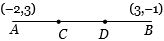
The coordinates of the join of trisection of the points $(-2, 3)$, $(3, -1)$ nearer to $(-2, 3)$, is
- ✓
$\left( { - \frac{1}{3},\,\frac{5}{3}} \right)$
- B
$\left( {\frac{4}{3},\frac{1}{3}} \right)$
- C
$\left( { - \frac{3}{4},\,2} \right)$
- D
$\left( {\frac{1}{3},\,\frac{5}{3}} \right)$
AnswerCorrect option: A. $\left( { - \frac{1}{3},\,\frac{5}{3}} \right)$
a
(a) $C$ divides the line in the ratio $1 : 2$,
so coordinates of $C$ will be $\left( { - \frac{1}{3},\,\frac{5}{3}} \right)$,
which is the required point.
View full question & answer→MCQ 51 Mark
The points of trisection of the line segment joining the points $(3, -2)$ and $(-3, -4)$ are
- A
$\left( {\frac{3}{2}, - \frac{5}{2}} \right)\,,\left( { - \frac{3}{2}, - \frac{{13}}{4}} \right)$
- B
$\left( { - \frac{3}{2},\frac{5}{2}} \right)\,,\left( {\frac{3}{2},\frac{{13}}{4}} \right)$
- ✓
$\left( {1, - \frac{8}{3}} \right)\,,\left( { - 1, - \frac{{10}}{3}} \right)$
- D
AnswerCorrect option: C. $\left( {1, - \frac{8}{3}} \right)\,,\left( { - 1, - \frac{{10}}{3}} \right)$
c
(c) Let $A(3,\, - 2)$,$B\,( - 3,\,\, - 4)$ and two points $C$ and $D$ are the trisection points of $AB$.
Obviously $C$ divides the line $AB$ in $1 : 2$, therefore coordinates of $C$ are
$\left( {\frac{{1( - 3) + 2(3)}}{{1 + 2}},\,\frac{{1( - 4) + 2( - 2)}}{{1 + 2}}} \right) = \left( {1,\,\, - \frac{8}{3}} \right)$.
Similarly $D$ divides the line $AB$ in $2 : 1$, hence coordinates of $D$ are
$\left( {\frac{{2( - 3) + 1(3)}}{{2 + 1}},\,\frac{{2( - 4) + 1( - 2)}}{{2 + 1}}} \right) = \left( { - 1,\,\, - \frac{{10}}{3}} \right)$.
View full question & answer→MCQ 61 Mark
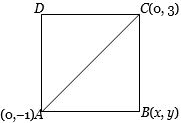
$(0, -1)$ and $(0, 3)$ are two opposite vertices of a square. The other two vertices are
- A
$(0, 1),\,(0, -3)$
- B
$(3, -1) \,(0, 0)$
- ✓
$(2, 1),\, (-2, 1)$
- D
$(2, 2), \,(1, 1)$
AnswerCorrect option: C. $(2, 1),\, (-2, 1)$
c
(c) Length of diagonal = $4$
Now, $A{C^2} = A{B^2} + B{C^2}$
$A{C^2} = 2A{B^2} \Rightarrow 8 = A{B^2}$
$AB = BC = 2\sqrt 2 $
Now, let $B\,(x,y)$; $\therefore A{B^2} = B{C^2}$
==>${(x - 0)^2} + {(y + 1)^2} = {(x - 0)^2} + {(y - 3)^2}$
${x^2} + {y^2} + 2y + 1 = {x^2} + {y^2} - 6y + 9$
==> $y = 1;\,\,\,\therefore {x^2} + {(2)^2} = 8; \Rightarrow {x^2} = 4 \Rightarrow x = \pm \,2$
$\therefore $ other vertices are $(2, 1)\,,(-2, 1)$.
View full question & answer→MCQ 71 Mark
The ratio in which point $(5, -2)$ divides the line segement joining points $(8, 4)$ and $(9, 6)$ is
- ✓
$3 : 4$ externally
- B
$7 : 9$ externally
- C
$3 : 4$ internally
- D
AnswerCorrect option: A. $3 : 4$ externally
View full question & answer→MCQ 81 Mark
The following points $A\, (2a,\, 4a),\, B(2a,\, 6a)$ and $C$ $(2a + \sqrt 3 a,\,5a)$, $(a > 0)$ are the vertices of
Answera
(a) $AB = \sqrt {{{(2a - 2a)}^2} + {{(4a - 6a)}^2}} = 2a$
$BC = \sqrt {{{(\sqrt 3 a)}^2} + {a^2}} = 2a$
$CA = \sqrt {{{(\sqrt 3 a)}^2} + {{( - a)}^2}} = 2a$
Since $AB = BC = CA,$ hence triangle is equilateral.
Therefore, it is an acute angled triangle.
View full question & answer→MCQ 91 Mark
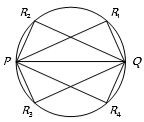
$P(3,1),\;Q(6,5)$ and $R(x,y)$ are three points such that the angle $PRQ$ is a right angle and the area of the $\Delta RPQ=5$, then the number of such points $R$ is
Answerd
(d) In the following figure, the four possible points are seen.
View full question & answer→MCQ 101 Mark
Circumcenter of the triangle formed by the line $y = x,\;\;y = 2x$ and $y = 3x + 4$ is
- A
$(6, 8)$
- ✓
$(6, -8)$
- C
$(3, 4)$
- D
$(-3, -4)$
AnswerCorrect option: B. $(6, -8)$
b
(b) ${x^2} + {y^2} = {(x + 4)^2} + {(y + 8)^2}\,\, \Rightarrow \,\,8x + 16y + 80 = 0$
and ${x^2} + {y^2} = {(x + 2)^2} + {(y + 2)^2}\,\, \Rightarrow \,\,4x + 4y + 8 = 0$
On simplification, we get $y = - 8$ and $x = 6$.
View full question & answer→MCQ 111 Mark
The incentre of the triangle formed by $(0, 0)$, $(5,12)$, $(16, 12)$ is
- ✓
$(7,9)$
- B
$(9,7)$
- C
$(-9, 7)$
- D
$(-7,9)$
AnswerCorrect option: A. $(7,9)$
a
(a) Obviously $a = 11,\,\,b = 20,\,\,c = 13.$
Hence incentre is
$\left( {\frac{{11 \times 0 + 20 \times 5 + 13 \times 16}}{{11 + 20 + 13}},\,\,\frac{{11 \times 0 + 20 \times 12 + 13 \times 12}}{{11 + 20 + 13}}} \right)$i.e. $(7, 9)$.
View full question & answer→MCQ 121 Mark
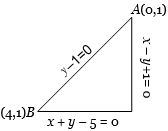
The equations of the sides of a triangle are $x + y - 5 = 0;\;$ $x - y + 1 = 0$ and $y - 1 = 0,$ then the coordinates of the circumcentre are
- ✓
$(2,1)$
- B
$(1,2)$
- C
$(2,-2)$
- D
$(1, -2)$
AnswerCorrect option: A. $(2,1)$
a
(a) Since the triangle is right angled so the circumcentre will be the middle point of hypotenuse i.e. $(2, 1)$.
View full question & answer→MCQ 131 Mark
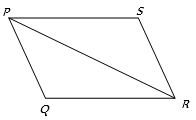
$P(2,1),\,Q(4, - 1),\,R(3,2)$ are the vertices of triangle and if through $P$ and $R$ lines parallel to opposite sides are drawn to intersect in $S$, then the area of $PQRS$ is
Answerb
(b) Since $PQRS$ is a parallelogram with an area which is twice the area of $\Delta PQR$.
Therefore, area $PQRS$ $ = 2.\frac{1}{2}\,\left| {\,\begin{array}{*{20}{c}}2&1&1\\4&{ - 1}&1\\3&2&1\end{array}\,} \right| = 4$.
View full question & answer→MCQ 141 Mark
If the points $(x + 1,\,2),\;(1,x + 2),\;\left( {\frac{1}{{x + 1}},\frac{2}{{x + 1}}} \right)$ are collinear, then x is
- A
$4$
- B
$0$
- C
$-4$
- ✓
$(b)$ and $(c)$ both
AnswerCorrect option: D. $(b)$ and $(c)$ both
d
(b) Let $A \equiv (x + 1,\,2),\,\,B \equiv (1,\,x + 2),\,\,C \equiv \left( {\frac{1}{{x + 1}},\,\,\frac{2}{{x + 1}}} \right)$
then $ A,\, B,\, C$ are collinear if area of $\Delta ABC = 0$
$ \Rightarrow \,\,\left| {\,\begin{array}{*{20}{c}}{x + 1}&2&1\\1&{x + 2}&1\\{\frac{1}{{x + 1}}}&{\frac{2}{{x + 1}}}&1\end{array}\,} \right| = 0$ $ \Rightarrow \,\,\left| {\,\begin{array}{*{20}{c}}x&{ - x}&0\\1&{x + 2}&1\\{\frac{1}{{x + 1}}}&{\frac{2}{{x + 1}}}&1\end{array}\,} \right| = 0$
$({R_1} \to {R_1} - {R_2})$
$ \Rightarrow \,\,\left| {\,\begin{array}{*{20}{c}}x&0&0\\1&{x + 3}&1\\{\frac{1}{{x + 1}}}&{\frac{3}{{x + 1}}}&1\end{array}\,} \right| = 0$ $({C_2} \to {C_2} + {C_1})$
$ \Rightarrow \,\,x\,\left( {x + 3 - \frac{3}{{x + 1}}} \right) = 0\,\, $
$\Rightarrow \,\,x({x^2} + 3 + 4x - 3) = 0$
$ \Rightarrow \,\,{x^2}(x + 4) = 0\,\, $
$\Rightarrow \,\,x = 0,\,\, - 4$.
View full question & answer→MCQ 151 Mark
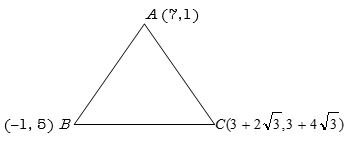
The incentre of a triangle with vertices $(7, 1) \,(-1, 5)$ and $(3 + 2\sqrt 3 ,\,3 + 4\sqrt 3 )$ is
- ✓
$\left( {3 + \frac{2}{{\sqrt 3 }},\,3 + \frac{4}{{\sqrt 3 }}} \right)$
- B
$\left( {1 + \frac{2}{{3\sqrt 3 }},\,1 + \frac{4}{{3\sqrt 3 }}} \right)$
- C
$(7, 1)$
- D
AnswerCorrect option: A. $\left( {3 + \frac{2}{{\sqrt 3 }},\,3 + \frac{4}{{\sqrt 3 }}} \right)$
a
(a) $AB=BC=CA=4 \sqrt 5$
i.e., given triangle is equilateral.
(In centre of a triangle are same as the centriod when triangle is equilateral)
.Hence, incentre = $\left( {\frac{{7 - 1 + 3 + 2\sqrt 3 }}{3},\frac{{1 + 5 + 3 + 4\sqrt 3 }}{3}} \right)$
$= \left( {3 + \frac{2}{{\sqrt 3 }},3 + \frac{4}{{\sqrt 3 }}} \right)$.
View full question & answer→MCQ 161 Mark
The orthocentre of the triangle with vertices $(-2, -6)$, $(-2, 4)$ and $(1, 3)$ is
- A
$(-3, 1)$
- B
$(-1,1/3)$
- ✓
$(1, 3)$
- D
AnswerCorrect option: C. $(1, 3)$
c
(c) Let $A( - 2, - 6),B( - 2,\,4)\,C(1,\,3)$ be the vertices of the triangle.
Slope of $BC = \frac{{3 - 4}}{{1 + 2}} = \frac{{ - 1}}{3}$
Slope of $ \bot $ to $BC = 3$
Equation of altitude through $A$ is
$y + 6 = 3(x + 2)$ ==> $y + 6 = 3x + 6$ ==> $y = 3x$ .....$(i)$
Slope of $CA = \frac{{3 + 6}}{{1 + 2}} = \frac{9}{3} = 3$
Slope of $ \bot $ to $CA = \frac{{ - 1}}{3}$
Equation of altitude through $B$ is
$y - 4 = \frac{{ - 1}}{3}(x + 2)$ ==> $3y - 12 = - x - 2$
==> $x + 3y - 10 = 0$ .....$(ii)$
Solving $(i)$ and $(ii)$ $x = 1,y = 3$
Hence, orthocentre $(1, 3).$
View full question & answer→MCQ 171 Mark
Orthocentre of the triangle whose vertices are $(0, 0) \,(3, 0)$ and $(0, 4)$ is
- ✓
$(0, 0)$
- B
$(1, 1)$
- C
$(2, 2)$
- D
$(3, 3)$
AnswerCorrect option: A. $(0, 0)$
a
(a) This is a right angled (at origin) triangle therefore orthocentre = $(0, 0).$
View full question & answer→MCQ 181 Mark
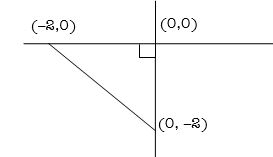
The circumcentre of a triangle formed by the line $xy + 2x + 2y + 4 = 0$ and $x + y + 2 = 0$ is
- ✓
$(-1, -1)$
- B
$(0, -1)$
- C
$(1, 1)$
- D
$(-1, 0)$
AnswerCorrect option: A. $(-1, -1)$
a
(a) $xy + 2x + 2y + 4 = 0$....$.(i)$
and $x + y + 2 = 0$.....$.(ii)$
from $(i)$ and $(ii)$, $xy = 0 \Rightarrow x = y = 0$
Vertices of triangle are $( - 2,0)\,\,(0,0)\,\,(0, - 2)$
(In a right angled triangle circumcentre is mid point of hypotenuse)
$( - 1, - 1)$ is the circumcircle.
View full question & answer→MCQ 191 Mark
If equation of three sides of a triangle are $x = 2,$ $y + 1 = 0$ and $x + 2y = 4$ then co-ordinates of circumcentre of this triangle are
- ✓
$(4, 0)$
- B
$(2, -1)$
- C
$(0, 4)$
- D
$ (-1, 2)$
AnswerCorrect option: A. $(4, 0)$
a
(a) Equations of three sides of a triangle are $x = 2,\,\,y + 1 = 0$and $x + 2y = 4$
Co-ordinates of point of intersection of the $x = 2$ and $y + 1 = 0$ is $(2, -1)$
Co-ordinates of point of intersection of $x = 2$ and $x + 2y = 4$ is $(2, 1)$
Co-ordinates of point of intersection of $y + 1 = 0$ and $x + 2y = 4$ is $(6, -1)$
Let Co-ordinates of circumcentre is $(x, y)$
${(x - 2)^2} + {(y + 1)^2} = {(x - 2)^2} + {(y - 1)^2}$
${(y + 1)^2} = {(y - 1)^2}$; ${y^2} + 2y + 1 = {y^2} - 2y + 1$
$4y = 0$, $y = 0$ and ${(x - 2)^2} + {(y - 1)^2} = {(x - 6)^2} + {(y + 1)^2}$
In this equation put $y = 0$
${(x - 2)^2} + {(0 - 1)^2} = {(x - 6)^2} + {(0 + 1)^2}$
${(x - 2)^2} + 1 = {(x - 6)^2} + 1$; ${(x - 2)^2} - {(x - 6)^2} = 0$
$(x - 2 + x - 6)(x - 2 - x + 6) = 0$
$4(2x - 8) = 0$==> $8(x - 4) = 0$; $x - 4 = 0$ ==> $x = 4$
Co-ordinates of circumcentre is $(4, 0)$.
View full question & answer→MCQ 201 Mark
The orthocentre of the triangle formed by $(0, 0),\, (8, 0), \,(4 6)$ is
AnswerCorrect option: A. $\left( {4,\,\frac{8}{3}} \right)$
a
(a) Let the vertices of the triangle be $O(0, 0)$ $A(8,0),$ $B(4,6)$. The equation of an altitude through $O$ and perpendicular to $AB$ is $y = \frac{2}{3}x$ and the equation of an altitude through $A(8,0)$ and perpendicular to $OB$ is $3y = - 2x + 16$. The two altitudes intersect at $\left( {4,\frac{8}{3}} \right)$.
View full question & answer→MCQ 211 Mark
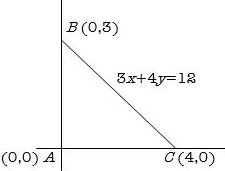
The incentre of triangle formed by the lines $x = 0,$ $y = 0$ and $3x + 4y = 12$ is
- A
$\left( {\frac{1}{2},\,\frac{1}{2}} \right)$
- ✓
$(1, 1)$
- C
$\left( {1,\,\frac{1}{2}} \right)$
- D
$\left( {\frac{{11}}{2},\,1} \right)$
AnswerCorrect option: B. $(1, 1)$
b
(b)Here $a = BC = 5,\,\,b = AC = 4,\,\,\,c = AB = 3$
Hence incentre is $\left( {\frac{{0 + 0 + 3 \times 4}}{{5 + 4 + 3}},\frac{{0 + 4 \times 3 + 0}}{{5 + 4 + 3}}} \right)$= $(1, 1)$.
View full question & answer→MCQ 221 Mark
Coordinates of the orthocentre of the triangle whose sides are $x = 3,\,y = 4$ and $3x + 4y = 6$ is
- A
$(0, 0)$
- B
$(3, 0)$
- C
$(0, 4)$
- ✓
$(3, 4)$
AnswerCorrect option: D. $(3, 4)$
d
(d) Obviously it is a right angled at $(3, 4)$. Hence the orthocentre is $(3, 4)$
View full question & answer→MCQ 231 Mark
If the vertices of a triangle be $(0,0)$, $(6,0)$ and $(6,8)$ then its incentre will be
- A
$(2,1)$
- B
$(1,2)$
- ✓
$(4,2)$
- D
$(2,4)$
AnswerCorrect option: C. $(4,2)$
c
(c) Let $A\,(0,\,\,0),\,\,B\,(6,\,\,0)$ and $C\,(6,\,8)$
Thus $c = AB = 6,\,\,a = BC = 8$ and $b = AC = 10$
Hence incentre
$ = \left( {\frac{{8 \times 0 + 10 \times 6 + 6 \times 6}}{{8 + 10 + 6}},\,\frac{{8 \times 0 + 10 \times 0 + 6 \times 8}}{{8 + 10 + 6}}} \right) = (4,\,\,2)$.
View full question & answer→MCQ 241 Mark
Area of the triangle formed by points $(102,-4), (105,-2)$ and $(103,-3)$ -
Answerc
Shift origin at $(102,-4)$
View full question & answer→MCQ 251 Mark
Number of values of $\lambda$ for which the points given by $(\lambda + 1, 1), (2\lambda +1, 3)$ $ \&$ $(2\lambda + 2, 2\lambda )$ are collinear, is-
Answerc
$A(2+1,1) \quad B(2 \lambda+1,3) \quad c(2 \lambda+2$
ase said to be cerlineas if Area $(\Delta A B C)=0$
$=\frac{S}{2}\left|\begin{array}{lll}2 & y & 1 \\ x_{2} & y_{2} & 1 \\ x_{3} & y_{3} & 1\end{array}\right|=0$
$\therefore \quad\left|\begin{array}{lll}\lambda+1 & 1 & 1 \\ 2 \lambda+1 & 3 & 1 \\ 2 \lambda+2 & 2 \lambda & 1\end{array}\right|=0$
$\Rightarrow(\dot{x}+1)(3-2 \lambda)-1(82+1-2 \lambda-2)$
$+1\left(4 x^{2}+2 x-6 x-6\right)=0$
$\Rightarrow 3 \lambda+3-2\left(\lambda^{2}-2 \lambda+1+4 x^{2}-4 \lambda-6=0\right.$
$\Rightarrow 2 \lambda^{2}-3 \lambda-2=0$
$\Rightarrow 2 \lambda^{2}-4 \lambda+\lambda-2=0$
a) $2 x(x-2)+1(x-2)=0$
$\Rightarrow \lambda=-1 / 2$ or 2
" polsible values of
$\lambda \operatorname{are} 2$
View full question & answer→MCQ 261 Mark
The mid points of three sides of a triangle are $(1,2)$; $(-1,1)$ and $(0,3)$. Area of this triangle will be (in sq. units)$^-$
Answerd
Area $ = 4 \times \frac{1}{2}|\left| {\begin{array}{*{20}{c}}
1&2&1\\
{ - 1}&1&1\\
0&3&1
\end{array}} \right|| = 6$
View full question & answer→MCQ 271 Mark
Without changing the direction of coordinate axes, origin is transferred to $(h,k)$, so that the linear (one degree) terms in the equation ${x^2} + {y^2} - 4x + 6y - 7$=$0$ are eliminated. Then the point $(h,k)$ is
- A
$(3, 2)$
- B
$(-3,2)$
- ✓
$(2, -3)$
- D
AnswerCorrect option: C. $(2, -3)$
c
(c) Putting $x = x' + h,\,\,y = y' + k,$ the given equation transforms to
${x'^2} + {y'^2} + x'(2h - 4) + y'(2k + 6) + {h^2} + {k^2} - 7 = 0$
To eliminate linear terms, we should have
$2h - 4 = 0,\,\,2k + 6 = 0\,\,\, \Rightarrow \,\,h = 2,\,\,k = - 3$
i.e., $(h,\,\,k) = (2,\,\, - 3)$.
View full question & answer→MCQ 281 Mark
The equation of the locus of a point whose distance from $(a, 0)$ is equal to its distance from y-axis, is
AnswerCorrect option: B. ${y^2} - 2ax + {a^2} = 0$
b
(b) Let the point be $(h,\,\,k),\,$
So,${(h - a)^2} + {(k - 0)^2} = {h^2}$$ \Rightarrow \,\,\,{h^2} + {a^2} - 2ah + {k^2} = {h^2}$
Hence locus is ${y^2} - 2ax + {a^2} = 0$.
View full question & answer→MCQ 291 Mark
Two points $A$ and $B$ have coordinates $(1, 0)$ and $(-1, 0)$ respectively and $Q$ is a point which satisfies the relation $AQ - BQ = $ $ \pm 1.$The locus of $Q$ is
AnswerCorrect option: B. $12{x^2} - 4{y^2} = 3$
b
(b) According to the given condition
$\sqrt {{{(x - 1)}^2} + {y^2}} - \sqrt {{{(x + 1)}^2} + {y^2}} = \pm 1$
On squaring both sides, we get
$2{x^2} + 2{y^2} + 1 = 2\sqrt {{{(x - 1)}^2} + {y^2}} .\sqrt {{{(x + 1)}^2} + {y^2}} $
Again on squaring, we get $12{x^2} - 4{y^2} = 3$.
View full question & answer→MCQ 301 Mark
The equation to the locus of a point which moves so that its distance from $x$-axis is always one half its distance from the origin, is
- A
${x^2} + 3{y^2} = 0$
- ✓
${x^2} - 3{y^2} = 0$
- C
$3{x^2} + {y^2} = 0$
- D
$3{x^2} - {y^2} = 0$
AnswerCorrect option: B. ${x^2} - 3{y^2} = 0$
b
(b) Let the moving point be $(x, y)$ and its distance from x-axis is $y$. Therefore, according to given condition $\frac{1}{2}\sqrt {{x^2} + {y^2}} = y\,\,\, \Rightarrow \,\,{x^2} - 3{y^2} = 0$
This is required locus of the point $(x, y)$.
View full question & answer→MCQ 311 Mark
The coordinates of the point $A$ and $B$ are $(ak,0)$ and $\left( {\frac{a}{k},0} \right),\,\,(k = \pm 1)$. If a point $P$ moves so that $PA = kPB,$ then the equation to the locus of $P$ is
- A
${k^2}({x^2} + {y^2}) - {a^2} = 0$
- B
${x^2} + {y^2} - {k^2}{a^2} = 0$
- C
${x^2} + {y^2} + {a^2} = 0$
- ✓
${x^2} + {y^2} - {a^2} = 0$
AnswerCorrect option: D. ${x^2} + {y^2} - {a^2} = 0$
d
(d) ${(x - ak)^2} + {y^2} = {k^2}\,\left[ {{{\left( {x - \frac{a}{k}} \right)}^2} + {y^2}} \right]$
$ \Rightarrow \,\,(1 - {k^2})\,({x^2} + {y^2}) - 2akx + 2akx + {a^2}{k^2} - {a^2} = 0$
$ \Rightarrow \,\,{x^2} + {y^2} - {a^2} = 0$.
View full question & answer→MCQ 321 Mark
The position of a moving point in the $XY$ -plane at time $t$ is given by $\left( {(u\cos \alpha )t,(u\sin \alpha )t - \frac{1}{2}g{t^2}} \right),$ where $u,\,\alpha ,\,g$ are constants. The locus of the moving point is
Answerb
(b) Let $h = u\,\cos \,\alpha \,.\,t,\,\,k = u\,\sin \alpha \,.\,t - \frac{1}{2}g{t^2},$ then $t = \frac{h}{{u\,\cos \alpha }}$.
Putting the value of t in $k = u\,\sin \alpha \,.\,t - \frac{1}{2}g{t^2},$ we get $k = h\,\tan \alpha - \frac{1}{2}g\frac{{{h^2}}}{{{u^2}{{\cos }^2}\alpha }}$
$\therefore \,\,$Locus of (h, k) is $y = x\tan \alpha - \frac{1}{2}g\frac{{{x^2}}}{{{u^2}\,{{\cos }^2}\alpha }}$, which is a parabola.
View full question & answer→MCQ 331 Mark
If $A(\cos \alpha ,\sin \alpha ),\;B(\sin \alpha , - \cos \alpha ),\,C(1,{\rm{ }}2)$ are the vertices of a $\Delta ABC$, then as $\alpha $ varies, the locus of its centroid is
- A
${x^2} + {y^2} - 2x - 4y + 1 = 0$
- ✓
$3({x^2} + {y^2}) - 2x - 4y + 1 = 0$
- C
${x^2} + {y^2} - 2x - 4y + 3 = 0$
- D
AnswerCorrect option: B. $3({x^2} + {y^2}) - 2x - 4y + 1 = 0$
b
(b) Let $(h,\,\,k)$ be the centroid of the triangle, then
$h = \frac{{\cos \alpha + \sin \alpha + 1}}{3}$ and $k = \frac{{\sin \alpha - \cos \alpha + 2}}{3}$
$ \Rightarrow \,\,3h - 1 = \cos \alpha + \sin \alpha $ and $3k - 2 = \sin \alpha - \cos \alpha $
$ \Rightarrow \,\,{(3h - 1)^2} + {(3k - 2)^2} = 2$, (squaring and adding)
$ \Rightarrow \,9\,({h^2} + {k^2}) - 6h - 12k + 3 = 0$
$ \Rightarrow \,\,3\,({h^2} + {k^2}) - 2h - 4k + 1 = 0$
$\therefore $ Locus of $(h,\,\,k)$ is $3\,({x^2} + {y^2}) - 2x - 4y + 1 = 0$.
View full question & answer→MCQ 341 Mark
The locus of a point whose difference of distance from points $(3, 0)$ and $(-3,0)$ is $4$, is
- ✓
$\frac{{{x^2}}}{4} - \frac{{{y^2}}}{5} = 1$
- B
$\frac{{{x^2}}}{5} - \frac{{{y^2}}}{4} = 1$
- C
$\frac{{{x^2}}}{2} - \frac{{{y^2}}}{3} = 1$
- D
$\frac{{{x^2}}}{3} - \frac{{{y^2}}}{2} = 1$
AnswerCorrect option: A. $\frac{{{x^2}}}{4} - \frac{{{y^2}}}{5} = 1$
a
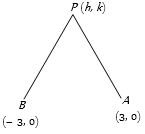
(a) Let the point be $P\,(h,\,\,k).$
Given that $PA - PB = 4$
$\sqrt {{{(h - 3)}^2} + {k^2}} - \sqrt {{{(h + 3)}^2} + {k^2}} = 4$
$ \Rightarrow \,\,\sqrt {{{(h - 3)}^2} + {k^2}} = 4 + \sqrt {{{(h + 3)}^2} + {k^2}} $
Squaring both sides, we get
${(h - 3)^2} + {k^2} = 16 + {(h + 3)^2} + {k^2} + 8\sqrt {{{(h + 3)}^2} + {k^2}} $
$ \Rightarrow \,\,\,{h^2} + 9 - 6h + {k^2} = 16 + {h^2} + 9 + 6h + {k^2}$
$ + \,8\sqrt {{{(h + 3)}^2} + {k^2}} $
$ \Rightarrow \,\, - 6h = 16 + 6h + 8\sqrt {{{(h + 3)}^2} + {k^2}} $
$ \Rightarrow \,\, - 8\,\sqrt {{{(h + 3)}^2} + {k^2}} = 12h + 16$
Again, squaring both sides, we get
$64\,({h^2} + 9 + 6h + {k^2}) = 144{h^2} + 256 + 2.16.12h$
$ \Rightarrow \,\,4\,({h^2} + 9 + 6h + {k^2}) = 9{h^2} + 16 + 24h$
$ \Rightarrow \,\,4{h^2} + 36 + 24h + 4{k^2} = 9{h^2} + 16 + 24h$
$ \Rightarrow \,\,5{h^2} - 4{k^2} = 20\,\, \Rightarrow \,\,\frac{{{h^2}}}{4} - \frac{{{k^2}}}{5} = 1$
Hence, the locus of point $P$ is $\frac{{{x^2}}}{4} - \frac{{{y^2}}}{5} = 1$.
View full question & answer→MCQ 351 Mark
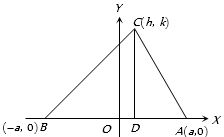
Two fixed points are $A(a,0)$ and $B( - a,0)$. If $\angle A - \angle B = \theta $, then the locus of point $C$ of triangle $ABC$ will be
- A
${x^2} + {y^2} + 2xy\tan \theta = {a^2}$
- B
${x^2} - {y^2} + 2xy\tan \theta = {a^2}$
- C
${x^2} + {y^2} + 2xy\cot \theta = {a^2}$
- ✓
${x^2} - {y^2} + 2xy\cot \theta = {a^2}$
AnswerCorrect option: D. ${x^2} - {y^2} + 2xy\cot \theta = {a^2}$
d
(d) Given $\angle A - \angle B = \theta $ $ \Rightarrow \,\,\tan \,(A - B) = \tan \theta $ .....$(i)$
In right angled triangle $CDA,\,\,\,\tan A = \frac{k}{{a - h}}$
and similarly in triangle $CDB,\,\,\tan B = \frac{k}{{a + h}}$
Also from $(i)$, $\frac{{\tan A - \tan B}}{{1 + \tan A\,.\,\tan B}} = \tan \theta $
Substituting the values of $\tan A$ and $\tan B,$ we get
${h^2} - {k^2} + 2hk\cot \theta = {a^2}$
Hence the locus is ${x^2} - {y^2} + 2xy\cot \theta = {a^2}$.
View full question & answer→MCQ 361 Mark
The co-ordinates axes are rotated through an angle $135^o$. If the coordinates of a point $P$ in the new system are known to be $(4, -3)$, then the coordinates of $P$ in the original system are
- A
$\left( {\frac{1}{{\sqrt 2 }},\frac{7}{{\sqrt 2 }}} \right)$
- B
$\left( {\frac{1}{{\sqrt 2 }},\frac{{ - 7}}{{\sqrt 2 }}} \right)$
- C
$\left( {\frac{{ - 1}}{{\sqrt 2 }},\frac{{ - 7}}{{\sqrt 2 }}} \right)$
- ✓
$\left( {\frac{{ - 1}}{{\sqrt 2 }},\frac{7}{{\sqrt 2 }}} \right)$
AnswerCorrect option: D. $\left( {\frac{{ - 1}}{{\sqrt 2 }},\frac{7}{{\sqrt 2 }}} \right)$
d
(d) $P = (x\cos \theta - y\sin \theta ,\,x\sin \theta + y\cos \theta )$
$ = \left( {4.\frac{{ - 1}}{{\sqrt 2 }} + 3.\frac{1}{{\sqrt 2 }},\,4.\frac{1}{{\sqrt 2 }} + 3.\frac{1}{{\sqrt 2 }}} \right) = \left( {\frac{{ - 1}}{{\sqrt 2 }},\,\frac{7}{{\sqrt 2 }}} \right)$
View full question & answer→MCQ 371 Mark
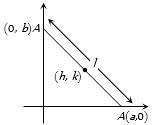
A stick of length l rests against the floor and a wall of a room. If the stick begins to slide on the floor, then the locus of its middle point is
Answerb
(b) Let middle point of stick $AB$ is $(h, k)$ therefore
$\left( {\frac{{a + 0}}{2},\,\frac{{0 + b}}{2}} \right)\, \equiv \,(h,\,\,k)\,\, \Rightarrow \,\,h = \frac{a}{2},\,\,k = \frac{b}{2}$
$ \Rightarrow \,\,a = 2h,\,\,b = 2k$
But we know from figure that
${a^2} + {b^2} = {l^2}\,\, \Rightarrow \,\,4{h^2} + 4{k^2} = {l^2}$
Hence the locus is ${x^2} + {y^2} = \frac{{{l^2}}}{4}$
which is obviously a circle.
View full question & answer→MCQ 381 Mark
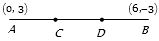
The point of trisection of the line joining the points $(0, 3) $ and $(6, -3)$ are
- A
$(2,\,0)$ and $(4,\, - 1)$
- B
$(2,\, - 1)$ and $(4,1)$
- C
$(3,1)$ and $(4, - 1)$
- ✓
$(2,1)$ and $(4, - 1)$
AnswerCorrect option: D. $(2,1)$ and $(4, - 1)$
d
(d) $C\,\left( {\frac{{6 + 0}}{3},\,\,\frac{{ - 3 + 6}}{3}} \right) \equiv (2,\,\,1)$
$D\,\left( {\frac{{2 \times 6 + 0}}{3},\,\frac{{ - 6 + 3}}{3}} \right)\, \equiv \,(4,\, - 1)$.
View full question & answer→MCQ 391 Mark
Area of the triangle with vertices $(a,b),\;({x_1},{y_1})$ and $({x_2},{y_2})$, where $a,\;{x_1}$ and ${x_2}$ are in $G.P.$ with common ratio r and b, ${y_1}$ and ${y_2}$ are in $G.P.$ with common ratio $s$, is given by
- A
$ab(r - 1)(s - 1)(s - r)$
- B
$\frac{1}{2}ab(r + 1)(s + 1)(s - r)$
- ✓
$\frac{1}{2}ab(r - 1)(s - 1)(s - r)$
- D
$ab(r + 1)(s + 1)(r - s)$
AnswerCorrect option: C. $\frac{1}{2}ab(r - 1)(s - 1)(s - r)$
c
(c) We have ${x_1} = ar,\,\,{x_2} = a{r^2},\,\,{y_1} = bs,\,\,{y_2} = b{s^2}$
The area of the triangle is given by
$\Delta = \frac{1}{2}\,\left| {\,\begin{array}{*{20}{c}}a&b&1\\{{x_1}}&{{y_1}}&1\\{{x_2}}&{{y_2}}&1\end{array}\,} \right| = \frac{1}{2}\,\left| {\,\begin{array}{*{20}{c}}a&b&1\\{ar}&{bs}&1\\{a{r^2}}&{b{s^2}}&1\end{array}\,} \right|$
$ = \frac{1}{2}ab\,\left| {\,\begin{array}{*{20}{c}}1&1&1\\r&s&1\\{{r^2}}&{{s^2}}&1\end{array}\,} \right|$$ = \frac{1}{2}ab\,\left| {\,\begin{array}{*{20}{c}}1&1&1\\{r - 1}&{s - 1}&0\\{{r^2} - 1}&{{s^2} - 1}&0\end{array}\,} \right|$
(Applying ${R_2} - {R_1},\,\,{R_3} - {R_1})$
$ = \frac{1}{2}ab\,(r - 1)\,(s - 1)\,(s - r)$.
View full question & answer→MCQ 401 Mark
Suppose $A B C D(A B \| C D)$ is a trapezium such that the diagonals $AC , BD$ bisect the angles $\angle DAB , \angle CBA$, respectively. Then
- A
no two side of the trapezium are equal
- B
exactly two sides of the trapezium are equal
- ✓
exactly three sides of the trapezium are equal
- D
none of the options above can be concluded
AnswerCorrect option: C. exactly three sides of the trapezium are equal
c
(c)
$AC$ is bisector of $\angle DAB$
$\therefore \angle DAC =\angle CAB$
and $DC \| AB$
$\therefore \angle CAB =\angle ACD \quad \ldots(2)$
$\therefore \angle DAC =\angle ACD$
Hence $AD = DC$
similarly $BC = DC$
Hence Exactly three sides are equal.

View full question & answer→MCQ 411 Mark
Let $A B C D$ be a convex quadrilateral in which $AC = BD . \quad AB = CD , \quad \angle BAC =70^{\circ}$ and $\angle BCD =60^{\circ}$. The acute angle between $AC$ and $BD$ is
- A
$70^{\circ}$
- B
$75^{\circ}$
- ✓
$80^{\circ}$
- D
$85^{\circ}$
AnswerCorrect option: C. $80^{\circ}$
c
(c)
In $\triangle ABC$ and $\triangle DCB$
$AB = DC$
$BC = CB$
$AC = DB$
$\triangle ABC \cong \triangle DCB$
$\therefore \angle BAC =\angle CDB =70^{\circ}$
$\angle ABC =\angle DCB =60^{\circ}$
$\angle ACB =180^{\circ}-\angle BAC -\angle ABC$
$=180^{\circ}-70^{\circ}-60^{\circ}$
$=50^{\circ}$
$\angle DCO =60^{\circ}-\angle ACB$
$=60^{\circ}-50^{\circ}=10^{\circ}$
$\angle DOC =180^{\circ}-70^{\circ}-10^{\circ}=100^{\circ}$
Acute angle $\angle DOC =80^{\circ}$

View full question & answer→MCQ 421 Mark
Suppose $A B C$ is triangle and $D, E$ are points on the sides $AB$ and $AC$ respectively. If $AD : AB =3: 5$ and $AE : AC =2: 3$, then the ratio of the areas of the triangles $ABC$ and $ADE$ lies in the interval.
- A
$(1,2]$
- ✓
$\left(2, \frac{5}{2}\right]$
- C
$\left(\frac{5}{2}, 3\right]$
- D
$\left(3, \frac{7}{2}\right]$
AnswerCorrect option: B. $\left(2, \frac{5}{2}\right]$
b
(b)
$\frac{\operatorname{ar} \triangle ABC }{\operatorname{ar} \triangle ADE }=\frac{\frac{1}{2} \cdot AB \cdot AC \sin \theta}{\frac{1}{2} \cdot AD \cdot AE \sin \theta}$
$=\frac{ AB }{ AD } \times \frac{ AC }{ AE }$
$=\frac{5}{3} \times \frac{3}{2}=\frac{5}{2}$
correct option is $\frac{5}{2}$

View full question & answer→MCQ 431 Mark
Six consecutive sides of an equiangular octagon are $6$ , $9,8,7,10,5$ in that order. The integer nearest to the sum of the remaining two sides is
Answerb
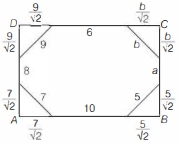
(b)
Let the remaining two sides be $a$ and $b$, then
.Since, $A B C D$ is a rectangle, then
$\frac{9}{\sqrt{2}}+6+\frac{b}{\sqrt{2}}=\frac{7}{\sqrt{2}}+10+\frac{5}{\sqrt{2}}$
$\quad \frac{b}{\sqrt{2}}=4+\frac{3}{\sqrt{2}}$
$\text { Similarly, } \frac{9}{\sqrt{2}}+8+\frac{7}{\sqrt{2}}=\frac{b}{\frac{\sqrt{2}}{}}+a+\frac{5}{\sqrt{2}}$
$\quad a=4+\frac{8}{\sqrt{2}}$
$\therefore \quad a+b=7+8 \sqrt{2}=18.3$
View full question & answer→MCQ 441 Mark
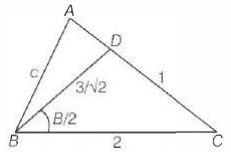
In a $\triangle A B C$, the angle bisector $B D$ of $\angle B$ intersects $A C$ in $D$. Suppose $B C=2, C D=1$ and $B D=\frac{3}{\sqrt{2}}$. The perimeter of the $\triangle A B C$ is
- A
$\frac{17}{2}$
- ✓
$\frac{15}{2}$
- C
$\frac{17}{4}$
- D
$\frac{15}{4}$
AnswerCorrect option: B. $\frac{15}{2}$
b
(b)
We have, $\cos \frac{B}{2}=\frac{\frac{9}{2}+4-1}{6 \sqrt{2}}=\frac{5}{4 \sqrt{2}}$
$\therefore$ Length of angle bisector,
$B D=\frac{2 a c}{a+c} \cos \frac{B}{2}$
$\frac{3}{\sqrt{2}} =\left(\frac{4 c}{e+2}\right) \cdot \frac{5}{4 \sqrt{2}}$
$c =3$
We know that, $\frac{A B}{B C}=\frac{A D}{C D}$
$A D=\frac{3}{2}$
$\therefore$ Perimeter of $\triangle A B C=1+\frac{3}{2}+3+2=\frac{15}{2}$
View full question & answer→MCQ 451 Mark
Let $a=B C, b=C A, c=A B$ be the side lengths of a $\triangle A B C$ and $m$ be the length of the median through $A$. If $a=8, b-c=2, m =6$, then the nearest integer to $b$ is
Answerb
(b)
If in a $\triangle A B C, A D$ is median, then by Apollonius Theorem
$A B^2+A C^2=2\left(A D^2+B D^2\right)$
Here, by using Apollonius theorem, we get
$x^2+(x-2)^2=2\left[6^2+4^2\right]$
$2 x^2-4 x+4=104$
$x^2-2 x-50=0 \Rightarrow x=1+\sqrt{51}$
The nearest integer to $b$ is $8$ .

View full question & answer→MCQ 461 Mark
Among all the parallelograms whose diagonals are $10$ and $4$,the one having maximum area has its perimeter lying in the interval
- A
$(19,20]$
- B
$(20,21]$
- ✓
$(21,22]$
- D
$(22,23]$
AnswerCorrect option: C. $(21,22]$
c
(c)
Area of parallelogram whose diagonals are 10 and 4 and if angle between adjacent side is $\theta$ is
$A=\frac{10 \times 4}{\sin \theta}$
The area will be maximum if $\theta=\frac{\pi}{2}$, so the parallelogram must be rhombus
Perimeter of rhombus
$=4 \sqrt{2} \overline{9}=\sqrt{46} \overline{4} \text { and } \sqrt{46} \overline{4} \in(21,22]$
View full question & answer→MCQ 471 Mark
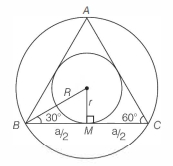
Let $A B C$ be an equilateral triangle with side length $a$. Let $R$ and $r$ denote the radii of the circumcircle and the incircle of triangle $A B C$ respectively. Then, as a function of $a$, the ratio $\frac{R}{r}$
Answerc
(c)
For an equilateral triangle $A B C$ having side length $a$. If $R$ and $r$ are radii of the circumcircle and the incircle of triangle $A B C$ respectively, then
$R=\frac{a}{2} \sec 30^{\circ}=\frac{a}{2}\left(\frac{2}{\sqrt{3}}\right)=\frac{a}{\sqrt{3}}$
and $r=\frac{a}{2} \tan 30^{\circ}=\frac{a}{2} \times \frac{1}{\sqrt{3}}=\frac{a}{2 \sqrt{3}}$
$\therefore \frac{R}{r}=\frac{\frac{a}{\sqrt{3}}}{\frac{a}{2 \sqrt{3}}}=2$, which is independent of $a$ and it is constant.
View full question & answer→MCQ 481 Mark
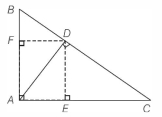
In a triangle $A B C, \angle B A C=90^{\circ} ; A D$ is the altitude from $A$ on to $B C$. Draw $D E$ perpendicular to $A C$ and $D F$ perpendicular to $A B$. Suppose $A B=15$ and $B C=25$. Then the length of $E F$ is
- ✓
$12$
- B
$10$
- C
$5 \sqrt{3}$
- D
$5 \sqrt{5}$
Answera
(a)
It is given that in triangle $A B C$, $\angle B A C=90^{\circ}, A D$ is the altitude from $A$ on to $B C$.
Since, $A B=15$ and $B C=25$
$\therefore \quad A C=\sqrt{B C^2-A B^2}=\sqrt{625-225}$
$=\sqrt{400}=20$
Now, since area of $\triangle A B C=\frac{1}{2}(B C)(A D)$
$=\frac{1}{2}(A B)(A C)$
$\Rightarrow \frac{1}{2}(B C)(A D)=\frac{1}{2} \times 15 \times 20$
$\Rightarrow \quad 25 \times A D=300$
$\Rightarrow \quad A D=12$
$\because A E D F$ is a rectangle, then
$E F=A D=12$
View full question & answer→MCQ 491 Mark
Let $P$ be an interior point of a convex quadrilateral $A B C D$ and $K, L, M, N$ be the mid-points of $A B, B C$, $C D, D A$ respectively. If Area $(P K A N)=25$, Area $(P L B K)=36$, and Area $(P M D N)=41$ then Area $(P L C M)$ is
Answerc
(c)
Let a convex quadrilateral $A B C D$ and $K, L, M, N$ be the mid-point of $A B$, $B C, C D, D A$ respectively.
Now, as area $\Delta A K P=$ area $\Delta B K P=x$ (let) Similarly
$\triangle B L P =\Delta C L P=y$
$\Delta C P M =\triangle D P M=z$
And $\Delta D N P =\triangle A N P=w$
It is given that Area $(P K A N)=x+w=25$ area $(P L B K)=x+y=36$
and area $(P M D N)=z+w=41$
So $\operatorname{area}(P L C M)=y+z$
$=(x+y)+(z+w)-(x+w)$
$=\operatorname{area}(P L B K)+$ area $(P M D N)-$ area $(P K A N)$
$=36+41-25=77-25=52$
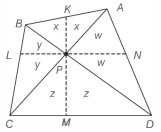
View full question & answer→MCQ 501 Mark
Let $l > 0$ be a real number, $C$ denote a circle with circumference $l$ and $T$ denote a triangle with perimeter $l$. Then
- ✓
given any positive real number $\alpha$, we can choose $C$ and
- B
given any positive real number $\alpha$, we can choose $C$ and $T$ as above such that ratio $\frac{\operatorname{Area}(C)}{\operatorname{Area}(T)}$ is less than $\alpha$
- C
give any $C$ and $T$ as above, the ratio $\frac{\text { Area }(C)}{\text { Area }(T)}$ is independent of $C$ and $T$
- D
there exist real numbers $a$ and $b$ such that for any circle $C$ and triangle $T$ as above, we must have $a < \frac{\text { Area }(C)}{\text { Area }(T)} < b$
AnswerCorrect option: A. given any positive real number $\alpha$, we can choose $C$ and
a
(a)
It is given that circumference of circle $C$ is $l$ and the perimeter of triangle $T$ is $l$.
Now, let the radius of circle $C$ is $r$, so
$2 \pi r=l \Rightarrow r=\frac{l}{2 \pi}$
$\therefore$ area of circle $C$ is $A_1=\pi r^2=\frac{l^2}{4 \pi}$
Now, as we know that area of triangle will be maximum for given perimeter if it is an equilateral triangle, let the length of side of equilateral triangle is ' $a$ ', then
$3 a=l \Rightarrow a=\frac{l}{3}$
and area of equilateral triangle is
$A_2=\frac{\sqrt{3}}{4} a^2$
So, $A_2=\frac{\sqrt{3}}{4}\left(\frac{l^2}{9}\right)=\frac{l^2}{12 \sqrt{3}}$
Since, as we took an equilateral triangle, which has maximum area. But we can take a triangle $T$ such that the ratio area $(C)$ is greater than any positive real area $(T)$ number $\alpha$.
View full question & answer→MCQ 511 Mark
Let $R$ be a rectangle, $C$ be a circle, and $T$ be a triangle in the plane. The maximum possible number of points common to the perimeters of $R, C$ and $T$ is
Answerd
(d)
Maximum possible number of points common to the perimeter of rectangle, circle and triangle is $6$.
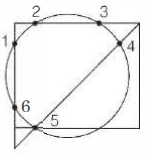
View full question & answer→MCQ 521 Mark
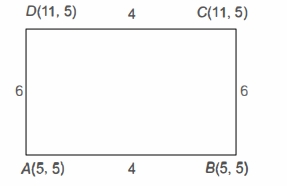
All the vertices of a rectangle are of the form $(a, b)$ with $a, b$ integers satisfying the equation $(a-8)^2-(b-7)^2=5$. Then, the perimeter of the rectangle is
Answera
(a)
Given, $(a-8)^2-(b-7)^2=5$
$\Rightarrow (a-8+b-7)(a-8-b+7)=5$
$\Rightarrow (a+b-15)(a-b-1)=5$
There are four case
$a+b-15=5 ; a-b-1=1$
$a+b-15=1 ; a-b-1=5$
$a+b-15=-5 ; a-b-1=-1$
$a+b-15=-1 ; a-b-1=-5$
On solving, we get
$(i)$ $a=11, b=9$
$(ii)$ $a=11, b=5$
$(iii)$ $a=5, b=5$
$(iv)$ $a=5, b=9$
$\therefore$ Perimeter $=2(4+6)=20$
View full question & answer→MCQ 531 Mark
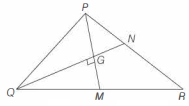
Consider a $\triangle P Q R$ in which the relation $Q R^2+P R^2=5 P Q^2$ holds. Let $G$ be the point of intersection of medians $P M$ and $Q N$. Then, $\angle Q G M$ is always
Answerc
(c)
In $\triangle P Q R$
Given, $Q R^2+P R^2=5 P Q^2$
Median $P M$ and $Q N$ intersect of $G$
$Q G=\frac{2}{3} Q N, G M=\frac{1}{3} P M$
$Q G^2+G M^2=\left(\frac{2}{3} Q N\right)^2+\left(\frac{1}{3} P M\right)^2$
$=\frac{4}{9} Q N^2+\frac{1}{9} P M^2$
$=\frac{\frac{4}{9}\left(\frac{2 P Q^2+2 Q R^2-P R^2}{4}\right) +\frac{1}{9}\left(\frac{2 P Q^2+2 P R^2-Q R^2}{4}\right)}{8 P Q^2+8 Q R^2-4 P R^2}$
$ \frac{1}{9}+\frac{2PQ^2+2PR^2-QR^2}{4} $
$=\frac{1}{9}\left[\frac{10 P Q^2+7 Q R^2-2 P R^2}{4}\right]$
$=\frac{1}{9}\left[\frac{2\left(5 P Q^2-P R^2\right)+7 Q R^2}{4}\right]$
$=\frac{1}{9}\left[\frac{2 Q R^2+7 Q R^2}{4}\right]=\frac{1}{4} Q R^2=Q M^2$
$\therefore O G^2+G M^2 =Q M^2$
$\therefore \angle Q G M =90^{\circ}$
View full question & answer→MCQ 541 Mark
Let $a, b, c$ be the side-lengths of a triangle and $l, m, n$ be the lengths of its medians. Put $K=\frac{l+m+n}{a+b+c}$.Then, as $a, b, c$ vary, $K$ can assume every value in the interval
- A
$\left(\frac{1}{4}, \frac{2}{3}\right)$
- B
$\left(\frac{1}{2}, \frac{4}{5}\right)$
- ✓
$\left(\frac{3}{4}, 1\right)$
- D
$\left(\frac{4}{5}, \frac{5}{4}\right)$
AnswerCorrect option: C. $\left(\frac{3}{4}, 1\right)$
c
(c)
Let $\triangle A B C$
$B C=a$
$A C=b$
$A B=c$
and median of $\triangle A B C$
$A D=l$
$B E=m$
$C F=n$
$A D$ is median,
$l < \frac{b+c}{2}$
$m < \frac{a+b}{2}$ and $n < \frac{a+c}{2}$
$l+m+n < a+b+c$
$=\frac{l+m+n}{a+b+c}$
Also in $\triangle B G C, B G+G C > B C$
$\therefore \quad \frac{2}{3}(m+n) > a$
Similarly, $\frac{2}{3}(n+l) > b$ and $\frac{2}{3}(m+l) > c$
$\because \quad \frac{4}{3}(l+m+n) > a+b+c$
$=\frac{l+m+n}{a+b+c} > \frac{3}{4}$
From Eqs. $(i)$ and $(ii)$, we get
$\frac{l+m+n}{a+b+c} \in\left(\frac{3}{4}, 1\right)$
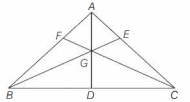
View full question & answer→MCQ 551 Mark
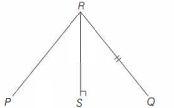
Let $P Q R$ be a triangle is which $P Q=3$. From the vertex $R$, draw the altitude $R S$ to meet $P Q$ at $S$. Assume that $R S=\sqrt{3}$ and $P S=Q R$. Then, $P R$ equals
- A
$\sqrt{5}$
- B
$\sqrt{6}$
- ✓
$\sqrt{7}$
- D
$\sqrt{8}$
AnswerCorrect option: C. $\sqrt{7}$
c
(c)
Given, in $\triangle P Q R$
$P Q=3$
$Altitude\,\,R S=\sqrt{3}$
$P S=Q R$
In $\triangle S Q R, \quad Q R^2=S R^2+S Q^2$
$P S^2=(\sqrt{3})^2+(Q P-P S)^2$
$[\because S Q=P Q-P S]$
$P S^2=3+(3-P S)^2$
$P S^2=3+9-6 P S+P S^2 \Rightarrow P S=2$
In $\triangle P R S$,
$P R^2=P S^2+R S^2=(2)^2+(\sqrt{3})^2=4+3$
$P R=\sqrt{7}$
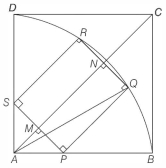
View full question & answer→MCQ 561 Mark
Let $A B C D$ be a square. An arc of a circle with $A$ as centre and $A B$ as radius is drawn inside the square joining the points $B$ and $D$. Points $P$ on $A B, S$ on $A D, Q$ and $R$ on $\operatorname{arc} B D$ are taken such that $P Q R S$ is a square. Further suppose that $P Q$ and $R S$ are parallel to $A C$. Then, $\frac{\text { area }}{\text { area }} \frac{P Q R S}{A B C D}$ is
- A
$\frac{1}{8}$
- B
$\frac{1}{5}$
- C
$\frac{1}{4}$
- ✓
$\frac{2}{5}$
AnswerCorrect option: D. $\frac{2}{5}$
d
(d)
Given, $A B C D$ is a square.
$\angle C A P=\angle M A P=45^{\circ}$
$A M=M P=Q N$
$P Q R S$ is a square,
$\because \quad M N=P Q=P S$
$P S =2 P M=2 A M$
$A N =A M+M N=3 A M$
In $\triangle A B Q$,
$A Q^2=A N^2+Q N^2$
$1=(3 A M)^2+A M^2[\because A Q=1]$
$10\,A M^2 =1$
$A M^2 =1$
$A M^2 =\frac{1}{10}$
Area of square $P Q R S=P S^2$
$=4\,A M^2=\frac{4}{10}=\frac{2}{5}$
Area square $P Q R S$
Area of square $A B C D=\frac{2}{5}$
View full question & answer→MCQ 571 Mark
Suppose $A B C D$ is a trapezium whose sides and height are integers and $A B$ is parallel to $C D$. If the area of $A B C D$ is $12$ and the sides are distinct, then $|A B-C D|$
- A
is $2$
- ✓
is $4$
- C
is $8$
- D
cannot be determined from the data
AnswerCorrect option: B. is $4$
b
(b)
We have,
$A B C D$ is a trapezium.
$A B$ is parallel to $C D$.
Area of trapezium $=12$
$\frac{1}{2} \times h(A B+C D)=12$
$A B+C D=\frac{24}{h}$
Sides and height of trapezium are integer.
$\therefore h$ is a factor of $24$
$h=1,2,3,4,6,8,12,24$
$A B+C D=24,12,8,6,4,3,2,1$
But $A B+C D > h$
$A B+C D=24,12,8,6$
In $\triangle B E C$,
$B E C$ is a right angled triangle.
$\therefore h$ must be $3$ and $4$
When $h=3, B E=4, C E=5$
$A B+C D=8$
$A E+B E+A E=8$
$2 A E=8-B E=8-4$
$A E=2$
$\therefore A B=4+2=6, C D=2$
$\therefore|A B-C D|=|6-2|=4$
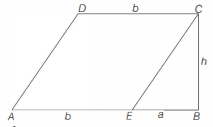
View full question & answer→MCQ 581 Mark
Consider four triangles having sides $(5,12,9),(5,12$, $11),(5,12,13)$ and $(5,12,15)$. Among these, the triangle having maximum area has sides.
- A
$(5,12,9)$
- B
$(5,12,11)$
- ✓
$(5,12,13)$
- D
$(5,12,15)$
AnswerCorrect option: C. $(5,12,13)$
c
(c)
We have,
Four triangle having sides are $(5,12,9),(5,12,11),(5,12,13),(5,12,15)$ A right triangle has maximum area.
$\therefore$ Among these the triangle whose sides $(5,12,13)$ form a right angled triangle.
$\therefore$ It has maximum area.
View full question & answer→MCQ 591 Mark
Let $A=\left(a_1, a_2\right)$ and $B=\left(b_1, b_2\right)$ be two points in the plane with integer coordinates. Which one of the following is not a possible value of the distance between $A$ and $B$ ?
- A
$\sqrt{65}$
- B
$\sqrt{7} \overline{4}$
- ✓
$\sqrt{8 \overline{3}}$
- D
$\sqrt{9} \overline{7}$
AnswerCorrect option: C. $\sqrt{8 \overline{3}}$
c
(c)
Given,
$A=\left( a _1, a_2\right), B=\left(b_1, b_2\right)$, where $a_1, a_2, b_1, b_2$ are integers.
Distance between $A B$
$=\sqrt{\left(b_1-a_1\right)^2+\left(b_2-a_2\right)^2}$
$\therefore A B=\sqrt{\text { sum of squares of two number }}$
$\sqrt{65}=\sqrt{64+1}$, it is possible.
$\sqrt{74}=\overline{\sqrt{49+2}}$, it is also possible.
$\sqrt{97}=\sqrt{81+16}$, it is also possible.
$83$ is not a sum of squares of two number.
Hence, option $(c)$ is correct.
View full question & answer→MCQ 601 Mark
Let $B C$ be a fixed line segment in the plane. The locus of a point $A$ such that the $\triangle A B C$ is isosceles, is (with finitely many possible exceptional points)
- A
- B
- C
the union of a circle and a line
- ✓
the union of two circles and a line
AnswerCorrect option: D. the union of two circles and a line
d
(d)
Given in $\triangle A B C, B C$ is fixed, $A$ is variable and $A B C$ is an isosceles triangle.
Case $I$ In $\triangle A B C$,
If $\quad A B=A C$
Then, locus of $A$ is perpendicular bisector of $B C$.
$\therefore$ Locus of $A$ is a straight line.
Case $II$ When $A B=B C$
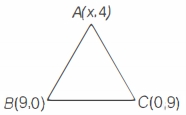
$B C$ fixed $B(a, 0), C(0, a)$, locus of $A$ is $(x-a)^2+y^2=2 a^2$, which represents the equation of circle.
Similarly, when $A C=B C$ also locus of $A$ is circle.
$\therefore$ Locus of $A$ is the union of two circles and the lines.
View full question & answer→MCQ 611 Mark
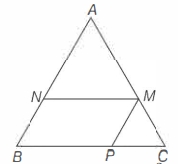
Let $A B C$ be a triangle and $M$ be a point on side $A C$ closer to vertex $C$ than $A$. Let $N$ be a point on side $A B$ such that $M N$ is parallel to $B C$ and let $P$ be a point on side $B C$ such that $M P$ is parallel to $A B$. If the area of the quadrilateral $B N M P$ is equal to $\frac{5}{18}$ of the area of $\triangle A B C$, then the ratio $A M / M C$ equals
- ✓
$5$
- B
$6$
- C
$\frac{18}{5}$
- D
$\frac{15}{2}$
Answera
(a)
$\triangle A B C \sim \triangle A N M$
$\frac{\text { Area of } \triangle A B C}{\text { Area of } \triangle A N M}=\frac{A C^2}{A M^2}$
$\triangle A B C \sim M P C$
$\frac{\text { Area of } \triangle A B C}{\text { Area of } \triangle M P C}=\frac{A C^2}{M C^2}$
From Eqs.$(i)$ and $(ii)$,we get
$\frac{\text { Area of } \triangle A N M}{\text { Area of } \triangle M P C}=\frac{A M^2}{M C^2}$
Area of $\triangle A N M+$ Area of $\triangle M P C$
Area of $\triangle M P C=\frac{AM^2+MC^2}{MC^2}$
Now, Area of $\triangle A N M+$ Area of $\triangle M P C$
$=$ Area of $\triangle A B C-$ Area of $B N M P$
$\therefore \quad \frac{13 \text { (Area of } \triangle A B C)}{18 \text { (Area of } \triangle M P C)}=\frac{A M^2+M C^2}{M C^2}$
From Eq. $(iii)$, $\frac{13}{18}\left(\frac{\left(A C^2\right)}{M C^2}\right)=\frac{A M^2+M C^2}{M C^2}$
$13(A M+M C)^2=18\left(A M^2+M C^2\right)$
$\frac{A M}{M C}=5$
View full question & answer→MCQ 621 Mark
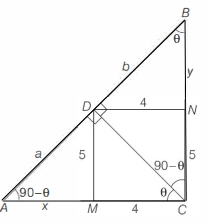
Let $A B C$ be a triangle with $\angle C=90^{\circ}$. Draw $C D$ perpendicular to $A B$. Choose points $M$ and $N$ on sides $A C$ and $B C$ respectively such that $D M$ is parallel to $B C$ and $D N$ is parallel to $A C$. If $D M=5, D N=4$, then $A C$ and $B C$ are respectively equal to
- ✓
$\frac{41}{4}, \frac{41}{5}$
- B
$\frac{39}{4}, \frac{39}{5}$
- C
$\frac{38}{4}, \frac{38}{5}$
- D
$\frac{37}{4}, \frac{37}{5}$
AnswerCorrect option: A. $\frac{41}{4}, \frac{41}{5}$
a
(a)
Given, $A B C$ is right angled triangle
$\angle C=90^{\circ}$
$C D$ is perpendicular on $A B, D N$ and $D M$ are parallel to $A C$ and $B C$, respectively. $D N=4$ and $D M=5$
In $\triangle D M C$ and $\triangle D N B$
$\Delta D M C \sim \Delta D N B$
$\frac{D M}{D N} =\frac{M C}{N B}$
$\frac{5}{4} =\frac{4}{N B} \Rightarrow N B=\frac{16}{5}$
In $\triangle D N C$ and $\triangle D M A$
$\Delta D N C \sim \Delta D M A$
$\frac{D N}{D M} =\frac{N C}{M A}$
$\frac{4}{5} =\frac{5}{M A} \Rightarrow M A=\frac{25}{4}$
$\therefore A C=M C+A M=4+\frac{25}{4}=\frac{41}{4}$
View full question & answer→MCQ 631 Mark
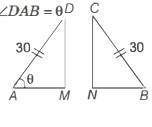
In an isosceles trapezium, the length of one of the parallel sides, and the lengths of the non-parallel sides are all equal to $30$ . In order to maximise the area of the trapezium, the smallest angle should be
- A
$\frac{\pi}{6}$
- B
$\frac{\pi}{4}$
- ✓
$\frac{\pi}{3}$
- D
$\frac{\pi}{2}$
AnswerCorrect option: C. $\frac{\pi}{3}$
c
(c)
$\operatorname{In} \triangle A M D$
$\quad \cos \theta=\frac{A M}{30} \Rightarrow A M=30 \cos \theta$
$\quad \sin \theta=\frac{D M}{30}=D M=30 \sin \theta$
$\text { Area of trapezium }=\frac{1}{2}(A B+C D) D M$
$\Rightarrow \quad A=\frac{1}{2}(60+60 \cos \theta) 30 \sin \theta$
$\Rightarrow \quad \quad \quad \quad \quad d A=900(\sin \theta+\sin \theta \cos \theta)$
$\Rightarrow \quad d \theta=900\left(\cos \theta-\sin ^2 \theta+\cos ^2 \theta\right)$
$\text { For maximum or minimum, put } \frac{d A}{d \theta}=0$
$\therefore \quad \cos \theta-\sin 2 \theta+\cos ^2 \theta=0$
$\Rightarrow \quad \cos \theta+\cos 2 \theta=0$
$\Rightarrow \quad 2 \cos \frac{3 \theta}{2} \cos \frac{\theta}{2}=0$
$\frac{3 \theta}{2} =\frac{\pi}{2} \text { or } \frac{\theta}{2}=\frac{\pi}{2}$
$\theta =\frac{\pi}{3} \text { or } \theta=\pi$
For maximum $\theta=\frac{\pi}{3}$
View full question & answer→MCQ 641 Mark
Let $A B C D$ be a square and $E$ be a point outside $A B C D$ such that $E, A, C$ are collinear in that order. Suppose $E B=E D=\sqrt{130}$ and the areas to $\triangle E A B$ and square $A B C D$ are equal. Then, the area of square $A B C D$ is
- A
$8$
- ✓
$10$
- C
$\sqrt{120}$
- D
$\sqrt{125}$
Answerb
(b)
Given, area of $\triangle E A B=$ area of square $A B C D$
$E B=E D=\sqrt{130}$
Let side of square $=x$
$B M=\frac{x}{\sqrt{2}}=A M$
Area of $\triangle A E B=$ Area of $\triangle B E M$ - area of
$=\frac{1}{2} E M \times B M-\frac{1}{2} A M \times B M$
$=\frac{1}{2} B M(E M-A M)$
$=\frac{1}{2} \frac{x}{\sqrt{2}}\left(\sqrt{\left.130-\frac{x^2}{2}-\frac{x}{\sqrt{2}}\right)}\right.$
$=\frac{1}{2}+\frac{x}{\sqrt{2}}\left(\sqrt{\left.130-\frac{x^2}{2}-\frac{x}{\sqrt{2}}\right)=x^2}\right.$
$=\sqrt{130-\frac{x^2}{2}}=2 \sqrt{2} x+\frac{x}{\sqrt{2}}$
$130-\frac{x^2}{2}=\left(\begin{array}{c}5 x \\ \sqrt{2}\end{array}\right)^2$
$130-\frac{x^2}{2}=\begin{array}{c}25 x^2 \\ 2\end{array}$
$13 x^2=130 \Rightarrow x^2=10$
$\therefore$ Area of square $=10$
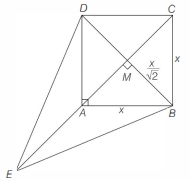
View full question & answer→MCQ 651 Mark
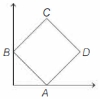
Consider a rigid square $A B C D$ a s in the figure with $A$ and $B$ on the $X$ and $Y$-axes, respectively.
When $A$ and $B$ slide along their respective axes, the locus of $C$ forms a part of
- A
- B
- C
- ✓
an ellipse which is not a circle
AnswerCorrect option: D. an ellipse which is not a circle
d
(d)
Given $A B C D$ is a square $A$ and $B . A$ and $B$ slide along theirs respective axes.
Let $A B=B C=C D=A D=a$ $\ln \Delta B M C$
$\sin \theta=\frac{B M}{B C}$
$\sin \theta=\frac{h}{a}$
$h=a \sin \theta$
$k=O B+N B$
$k=a \sin \theta+a \cos \theta$
$[\because O B=a \sin \theta, N B=a \cos \theta]$
$k=h+a \cos \theta$
$k-h=a \cos \theta$
On squaring and adding Eqs.$(i)$ and $(ii)$, we get
$h^2+(k-h)^2=a^2$
$\because$ Locus of $C B$
$x^2+(y-x)^2 =a^2$
$2 x^2+y^2-2 x y =a^2$
which is ellipse not a circle.
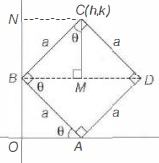
View full question & answer→MCQ 661 Mark
Let $n \geq 4$ be a positive integer and let $l_1, l_2, \ldots, l_n$ be the lengths of the sides of arbitrary $n$ sided non-degenerate polygon $P$. Suppose $\frac{l_1}{l_2}+\frac{l_2}{l_3}+\ldots+\frac{l_{n-1}}{l_n}+\frac{l_n}{l_1}=n$ Consider the following statements:
$I$. The lengths of the sides of $P$ are equal.
$II$. The angles of $P$ are equal.
$III.$ $P$ is a regular polygon if it is cyclic.
AnswerCorrect option: D. $I$ and $III$ are true
d
(d)
We have, $l_1, l_2, l_3 \ldots, l_n$ be the lengths of the side of arbitrary $n$ sided non-degenerate polygon $P$ and $\frac{l_1}{l_2}+\frac{l_2}{l_3}+\frac{l_3}{l_4}+\ldots+\frac{\ln -1}{l_n}+\frac{\ln }{l_1}=n, n \geq 4$
Using AM $\geq$ GM, we get
$\therefore$ The length of sides of $P$ are equal and $P$ is regular polygon of it is cyclic.
View full question & answer→MCQ 671 Mark
A quadrilateral has distinct integer side lengths. If the second-largest side has length $10$, then the maximum possible length of the largest side is
Answerb
(b)
We have, side of quadrilateral has distinct integer second largest size has length $10.$
Let $a=8, b=9, c=10$, (All are distinct) We know, in quadrilateral Sum of three sides is greater than fourth side
$\therefore a+b+c>d \Rightarrow 8+9+10 > d \Rightarrow d < 27$
$\therefore$ Maximum length of $4$th side is $26.$
View full question & answer→MCQ 681 Mark
Suppose we have to cover the $X Y$-plane with identical tiles such that no two titles overlap and no gap is left between the tiles. Suppose that we can choose tiles of the following shapes : equilateral triangle, square, regular pentagon, regular hexagon. Then, the tiling can be done with tiles of
- A
- ✓
exactly three of the four shapes
- C
exactly two of the four shapes
- D
exactly one of the four shapes
AnswerCorrect option: B. exactly three of the four shapes
b
(b)
We have,
four shape of tiles
$(1)$ Equilateral triangle
$(2)$ Square
$(3)$ Regular pentagon
$(4)$ Regular hexagon
Cover the $X Y$-plane with four shapes such that no two tiles are overlaps.
$\therefore$ We use cquilateral triangular, regular hexagon is also made of equilateral triangle but pentagon cannot cover the plane because of its shape.
$\therefore$ Exactly three of four shapes, i.e. equilateral triangle, square and regular hexagon.
View full question & answer→MCQ 691 Mark
Let $A B C D$ be a trapezium, in which $A B$ is parallel to $C D, A B=11, B C=4, C D=6$ and $D A=3$. The distance between $A B$ and $C D$ is
- A
$2$
- ✓
$2.4$
- C
$2.8$
- D
Not determinable with the data
Answerb
(b)
$A B C D$ is a trapezium.
$A B$ is parallel to $C D$.
$A B=11, B C=4, C D=6$ and $D A=3$
Construct $C E$ is parallel to $D A$.
$C E=3$
$B C=4$
$B E=5$
$\therefore \angle B C E$ is a right angled triangle.
$\therefore$ Area of $\triangle B C E=\frac{1}{2} E C \times B C$
$=\frac{1}{2} \times 3 \times 4$
Also, area of
$\triangle B C E =\frac{1}{2} \times B E \times h$
$=\frac{1}{2} \times 5 \times h$
From Eqs.$(i)$ and $(ii)$,
$\frac{1}{2} \times 3 \times 4 =\frac{1}{2} \times 5 \times h$
$\Rightarrow \quad h =2.4$
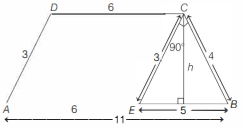
View full question & answer→MCQ 701 Mark
Let $P$ be a point inside a $\triangle A B C$ with $\angle A B C=90^{\circ}$. Let $P_1$ and $P_2$ be the images of $P$ under reflection in $A B$ and $B C$ respectively. The distance between the circumcenters of $\triangle A B C$ and $P_1 P P_2$ is
- A
$\frac{A B}{2}$
- B
$\frac{A P+B P+C P}{3}$
- ✓
$\frac{A C}{2}$
- D
$\frac{A B+B C+A C}{2}$
AnswerCorrect option: C. $\frac{A C}{2}$
c
(c)
$A B C$ is a right angled triangle, $\angle A B C=90^{\circ}$
Circumcentre of $\triangle A B C$ is mid-point of $A C$ i.e. $M$.
Circumcentre of $\Delta P_1 P P_2$ is mid-point of $P_1 P_2$
$A B$ is perpendicular bisector of $P P_1$ and $B C$ is perpendicular bisector of $P P_2$.
Perpendicular bisector of $P P_1$ and $P P_2$ intersect at $B$.
$\therefore B$ is circumcentre of $\Delta P_1 P P_2$.
$\therefore$ Distance between
$B M=A M=M C=\frac{A C}{2}$
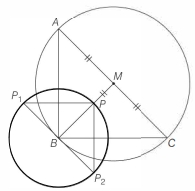
View full question & answer→MCQ 711 Mark
Consider a cuboid all of whose edges are integers and whose base is a square. Suppose the sum of all its edges is numerically equal to the sum of the areas of all its six faces. Then, the sum of all its edges is
Answerc
(c)
Given, a cuboid has all edges are integers and base is square.
Let the length, breadth and height of cuboid is $x, x, y$.
Sum of all edges of cuboid $=4 x+4 x+4 y$
Sum of area of all faces $=2 x^2+2 x y+2 x y$
Given,
Sum of all edges of cuboid = Sum of area of all faces
$\therefore \quad 4 x+4 x+4 y=2\left(x^2+x y+x y\right)$
$\Rightarrow \quad 4(2 x+y)=2\left(x^2+2 x y\right)$
$\Rightarrow \quad x^2+2 x y-4 x-2 y=0$
$\Rightarrow \quad x^2+2 x(y-2)-2 y=0$
$\Rightarrow \quad x=\frac{-2(y-2) \pm \sqrt{4(y-2)^2+4(2 y)}}{2}$
$\Rightarrow \quad x=y-2 \pm \sqrt{y^2-2 y+4}$
$x \text { is integer, when } y=2$
$\therefore \quad \quad y=2 x=2$
Hence, sum of edges $=8 x+4 y=16+8=24$
View full question & answer→MCQ 721 Mark
Ten ants are on the real line. At time $t=0$, the $k$ th ant starts at the point $k^2$ and travelling at uniform speed, reaches the point $(11-k)^2$ at time $t=1$. The number of distinct times at which at least two ants are at the same location is
Answerc
(c)
Attime $t=0, k$ th ant starts at point $k^2$ and reaches at time $t=0$ at the point $(11-k)^2$.
$\therefore$ Velocity of $k$ th ant
$=\frac{x_2-x_1-(11-k)^2-k^2}{t_2-t_1}$
$u=121-12\,h$
Now, two ants are at the same location
$x_i=x_j$
$x_i=x+u t$
$\Rightarrow \quad k_i^2-22 k_i t+121 t=k_j-22 k_j t+121 t$
$\Rightarrow \quad t=\frac{k_j^2-k_i^2}{22\left(k_j-k_i\right)}=\frac{k_j+k_i}{22}$ $\quad\left[k_i \neq k_j\right]$
Now, for $i=1$,
values of $t$ will be $\frac{3}{22}, \frac{4}{22}, \frac{5}{22}, \ldots, \frac{11}{22}$
($9$ values)
When $i=2$
value of $t$ will be $\frac{4}{22}, \frac{5}{22}, \ldots, \frac{11}{22}, \frac{12}{22}$
Only one distinct value.
Similarly, for $i=3,4,5,6,7,8,9$, we get only $1$ distinct value.
So, in all there are $17$ distinct value of $t$.
View full question & answer→MCQ 731 Mark
In the figure given below, if the areas of the two regions are equal then which of the following is true?
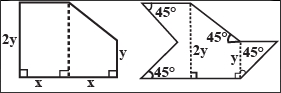
- A
$x=y$
- ✓
$x=2y$
- C
$2x=y$
- D
$x=3y$
AnswerCorrect option: B. $x=2y$
b
(b)
Given,
Area of both figures are equal
Area of fig. $(i)$ $=2 x y+\frac{1}{2} \cdot x(3 y)$
$=2 x y+\frac{3 x y}{2}=\frac{7 x y}{2}$
Area of fig.$(ii)$
Area of $A B C G+$ Area of $D E F G$
$=2 x y+(2 x-y) y$
$=2 x y+2 x y-y^2=4 x y-y^2$
$\therefore \frac{7 x y}{2}=4 x y-y^2 \Rightarrow y^2=\frac{1}{2} x y \Rightarrow 2 y=x$
View full question & answer→MCQ 741 Mark
Let $P$ be an interior point of a $\triangle A B C$. Let $Q$ and $R$ be the reflections of $P$ in $A B$ and $A C$, respectively. If $Q, A, R$ are collinear, then $\angle A$ equals
- A
$30^{\circ}$
- B
$60^{\circ}$
- ✓
$90^{\circ}$
- D
$120^{\circ}$
AnswerCorrect option: C. $90^{\circ}$
c
(c)
$A B C$ is a triangle. $P$ be interior point of a $\triangle A B C, Q$ and $R$ be the reflections of $P$ in $A B$ and $A C$ respectively.
$Q A R$ are collinear
$\therefore \angle Q A R=180^{\circ}$
$Q \text { is reflection of } P \text { on } A B$
$\therefore \angle Q A B=\angle P A B$
$R \text { is reflection of } P \text { on } A C$
$\therefore \angle R A C=\angle P A C$
$\therefore 2(\angle P A B+\angle P A C)=180^{\circ}$
$\Rightarrow \angle P A B+\angle P A C=90^{\circ}$
$\Rightarrow \angle B A C=90^{\circ}$
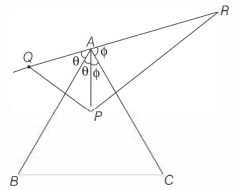
View full question & answer→MCQ 751 Mark
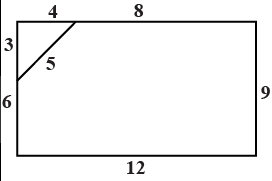
A triangular corner is cut from a rectangular piece of paper and the resulting pentagon has sides $5,6,8,9, 12$ in some order. The ratio of the area of the pentagon to the area of the rectangle is
- A
$\frac{11}{18}$
- B
$\frac{13}{18}$
- C
$\frac{15}{18}$
- ✓
$\frac{17}{18}$
AnswerCorrect option: D. $\frac{17}{18}$
d
(d)
We have,
A rectangular corner is cut form a rectangular piece of paper.
Area of rectangle
$\quad=12 \times 9=108 \text { sq units }$
$\text { Area of pentagon }$
$\qquad \quad=\text { Area of rectangle }-\text { Area of triangle }$
$\quad=108-6=102$
$\therefore \text { Ratio }=\frac{102}{108}=\frac{17}{18}$
View full question & answer→MCQ 761 Mark
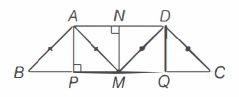
Let $A B C D$ be a trapezium with $A D$ parallel to $B C$. Assume there is a point $M$ in the interior of the segment $B C$ such that $A B=A M$ and $D C=D M$. Then, the ratio of the area of the trapezium to the area of $\triangle A M D$ is
- A
$2$
- ✓
$3$
- C
$4$
- D
not determinable from the data
Answerb
(b)
Given,
$A B C D$ is a trapezium.
$A D$ is parallel to $B C$
$M$ is point on $B C$
such that $A B=A M$ and $D C=D M$
In $\triangle A M D$
Area of $\triangle A M D=$ Area of $\triangle A M N$
$+$ Area of $\triangle D M N$
Area of $\triangle A M N=$ Area of $\triangle A M P$
$=$ Area of $\triangle A B P$
Area of $\triangle D M N=$ Area of $\triangle D Q M$
$=$ Area of $\triangle D Q C$
$\therefore$ Area of trapezium $A B C D$
$=$ Area of $\triangle A B M+$ Area of $\triangle A M D$
$+$ Area of $\triangle M D C$
$=3[$ Area of $\triangle A P M+$ Area of $\triangle D M N)$
$=3$ Area of $\triangle A M D$
Area of trapezium $A B C D$
$\quad$ Area of $\triangle A M D$
$=\quad 3[$ Area of $\triangle A D M]=\frac{3}{1}=3: 1$
View full question & answer→MCQ 771 Mark
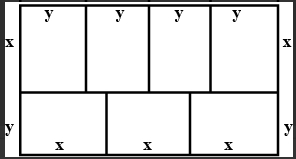
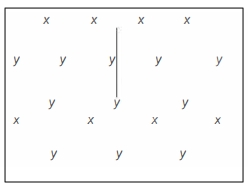
In the figure given below, a rectangle of perimeter $76$ units is divided into $7$ congruent rectangles.What is the perimeter of each of the smaller rectangles?
Answerc
(c)
Given,
Perimeter of rectangle is $76$ units.
Let $x$ and $y$ are sides of each rectangles.
$\therefore$ Perimetre of rectangle $=6 x+5 y=76$
and $\quad 4 x=3 y \quad \ldots (i)$
On solving Eqs.$(i)$ and $(ii)$,we get
$x=6, y=8$
$\therefore$ Perimeter of each rectangle
$=2(x+y)=2(6+8)=28 \text { units }$
View full question & answer→MCQ 781 Mark
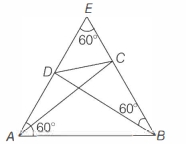
In a quadrilateral $A B C D$, which is not a trapezium, it is known that $\angle D A B=\angle A B C=60^{\circ}$. Moreover, $\angle C A B=\angle C B D$. Then,
- A
$A B=B C+C D$
- B
$A B=A D+C D$
- ✓
$A B=B C+A D$
- D
$A B=A C+A D$
AnswerCorrect option: C. $A B=B C+A D$
c
(c)
$A B C D$ is a quadrilateral
$\angle D A B=\angle A B C=60^{\circ}$
and $\quad \angle C A B=\angle C B D$
Construction, $A D$ and $B C$ produced to meet at such that
$\triangle A E B$ is an equilateral.
$\because \quad A B=B E=A E$
In $\triangle B D E$ and $\triangle A B C$,
$\angle B E D=\angle A B C$
$\angle D B E=\angle C A B$ given,
$[\because \angle D B E=\angle D B C]$
$\triangle B E D \sim \triangle A B C$
$\frac{B E}{A B}=\frac{B D}{A C}=\frac{E D}{B C} \Rightarrow \frac{B E}{A B}=\frac{E D}{B C}$
$\frac{A B}{A B}=\frac{A E-A D}{B C}$
$\Rightarrow \quad A E-A D=B C \Rightarrow A B=A D+B C$
View full question & answer→MCQ 791 Mark
The angle bisectors $B D$ and $C E$ of a $\triangle A B C$ are divided by the incentre $I$ in the ratios $3: 2$ and $2: 1$ respectively. Then, the ratio in which $I$ divides the angle bisector through $A$ is
- A
$3: 1$
- ✓
$11: 4$
- C
$6: 5$
- D
$7: 4$
AnswerCorrect option: B. $11: 4$
b
(b)
Given,
In $\triangle A B C$
The angle bisector $B D$ and $C E$ are divided by incentre $I$ in the ratio $3: 2$ and $2: 1$ respectively.
$\frac{B I}{I D}=\frac{3}{2}$
and$\frac{C I}{I C}=\frac{2}{1}$
We know, $\frac{A I}{I F}=\frac{b+c}{a}, \frac{B I}{I D}=\frac{a+c}{b}$.
$\frac{C I}{I E}=\frac{a+b}{c}$
$\because \quad \frac{B I}{I D}=\frac{a+c}{b}=\frac{3}{2} \Rightarrow 2(a+c)=3 b \quad \ldots (i)$
and $\frac{C I}{I E}=\frac{a+b}{c}=\frac{2}{1} \Rightarrow a+b=2 c$
On solving Eqs.$(i)$ and $(ii)$, we get
$b=\frac{3}{2} a \text { and } c=\frac{5}{4} a$
$\because \quad \frac{A I}{I F}=\frac{b+c}{a}=\frac{\frac{3}{2} a+\frac{5}{4} a}{a}=\frac{11}{4}$
Hence, ratio $=11: 4$.
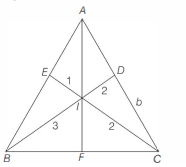
View full question & answer→MCQ 801 Mark
In a $\triangle A B C$ with $\angle A<\angle B<\angle C$, points $D, E, F$ are on the interior of segments $B C, C A, A B$ respectively. Which of the following triangles cannot be similar to $\triangle A B C ?$
- ✓
$\triangle A B D$
- B
$\triangle B C E$
- C
$\triangle C A F$
- D
$\triangle D E F$
AnswerCorrect option: A. $\triangle A B D$
a
(a)
In $\triangle A B C, \angle A < \angle B < \angle C$
In $\triangle A B D, \quad \angle D > \angle C$
So, $\triangle A B D$ not similar to $\triangle A B C$.
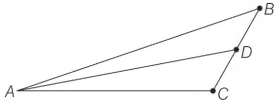
View full question & answer→MCQ 811 Mark
Consider a $\triangle A B C$ in the $X Y$-plane with vertices $A=(0,0), B=(1,1)$ and $C=(9,1)$. If the line $x=a$ divides the triangle into two parts of equal area, then a equals
Answera
(a)
Given, in $\triangle A B C$
$A(0,0), B(1,1) C(9,1)$
$\text { Area of } \triangle C D E=\frac{1}{2} \text { Area of } \triangle A B C$ $\Rightarrow \quad \frac{1}{2} \times C D \times D E=\frac{1}{4} \times B C \times A P$ $\Rightarrow \quad \frac{1}{2}(9-a) \times\left(1-\frac{a}{9}\right)=\frac{1}{4} \times 8 \times 1$
$\Rightarrow \quad (9-a)(9-a)=36$
$\Rightarrow \quad 9-a=6 \Rightarrow a=3$
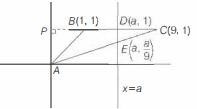
View full question & answer→MCQ 821 Mark
In a $\triangle A B C$, let $G$ denote its centroid and let $M, N$ be points in the interiors of the segments $A B, A C$, respectively, such that $M, G, N$ are collinear. If $r$ denotes the ratio of the area of $\triangle A M N$ to the area of $A B C$, then
- A
$r=1 / 2$
- B
$r > 1 / 2$
- ✓
$4 / 9 \leq r < 1 / 2$
- D
$4 / 9 < r$
AnswerCorrect option: C. $4 / 9 \leq r < 1 / 2$
c
(c)
We have,
$G$ is the centroid of $\triangle A B C, M$ and $N$ are interior point on sides $A B$ and $A C$ respectively.
$M G N$ are collinear.
If $M$ and $B$ are coincide.
$\therefore M G N$ are median of $\triangle A B C$.
$\therefore$ Area of $\triangle A M N=\frac{1}{2}$ area of $\triangle A B C$
Given, $\frac{\text { area of } \triangle A M N}{\text { area of } \triangle A B C}=r$
$\therefore \quad r_{\max }=\frac{1}{2}$
Case I When MGN are parallel to $B C$
$A G: A D=2: 3$
$\triangle A M N \sim \triangle A B C$
$\frac{\operatorname{ar}(\triangle A M N)}{\alpha r(\triangle A B C)}=\left(\frac{2}{3}\right)^2=\frac{4}{9}$
$r \geq \frac{4}{9}$
From Eqs.$(i)$ and $(ii)$, we get
$\frac{4}{9} \leq r < \frac{1}{2}$
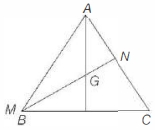
View full question & answer→MCQ 831 Mark
The number of values of $b$ for which there is an isosceles triangle with sides of lengths $b+5,3 b-2$ and $6-b$ is
Answerc
(c)
We have sides of triangle are,
$b+5,3 b-2,6-b$
Triangle are isosceles.
$\therefore$ Two sides are equal.
Case $I$ $b+5=3 b-2$
$\therefore \quad b=\frac{7}{2}$
So, sides are $\frac{17}{2}, \frac{17}{2}, \frac{5}{2}$
Case $II$ $3 b-2=6-b \Rightarrow b=2$
$\therefore$ Sides are 7, 4, 4
Case $III$ $b+5=6-b \Rightarrow b=\frac{1}{2}$
Sides are $\frac{11}{2},-\frac{1}{2}, \frac{11}{2}$ which is not possible.
$\therefore$ Only for two values of $b$, triangles are isosceles.
View full question & answer→MCQ 841 Mark
In a rectangle $A B C D$, points $X$ and $Y$ are the mid-points of $A D$ and $D C$, respectively. Lines $B X$ and $C D$ when extended intersect at $E$, lines $B Y$ and $A D$ when extended intersect at $F$. If the area of $A B C D$ is 60 , then the area of $B E F$ is
Answerc
(c)
Given, $A B C D$ is rectangle.
$\therefore \quad A B=C D, B C=A D$
$X$ and $Y$ are mid-point of $A D$ and $C D$ recnertivels
Let $A B=2 x, B C=2 y$
$\therefore A X=X D=y$
$D Y=Y C=x$
Area of rectangle $A B C D=4 x y=60$ $\Rightarrow x y=15$
In $\triangle A B X$ and $\triangle D E X$
$\triangle A B X \simeq \Delta D E X$
$D E =A B=2 x$
Similarly, $\triangle C B Y \simeq \triangle D F Y$
$\therefore F D=B C=2 y$
$\therefore$ Area of $\triangle B E F$
$=$ Area of $\triangle E F X+$ Area of $\triangle B F X$
$=\frac{1}{2} F X \cdot D E+\frac{1}{2} F X \cdot A B$
$=\frac{1}{2} \times 3 y \times 2 x+\frac{1}{2} \times 3 y \times 2 x$
$=6 x y$
$=6 \times 15=90 \quad[\because x y=15]$
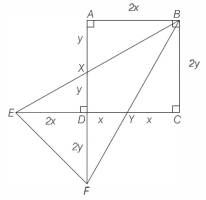
View full question & answer→MCQ 851 Mark
In the figure given below, $A B C D E F$ is a regular hexagon of side length $1$, $A F P S$ and $A B Q R$ are squares. Then, the ratio $\operatorname{ar}(A P Q) \operatorname{lar}(S R P)$ equals
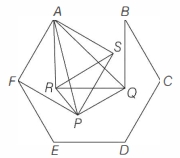
- A
$\frac{\sqrt{2}+1}{2}$
- B
$\sqrt{2}$
- C
$\frac{3 \sqrt{3}}{4}$
- ✓
$2$
Answerd
(d)
Given,
$A B C D E F$ is a regular hexagon of side length $1.$
$A B Q R$ and $A F P S$ is a square of each side length also $1 .$
$A D C D E F$ is a regular hexagon
$\therefore \quad \angle F A B=120^{\circ}$
$\text { In square } A B Q R,$
$\qquad A B=B Q=1$
$A Q$ is a diagonal of square
$\therefore \quad A Q=\sqrt{A B^2+B Q^2}=\sqrt{2}$
$\Rightarrow \angle B A S=\angle F A B-\angle F A S$
$\quad=120^{\circ}-90^{\circ}=30^{\circ}$
$\Rightarrow \angle S A R=\angle B A R-\angle B A S$
$\quad=90^{\circ}-30^{\circ}=60^{\circ}$
$\Rightarrow \angle A S R=60^{\circ}$
$\qquad \quad[\because A R S \text { is an equilateral triangle }]$
$\Rightarrow \angle R S P=\angle A S P-\angle A S R$
$\quad=90^{\circ}-60^{\circ}=30^{\circ}$
$\Rightarrow \angle F A B=\angle F A P+\angle P A Q+\angle Q A B$
$\Rightarrow \quad 120^{\circ}=45^{\circ}+\angle P A Q+45^{\circ}$
${\left[\because \angle F A P=\angle Q A B=45^{\circ}\right.}$
$F A=F P$ and $A B=B Q]$
$\therefore \angle P A Q=30^{\circ}$
$\therefore \frac{\text { Area of } \triangle P A Q}{\text { Area of } \triangle R S P}=\frac{\frac{1}{2} \times A Q \times A P \times \sin 30^{\circ}}{\frac{1}{2} \times R S \times P S \times \sin 30^{\circ}}$
$=\frac{\sqrt{2} \times \sqrt{2}}{1}=2$
$[\because A Q=A P=\sqrt{2}, R S=P S=1]$
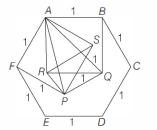
View full question & answer→MCQ 861 Mark
On each face of a cuboid, the sum of its perimeter and its area is written. Among the six numbers so written, there are three distinct numbers and they are $16,24$ and $31$.The volume of the cuboid lies between
- A
$7$ and $14$
- B
$14$ and $21$
- C
$21$ and $28$
- ✓
$28$ and $35$
AnswerCorrect option: D. $28$ and $35$
d
(d)
Let the length, breadth and height of cuboid be $x, y$ and $z$ respectively. $\therefore$ Perimeter of face $P Q R S=2(x+y)$
Area of $P Q R S=x y$
$2(x+y)+x y=16$
Similarly, for face $A P S D$,
$\qquad 2(y+z)+y z=24$
$\text { and for face } A P Q B$
$2(x+z)+x z=31$
$\text { From Eqs. $(ii)$ and $(iii)$, we get }$
$(x-y)(2+z)=7$
From Eqs. $(ii)$ and $(iv)$, we get
$4 x=2+5 y$
On solving Eqs.$(i)$ and $(v)$, we get
$x=3, y=2, z=5$
$\therefore$ Volume of cuboid $=x y z=3 \times 2 \times 5=30$
Hence, option $(d)$ is correct.
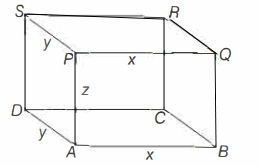
View full question & answer→MCQ 871 Mark
Let $A B C D$ be a square andlet $P$ be a point on segment $C D$ such that $D P: P C=1: 2$. Let $Q$ be a point on segment $A P$ such that $\angle B Q P=90^{\circ}$. Then, the ratio of the area of quadrilateral $P Q B C$ to the area of the square $A B C D$ is
- A
$\frac{31}{60}$
- B
$\frac{37}{60}$
- C
$\frac{39}{60}$
- ✓
$\frac{41}{60}$
AnswerCorrect option: D. $\frac{41}{60}$
d
(d)
Given, $A B C D$ is a square.
Let $A B=B C=C D=A D=3 x$
$P D: P C =1: 2$
$P D =x$
$P C =2 x$
In $\triangle D A P$ and $\triangle Q B A$,
$\angle D A P =\angle Q B A$
$\angle D =\angle Q=90^{\circ}$
$\triangle D A P \sim \triangle Q B A$
$\frac{D A}{Q B}=\frac{A P}{B A}=\frac{D P}{Q B}$
$\frac{3 x}{Q B}=\frac{\sqrt{10} x}{3 x}=\frac{x}{Q A}$
$\quad\left[\because A P=\sqrt{\left.9 x^2+x^2=\sqrt{10} x\right]}\right.$
$\therefore \quad Q B=\frac{9}{\sqrt{10}} x \Rightarrow Q A=\frac{3}{\sqrt{10}} x$
Area of quadrilateral $B Q P C=$ area of square $A B C D-($ area of $\triangle A P D+$ area of $\triangle A B Q)$
$=(3 x)^2-\left(\frac{1}{2} \times 3 x \times x+\frac{1}{2} \times \frac{9}{\sqrt{10}} x \times \frac{3}{\sqrt{10}} x\right)$
$=9 x^2-\left(\frac{3}{2} x^2+\frac{27}{20} x^2\right)=\frac{123 x^2}{20}$
$\frac{\text { Area of quadrilateral } P Q B C}{\text { Area of square } A B C D}=\frac{\frac{123 x^2}{20}}{9 x^2}$
$=\frac{41}{60}$
View full question & answer→MCQ 881 Mark
Let $H$ be the orthocentre of an acute angled $\triangle A B C$ and $O$ be its circumcenter. Then, $H A + H B + H C$
- A
is equal to $HO$
- B
is equal to $3 HO$
- ✓
is equal to $2 HO$
- D
is not a scalar multiple of HOin general
AnswerCorrect option: C. is equal to $2 HO$
c
(c)
Given, $H$ is orthocentre of $\triangle A B C$ and $O$ is circumcentre of $\triangle A B C$.
Let centroid of $\triangle A B C$ is $G$.
In acute angle $\triangle A B C$,
We know, $H G: G O=2: 1$
$L =\frac{ A + B + C }{3}$
Now, $G =\frac{2 O + H }{3}$
$\Rightarrow \quad 3 G =2 O + H$
$\therefore HA + HB + HC$
$= A - H + B - H + C - H$
$=( A + B + C )-3 H$
$=3 G -3 H$
$=2 O + H -3 H$
$=2 O -2 H$
$=2 HO$

View full question & answer→MCQ 891 Mark
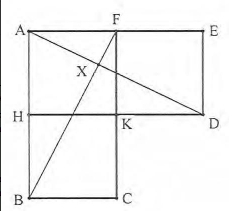
In the figure, $A H K F, F K D E$ and $H B C K$ are unit squares, $A D$ and $B F$ intersect in $X$. Then, the ratio of the areas of triangles $A X F$ and $A B F$ is
- A
$\frac{1}{4}$
- ✓
$\frac{1}{5}$
- C
$\frac{1}{6}$
- D
$\frac{1}{8}$
AnswerCorrect option: B. $\frac{1}{5}$
b
(b)
We have,
$A H K F, F K D E$ and $H B C K$ is a unit square. $A D$ and $B F$ intersect at $X$. In $\triangle A B F, \quad A B=2$
$A F=1$
$\therefore F B^2=A B^2+A F^2=4+1=5$
In $\triangle A X F$ and $\triangle B A F$,
$\angle F =\angle F$
$\angle X =\angle A=\left(90^{\circ}\right)$
$\therefore \quad \triangle A X F \sim \Delta B A F$
$\therefore \quad \frac{\operatorname{ar}(\triangle A X F)}{\operatorname{ar}(B A F)}$ $=\frac{A F^2}{B F^2}=\frac{1}{5}$
View full question & answer→MCQ 901 Mark
Let $A B C$ be a triangle with $\angle B=90^{\circ}$. Let $A D$ be the bisector of $\angle A$ with $D$ on $B C$. Suppose $A C=6 cm$ and the area of the $\triangle A D C$ is $10 cm ^2$. Then, the length of $B D$ in $cm$ is equal to
- A
$\frac{3}{5}$
- B
$\frac{3}{10}$
- C
$\frac{5}{3}$
- ✓
$\frac{10}{3}$
AnswerCorrect option: D. $\frac{10}{3}$
d
(d)
Given,
$A B C$ is right angled triangle with $B$ is $90^{\circ} .$
$A D$ is angle bisector of $\angle A$.
$\therefore \quad \frac{A B}{A C}=\frac{B D}{D C}$
$\Rightarrow \quad A B \cdot C D=B D \cdot A C$
Area of $\triangle A D C=10$
$\Rightarrow \quad \frac{1}{2} \times A B \cdot C D=10$
$\Rightarrow \quad \frac{1}{2} \times B D \cdot A C=10$
$\Rightarrow \quad B D=\frac{20}{A C}$
$\Rightarrow \quad B D=\frac{20}{6} \quad[\because A C=6]$
$\Rightarrow \quad B D=\frac{10}{3}$

View full question & answer→MCQ 911 Mark
Let $A=(4,0), B=(0,12)$ be two points in the plane.The locus of a point $C$ such that the area of $\triangle A B C$ is $18$ sq units is
- A
$(y+3 x+12)^2=81$
- B
$(y+3 x+81)^2=12$
- ✓
$(y+3 x-12)^2=81$
- D
$(y+3 x-81)^2=12$
AnswerCorrect option: C. $(y+3 x-12)^2=81$
c
(c)
Given, $A(4,0)$ and $B(0,12)$.
Let $C(x, y)$
$\begin{array}{l} \text { Area of } \triangle A B C=\frac{1}{2}\left|\begin{array}{ccc} x & y & 1 \\ 4 & 0 & 1 \\ 0 & 12 & 1 \end{array}\right|\end{array}$
$\Rightarrow 18=\frac{1}{2}|\{x(0-12)-y(4-0)+1(48-0)\}|$
$\Rightarrow 18=\frac{1}{2}|(-12 x-4 y+48)|$
$\Rightarrow 18=\frac{-4}{2}|(3 x+y-12)|$
$\Rightarrow \quad(3 x+y-12)^2=81$
$\Rightarrow \quad(y+3 x-12)^2=81$
View full question & answer→MCQ 921 Mark
A frog is presently located at the origin $(0,0)$ in the $X Y$-plane. It always jumps from a point with integer coordinates to a point with integer coordinates moving a distance of $5$ units in each jump. What is the minimum number of jumps required for the frog to go from $(0,0)$ to $(0,1)$ ?
Answerb
(b)
We have, initial position of frog $=(0,0)$
After $1st$ jump position of frog at $(4,3)$.
At $2 nd$ jump position of frog at $(0,6)$.
At $3rd$ jump position of frog at $(0,1)$.
$\therefore$ Minimum number of jumps required for the frog to go from $(0,0)$ to $(0,1)$ and each distance is $5$ units is $3$.

View full question & answer→MCQ 931 Mark
Consider a square $A B C D$ of side $12$ and let $M, N$ be the midpoints of $A B, C D$ respectively. Take a point $P$ on $M N$ and let $A P=r, P C=s$. Then, the area of the triangle whose sides are $r, s, 12$ is
- A
$72$
- ✓
$36$
- C
$\frac{r s}{2}$
- D
$\frac{r s}{4}$
Answerb
(b)
Given $A B C D$ is square
$A B=B C=12$ units
$M$ is mid-point of $A B$,
$N$ is mid-point of $C D$,
$P$ is point of $M N$ and $C P=S$
$\because A P B$ is an isosceles triangle,
$A P=P B=r$
$O P=M B=6$ units
Area of triangle whose sides $r, s$ and $12$ are the area of $\triangle P B C$
$=\frac{1}{2} \times$ Base $\times$ Height $=\frac{1}{2} \times B C \times O P$
$=\frac{1}{2} \times 12 \times 6=36$ sq units
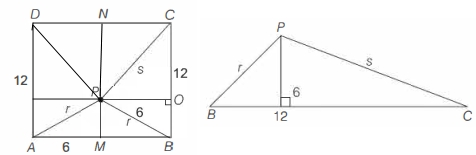
View full question & answer→MCQ 941 Mark
The three different face diagonals of a cuboid (rectangular parallelopiped) have lengths $39,40,41$. The length of the main diagonal of the cuboid which joins a pair of opposite corners is
- ✓
$49$
- B
$49 \sqrt{2}$
- C
$60$
- D
$60 \sqrt{2}$
Answera
(a)
Let the length, breadth and height of cuboid is $l, b$ and $h$ respectively.
$Given, l^2+h^2=39^2$
$\Rightarrow b^2+h^2=40^2$
$\Rightarrow \quad l^2+b^2=41^2$
$\Rightarrow \quad 2\left(l^2+b^2+h^2\right)=39^2+40^2+41^2$
$\Rightarrow \quad l^2+b^2+h^2=2401$
$\therefore$ Length of longest diagonal
$=\sqrt{l^2+b^2+h^2}$
$=\sqrt{2401}=49$
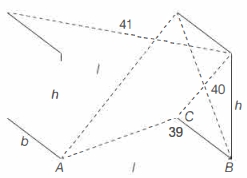
View full question & answer→MCQ 951 Mark
Let $A B C$ be an equilateral triangle, let $K L M N$ be a rectangle with $K, L$ on $B C, M$ on $A C$ and $N$ on $A B$. Suppose $A N / N B=2$ and the area of $\triangle B K N$ is $6$ .The area of the $\triangle A B C$ is
- A
$54$
- ✓
$108$
- C
$48$
- D
not determinable with the above data
Answerb
(b)
Given,
$A B C$ is an equilateral triangle.
$\therefore \quad A B=B C=A C$
$K L M N$ be a rectangle.
$\therefore \quad K L=M N$
and $N K=L M$
$\frac{A N}{N B}=2$
$\therefore \quad A N=2 N B=A M=M N$
$A B=A N+N B=3 N B$.
Area of $\triangle B K N=6$
$\ln \triangle B K N$,
$\begin{array}{l}\quad \sin 60^{\circ}=\frac{N K}{B N} \Rightarrow N K=\frac{\sqrt{3}}{2} B N \\\text { Area of } \triangle B K N=\frac{1}{2} \cdot B N \cdot N K \sin 30^{\circ} \\\Rightarrow \quad 6=\frac{1}{2} \cdot B N \cdot \frac{\sqrt{3}}{2} \cdot B N \cdot \frac{1}{2} \Rightarrow B N^2=\frac{48}{\sqrt{3}} \\ \therefore \text { Area of } \triangle A B C=\frac{\sqrt{3}}{4} \times A B^2 \\ =\frac{\sqrt{3}}{4} \times 9 B N^2=\frac{\sqrt{3}}{4} \times 9 \times \frac{48}{\sqrt{3}}=108 \end{array}$
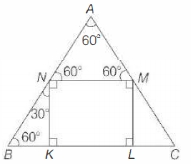
View full question & answer→MCQ 961 Mark
Among all cyclic quadrilaterals inscribed in a circle of radius $R$ with one of its angles equal to $120^{\circ}$. Consider the one with maximum possible area. Its area is
- A
$\sqrt{2} R^2$
- ✓
$\sqrt{3} R^2$
- C
$2 R^2$
- D
$2 \sqrt{3} R^2$
AnswerCorrect option: B. $\sqrt{3} R^2$
b
(b)
$A B C D$ is a cyclic quadrilateral $\angle A=120^{\circ}$
$A B C D$ has maximum area possible.
When $\angle B=\angle D=90^{\circ}$
$\therefore$ Area of quadrilateral
$=2 \times \frac{1}{2} \times A D \times D C$
$=2 \times \frac{1}{2} \times R \times \sqrt{3} R$
$=\sqrt{3} R^2 \quad[\because A D=R, D C=\sqrt{3} R]$
View full question & answer→MCQ 971 Mark
A rectangle is divided into $16$ sub-rectangles as in the figure, the number in each sub-rectangle represents the area of that sub-rectangle. What is the area of the rectangle $K L M N$ ?
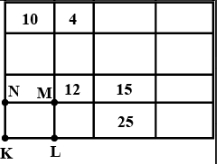
Answerd
(d)
Area of rectangles are
$a c=10$
$b c=4$
$b d=12$
$d e=15$
$e f=25$
$\therefore \frac{a c}{b c} \times \frac{b d}{d e} \times e f =\frac{10}{4} \times \frac{12}{15} \times 25$
$\Rightarrow a f =50$
View full question & answer→MCQ 981 Mark
The lengths of the sides and the diagonal of an isosceles trapezium form a two-element set $\{a, b\}$. If $a > b$, then $a / b$ equals
AnswerCorrect option: A. $\frac{1}{2}(\sqrt{6}+\sqrt{2})$
View full question & answer→MCQ 991 Mark
Let $P_1, P_2, P_3, P_4, P_5$ be five equally spaced points on the circumference of a circle of radius 1 , centred at $O$. Let $R$ be the set of points in the plane of the circle that are closer to $O$ than any of $P_1, P_2, P_3, P_4, P_5$. Then, $R$ is a
- A
- ✓
- C
- D
oval region that is not circular
Answerb
(b)
$P_1, P_2, P_3, P_4, P_5$ be five equally spaced points on the circumference of circle of radius $1$ .
Let $R$ which is near to point $O$. $\therefore O R$ is lie between the pentagonal region $Q_1, Q_2, Q_3, Q_4, Q_5$

View full question & answer→MCQ 1001 Mark
In a triangle, two vertices are $(2,3)$ and $(4,0)$, and its circumcentre is $(2, z)$ for some real number $z$. The circumradius is
- A
$\frac{6}{2+\sqrt{13}}$
- B
$\sqrt{5}$
- C
$2$
- ✓
$\frac{13}{6}$
AnswerCorrect option: D. $\frac{13}{6}$
d
(d)
$\because O(2, z)$ is circumcentre of $\triangle A B C$.
$O A^2=O B^2$
$\Rightarrow (2-z)^2+(z-3)^2=(4-2)^2+(z)^2$
$\Rightarrow z^2-6 z+9=4+z^2$
$\Rightarrow z=\frac{5}{6}$
$\Rightarrow O A=r=\sqrt{\left(\frac{5}{6}-3\right)^2}=\frac{13}{6}$

View full question & answer→MCQ 1011 Mark
Let $t_n$ denote the number of integral-sided triangles with distinct sides chosen from $\{1,2,3, \ldots, n\}$. Then, $t_{20}-t_{19}$ equals
Answera
(a)
$t_n$ denotes the number of integral sided triangle with distincts sides from $\{1,2,3, \ldots, n\} . t_{19}$ is the number of triangle formed by the sides from $\{1,2,3, \ldots, 19\}$ and $t_{20}$ is the number of triangle formed by the distinct sides from $\{1,2,3, \ldots, 20\}$.
Any triangle counted in $t_{19}$ is also counted in $t_{20}$, but $t_{20}-t_{19}$ is the number of triangle counted in $t_{20}$ but not in $t_{19+}$ A triangle is counted in $t_{20}$ but no $t_{19}$ if and only if its largest side is $20$.
The middle side of is $a$ and the smallest side can be $21-a$ to $a-1$
So, the number of triangle with largest side 20 and middle side.
$a=11$, then other sides are 21-11, 11-1
i.e. $10,10(11,10,10) 1$ triangle. Similarly
$a=12$, (smallest sides are $(9,10,11)=3$
triangle $a=13$, smallest sides are
$(8,9,10,11,12)=5$ triangle
$\therefore$ Total number of triangles on
$1+3+5+7+\ldots .+17=81$
View full question & answer→MCQ 1021 Mark
Let $\left(5, \frac{a}{4}\right)$, be the circumcenter of a triangle with vertices $A(a,-2), B(a, 6)$ and $C\left(\frac{a}{4},-2\right)$. Let $\alpha$ denote the circumradius, $\beta$ denote the area and $\gamma$ denote the perimeter of the triangle. Then $\alpha+\beta+\gamma$ is
Answerb
$ A(a,-2), B(a, 6), C\left(\frac{a}{4},-2\right), O\left(5, \frac{a}{4}\right) $
$ A O=B O $
$ (a-5)^2+\left(\frac{a}{4}+2\right)^2=(a-5)^2+\left(\frac{a}{4}-6\right)^2 $
$ a=8 $
$ A B=8, A C=6, B C=10 $
$ \alpha=5, \beta=24, \gamma=24$A
View full question & answer→MCQ 1031 Mark
Let $A$ and $B$ be two finite sets with $m$ and $n$ elements respectively. The total number of subsets ments set $A$ is $56$ more than the total number of subsets of $B$. Then the distance of the point $P(m, n)$ from the point $Q(-2,-3)$ is
Answera
$2^{\mathrm{m}}-2^{\mathrm{n}}=56 $
$2^{\mathrm{n}}\left(2^{\mathrm{m}-\mathrm{n}}-1\right)=2^3 \times 7 $
$ 2^{\mathrm{n}}=2^3 \text { and } 2^{\mathrm{m}-\mathrm{n}}-1=7 $
$ \Rightarrow \mathrm{n}=3 \text { and } 2^{\mathrm{m}-\mathrm{n}}=8 $
$ \Rightarrow \mathrm{n}=3 \text { and } \mathrm{m}-\mathrm{n}=3 $
$ \Rightarrow \mathrm{n}=3 \text { and } \mathrm{m}=6 $
$ \mathrm{P}(6,3) \text { and } \mathrm{Q}(-2,-3) $
$ \mathrm{PQ}=\sqrt{8^2+6^2}=\sqrt{100}=10$
Hence option $(1)$ is correct
View full question & answer→MCQ 1041 Mark
If $\mathrm{P}(6,1)$ be the orthocentre of the triangle whose vertices are $A(5,-2), B(8,3)$ and $C(h, k)$, then the point $C$ lies on the circle.
- ✓
$x^2+y^2-65=0$
- B
$x^2+y^2-74=0$
- C
$x^2+y^2-61=0$
- D
$x^2+y^2-52=0$
AnswerCorrect option: A. $x^2+y^2-65=0$
a
Slope of $\mathrm{AD}=3$
Slope of $\mathrm{BC}=-\frac{1}{3}$
equation of $\mathrm{BC}=3 \mathrm{y}+\mathrm{x}-17=0$
slope of $\mathrm{BE}=1$
Slope of $A C=-1$
equation of $A C$ is $x+y-3=0$
point $C$ is $(-4,7)$
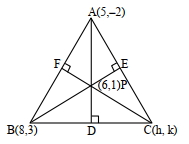
View full question & answer→MCQ 1051 Mark
If the orthocentre of the triangle formed by the lines $2 x+3 y-1=0, x+2 y-1=0$ and $a x+b y-1=0$, is the centroid of another triangle, whose circumecentre and orthocentre respectively are $(3,4)$ and $(-6,-8)$, then the value of $|a-b|$ is..........
Answerb
$ 2 x+3 y-1=0 $
$ x+2 y-1=0 $
$ a x+b y-1=0$
$Image$
$ \left(\frac{6-6}{3}, \frac{8-8}{3}\right) $
$ =(0,0)$
$Image$
$ a x+b y-1=0 $
$ \left(\frac{1-0}{-1-0}\right)\left(\frac{-a}{b}\right)=-1 $
$ \Rightarrow-a=b $
$ \Rightarrow \quad a x-a y-1=0 $
$ a x-a\left(1-\frac{2 x}{3}\right)-1 $
$ x\left(a+\frac{2 a}{3}\right)=\frac{a}{3} $
$ x=\frac{a+3}{5 a} $
$ 2\left(\frac{a+3}{5 a}\right)+3 y-1=0 $
$ y=\frac{1-\frac{2 a+6}{5 a}}{3}=\frac{3 a-6}{3 \times 5 a} $
$ y=\frac{a-2}{5 a} $
$ \left(\frac{a-2}{5 a}\right) $
$ \left(\frac{a+3}{5 a}\right) $
$ a=-8 $
$ b=8 $
$ -8 x+8 y-1=0 $
$ |a-b|=16$
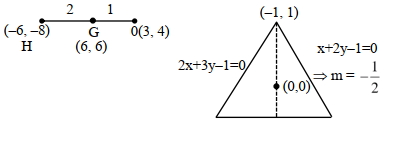
View full question & answer→MCQ 1061 Mark
Let $(\alpha, \beta)$ be the centroid of the triangle formed by the lines $15 x-y=82,6 x-5 y=-4$ and $9 x+4 y=17$. Then $\alpha+2 \beta$ and $2 \alpha-\beta$ are the roots of the equation $...........$.
- A
$x^2-7 x+12=0$
- ✓
$x^2-13 x+42=0$
- C
$x^2-14 x+48=0$
- D
$x^2-10 x+25=0$
AnswerCorrect option: B. $x^2-13 x+42=0$
b
Sol. upon solving we get coordinates as $(6,8),(1,2)$ and $(5,-7)$
So centroid : $(\alpha, \beta)$ is
$\alpha=\frac{6+1+5}{3}=4$
$\beta=\frac{8+2-7}{3}=1$
$\alpha+2 \beta=6$
$2 \alpha-\beta=7$
$\text { Ans. } x^2-13 x+42=0$
View full question & answer→MCQ 1071 Mark
If the orthocentre of the triangle, whose vertices are $(1,2),(2,3)$ and $(3,1)$ is $(\alpha, \beta)$, then the quadratic equation whose roots are $\alpha+4 \beta$ and $4 \alpha+\beta$, is
- A
$x ^2-19 x +90=0$
- B
$x ^2-18 x +80=0$
- C
$x ^2-22 x +120=0$
- ✓
$x^2-20 x+99=0$
AnswerCorrect option: D. $x^2-20 x+99=0$
d
Here $mBH \times mAC =-1$
$\left(\frac{\beta-3}{\alpha-2}\right)\left(\frac{1}{-2}\right)=-1$
$\beta-3=2 \alpha-4$
$\beta=2 \alpha-1$
$m _{ AH } \times m _{ HC }=-1$
$\left(\frac{\beta-2}{\alpha-1}\right)(-2)=-1$
$2 \beta-4=\alpha-1 $$2(2 \alpha-1)=\alpha+3$
$3 \alpha=5$
$\alpha=\frac{5}{3}, \beta=\frac{7}{3} \Rightarrow H \left(\frac{5}{3}, \frac{7}{3}\right)$
$\alpha+4 \beta=\frac{5}{3}+\frac{28}{3}=\frac{33}{3}=11$
$\beta+4 \alpha=\frac{7}{3}+\frac{20}{3}=\frac{27}{3}=9$
$x ^2-20 x +99=0$
View full question & answer→MCQ 1081 Mark
Let $C(\alpha, \beta)$ be the circumcenter of the triangle formed by the lines
$4 x+3 y=69$
$4 y-3 x=17 \text { and }$
$x+7 y=61$
Then $(\alpha-\beta)^2+\alpha+\beta$ is equal to $.........$.
Answerb
$4 x+28 y=244$
$4 x+3 y=69$
$25 y=175$
$y=7, x=12$
$A(12,7)$
$-3 x+4 y=17$
$3 x+21 y=183$
$25 y=200$
$y=8, x=5$
$B (5,8)$
$\therefore \text { Circumcenter }$
$\alpha=\frac{17}{2} \beta=\frac{15}{2}$
$\left(\frac{17}{2}, \frac{15}{2}\right)$
$(\alpha-\beta)^2+\alpha+\beta$
$1+16=17$
View full question & answer→MCQ 1091 Mark
If $(\alpha, \beta)$ is the orthocentre of the triangle $A B C$ with vertices $A(3,-7), B(-1,2)$ and $C(4,5)$, then $9 \alpha-6 \beta+60$ is equal to:
Answerb
Altitude of BC: $y+7=\frac{-5}{3}(x-3)$
$3 y+21=-5 x+15$
$5 x+3 y+6=0$
Altitude of $AC : y -2=\frac{-1}{12}( x +1)$
$12 y-24=-x-1$
$x+12 y=23$
$\alpha=\frac{-47}{19}, \quad \beta=\frac{121}{57}$
$9 \alpha-6 \beta+60=25$
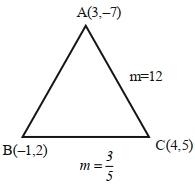
View full question & answer→MCQ 1101 Mark
Let $R$ be a rectangle given by the lines $x =0, x =2$, $y=0$ and $y=5$. Let $A(\alpha, 0)$ and $B(0, \beta), \alpha \in[0,2]$ and $\beta \in[0,5]$, be such that the line segment $A B$ divides the area of the rectangle $R$ in the ratio $4: 1$. Then, the mid-point of $AB$ lies on a $.........$.
Answerb
$\frac{ ar ( OPQR )}{\operatorname{or}( OAB )}=\frac{4}{1}$
Let $M$ be the mid-point of $A B$.
$M ( h , k ) \equiv\left(\frac{\alpha}{2}, \frac{\beta}{2}\right)$
$\frac{10-\frac{1}{2} \alpha \beta}{\frac{1}{2} \alpha \beta}=4$
$\frac{5}{2} \alpha \beta=10 \Rightarrow \alpha \beta=4$
$(2 h )(2 K )=4$
Locus of $M$ is $x y=1$
Which is a hyperbola.
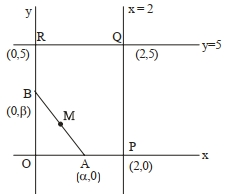
View full question & answer→MCQ 1111 Mark
The equations of the sides $AB , BC$ and $CA$ of a triangle $ABC$ are: $2 x + y =0, x + py =21 a ,( a \neq 0)$ and $x-y=3$ respectively. Let $P(2, a)$ be the centroid of $\triangle ABC$. Then $( BC )^2$ is equal to $........$
Answerd
Assume $B (\alpha,-2 \alpha) \quad$ and $C (\beta+3, \beta)$
$\frac{\alpha+\beta+3+1}{3}=2 \quad \text { also } \frac{-2 \alpha-2+\beta}{3}= a$
$\begin{array}{lc}\Rightarrow \alpha+\beta=2 & -2 \alpha-2+\beta=3 a \\\Rightarrow \beta=2-\alpha & -2 \alpha- 2+ 2-\alpha=3 a \Rightarrow \alpha=- a\end{array}$
Now both $B$ and $C$ lies as given line
$\alpha- p \cdot 2 \alpha=21 a$
$\alpha(1-2 p )=21 a$
$-\alpha(1-2 p )=21 a \Rightarrow p =11$
$\beta+3+ p \beta=21 a$
$\beta+3+11 \beta=21 a$
$21 \alpha+12 \beta+3=0$
Also $\beta=2-\alpha$
$21 \alpha+12(2-\alpha)+3=0$
$21 \alpha+24-12 \alpha+3=0$
$9 \alpha+27=0$
$\alpha=-3, \beta=5$
So $BC =\sqrt{122}$ and $( BC )^2=122$
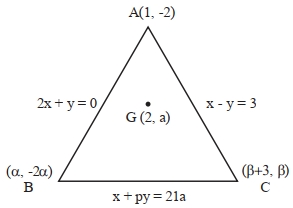
View full question & answer→MCQ 1121 Mark
$A$ line segment $AB$ of length $\lambda$ moves such that the points $A$ and $B$ remain on the periphery of a circle of radius $\lambda$. Then the locus of the point, that divides the line segment $A B$ in the ratio $2: 3$, is a circle of radius
AnswerCorrect option: D. $\frac{\sqrt{19}}{5} \lambda$
d
$h=\frac{\frac{2 \lambda}{\sqrt{2} \sin \theta}+3 \times \frac{\lambda}{\sqrt{2}} \cos \theta}{5}$
$k=\frac{\frac{-2 \lambda}{\sqrt{2}} 2 \cos \theta+\frac{3 \lambda}{\sqrt{2}} \sin \theta}{5}$
$h^2+k^2=\frac{19 \lambda^2}{5}$
$r=\frac{\sqrt{19} \lambda}{5}$
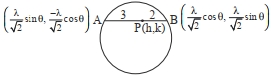
View full question & answer→MCQ 1131 Mark
The distance of the origin from the centroid of the triangle whose two sides have the equations $x -2 y +1=0$ and $2 x - y -1=0$ and whose orthocenter is $\left(\frac{7}{3}, \frac{7}{3}\right)$ is
- A
$\sqrt{2}$
- B
$2$
- ✓
$2 \sqrt{2}$
- D
$4$
AnswerCorrect option: C. $2 \sqrt{2}$
c
$AB \equiv x -2 y +1=0$
$AC \equiv 2 x - y -1=0$
So $A (1,1)$
Altitude from $B$ is $BH = x +2 y -7=0 \Rightarrow B (3,2)$
Altitude from $C$ is $CH =2 x + y -7=0 \Rightarrow C (2,3)$
Centroid of $\triangle ABC = E (2,2) OE =2 \sqrt{2}$
View full question & answer→MCQ 1141 Mark
Let $R$ be the point $(3,7)$ and let $P$ and $Q$ be two points on the line $x+y=5$ such that $P Q R$ is an equilateral triangle. Then the area of $\triangle PQR$ is
- A
$\frac{25}{4 \sqrt{3}}$
- B
$\frac{25 \sqrt{3}}{2}$
- C
$\frac{25}{\sqrt{3}}$
- ✓
$\frac{25}{2 \sqrt{3}}$
AnswerCorrect option: D. $\frac{25}{2 \sqrt{3}}$
d
$x+y=5$
$\sin 60^{\circ}=\frac{5 / \sqrt{2}}{a}$
$a=\frac{5 \sqrt{2}}{3}$
Area of $\triangle PQR =\frac{\sqrt{3}}{4} a ^{2}=\frac{25}{2 \sqrt{3}}$
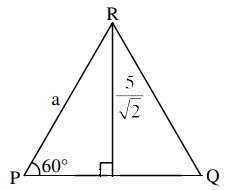
View full question & answer→MCQ 1151 Mark
A rectangle $R$ with end points of the one of its dies as $(1,2)$ and $(3,6)$ is inscribed in a circle. If the equation of a diameter of the circle is $2 x - y +4=$ 0 , then the area of $R$ is
Answerc
Eq. of line $A B$
$y=2 x$
Slope of $AB =2$
Slope of given diameter $=2$
So the diameter is parallel to $AB$
Distance between diameter and line $AB$ $=\left(\frac{4}{\sqrt{2^{2}+12}}\right)=\frac{4}{\sqrt{5}}$
Thus $BC =2 \times \frac{4}{\sqrt{5}}=\frac{8}{\sqrt{5}}$
$AB =\sqrt{(1-3)^{2}+(2-6)^{2}}=\sqrt{20}=2 \sqrt{5}$
$\text { Area }= AB \times BC =\frac{8}{\sqrt{5}} \times 2 \sqrt{5}=16 \text { Ans. }$
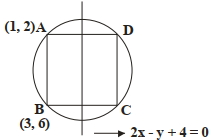
View full question & answer→MCQ 1161 Mark
Let $A \left(\frac{3}{\sqrt{ a }}, \sqrt{ a }\right) a >0$, be a fixed point in the $xy$-plane. The image of $A$ in $y$-axis be $B$ and the image of $B$ in $x$-axis be $C$. If $D(3 \cos \theta$, a $\sin \theta)$ is a point in the fourth quadrant such that the maximum area of $\triangle ACD$ is $12$ square units, then $a$ is equal to
Answerb
$A =\left(\frac{3}{\sqrt{ a }}, \sqrt{ a }\right)$
$B =\left(\frac{-3}{\sqrt{ a }}, \sqrt{ a }\right)$
$C =\left(-\frac{3}{\sqrt{ a }},-\sqrt{ a }\right)$
Area of $ACD$
$\frac{1}{2}\left|\begin{array}{cc}\frac{3}{\sqrt{a}} & \sqrt{a} \\ -\frac{3}{\sqrt{a}} & -\sqrt{a} \\ 3 \cos \theta & a \sin \theta \\ \frac{3}{\sqrt{a}} & \sqrt{a}\end{array}\right|$
$\frac{1}{2} 6 \sqrt{ a }(\cos \theta-\sin \theta)$
$3 \sqrt{ a }(\cos \theta-\sin \theta)$
max values of function is $3 \sqrt{ a } \sqrt{2}$
$3 \sqrt{a} \sqrt{2}=12$
$2 a=16$
$a=8$
View full question & answer→MCQ 1171 Mark
In an isosceles triangle $ABC$, the vertex $A$ is $(6,1)$ and the equation of the base $BC$ is $2 x + y =4$. Let the point $B$ lie on the line $x+3 y=7$. If $(\alpha, \beta)$ is the centroid $\triangle A B C$, then $15(\alpha+\beta)$ is equal to
Answerd
Point $B (1,2)$
Now let $C$ be $(h, 4-2h)$
(As $C$ lies on $2 x+y=4$ )
$\because \Delta$ is isosceles with base $B C$
$\therefore A B=A C$
$\sqrt{25+1}=\sqrt{(6-h)^{2}+(2 h-3)^{2}}$
$\sqrt{26}=\sqrt{36+h^{2}-12 h+4 h^{2}+9-12 h}$
$26=5 h^{2}-24 h+45 \Rightarrow 5 h^{2}-24 h+19=0$
$\Rightarrow 5 h^{2}-5 h-19 h+19=0$
$h=\frac{19}{5}$ or $h =1$
Thus $C\left(\frac{19}{5}, \frac{-18}{5}\right)$
Centroid $\left(\frac{6+1+\frac{19}{5}}{3}, \frac{1+2-\frac{18}{5}}{3}\right)$
$\left(\frac{35+19}{15}, \frac{15-18}{15}\right)$
$\left(\frac{54}{15}, \frac{-3}{15}\right)$
$\alpha=\frac{54}{15} ; \beta=\frac{-3}{15}$
$15(\alpha+\beta)=51$
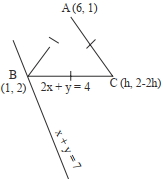
View full question & answer→MCQ 1181 Mark
The equations of the sides $AB , BC$ and $CA$ of a triangle $ABC$ are $2 x + y =0, x + py =15 a$ and $x-y=3$ respectively. If its orthocentre is $(2, a)$, $-\frac{1}{2}< a <2$, then $p$ is equal to$...$
Answerc
Coordinates of $A (1,-2)$,
orthocentre $H (2$, a)
Slope of $AH = p$
$a +2= p$
Slope of $BH =-1$
$31 a -2 ab =15 a +4 p -2$
From $(1)$ and $(2)$
$a =1$ and $p =3$
View full question & answer→MCQ 1191 Mark
The equations of the sides $AB , BC$ and $CA$ of a triangle $ABC$ are $2 x + y =0, x + py =39$ and $x - y =3$ respectively and $P (2,3)$ is its circumcentre. Then which of the following is $NOT$ true.
AnswerCorrect option: D. $34<\operatorname{area}(\triangle ABC )<38$
d
Perpendicular bisector of $AB$
$x+y=5$
Take image of $A$
$\frac{ x -1}{1}=\frac{ y +2}{1}=\frac{-2(-6)}{2}=6$
$(7,4)$
$7+4 p =39$
$p =8$
$\text { solving } x +8 y =39 \text { and } y =-2 x$
$x =\frac{-39}{15} \quad y =\frac{78}{15}$
$AC =72=9\,p4$
$AC ^{2}+ p ^{2}=72+64=136$
$\Delta ABC =\frac{1}{2}\left|\begin{array}{ccc}1 & -2 & 1 \\ 7 & 4 & 1 \\ \frac{-39}{15} & \frac{78}{15} & 1\end{array}\right|$
$=\frac{1}{2}\left[4-\frac{78}{15}+2\left(7+\frac{39}{15}\right)+7\left(\frac{78}{15}\right)+\frac{4 \times 39}{15}\right]$
$=\frac{1}{2}\left[18+18 \times \frac{13}{5}\right]$
$=9\left[\frac{18}{5}\right]=\frac{162}{5}=32.4$
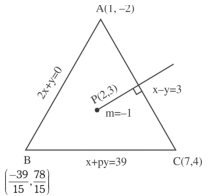
View full question & answer→MCQ 1201 Mark
Let $A (1,1), B (-4,3) C (-2,-5)$ be vertices of a triangle $ABC , P$ be a point on side $BC$, and $\Delta_{1}$ and $\Delta_{2}$ be the areas of triangle $APB$ and $ABC$. Respectively.If $\Delta_{1}: \Delta_{2}=4: 7$, then the area enclosed by the lines $AP , AC$ and the $x$-axis is
- A
$\frac{1}{4}$
- B
$\frac{3}{4}$
- ✓
$\frac{1}{2}$
- D
$1$
AnswerCorrect option: C. $\frac{1}{2}$
c
Given $\Delta_{1}=\frac{1}{2}\left|\begin{array}{ccc}x & y & 1 \\ 1 & 1 & 1 \\ -4 & 3 & 1\end{array}\right|$
$\Delta_{2}=\frac{1}{2}\left|\begin{array}{ccc}1 & 1 & 1 \\ -4 & 3 & 1 \\ -2 & -5 & 1\end{array}\right|$
Given $\frac{\Delta_{1}}{\Delta_{2}}=\frac{4}{7} \Rightarrow \frac{-2 x-5 y+7}{36}=\frac{4}{7}$ $\Rightarrow 14 x+35 y=-95 \ldots(1)$
Equation of $BC$ is $4 x + y =-13 \ldots(2)$
Solve equation $(1)$ and $(2)$
Point $P\left(\frac{-20}{7}, \frac{-11}{7}\right)$
Here point $Q\left(\frac{-1}{2}, 0\right) \& R\left(\frac{1}{2}, 0\right)$
So Area of triangle $AQR =\frac{1}{2} \times 1 \times 1=\frac{1}{2}$
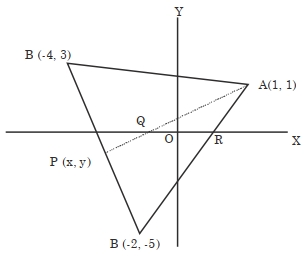
View full question & answer→MCQ 1211 Mark
For $t \in(0,2 \pi)$, if $ABC$ is an equilateral triangle with vertices $A (\operatorname{sint},-\cos t), B (\operatorname{cost}$, sint) and $C ( a , b )$ such that its orthocentre lies on a circle with centre $\left(1, \frac{1}{3}\right)$, then $\left(a^{2}-b^{2}\right)$ is equal to.
- A
$\frac{8}{3}$
- ✓
$8$
- C
$\frac{77}{9}$
- D
$\frac{80}{9}$
Answerb
$s \equiv \sin t, c \equiv \cos t$
Let orthocentre be $( h , k )$
Since it if an equilateral triangle hence orthocentre coincides with centroid.
$\therefore a + s + c =3 h , b + s - c =3 k$
$\therefore(3 h - a )^{2}+(3 k - b )^{2}=( s + c )^{2}+( s - c )^{2}=2\left( s ^{2}+ c ^{2}\right)=2$
$\therefore\left( h -\frac{ a }{3}\right)^{2}+\left( K -\frac{ b }{3}\right)^{2}=\frac{2}{9} \text {, }$
circle centre at $\left(\frac{ a }{3}, \frac{ b }{3}\right)$
Gives, $\frac{ a }{3}=1, \frac{ b }{3}=\frac{1}{3} \Rightarrow a =3, b =1$
$\therefore a^{2}-b^{2}=8$
View full question & answer→MCQ 1221 Mark
Let $A (\alpha,-2), B (\alpha, 6)$ and $C \left(\frac{\alpha}{4},-2\right)$ be vertices of a $\triangle ABC$. If $\left(5, \frac{\alpha}{4}\right)$ is the circumcentre of $\triangle ABC$, then which of the following is $NOT$ correct about $\triangle ABC$.
- A
area is $24$
- ✓
perimeter is $25$
- C
circumradius is $5$
- D
inradius is $2$
AnswerCorrect option: B. perimeter is $25$
b
$A (\alpha,-2): B (\alpha, 6): C \left(\frac{\alpha}{4},-2\right)$
since $AC$ is perpendicular to $AB$.
So, $\triangle ABC$ is right angled at $A$.
Circumcentre $=$ mid point of $BC .=\left(\frac{5 \alpha}{8}, 2\right)$
$\therefore \frac{5 \alpha}{8}=5 \& \frac{\alpha}{4}=2$
$\alpha=8$
Area $=\frac{1}{2}(6)(8)=24$
Perimeter $=24$
Circumradius $=5$
Inradius $=\frac{\Delta}{ s }=\frac{24}{12}=2$
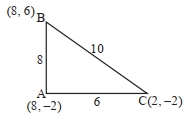
View full question & answer→MCQ 1231 Mark
A point $P$ moves so that the sum of squares of its distances from the points $(1,2)$ and $(-2,1)$ is $14$ . Let $f(x, y)=0$ be the locus of $P$, which intersects the $x$-axis at the points $A , B$ and the $y-$axis at the point $C , D$. Then the area of the quadrilateral $ACBD$ is equal to.
- A
$\frac{9}{2}$
- ✓
$\frac{3 \sqrt{17}}{2}$
- C
$\frac{3 \sqrt{17}}{4}$
- D
$9$
AnswerCorrect option: B. $\frac{3 \sqrt{17}}{2}$
b
$(x-1)^{2}+(y-2)^{2}+(x+2)^{2}+(y-1)^{2}=14$
$\Rightarrow x^{2}+y^{2}+x-3 y-2=0$
Put $x=0$
$\Rightarrow y^{2}-3 y-2=0$
$\Rightarrow y=\frac{3 \pm \sqrt{17}}{2}$
Put $y=0$
$\Rightarrow x^{2}+x-2=0$
$(x+2)(x-1)=0$
$\therefore$ A $(-2,0), B(1,0), C\left(0, \frac{3+\sqrt{17}}{2}\right), D\left(0, \frac{3-\sqrt{17}}{2}\right)$
Area $=\frac{1}{2} \cdot 3 \cdot \sqrt{17}=\frac{3 \sqrt{17}}{2}$
View full question & answer→MCQ 1241 Mark
In a triangle $PQR ,$ the co-ordinates of the points $P$ and $Q$ are $(-2,4)$ and $(4,-2)$ respectively. If the equation of the perpendicular bisector of $PR$ is $2 x-y+2=0,$ then the centre of the circumcircle of the $\Delta PQR$ is
- A
$(-1,0)$
- ✓
$(-2,-2)$
- C
$(0,2)$
- D
$(1, 4)$
AnswerCorrect option: B. $(-2,-2)$
b
Equation of perpendicular bisector of $PR$ is $y = x$
Solving with $2 x - y +2=0$ will give $(-2,2)$
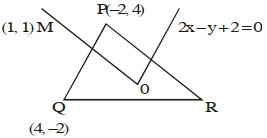
View full question & answer→MCQ 1251 Mark
Let the centroid of an equilateral triangle $ABC$ be at the origin. Let one of the sides of the equilateral triangle be along the straight line $x + y =3$. If $R$ and $r$ be the radius of circumcircle and incircle respectively of $\Delta ABC ,$ then $( R + r )$ is equal to ..... .
- ✓
$\frac{9}{\sqrt{2}}$
- B
$7 \sqrt{2}$
- C
$2 \sqrt{2}$
- D
$3 \sqrt{2}$
AnswerCorrect option: A. $\frac{9}{\sqrt{2}}$
a
$r = OM =\frac{3}{\sqrt{2}}$
$\& \sin 30^{\circ}=\frac{1}{2}=\frac{ r }{ R } \Rightarrow R =\frac{6}{\sqrt{2}}$
$\therefore r + R =\frac{9}{\sqrt{2}}$
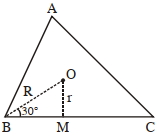
View full question & answer→MCQ 1261 Mark
In the circle given below, let $OA =1$ unit, $OB =13$ unit and $PQ \perp OB$. Then, the area of the triangle $PQB$ (in square units) is
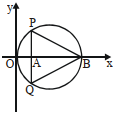
- A
$24 \sqrt{2}$
- ✓
$24 \sqrt{3}$
- C
$26 \sqrt{3}$
- D
$26 \sqrt{2}$
AnswerCorrect option: B. $24 \sqrt{3}$
b
$PA = AQ =\lambda$
$OA \cdot AB$
$= AP \cdot AQ$
$\Rightarrow 1.12=\lambda \cdot \lambda$
$\Rightarrow \lambda=2 \sqrt{3}$
Area $\Delta PQB =\frac{1}{2} \times 2 \lambda \times AB$
$\Delta=\frac{1}{2} \cdot 4 \sqrt{3} \times 12$
$=24 \sqrt{3}$
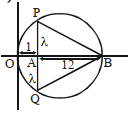
View full question & answer→MCQ 1271 Mark
A man starts walking from the point $\mathrm{P}(-3,4)$, touches the $\mathrm{x}$-axis at $\mathrm{R}$, and then turns to reach at the point $\mathrm{Q}(0,2) .$ The man is walking at a constant speed. If the man reaches the point $Q$ in the minimum time, then $50\,\left((\mathrm{PR})^{2}+(\mathrm{RQ})^{2}\right)$ is equal to ..... .
- A
$5025$
- B
$5020$
- C
$2050$
- ✓
$1250$
AnswerCorrect option: D. $1250$
d
$50\left(\mathrm{PR}^{2}+\mathrm{RQ}^{2}\right)$
$50(20+5)$
$50(25)$
$=1250$
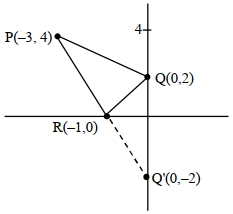
View full question & answer→MCQ 1281 Mark
In $\Delta ABC ,$ the lengths of sides $AC$ and $AB$ are $12\, cm$ and $5 \,cm ,$ respectively. If the area of $\triangle ABC$ is $30\, cm ^{2}$ and $R$ and $r$ are respectively the radii of circumcircle and incircle of $\Delta ABC$ then the value of $2 R + r ( in cm )$ is equal to ....... .
Answerd
$\Delta=\frac{1}{2} \cdot 5 \cdot 12 \cdot \sin A =30$
$\sin A =1$
$A =90^{\circ} \Rightarrow BC =13$
$BC =2 R =13$
$r =\frac{\Delta}{ S }=\frac{30}{15}=2$
$2 R + r =15$
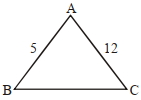
View full question & answer→MCQ 1291 Mark
Let $\mathrm{A}(\mathrm{a}, 0), \mathrm{B}(\mathrm{b}, 2 \mathrm{~b}+1)$ and $\mathrm{C}(0, \mathrm{~b}), \mathrm{b} \neq 0, \mathrm{|b} \mid \neq 1$ be points such that the area of triangle $\mathrm{ABC}$ is $1 \,\mathrm{sq}$. unit, then the sum of all possible values of a is :
AnswerCorrect option: D. $\frac{-2 b^{2}}{b+1}$
d
$\left|\frac{1}{2}\right| \begin{array}{ccc}\mathrm{a} & 0 & 1 \\ \mathrm{~b} & 2 \mathrm{~b}+1 & 1 \\ 0 & \mathrm{~b} & 1\end{array} \|=1$
$\Rightarrow\left|\begin{array}{ccc}\mathrm{a} & 0 & 1 \\ \mathrm{~b} & 2 \mathrm{~b}+1 & 1 \\ 0 & \mathrm{~b} & 1\end{array}\right|=\pm 2$
$\Rightarrow \mathrm{a}(2 \mathrm{~b}+1-\mathrm{b})-0+1\left(\mathrm{~b}^{2}-0\right)=\pm 2$
$\Rightarrow \mathrm{a}=\frac{\pm 2-\mathrm{b}^{2}}{\mathrm{~b}+1}$
$\therefore \mathrm{a}=\frac{2-\mathrm{b}^{2}}{\mathrm{~b}+1} \text { and } \mathrm{a}=\frac{-2-\mathrm{b}^{2}}{\mathrm{~b}+1}$
sum of possible values of $'a'$ is $=\frac{-2 \mathrm{~b}^{2}}{\mathrm{b}+1}$
View full question & answer→MCQ 1301 Mark
Let a vector $\alpha \hat{i}+\beta \hat{j}$ be obtained by rotating the vector $\sqrt{3} \hat{ i }+\hat{ j }$ by an angle $45^{\circ}$ about the origin in counterclockwise direction in the first quadrant. Then the area of triangle having vertices $(\alpha, \beta),(0, \beta)$ and $(0,0)$ is equal to
- ✓
$\frac{1}{2}$
- B
$1$
- C
$\frac{1}{\sqrt{2}}$
- D
$2 \sqrt{2}$
AnswerCorrect option: A. $\frac{1}{2}$
a
Area of $\Delta\left( OA ^{\prime} B \right)=\frac{1}{2} OA ^{\prime} \cos 15^{\circ} \times OA ^{\prime} \sin 15^{\circ}$
$=\frac{1}{2}\left( OA ^{\prime}\right)^{2} \frac{\sin 30^{\circ}}{2}$
$=(3+1) \times \frac{1}{8}=\frac{1}{2}$
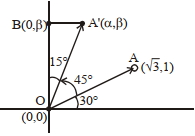
View full question & answer→MCQ 1311 Mark
A vector $\vec a$ has components $3 p$ and $1$ with respect to a rectangular cartesian system. This system is rotated through a certain angle about the origin in the counter clockwise sense. If, with respect to new system, $\overrightarrow{\text { a }}$ has components $p +1$ and $\sqrt{10},$ then a value of $p$ is equal to
- A
$1$
- B
$-\frac{5}{4}$
- C
$\frac{4}{5}$
- ✓
$-1$
Answerd
$\overrightarrow{ a }_{ Old }=3 p \hat{ i }+\hat{ j }$
$\overrightarrow{ a }_{ New }=( p +1) \hat{ i }+\sqrt{10} \hat{ j }$
$\Rightarrow\left|\overrightarrow{ a }_{ Od }\right|=\left|\overrightarrow{ a }_{ New }\right|$
$\Rightarrow 9 p^{2}+1=p^{2}+2 p+1+10$
$8 p^{2}-2 p-10=0$
$4 p^{2}-p-5=0$
$(4 p-5)(p+1)=0 \rightarrow p=\frac{5}{4},-1$
View full question & answer→MCQ 1321 Mark
The point $\mathrm{P}(\mathrm{a}, \mathrm{b})$ undergoes the following three transformations successively:
$(a)$ reflection about the line $y=x$.
$(b)$ translation through $2$ units along the positive direction of $x$-axis.
$(c)$ rotation through angle $\frac{\pi}{4}$ about the origin in the anti-clockwise direction.
If the co-ordinates of the final position of the point $P$ are $\left(-\frac{1}{\sqrt{2}}, \frac{7}{\sqrt{2}}\right)$, then the value of $2 a+b$ is equal to:
Answera
Image of $A(a, b)$ along $y=x$ is $B(b, a)$. Translating it 2 units it becomes $C(b+2, a)$
Now, applying rotation theorem
$-\frac{1}{\sqrt{2}}+\frac{7}{\sqrt{2}} i=((b+2)+a i)\left(\cos \frac{\pi}{4}+i \sin \frac{\pi}{4}\right)$
$\frac{-1}{\sqrt{2}}+\frac{7}{\sqrt{2}} i=\left(\frac{b+2}{\sqrt{2}}-\frac{a}{\sqrt{2}}\right)+i\left(\frac{b+2}{\sqrt{2}}+\frac{a}{\sqrt{2}}\right)$
$\Rightarrow b-a+2=-1....(1)$
$\text { and } b+2+a=7....(2)$
$\Rightarrow a=4 ; b=1$
$\Rightarrow 2 a+b=9$
View full question & answer→MCQ 1331 Mark
Let $A (-1,1), B (3,4)$ and $C (2,0)$ be given three points. $A$ line $y = mx , m > 0$, intersects lines $AC$ and $BC$ at point $P$ and $Q$ respectively. Let $A _{1}$ and $A _{2}$ be the areas of $\Delta ABC$ and $\Delta PQC$ respectively, such that $A _{1}=3 A _{2}$, then the value of $m$ is equal to:
- A
$\frac{4}{15}$
- ✓
$1$
- C
$2$
- D
$3$
Answerb
$P \equiv\left( x _{1}, mx _{1}\right)$
$Q \equiv\left( x _{2}, mx _{2}\right)$
$A _{1}=\frac{1}{2}\left|\begin{array}{ccc}3 & 4 & 1 \\ 2 & 0 & 1 \\ -1 & 1 & 1\end{array}\right|=\frac{13}{2}$
$A _{2}=\frac{1}{2}\left|\begin{array}{ccc} x _{1} & mx _{1} & 1 \\ x _{2} & mx _{2} & 1 \\ 2 & 0 & 1\end{array}\right|$
$A _{2}=\frac{1}{2}\left|2\left( mx _{1}- mx _{2}\right)\right|= m \left| x _{1}- x _{2}\right|$
$A _{1}=3 A _{2} \Rightarrow \frac{13}{2}=3 m \left| x _{1}- x _{2}\right|$
$AC : x +3 y =2$
$BC : y =4 x -8$
$P : x +3 y =2$ and $y = mx \Rightarrow x _{1}=\frac{2}{1+3 m }$
$Q : y =4 x -8$ and $y = mx \Rightarrow x _{2}=\frac{8}{4- m }$
$\left| x _{1}- x _{2}\right|=\left|\frac{2}{1+3 m }-\frac{8}{4- m }\right|$
$=\left|\frac{-26 m }{(1+3 m )(4- m )}\right|=\frac{26 m }{(3 m +1)| m -4|}$
$=\frac{26 m }{(3 m +1)(4- m )}$
$\left| x _{1}- x _{2}\right|=\frac{13}{6 m }$
$\Rightarrow \frac{26 m }{(3 m +1)(4- m )}=\frac{13}{6 m }$
$\Rightarrow \quad 12 m ^{2}=-(3 m +1)( m -4)$
$\Rightarrow \quad 12 m ^{2}=-\left(3 m ^{2}-11 m -4\right)$
$\Rightarrow \quad 15 m ^{2}-11 m -4=0$
$\Rightarrow \quad 15 m ^{2}-15 m +4 m -4=0$
$\Rightarrow \quad(15 m +4)( m -1)=0$
$\Rightarrow m =1$
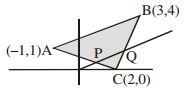
View full question & answer→MCQ 1341 Mark
Let $\mathrm{A}(1,0), \mathrm{B}(6,2)$ and $\mathrm{C}\left(\frac{3}{2}, 6\right)$ be the vertices of a triangle $ABC$. If $P$ is a point inside the triangle $\mathrm{ABC}$ such that the triangles $\mathrm{APC}, \mathrm{APB}$ and $BPC$ have equal areas, then the length of the line segment $PQ,$ where $Q$ is the point $\left(-\frac{7}{6},-\frac{1}{3}\right)$ is
Answerb
$\mathrm{P}$ is centroid of the triangle $\mathrm{ABC}$
$\Rightarrow P \equiv\left(\frac{17}{6}, \frac{8}{3}\right)$
$\Rightarrow \mathrm{PQ}=5$
View full question & answer→MCQ 1351 Mark
A square is inscribed in the circle $x^2 + y^2 - 6x + 8y -103 = 0$ with its sides parallel to the coordinate axes. Then the distance of the vertex of the square which is nearest to the origin is
- A
$6$
- B
$\sqrt {137}$
- ✓
$\sqrt {41}$
- D
$13$
AnswerCorrect option: C. $\sqrt {41}$
c
Centre $(3,-4)$
Radius $ = \sqrt {9 + 16 + 103} = \sqrt {128} = 8\sqrt 2 $
$\therefore \left( { - 5,4} \right)$ will be nearer to the $(0,0)$
$\therefore $ Ans. $\sqrt {{5^2} + {4^2}} = \sqrt {25 + 16} = \sqrt {41} $
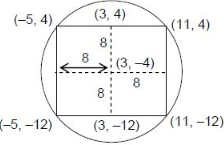
View full question & answer→MCQ 1361 Mark
Two vertices of a triangle are $(0, 2)$ and $(4, 3)$. If its orthocenter is at the origin, then its third vertex lies in which quadrant?
Answerb
$\frac{{k - 3}}{{h - 4}} = 0\,\,\,\,\,\,\,\,\,k = 3$
$\frac{k}{h} = - \frac{{4 - 0}}{{3 - 2}}\,\,\,\,\,\,\,\,\, - 4h = k$
$\,\,\,\,\,\,\,\,\,\,\,\,\,\,\,\,h = \frac{{ - 3}}{4}$
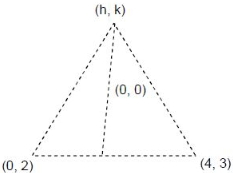
View full question & answer→MCQ 1371 Mark
A triangle has a vertex at $(1, 2)$ and the mid points of the two sides through it are $(-1, 1)$ and $(2,3)$. Then the centroid of this triangle is
- A
$\left( {1,\frac{7}{3}} \right)$
- B
$\left( {\frac{1}{3},1} \right)$
- ✓
$\left( {\frac{1}{3},2} \right)$
- D
$\left( {\frac{1}{3},\frac{5}{3}} \right)$
AnswerCorrect option: C. $\left( {\frac{1}{3},2} \right)$
c
$\frac{{{\alpha _2} + 1}}{2} = - 1,\frac{{{y_2} + 2}}{2} = 1$
${x_2} = - 3,{y_2} = 0$
$B\left( { - 3,0} \right)$
$\frac{{{x_3} + 1}}{2} = 2$ and $\frac{{{y_3} + 2}}{2} = 3$
${x_3} = 3,{y_3} = 4$
$C\left( {3,4} \right)$
Centroid $\left( {\frac{{{x_1} + {x_2} + {x_3}}}{3},\frac{{{y_1} + {y_2} + {y_3}}}{3}} \right)$
$\left( {\frac{{1 - 3 + 3}}{3},\frac{{2 + D + 4}}{3}} \right) = \left( {\frac{1}{3},2} \right)$
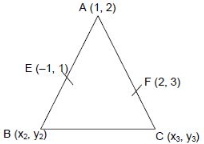
View full question & answer→MCQ 1381 Mark
Let $O\, (0, 0)$ and $A\, (0, 1)$be two fixed points. Then the locus of a point $P$ such that the perimeter of $\Delta AOP$ , is $4$
- A
$9{x^2} - 8{y^2} + 8y = 16$
- B
$8{x^2} + 9{y^2} - 9y = 18$
- ✓
$9{x^2} + 8{y^2} - 8y = 16$
- D
$8{x^2} - 9{y^2} + 9y = 18$
AnswerCorrect option: C. $9{x^2} + 8{y^2} - 8y = 16$
c
$AP+OP+AO=4$
$\sqrt {{h^2} + {{\left( {k - 1} \right)}^2}} + \sqrt {{h^2} + {k^2}} + 1 = 4$
$\sqrt {{h^2} + {{\left( {k - 1} \right)}^2}} + \sqrt {{h^2} + {k^2}} = 3$
${h^2} + {\left( {k - 1} \right)^2} = 9 + {h^2} + {k^2} - 6\sqrt {{h^2} + {k^2}} $
$ - 2k - 8 = - 6\sqrt {{h^2} + {k^2}} $
$k + 4 = 3\sqrt {{h^2} + {k^2}} $
${k^2} + 16 + 8k = 9\left( {{h^2} + {k^2}} \right)$
$9{h^2} + 8{k^2} - 8k - 16 = 0$
Locus of $P$ is $9{x^2} + 8{y^2} - 8y - 16 = 0$
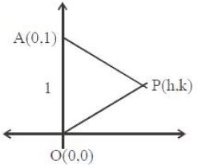
View full question & answer→MCQ 1391 Mark
Let the orthocentre and centroid of a triangle be $A(-3, 5)$ and $B(3, 3)$ respectively. If $C$ is the circumcentre of this triangle ,then the radius of the circle having line segment $AC$ as diameter, is:
- A
$2\sqrt {10} $
- ✓
$3\sqrt {\frac{5}{2}} $
- C
$\frac{{3\sqrt 5 }}{2}$
- D
$\sqrt {10} $
AnswerCorrect option: B. $3\sqrt {\frac{5}{2}} $
b
Since Orthocentre of the triangle is $A(-3,5)$ and centriod of the triangle is $B(3,3)$, then
$AB = \sqrt {40} = 2\sqrt {10} $
Centroud divides orthocenter and cicumcentre of the triangle in ratio $2:1$
$\therefore $ $ AB:BC=2:1$
Now, $AB = \frac{2}{3}AC$
$AC = \frac{3}{2}AB = \frac{3}{2}\left( {2\sqrt {10} } \right)\,\, \Rightarrow AC = 3\sqrt {10} $
Radius of circle with $AC$ as diamentre
$ = \frac{{AC}}{2} = \frac{3}{2}\sqrt {10} = 3\sqrt {\frac{5}{2}} $
View full question & answer→MCQ 1401 Mark
A square, of each side $2$, lies above the $x-$ axis and has one vertex at the origin. If one of the sides passing through the origin makes an angle $30^o$ with the positive direction of the $x-$ axis, then the sum of the $x$ coordinates of the vertices of the square is
- A
$2\sqrt 3 - 1$
- ✓
$2\sqrt 3 - 2$
- C
$\sqrt 3 - 2$
- D
$\sqrt 3 - 1$
AnswerCorrect option: B. $2\sqrt 3 - 2$
b
$\frac{x}{{\cos \,{{30}^o}}} = \frac{y}{{\sin \,{{30}^o}}}$
$x = \sqrt 3 $
$y = 1$
$\frac{x}{{\cos \,{{120}^o}}}\frac{y}{{\sin \,{{120}^o}}} = 2$
$x = - 1,y = \sqrt 3 $
$\frac{x}{{\cos \,{{75}^o}}} = \frac{y}{{\sin \,{{75}^o}}} = 2\sqrt 2 $
$x = \sqrt 3 - 1$
$y = \sqrt 3 + 1$
Sum $ = 2\sqrt 3 - 2$
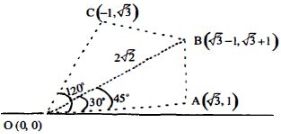
View full question & answer→MCQ 1411 Mark
Let $k$ be an integer such that triangle with vertices $\left( {k, - 3k} \right),\left( {5,k} \right)$ and $\left( { - k,2} \right)$ has area $28$ sq. units. Then the orthocentre of his triangle is at the point :
- ✓
$\left( {2,\frac{1}{2}\;} \right)\;$
- B
$\left( {2,\frac{{ - 1}}{2}\;} \right)$
- C
$\left( {1,\frac{3}{4}\;} \right)$
- D
$\left( {1,\frac{{ - 3}}{4}\;} \right)$
AnswerCorrect option: A. $\left( {2,\frac{1}{2}\;} \right)\;$
a
(1) We have
$\frac{1}{2}\,\left\| \begin{array}{l}
\,k\,\,\, - 3k\,\,\,1\\
\,5\,\,\,\,\,\,\,\,k\,\,\,\,\,1\\
- k\,\,\,\,\,2\,\,\,\,\,1
\end{array} \right\| = 28$
$ \Rightarrow 5{k^2} + 13k - 46 = 0$
or $5{k^2} + 13k - 66 = 0$
Now, $5{k^2} + 13k - 46 = 0$
$ \Rightarrow k = \frac{{ - 13 \pm \sqrt {1089} }}{{10}}$
$\therefore k = \frac{{ - 23}}{5};k = 2$
since $k$ is an integer, $\therefore k = 2$
Also $5{k^2} + 13k + 66 = 0$
$ \Rightarrow k = \frac{{ - 13 \pm \sqrt { - 1151} }}{{10}}$
So no real solution exist
For cothocentre
$BH \bot AC$
$\therefore \left( {\frac{{\beta - 2}}{{\alpha - 5}}} \right)\left( {\frac{8}{{ - 4}}} \right) = - 1$
$ \Rightarrow \,\,\alpha - 2\beta = 1\,\,\,\,\,\,\,\,\,\,.......\left( 1 \right)$
Also $CH \bot AB$
$\therefore \left( {\frac{{\beta - 2}}{{\alpha + 2}}} \right)\left( {\frac{8}{3}} \right) = - 1$
$ \Rightarrow \,\,3\alpha - 8\beta = 1\,0\,\,\,\,\,\,\,\,\,.......\left( 2 \right)$
Solving $(1)$ and $(2)$ , we get
$\alpha = 2,\beta = \frac{1}{2}$
orthocentre is $\left( {2,\frac{1}{2}} \right)$
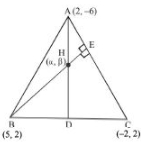
View full question & answer→MCQ 1421 Mark
$ABC$ is triangle in a plane with vertices $A(2, 3, 5), B (-1 , 3, 2)$ and $C\left( {\lambda ,5,\mu } \right)$ . lf the median through $A$ is equally inclined to the coordinate axes, then the value of $\left( {{\lambda ^3}+{\mu ^3} + 5} \right)$ is
- A
$1130$
- ✓
$1348$
- C
$1077$
- D
$676$
AnswerCorrect option: B. $1348$
b
$DR'$ of $AD$ are $\frac{{\lambda - 1}}{2}\,\, - 2,4 - 3,\frac{{\mu + 2}}{2}\, - 5$
i.e. $\frac{{\lambda - 5}}{2}\,\,,1,\frac{{\lambda - 8}}{2}\,\,$
$\because$ This median is making equal angles with coordinate axes, therefore,
$\frac{{\lambda - 5}}{2}\,\, = 1 = \frac{{\mu - 8}}{2}\,$
$ \Rightarrow \lambda = 7\,\,\& \,\,\mu = 10$
$\therefore {\lambda ^3} + {\mu ^3} = 5 = 1348$
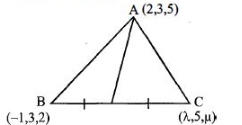
View full question & answer→MCQ 1431 Mark
The $x-$ coordinate of the incentre of the triangle that has the coordinates of mid points of its sides as $(0,1) , (1,1)$ and $(1,0)$ is
- A
$2 + \sqrt 2 $
- ✓
$\;2 - \sqrt 2 $
- C
$\;1 + \sqrt 2 $
- D
$\;1 - \sqrt 2 $
AnswerCorrect option: B. $\;2 - \sqrt 2 $
b
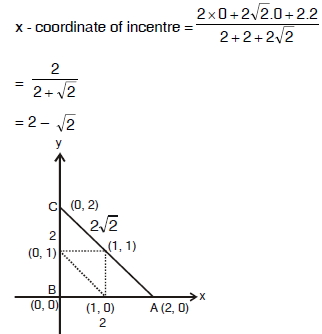
View full question & answer→MCQ 1441 Mark
Let $R ^3$ denote the three-dimensional space. Take two points $P=(1,2,3)$ and $Q=(4,2,7)$. Let $\operatorname{dist}(X, Y)$ denote the distance between two points $X$ and $Y$ in $R ^3$. Let
$S=\left\{X \in R ^3:(\operatorname{dist}(X, P))^2-(\operatorname{dist}(X, Q))^2=50\right\} \text { and }$
$T=\left\{Y \in R ^3:(\operatorname{dist}(Y, Q))^2-(\operatorname{dist}(Y, P))^2=50\right\}.$
Then which of the following statements is (are) $TRUE$?
$(A)$ There is a triangle whose area is $1$ and all of whose vertices are from $S$.
$(B)$ There are two distinct points $L$ and $M$ in $T$ such that each point on the line segment $L M$ is also in $T$.
$(C)$ There are infinitely many rectangles of perimeter $48$ , two of whose vertices are from $S$ and the other two vertices are from $I$.
$(D)$ There is a square of perimeter $48$ , two of whose vertices are from $S$ and the other two vertices are from $T$.
- ✓
$A,B,C,D$
- B
$A,B,C$
- C
$A,B,D$
- D
$A,C,D$
AnswerCorrect option: A. $A,B,C,D$
a
$S =\left\{ X :( XP )^2-( XQ )^2=50\right\}$
$T =\left\{ Y :( YQ )^2-( YP )^2=50\right\}$
for finding $S \equiv X(x, y, z)$ and for $T \equiv Y(x, y, z)$
$\left(( x -1)^2+( y -1)^2+( z -1)^2\right)-\left(( x -4)^2+( y -2)^2+( z -7)^2\right)=50$
$\Rightarrow \quad S =\{( x , y , z ): 6 x +8 z =105\}$
$\quad T =\{( x , y , z ): 6 x +8 z =5\}$
Since $S$ and $T$ both are plane ;
$(A)$ There exist a triangle in plane $S$ whose area $=1$ (always)
$(B)$ $L \& M$ lies on plane $T$, hence line segment joining $L \& M$ will lie on plane $T$.
$(C)$ Distance between $S \& T$
$d=\left|\frac{105-5}{10}\right|=10$
Hence for rectangle of perimeter $48$ can exist.
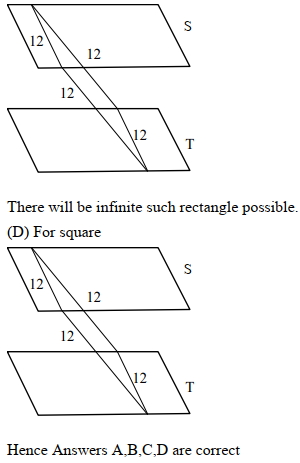
View full question & answer→MCQ 1451 Mark
Consider three points $\mathrm{P}=(-\sin (\beta-\alpha),-\cos \beta), \mathrm{Q}=(\cos (\beta-\alpha), \sin \beta)$ and $\mathrm{R}=(\cos (\beta-\alpha+\theta), \sin (\beta-\theta))$, where $0<$ $\alpha, \beta, \theta<\frac{\pi}{4}$. Then
- A
$\mathrm{P}$ lies on the line segment $\mathrm{RQ}$
- B
$\mathrm{Q}$ lies on the line segment $\mathrm{PR}$
- C
$\mathrm{R}$ lies on the line segment $\mathrm{QP}$
- ✓
$\mathrm{P}, \mathrm{Q}, \mathrm{R}$ are non-collinear
AnswerCorrect option: D. $\mathrm{P}, \mathrm{Q}, \mathrm{R}$ are non-collinear
d
$ P \equiv(-\sin (\beta-\alpha),-\cos \beta) \equiv\left(x_1, y_1\right) $
$ Q \equiv(\cos (\beta-\alpha), \sin \beta) \equiv\left(x_2, y_2\right) $
$ \text { and } R \equiv\left(x_2 \cos \theta+x_1 \sin \theta, y_2 \cos \theta+y_1 \sin \theta\right) $
$ \text { We see that } T \equiv\left(\frac{x_2 \cos \theta+x_1 \sin \theta}{\cos \theta+\sin \theta}, \frac{y_2 \cos \theta+y_1 \sin \theta}{\cos \theta+\sin \theta}\right)$
We see that $\mathrm{T} \equiv\left(\frac{\mathrm{x}_2 \cos \theta+\mathrm{x}_1 \sin \theta}{\cos \theta+\sin \theta}, \frac{\mathrm{y}_2 \cos \theta+\mathrm{y}_1 \sin \theta}{\cos \theta+\sin \theta}\right)$
and $\mathrm{P}, \mathrm{Q}, \mathrm{T}$ are collinear $\Rightarrow P, Q, R$ are non-collinear.
View full question & answer→MCQ 1461 Mark
A straight line through the vertex $P$ of a triangle $P Q R$ intersects the side $Q R$ at the point $S$ and the circumcircle of the triangle $P Q R$ at the point $T$. If $S$ is not the centre of the circumcircle, then
$(A)$ $\frac{1}{\mathrm{PS}}+\frac{1}{\mathrm{ST}}<\frac{2}{\sqrt{\mathrm{QS} \times \mathrm{SR}}}$
$(B)$ $\frac{1}{\mathrm{PS}}+\frac{1}{\mathrm{ST}}>\frac{2}{\sqrt{\mathrm{QS} \times \mathrm{SR}}}$
$(C)$ $\frac{1}{\mathrm{PS}}+\frac{1}{\mathrm{ST}}<\frac{4}{\mathrm{QR}}$
$(D)$ $\frac{1}{\mathrm{PS}}+\frac{1}{\mathrm{ST}}>\frac{4}{\mathrm{QR}}$
Answera
$ \mathrm{PS} \times \mathrm{ST}=\mathrm{QS} \times \mathrm{SR} $
$ \frac{\frac{1}{\mathrm{PS}}+\frac{1}{\mathrm{ST}}}{2}>\sqrt{\frac{1}{\mathrm{PS}} \times \frac{1}{\mathrm{ST}}} $
$ \Rightarrow \frac{1}{\mathrm{PS}}+\frac{1}{\mathrm{ST}}>\frac{2}{\sqrt{\mathrm{QS} \times \mathrm{SR}}} $
$ \frac{\mathrm{QS}+\mathrm{SR}}{2}>\sqrt{\mathrm{QS} \times \mathrm{SR}} $
$ \frac{\mathrm{QR}}{2}>\sqrt{\mathrm{QS} \times \mathrm{SR}} \Rightarrow \frac{1}{\sqrt{\mathrm{QS} \times \mathrm{SR}}}>\frac{2}{\mathrm{QR}} $
$ \Rightarrow \frac{1}{\mathrm{PS}}+\frac{1}{\mathrm{ST}}>\frac{4}{\mathrm{QR}} .$

View full question & answer→MCQ 1471 Mark
Let $\mathrm{O}(0,0), \mathrm{P}(3,4), \mathrm{Q}(6,0)$ be the vertices of the triangle $O P Q$. The point $R$ inside the triangle $O P Q$ is such that the triangles $O P R, P Q R, O Q R$ are of equal area. The coordinates of $R$ are
- A
$\left(\frac{4}{3}, 3\right)$
- B
$\left(3, \frac{2}{3}\right)$
- ✓
$\left(3, \frac{4}{3}\right)$
- D
$\left(\frac{4}{3}, \frac{2}{3}\right)$
AnswerCorrect option: C. $\left(3, \frac{4}{3}\right)$
c
Since, $\Delta$ is isosceles, hence centroid is the desired point.
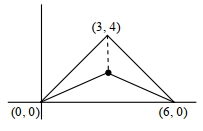
View full question & answer→MCQ 1481 Mark
Orthorcentre of triangle with vertices $(0, 0), \,(3, 4)$ and $(4, 0)$ is
- A
$\left( {3,\,\frac{5}{4}} \right)$
- B
$(3, 12)$
- ✓
$\left( {3,\,\frac{3}{4}} \right)$
- D
$(3, 9)$
AnswerCorrect option: C. $\left( {3,\,\frac{3}{4}} \right)$
c
(c) $BD \bot AC$. Slope of $BD = - \frac{3}{4}$
Equation of $BD$, $3x + 4y - 12 = 0;AE\, \bot \,BC$.....$(i)$
Slope of $AE = \frac{1}{4}$
Equation of $AE$, $x - 4y = 0$.....$(ii)$
From equation $(i)$ and $(ii)$, $x = 3,y = \frac{3}{4}$
orthocentre of the triangle is $\left( {3,\frac{3}{4}} \right)$
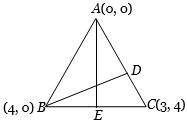
View full question & answer→MCQ 1491 Mark
The incentre of the triangle with vertices $(1,\sqrt 3 )$, $(0, 0)$ and $(2, 0)$ is
- A
$\left( {1,\frac{{\sqrt 3 }}{2}} \right)$
- B
$\left( {\frac{2}{3},\frac{1}{{\sqrt 3 }}} \right)$
- C
$\left( {\frac{2}{3},\frac{{\sqrt 3 }}{2}} \right)$
- ✓
$\left( {1,\frac{1}{{\sqrt 3 }}} \right)$
AnswerCorrect option: D. $\left( {1,\frac{1}{{\sqrt 3 }}} \right)$
d
(d) Clearly, the triangle is equilateral.
So, the incentre is the same as the centroid.
$\therefore $ Incentre $ = \,\left( {\frac{{1 + 0 + 2}}{3},\,\,\frac{{\sqrt 3 + 0 + 0}}{3}} \right) = \left( {1,\,\frac{1}{{\sqrt 3 }}} \right)$.
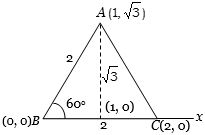
View full question & answer→MCQ 1501 Mark
$A$ pole stands vertically inside a triangular park $ABC$. If the angle of elevation of the top of the pole from each corner of the park is the same, then in the $\Delta $ $ABC$, the foot of the pole is at the
Answerb
(b) If $P$ be the foot, then $PA = PB = PC,$ i.e. $P$ is the circumcentre.
View full question & answer→MCQ 1511 Mark
If $P \,(1,2),\, Q\,(4,6)\, R\,(5, 7)$ and $S\,(a, b)$ are the vertices of a parallelogram $PQRS$, then
- A
$a = 2,\,b = 4$
- B
$a = 3,\,b = 4$
- ✓
$a = 2,\,b = 3$
- D
$a = 3,\,b = 5$
AnswerCorrect option: C. $a = 2,\,b = 3$
c
(c) Diagonals cut each other at middle points.
Hence $\frac{{a + 4}}{2} = \frac{{1 + 5}}{2}\,\, \Rightarrow \,\,a = 2$
$\frac{{b + 6}}{2} = \frac{{2 + 7}}{2}\,\, \Rightarrow \,\,b = 3$.
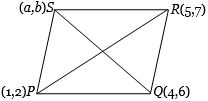
View full question & answer→MCQ 1521 Mark
If the vertices $P,\, Q, \,R$ of a triangle $PQR$ are rational points, which of the following points of the triangle $PQR$ is $(are)$ always rational point $(s)$
(A rational ponit is a point both of whose coordinates are rational numbers)
Answerd
(d) If $A = ({x_1},\,\,{y_1}),\,\,B = ({x_2},\,\,{y_2}),\,\,C = ({x_3},\,\,{y_3}),$ where ${x_1},\,\,{y_1},$ etc., are rational numbers then $\Sigma {x_1},\,\,\Sigma {y_1}$ are also rational.
So, the coordinates of the centroid $\left( {\frac{{\Sigma {x_1}}}{3},\,\,\frac{{\Sigma {y_1}}}{3}} \right)$ will be rational. As $AB = c = \sqrt {{{({x_1} - {x_2})}^2} + {{({y_1} - {y_2})}^2},} \,\,c$ may or may not be rational and it may be an irrational number of the form $\sqrt p .$ Hence, the coordinates of the incentre $\left( {\frac{{\Sigma a{x_1}}}{{\Sigma a}},\,\,\frac{{\Sigma a{y_1}}}{{\Sigma a}}} \right)$ may or may not be rational.
If $(\alpha ,\,\,\beta )$ be the circumcentre or orthocentre, $\alpha$ and $\beta$ are found by solving two linear equations in $\alpha ,\,\,\beta $ with rational coefficients. So $\alpha ,\,\,\beta $must be rational numbers.
View full question & answer→MCQ 1531 Mark
The orthocentre of the triangle with vertices $\left( {2,\,\frac{{\sqrt 3 - 1}}{2}} \right)$, $\left( {\frac{1}{2},\, - \frac{1}{2}} \right)$ and $\left( {2,\, - \frac{1}{2}} \right)$ is
- A
$\left( {\frac{3}{2},\,\frac{{\sqrt 3 - 3}}{6}} \right)$
- ✓
$\left( {2,\, - \frac{1}{2}} \right)$
- C
$\left( {\frac{5}{4},\,\frac{{\sqrt 3 - 2}}{4}} \right)$
- D
$\left( {\frac{1}{2},\, - \frac{1}{2}} \right)$
AnswerCorrect option: B. $\left( {2,\, - \frac{1}{2}} \right)$
b
(b) Here, the given triangle is a right angled triangle at the vertex $\left( {2, - \frac{1}{2}} \right)$. Hence the orthocentre is at $\left( {2,\frac{{ - 1}}{2}} \right)$.
View full question & answer→MCQ 1541 Mark
The new coordinates of a point $(4, 5)$, when the origin is shifted to the point $(1,-2)$ are
- A
$(5, 3)$
- B
$(3, 5)$
- ✓
$(3, 7)$
- D
AnswerCorrect option: C. $(3, 7)$
c
(c) We know that if the origin is shifted to $(h, k)$, then new coordinates $(x, y)$ becomes $(x -h,\, y -k)$.
Therefore, the new coordinate of $(4, 5)$ with respect to new origin $(1, -2)$ are $(3, 7).$
View full question & answer→MCQ 1551 Mark
If $A$ and $B$ are two fixed points and $P$ is a variable point such that $PA + PB = 4$, then the locus of $P$ is a/an
Answerb
(b) It is a fundamental concept.
View full question & answer→MCQ 1561 Mark
If $P = (1,0),\, Q =(-1,0)$ and $R =(2,0)$ are three given points, then the locus of a point $S$ satisfying the relation $S{Q^2} + S{R^2} = 2S{P^2}$ is
AnswerCorrect option: D. A straight line parallel to $y$-axis
d
(d) Let $S\,(x,\,y),$ then
${(x + 1)^2} + {y^2} + {(x - 2)^2} + {y^2} = 2\,[{(x - 1)^2} + {y^2}]$
$ \Rightarrow \,\,2x + 1 + 4 - 4x = - 4x + 2\,\, \Rightarrow \,\,x = - \frac{3}{2}$
Hence it is a straight line parallel to $y$-axis.
View full question & answer→MCQ 1571 Mark
The ends of a rod of length $l$ move on two mutually perpendicular lines. The locus of the point on the rod which divides it in the ratio $1 : 2$ is
- A
$36{x^2} + 9{y^2} = 4{l^2}$
- B
$36{x^2} + 9{y^2} = {l^2}$
- ✓
$9{x^2} + 36{y^2} = 4{l^2}$
- D
AnswerCorrect option: C. $9{x^2} + 36{y^2} = 4{l^2}$
c
(c) According to the figure
$AP\,\,:\,\,PB = 1\,\,:\,\,2,$ then $h = \frac{{1 \times 0 + 2 \times a}}{{1 + 2}} = \frac{{2a}}{3}$
or $a = \frac{{3h}}{2},$ similarly $b = 3k$
Now we have $O{A^2} + O{B^2} = A{B^2}$
$ \Rightarrow \,\,{\left( {\frac{{3h}}{2}} \right)^2} + {(3k)^2} = {l^2}$
Hence locus of $P(h,\,\,k)$ is given by $9{x^2} + 36{y^2} = 4{l^2}$.
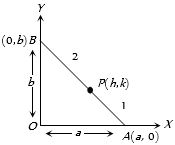
View full question & answer→MCQ 1581 Mark
All points lying inside the triangle formed by the points $(1, 3)$, $(5,0)$ and $(-1,2)$ satisfy
- A
$3x + 2y \ge 0$
- B
$2x + y - 13 \le 0$
- C
$2x - 3y - 12 \le 0$
- ✓
Answerd
(d) For $(1,\,\,3),\,\,3x + 2y = 3 + 6 > 0,$
for $(5, 0)$,$3 \times 5 + 0 > 0$ and
$( - 1,\,\,2)$ for $( - 1,\,\,2),\,\, - 3 + 4 > 0.$
Similarly other inequalities hold good.
View full question & answer→MCQ 1591 Mark
The orthocentre of the triangle formed by the lines $x + y = 1,\,2x + 3y = 6$ and $4x - y + 4 = 0$ lies in quadrant
Answera
(a) On solving the equations, we get the two vertices $(-3, 4)$ and $\left( {\frac{{ - 3}}{7},\frac{{16}}{7}} \right)$.
Also perpendicular passes through vertices are $x + 4y = 13$ and $7x - 7y = - 19$.
Solving these lines, we get the orthocentre $\left( {\frac{3}{7},\frac{{22}}{7}} \right)$ i.e. in first quadrant.
View full question & answer→MCQ 1601 Mark
If $\left| {\begin{array}{*{20}{c}}{{x_1}}&{{y_1}}&1\\{{x_2}}&{{y_2}}&1\\{{x_3}}&{{y_3}}&1\end{array}} \right| = \left| {\begin{array}{*{20}{c}}{{a_1}}&{{b_1}}&1\\{{a_2}}&{{b_2}}&1\\{{a_3}}&{{b_3}}&1\end{array}} \right|$, then the two triangle with vertices $({x_1},{y_1}),\,({x_2},{y_2}),\,$ $({x_3},{y_3})$ and $({a_1},{b_1}),\,$ $\,({a_2},{b_2}),$ $({a_3},{b_3})$ must be
Answerb
(b) By the given condition, we mean that the areas of both triangles are same. But it does not mean that the triangles are congruent.
View full question & answer→MCQ 1611 Mark
The vertices of a triangle are $[a{t_1}{t_2},\,a({t_1} + {t_2})],\,$ $[a{t_2}{t_3},\,a({t_2} + {t_3})]$, $[a{t_3}{t_1},\,a({t_3} + {t_1})]$, then the coordinates of its orthocentre are
- A
$[a,\,a({t_1} + {t_2} + {t_3} + {t_1}{t_2}{t_3})]$
- ✓
$[ - a,a\,({t_1} + {t_2} + {t_3} + {t_1}{t_2}{t_3})]$
- C
$[ - a\,({t_1} + {t_2} + {t_3} + {t_1}{t_2}{t_3}),\,a]$
- D
AnswerCorrect option: B. $[ - a,a\,({t_1} + {t_2} + {t_3} + {t_1}{t_2}{t_3})]$
b
(b) $m_1 = {\frac{{ - a({t\_1}{t\_2} - {t\_2}{t\_3})}}{{a({t\_1} - {t\_3})}}} = - t_2, m_2 = -t_3$
Therefore, perpendicular from point third ${t_2}x + y = a[{t_1}{t_2}{t_3} + {t_1} + {t_3}]$ and
perpendicular from point first ${t_3}x + y = a[{t_1}{t_2}{t_3} + {t_1} + {t_2}]$
.$x = - a,y = a[{t_1}{t_2}{t_3} + {t_1} + {t_2} + {t_3}]$.
View full question & answer→MCQ 1621 Mark
Given the points $A(0,4)$ and $B(0, - 4)$. Then the equation of the locus of the point $P(x,y)$ such that $|AP - BP| = 6$, is
- A
$\frac{{{x^2}}}{7} + \frac{{{y^2}}}{9} = 1$
- B
$\frac{{{x^2}}}{9} + \frac{{{y^2}}}{7} = 1$
- C
$\frac{{{x^2}}}{7} - \frac{{{y^2}}}{9} = 1$
- ✓
$\frac{{{y^2}}}{9} - \frac{{{x^2}}}{7} = 1$
AnswerCorrect option: D. $\frac{{{y^2}}}{9} - \frac{{{x^2}}}{7} = 1$
d
(d) Locus of $P$ is
$|\,\sqrt {{x^2} + {y^2} - 8y + 16} - \sqrt {{x^2} + {y^2} + 8y + 16} \,|\, = 6$
Squaring both sides, we get
${x^2} + {y^2} - 2 = \sqrt {{x^2} + {y^2} + 8y + 16} \,\sqrt {{x^2} + {y^2} - 8y + 16} $
$ \Rightarrow \,\,{({x^2} + {y^2} - 2)^2} = {({x^2} + {y^2} + 16)^2} - {(8y)^2}$
$ \Rightarrow \,\,$ On simplification, we get $\frac{{{y^2}}}{9} - \frac{{{x^2}}}{7} = 1$.
View full question & answer→MCQ 1631 Mark
The points $(0, 8/3)$, $(1, 3)$ and $(82, 30)$ are the vertices of
Answerd
(d) Since the area of triangle formed by these points is zero, therefore the points are collinear.
View full question & answer→MCQ 1641 Mark
Three points are $A(6,{\rm{ }}3),\,B{\rm{ }}( - \,3,{\rm{ }}5),\,C{\rm{ }}(4,{\rm{ }} - 2)$ and $P \,(x, y)$ is a point, then the ratio of area of $\Delta $ $PBC$ and $\Delta $ $ABC$ is
- ✓
$\left| {\frac{{x + y - 2}}{7}} \right|$
- B
$\left| {\frac{{x - y + 2}}{2}} \right|$
- C
$\left| {\frac{{x - y - 2}}{7}} \right|$
- D
AnswerCorrect option: A. $\left| {\frac{{x + y - 2}}{7}} \right|$
a
(a) $\frac{{\Delta \,PBC}}{{\Delta \,ABC}} = \left| {\frac{{[ - 3( - 2 - y) + 4(y - 5) + x(5 + 2)]}}{{[6\,(5 + 2) - 3( - 2 - 3) + 4(3 - 5)]}}} \right|$
$ = \left| {\frac{{7x + 7y - 14}}{{49}}} \right| = \left| {\frac{{x + y - 2}}{7}} \right|$.
View full question & answer→MCQ 1651 Mark
The points $( - a,\, - b),\;(0,\,0),\;(a\,,b)$ and $({a^2},ab)$ are
- ✓
- B
- C
Vertices of a parallelogram
- D
Answera
(a) Here area of quadrilateral is equal to area of $\Delta ABD$+area of $\Delta BCD$
$ = \left| {\begin{array}{*{20}{r}}{ - a}&{ - b}&1\\0&0&1\\{{a^2}}&{ab}&1\end{array}\,} \right| + \left| {\begin{array}{*{20}{r}}0&0&1\\a&b&1\\{{a^2}}&{ab}&1\end{array}\,} \right| = 0$
Hence the points are collinear.
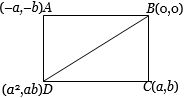
View full question & answer→MCQ 1661 Mark
The area of a triangle is $5$. If two of its vertices are $(2,1), (3,-2)$ and the third vertex lies on the line $y = x + 3$, then the third vertex is
- A
$\left( { - \frac{7}{2}, - \frac{{13}}{2}} \right)$
- B
$\left( { - \frac{7}{2},\frac{{13}}{2}} \right)$
- C
$\left( {\frac{7}{2}, - \frac{{13}}{2}} \right)$
- ✓
$\left( {\frac{7}{2},\frac{{13}}{2}} \right)$
AnswerCorrect option: D. $\left( {\frac{7}{2},\frac{{13}}{2}} \right)$
d
(d) Let the third vertex be $(p, q).$ Since it lies on the line $y = x + 3,$ therefore $q = p + 3$ .....$(i)$
Also area of the triangle is $5,$
$\therefore$ $\frac{1}{2}\,[2\,( - 2 - q) + 3\,(q - 1) + p\,(1 + 2)] = \pm \,5$
$ \Rightarrow \,\,q + 3p - 7 = \pm \,10$.....$(ii)$
Thus on solving $(i)$ and $(ii),$ we get $p = \frac{7}{2},\,\, - \frac{3}{2}$ and $q = \frac{{13}}{2},\,\frac{3}{2}.$ Hence the third vertex is either $\left( {\frac{7}{2},\,\frac{{13}}{2}} \right)$ or $\left( { - \frac{3}{2},\,\,\frac{3}{2}} \right)$.
View full question & answer→MCQ 1671 Mark
The area of the triangle formed by the lines $7x - 2y + 10 = 0,$ $7x + 2y - 10 = 0$ and $y + 2 = 0$ is ............ $\mathrm{sq. \,unit}$
Answerc
(c) On solving the simultaneous equations, we get the vertices of triangle as $(-2, -2)$, $(2, -2)$ and $(0, 5)$.
Hence, area $ = \frac{1}{2}\,\left| {\,\begin{array}{*{20}{c}}{ - 2}&{ - 2}&1\\2&{ - 2}&1\\0&5&1\end{array}\,} \right| = 14\,sq.\,units.$
View full question & answer→MCQ 1681 Mark
If the vertices of a triangle have integral coordinates, then the triangle is
Answerb
(b) Let and be the coordinates of the vertices of a triangle and let be all integers. Then the area of triangle
= Some rational numbers, because $x’s$ and $y's$ are integers.
Also, if the triangle is equilateral and a be the length of its side, then ${a^2} = {({x_1} - {x_2})^2} + {({y_1} - {y_2})^2} = A$ positive integer.
The area of the triangle $ = \frac{1}{2}bc\,\,\sin A$ $ = \frac{1}{2}.\,a\,.\,a\,\sin {60^o} = \frac{{\sqrt 3 }}{4}{a^2}$every angle is of ${60^o}\} $
Which is irrationals, because ${a^2}$ is positive integer.
But earlier we have calculated that the area of the triangle is rational number. Hence it is a contradiction. Therefore, if the vertices of a triangle are integers, the triangle cannot be equilateral.
Note : Students should remember this question as a fact.
View full question & answer→MCQ 1691 Mark
The orthocentre of triangle formed by lines $4x - 7y + 10 = 0,$ $x + y = 5$ and $7x + 4y = 15$ is
- ✓
$(1, 2)$
- B
$(1, -2)$
- C
$(-1, -2)$
- D
$(-1, 2)$
AnswerCorrect option: A. $(1, 2)$
a
(a) Orthocentre of right angled triangle is same as the vertex of right angle. Therefore, point of intersection of $7x + 4y - 15 = 0$ and $4x - 7y + 10 = 0$ is $(1, 2).$
View full question & answer→MCQ 1701 Mark
The point $A$ divides the join of the points $(-5,1)$ and $(3,5)$ in the ratio $k :1$ and the coordinates of the points $B$ and $C$ are $(1,5)$ and $(7,-2)$ respectively. If the area of the triangle $ABC$ be $2$ units, then $k =$
- A
$6,7$
- B
$31/9,9$
- ✓
$7, 31/9$
- D
$7, 9$
AnswerCorrect option: C. $7, 31/9$
c
(c) The coordinates of the point $A$ are $\left( {\frac{{3k - 5}}{{k + 1}},\,\frac{{5k + 1}}{{k + 1}}} \right)$ and that of $B$ and $C$ are $(1, 5)$ and $(7, -2)$. Thus area of triangle $ABC$ is
$\frac{1}{2}\left[ {\frac{{3k - 5}}{{k + 1}}\,(5 + 2) + 1\,\left( { - 2 - \frac{{5k + 1}}{{k + 1}}} \right) + 7\,\left( {\frac{{5k + 1}}{{k + 1}} - 5} \right)} \right]$
$ = \pm \,2$
$ \Rightarrow \,\,21k - 35 - 7k - 3 - 28 = \pm 4\,(k + 1)$
$ \Rightarrow \,\,k = 7$ or $\frac{{31}}{9}$ .
View full question & answer→MCQ 1711 Mark
Orthocentre of the triangle whose vertices are $(0, 0) \,(2, -1)$ and $(1, 3)$ is
- A
$\left( {\frac{4}{7},\,\frac{1}{7}} \right)$
- ✓
$\left( { - \frac{4}{7},\, - \frac{1}{7}} \right)$
- C
$(-4, -1)$
- D
$(4, 1)$
AnswerCorrect option: B. $\left( { - \frac{4}{7},\, - \frac{1}{7}} \right)$
b
(b) Equation of line $BC$ is $4x + y = 7$, then equation of line $AD$ is $x - 4y + k = 0$
but it passes through $(0,0)$ hence $k = 0$
thus equation of $AD = x - 4y = 0$.....$(i)$
Similarly the equation of $AC = 3x - y = 0$ and $BE$ is
$x + 3y + 1 = 0$.....$(ii)$
On solving $(i)$ and $(ii)$, the required orthocentre is $\left( {\frac{{ - 4}}{7},\frac{{ - 1}}{7}} \right)$.
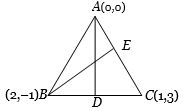
View full question & answer→MCQ 1721 Mark
The line $x + y = 4$ divides the line joining the points $(-1, 1)$ and $(5, 7)$ in the ratio
- A
$2 : 1$
- ✓
$1 : 2$
- C
$1 : 2$ externally
- D
AnswerCorrect option: B. $1 : 2$
b
(b) Ratio$ = - \left( {\frac{{ - 1 + 1 - 4}}{{5 + 7 - 4}}} \right) = \frac{1}{2}$.(Using the formula given in the book)
View full question & answer→MCQ 1731 Mark
If the vertices of a triangle be $(2,1), (5,2)$ and $(3,4)$, then its circumcentre is
- A
$\left( {\frac{{13}}{2},\frac{9}{2}} \right)$
- ✓
$\left( {\frac{{13}}{4},\frac{9}{4}} \right)$
- C
$\left( {\frac{9}{4},\frac{{13}}{4}} \right)$
- D
AnswerCorrect option: B. $\left( {\frac{{13}}{4},\frac{9}{4}} \right)$
b
(b) Let circumcentre be $O\,(x,\,y)$ and given points are $A\,(2,\,\,1),\,\,B\,(5,\,\,2),\,C\,(3,\,\,4).$ Hence $O{A^2} = O{B^2} = O{C^2}$
$\therefore \,\,\,\,{(x - 2)^2} + {(y - 1)^2} = {(x - 5)^2} + {(y - 2)^2}$......(i)
and ${(x - 2)^2} + {(y - 1)^2} = {(x - 3)^2} + {(y - 4)^2}$.....(ii)
On solving (i) and (ii), we get $x = \frac{{13}}{4}$ and $y = \frac{9}{4}$.
Trick : If $(x, y)$ is the circumcentre, then its distances from the vertices of a triangle must be equal.
Therefore check with the options. Obviously, point $\left( {\frac{{13}}{4},\,\,\frac{9}{4}} \right)$ is equidistant from the points $(2,\,\,1),\,\,(5,\,\,2)$ and $(3, 4)$.
View full question & answer→MCQ 1741 Mark
The coordinates of the points $O, \,A $ and B are $(0,0)$, $(0,4)$ and $(6,0)$ respectively. If a points $P$ moves such that the area of $\Delta POA$ is always twice the area of $\Delta POB$, then the equation to both parts of the locus of $P$ is
- ✓
$(x - 3y)(x + 3y) = 0$
- B
$(x - 3y)(x + y) = 0$
- C
$(3x - y)(3x + y) = 0$
- D
AnswerCorrect option: A. $(x - 3y)(x + 3y) = 0$
a
(a) The three given points are $O\,\,(0,\,\,0),\,\,A(0,\,\,4)$ and $B\,(6,\,\,0)$ and let $P(x,\,\,y)$ be the moving point.
Area of $\Delta POA = 2\,.\,$Area of $\Delta POB$
$ \Rightarrow \,\,\frac{1}{2} \times 4 \times x = \pm \,2 \times \frac{1}{2} \times 6 \times y$ or $x = \pm \,3y$
Hence the equation to both parts of the locus of $P$ is $(x - 3y)\,(x + 3y) = 0$.
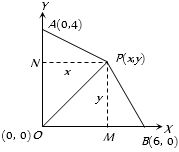
View full question & answer→MCQ 1751 Mark
The centroid of a triangle, whose vertices are $(2,1)$, $(5,2)$ and $(3,4)$, is
- A
$\left( {\frac{8}{3},\frac{7}{3}} \right)$
- ✓
$\left( {\frac{{10}}{3},\frac{7}{3}} \right)$
- C
$\left( { - \frac{{10}}{3},\frac{7}{3}} \right)$
- D
$\left( {\frac{{10}}{3}, - \frac{7}{3}} \right)$
AnswerCorrect option: B. $\left( {\frac{{10}}{3},\frac{7}{3}} \right)$
b
(b)$x = \frac{{2 + 5 + 3}}{3} = \frac{{10}}{3}$ and $y = \frac{{1 + 2 + 4}}{3} = \frac{7}{3}$.
View full question & answer→MCQ 1761 Mark
The area of the triangle formed by the points $(a,b + c),\,(b,c + a),\,(c,a + b)$ is
- A
$abc$
- B
${a^2} + {b^2} + {c^2}$
- C
$ab + bc + ca$
- ✓
$0$
Answerd
(d) Area$ = \frac{1}{2}\,\left| {\,\begin{array}{*{20}{c}}a&{b + c}&1\\b&{c + a}&1\\c&{a + b}&1\end{array}\,} \right| = \frac{1}{2}\,\left| {\,\begin{array}{*{20}{c}}a&{a + b + c}&1\\b&{a + b + c}&1\\c&{a + b + c}&1\end{array}\,} \right|$
(Applying ${C_2} \to {C_1} + {C_2})$
$ = \frac{{(a + b + c)}}{2}\,\left| {\,\begin{array}{*{20}{c}}a&1&1\\b&1&1\\c&1&1\end{array}\,} \right| = 0$.
View full question & answer→MCQ 1771 Mark
If $O$ be the origin and if the coordinates of any two points $Q_1$ and $Q_2$ be $(x_1, y_1)$ and $(x_2, y_2)$ respectively, then $O{Q_1}.O{Q_2}\cos {Q_1}O{Q_2} = $
- A
${x_1}{x_2} - {y_1}{y_2}$
- B
${x_1}{y_1} - {x_2}{y_2}$
- ✓
${x_1}{x_2} + {y_1}{y_2}$
- D
${x_1}{y_1} + {x_2}{y_2}$
AnswerCorrect option: C. ${x_1}{x_2} + {y_1}{y_2}$
c
(c)From triangle $O{Q_1}{Q_2},$ by applying cosine formula
${Q_1}Q_2^2 = OQ_1^2 + OQ_2^2 - 2O{Q_1}.O{Q_2}\,\cos \,{Q_1}O{Q_2}$
or ${({x_1} - {x_2})^2} + {({y_1} - {y_2})^2}$
= $x_1^2 + y_1^2 + x_2^2 + y_2^2 - 2O{Q_1}.O{Q_2}\,\cos \,\theta $
or ${x_1}{x_2} + {y_1}{y_2} = O{Q_1}.O{Q_2}\,\cos \,\,{Q_1}O{Q_2}$.
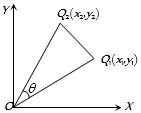
View full question & answer→MCQ 1781 Mark
If $A(6,3),$ $B( - 3,5)$, $C(4, - 2)$ and $D(x,{\rm{ }}3x)$ are four points. If the ratio of area of $\Delta DBC$ and $\Delta ABC$ is $1 : 2$, then the value of $x$, will be
- ✓
$\frac{{11}}{8}$
- B
$\frac{8}{{11}}$
- C
$3$
- D
AnswerCorrect option: A. $\frac{{11}}{8}$
a
(a) $\frac{{\Delta \,DBC}}{{\Delta \,ABC}} = \frac{1}{2} \Rightarrow \,\,2\Delta DBC = \Delta ABC$
$ \Rightarrow \,\,2(14x - 7) = \frac{{49}}{2}\,\, \Rightarrow \,\,x = \frac{{77}}{{56}} = \frac{{11}}{8}$.
View full question & answer→MCQ 1791 Mark
The coordinates of a point are $(0, 1)$ and the ordinate of another point is -$3$. If the distance between the two points is $5$, then the abscissa of another point is
AnswerCorrect option: C. $ \pm 3$
c
(c) $25 = {x^2} + 16\,\, \Rightarrow \,\,x = \pm \,3$.
View full question & answer→MCQ 1801 Mark
The point whose abscissa is equal to its ordinate and which is equidistant from the points $(1,0)$ and $(0,3)$ is
- A
$(1, 1)$
- ✓
$(2, 2)$
- C
$(3, 3)$
- D
$(4, 4)$
AnswerCorrect option: B. $(2, 2)$
b
(b) Let the point be $(x, x)$, so according to the condition ${(x - 1)^2} + {(x - 0)^2} = {(x - 0)^2} + {(x - 3)^2}$
$ \Rightarrow \,\, - 2x + 1 = - 6x + 9\,\, \Rightarrow \,\,x = 2$.
Hence the point is $(2, 2)$.
View full question & answer→MCQ 1811 Mark
If the point $(x, y)$ be equidistant from the points $(a + b,\,b - a)$ and $(a - b,\,a + b),$ then
- A
$ax + by = 0$
- B
$ax - by = 0$
- C
$bx + ay = 0$
- ✓
$bx - ay = 0$
AnswerCorrect option: D. $bx - ay = 0$
d
(d) ${\left\{ {x - (a + b)} \right\}^2} + {\left\{ {y - (b - a)} \right\}^2} = {\left\{ {x - (a - b)} \right\}^2} + {\left\{ {y - (a + b)} \right\}^2}$
$ \Rightarrow \,\,{x^2} + {(a + b)^2} - 2x\,(a + b) + {y^2} + {(b - a)^2} - 2y(b - a)$
$ = {x^2} + {(a - b)^2} - 2x(a - b) + {y^2} + {(a + b)^2} - 2y(a + b)$
On simplification, we get $bx - ay = 0$
Trick : The locus will be right bisector of the line joining the given points, therefore the line must pass through the mid-points of the given point i.e. $(a, b)$. Obviously, the line given in option $(d)$ passes through $(a, b)$.
View full question & answer→MCQ 1821 Mark
The distance between the points $(a\cos\, \alpha ,\,\,a\sin\, \alpha )$ and $(a\cos \,\beta ,a\sin\, \beta )$ is
- A
$a\cos\, \frac{{\alpha -\, \beta }}{2}$
- B
$2a\cos\, \frac{{\alpha -\, \beta }}{2}$
- C
$a\sin\,\frac{{\alpha -\, \beta }}{2}$
- ✓
$2a\sin\, \frac{{\alpha - \,\beta }}{2}$
AnswerCorrect option: D. $2a\sin\, \frac{{\alpha - \,\beta }}{2}$
d
(d) Distance $ = \sqrt {{a^2}{{(\cos \alpha - \cos \beta )}^2} + {a^2}{{(\sin \alpha - \sin \beta )}^2}} $
$ = a\sqrt {{{\sin }^2}\alpha + {{\cos }^2}\alpha + {{\cos }^2}\beta + {{\sin }^2}\beta - 2\cos \alpha \cos \beta - 2\sin \alpha \sin \beta } $
$ = a\sqrt {2\left\{ {1 - \cos \,(\alpha - \beta )} \right\}} $
$= 2a\,\sin \,\left( {\frac{{\alpha - \beta }}{2}} \right)$
Trick : Put $a = 1,\,\,\alpha = \frac{\pi }{2},\,\beta = \frac{\pi }{6},$ then the points will be $(0, 1)$ and $\left( {\frac{{\sqrt 3 }}{2},\,\,\frac{1}{2}} \right)$.
Obviously, the distance between these two points is 1 which is given by $(d)$.
$\left\{ {\,\,2a\,\sin \frac{{\alpha - \beta }}{2} = 2 \times 1 \times \sin \frac{{(\pi /2) - (\pi /6)}}{2} = 2 \times \frac{1}{2} = 1} \right\}$
View full question & answer→MCQ 1831 Mark
A point equidistant from the points $(2, 0)$ and $(0, 2)$ is
- A
$(1, 4)$
- B
$(2, 1)$
- C
$(1, 2)$
- ✓
$(2, 2)$
AnswerCorrect option: D. $(2, 2)$
d
(d) ${(x - 2)^2} + {y^2} = {x^2} + {(y - 2)^2}\,\, \Rightarrow \,\,(x,\,\,y) = (2,\,\,2)$
Trick : Check with option. Obviously, the point $(2, 2)$ is equidistant from the points $(2, 0)$ and $(0, 2)$.
View full question & answer→MCQ 1841 Mark
The point on $y$-axis equidistant from the points $(3, 2)$ and $(-1, 3)$ is
- A
$(0, -3)$
- ✓
$(0, -3/2)$
- C
$(0, 3/2)$
- D
$(0, 3)$
AnswerCorrect option: B. $(0, -3/2)$
b
(b) Point on y-axis is $(0, b)$, therefore by given condition ${(0 - 3)^2} + {(b - 2)^2} = {(0 + 1)^2} + {(b - 3)^2}$
$ \Rightarrow \,\,9 + {b^2} + 4 - 4b = 1 + {b^2} + 9 - 6b\,\, \Rightarrow \,\,b = - \frac{3}{2}$
Hence the point is $\left( {0,\, - \frac{3}{2}} \right)$.
View full question & answer→MCQ 1851 Mark
If a vertex of an equilateral triangle is on origin and second vertex is $(4, 0)$, then its third vertex is
- A
$(2,\, \pm\, \sqrt 3 )$
- B
$(3,\, \pm \,\sqrt 2 )$
- ✓
$(2,\, \pm\, 2\sqrt 3 )$
- D
$(3,\, \pm\, 2\sqrt 2 )$
AnswerCorrect option: C. $(2,\, \pm\, 2\sqrt 3 )$
c
(c) By inspection i.e. length of the three sides must be equal. We find the required point $(2,\,\, \pm \,2\sqrt 3 )$.
View full question & answer→MCQ 1861 Mark
If the coordinates of vertices of $\Delta OAB$ are $(0,0)$ $(\cos \alpha ,\,\sin \alpha )$ and $( - \sin \alpha ,\,\cos \alpha )$ respectively, then $O{A^2} + O{B^2} = $
Answerc
(c) $O{A^2} = {\cos ^2}\alpha + {\sin ^2}\alpha = 1$
and $O{B^2} = {\sin ^2}\alpha + {\cos ^2}\alpha = 1$.
Hence $O{A^2} + O{B^2} = 1 + 1 = 2$.
View full question & answer→MCQ 1871 Mark
The length of altitude through $A$ of the triangle $ABC$, where $A \equiv ( - 3,\,0);\,B \equiv (4,\, - 1);\,C \equiv (5,\,2),$ is
- A
$\frac{2}{{\sqrt {10} }}$
- B
$\frac{4}{{\sqrt {10} }}$
- C
$\frac{{11}}{{\sqrt {10} }}$
- ✓
$\frac{{22}}{{\sqrt {10} }}$
AnswerCorrect option: D. $\frac{{22}}{{\sqrt {10} }}$
d
(d) In $\Delta ABC$, $A \equiv ( - \,3,\,0);\,\,B \equiv (4,\,\, - 1)$ and $C \equiv (5,\,\,2)$
We know that $BC = \sqrt {{{(5 - 4)}^2} + {{(2 + 1)}^2}} $
$ = \sqrt {1 + 9} = \sqrt {10} $
and area of $\Delta ABC$
$ = \frac{1}{2}[ - 3\,( - 1 - 2) + 4(2 - 0) + 5\,(0 + 1)] = 11$
Therefore, altitude $AL = \frac{{2\,\Delta ABC}}{{BC}} = \frac{{2 \times 11}}{{\sqrt {10} }} = \frac{{22}}{{\sqrt {10} }}$.
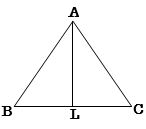
View full question & answer→MCQ 1881 Mark
The distance of the middle point of the line joining the points $(a\sin \theta ,0)$and $(0,a\cos \theta )$from the origin is
AnswerCorrect option: A. $\frac{a}{2}$
a
(a)Mid-point will be $\left( {\frac{{a\,\sin \theta }}{2},\,\frac{{a\,\cos \theta }}{2}} \right)$ and distance from origin will be $\sqrt {{{\left( {\frac{{a\,\sin \theta }}{2} - 0} \right)}^2} + {{\left( {\frac{{a\,\cos \theta }}{2} - 0} \right)}^2}} = \frac{a}{2}$.
View full question & answer→MCQ 1891 Mark
If the points $(1,1)$, $(-1, -1)$ and $( - \sqrt 3 ,k)$ are vertices of an equilateral triangle then the value of $k$ will be
- A
$1$
- B
$-1$
- ✓
$\sqrt 3 $
- D
$ - \sqrt 3 $
AnswerCorrect option: C. $\sqrt 3 $
c
(c) ${l^2} = {2^2} + {2^2} = 8 = {(\sqrt 3 + 1)^2} + {(k - 1)^2}\,\, \Rightarrow \,\,k = \sqrt 3 $.
View full question & answer→MCQ 1901 Mark
The distance between the points $(7, 5)$ and $(3, 2)$ is equal to ........... $\mathrm{unit}$
Answerd
(d) Distance between points $(7, 5)$ and $(3, 2)$
=$\sqrt {{{(3 - 7)}^2} + {{(2 - 5)}^2}} = \sqrt {16 + 9} = 5$ unit.
View full question & answer→MCQ 1911 Mark
If the point dividing internally the line segment joining the points $(a, b)$ and $(5, 7)$ in the ratio $2 : 1$ be $(4, 6)$, then
- A
$a = 1,\,b = 2$
- B
$a = 2,\,b = - 4$
- ✓
$a = 2,\,b = 4$
- D
$a = - 2,\,b = 4$
AnswerCorrect option: C. $a = 2,\,b = 4$
c
(c) $\frac{{2 \times 5 + 1(a)}}{{2 + 1}} = 4 \Rightarrow a = 2$
and $\frac{{2 \times 7 + 1(b)}}{{2 + 1}} = 6 \Rightarrow b = 4$.
View full question & answer→MCQ 1921 Mark
If the middle point of the line segment joining the points $(5, a)$ and $(b,7) $ be $(3,5)$, then $(a, b) $=
- ✓
$(3,1)$
- B
$(1,3)$
- C
$(-2,-2)$
- D
$(-3, -1)$
AnswerCorrect option: A. $(3,1)$
a
(a) $\frac{{5 + b}}{2} = 3,\,\,\,\frac{{a + 7}}{2} = 5\,\, \Rightarrow \,\,b = 1,\,\,a = 3$.
View full question & answer→MCQ 1931 Mark
The ratio in which $x$-axis divides the join of the points $(2, -3)$ and $(5, 6)$ is
- A
$2 : 1$
- ✓
$1 : 2$
- C
$2 : -1$
- D
AnswerCorrect option: B. $1 : 2$
b
(b) Let ratio be $k : 1$ and coordinates of $x$-axis are $(a,\,\,0).$ Therefore $0 = \frac{{k \times 6 + 1 \times ( - \,3)}}{{k + 1}}\,\, \Rightarrow \,\,k = \frac{1}{2}$
Hence the ratio is $1 : 2.$
Aliter : Apply the formula given in the theory part, the required ratio is $ - \left( {\frac{{ - 3}}{6}} \right)$ or $1 : 2$.
View full question & answer→MCQ 1941 Mark
The point which divides externally the line joining the points $(a + b,\,a - b)$ and $(a - b,a + b)$ in the ratio $a:b$, is
- ✓
$\left( {\frac{{{a^2} - 2ab - {b^2}}}{{a - b}},\frac{{{a^2} + {b^2}}}{{a - b}}} \right)$
- B
$\left( {\frac{{{a^2} - 2ab - {b^2}}}{{a - b}},\frac{{{a^2} - {b^2}}}{{a - b}}} \right)$
- C
$\left( {\frac{{{a^2} - 2ab + {b^2}}}{{a - b}},\frac{{{a^2} + {b^2}}}{{a - b}}} \right)$
- D
AnswerCorrect option: A. $\left( {\frac{{{a^2} - 2ab - {b^2}}}{{a - b}},\frac{{{a^2} + {b^2}}}{{a - b}}} \right)$
a
(a) Here $x = \frac{{a\,(a - b) - b\,(a + b)}}{{a - b}} = \frac{{{a^2} - 2ab - {b^2}}}{{a - b}}$
$y = \frac{{a\,(a + b) - b\,(a - b)}}{{a - b}} = \frac{{{a^2} + {b^2}}}{{a - b}}$.
View full question & answer→MCQ 1951 Mark
If the point $(x, -1)$, $(3, y)$, $(-2,3)$ and $(-3, -2)$ be the vertices of a parallelogram, then
- ✓
$x = 2,\,y = 4$
- B
$x = 1,\,y = 2$
- C
$x = 4,\,y = 2$
- D
AnswerCorrect option: A. $x = 2,\,y = 4$
a
(a) Mid-points of the diagonals must be same.
$ \Rightarrow \,\,\frac{{x - 2}}{2} = \frac{{ - 3 + 3}}{2}\,\, \Rightarrow \,\,x = 2$
and $\frac{{ - 1 + 3}}{2} = \frac{{ - 2 + y}}{2}\,\, \Rightarrow \,\,y = 4$.
View full question & answer→MCQ 1961 Mark
Point $\left( {\frac{1}{2},\,\frac{{ - 13}}{4}} \right)$ divides the line joining the points $(3, - 5)$ and $( - 7,2)$ in the ratio of
- ✓
$1 : 3$ internally
- B
$3 : 1$ internally
- C
$1 : 3$ externally
- D
$3 : 1$ externally
AnswerCorrect option: A. $1 : 3$ internally
a
(a) Let the ratio be $k : 1$
Therefore, $\frac{{ - 7k + 3}}{{k + 1}} = \frac{1}{2}\,\, \Rightarrow \,\,k = \frac{1}{3}$.
Hence ratio is $1 : 3$ internally.
View full question & answer→MCQ 1971 Mark
If the vertices of a triangle are $A(1,4),\,B(3,0)$ and $C(2,1),$ then the length of the median passing through $C$ is
- ✓
$1$
- B
$2$
- C
$\sqrt 2 $
- D
$\sqrt 3 $
Answera
(a) Mid-point of $AB$ is $(2, 2)$, therefore the required length is the distance between the points $(2, 2)$ and $(2, 1)$ i.e., $1.$
View full question & answer→MCQ 1981 Mark
Three vertices of a parallelogram taken in order are $( - 1,\, - 6)$, $(2,\, - 5)$ and $(7,\,2)$. The fourth vertex is
- A
$(1, 4)$
- ✓
$(4, 1)$
- C
$(1, 1)$
- D
$( 4, 4)$
AnswerCorrect option: B. $(4, 1)$
b
(b) $\frac{{ - 1 + 7}}{2} = \frac{{2 + x}}{2}$ $ \Rightarrow \,\,x = 4$
$\frac{{ - 6 + 2}}{2} = \frac{{ - 5 + y}}{2}$ $ \Rightarrow \,\,y = 1$
$\therefore $ Fourth vertex $(x, y)$ is $(4, 1)$.
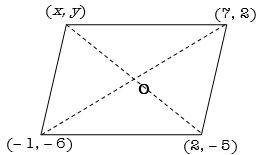
View full question & answer→MCQ 1991 Mark
P and Q are points on the line joining $A\,(-2, 5)$ and $B \,(3, 1)$ such that $AP\, = PQ\, = QB$. Then the mid-point of $PQ$ is
- ✓
$\left( {\frac{1}{2},\,3} \right)$
- B
$\left( { - \frac{1}{2},\,4} \right)$
- C
$(2,\,3)$
- D
$(1,\,4)$
AnswerCorrect option: A. $\left( {\frac{1}{2},\,3} \right)$
a
(a) Mid-point of $PQ$ is the same as that of $AB$ in view of the given conditions i.e., $\left( {\frac{1}{2},\,\,3} \right)$.
View full question & answer→MCQ 2001 Mark
The coordinates of the point dividing internally the lines joining the points $(4, -2)$ and $(8, 6)$ in the ratio $7 : 5$ will be
- A
$(16,\,18)$
- B
$(18,\,16)$
- ✓
$\left( {\frac{{19}}{3},\,\frac{8}{3}} \right)$
- D
$\left( {\frac{8}{3},\frac{{19}}{3}} \right)$
AnswerCorrect option: C. $\left( {\frac{{19}}{3},\,\frac{8}{3}} \right)$
c
(c) $x = \frac{{4 \times 5 + 8 \times 7}}{{12}} = \frac{{19}}{3}$ and $y = \frac{{ - 2 \times 5 + 6 \times 7}}{{12}} = \frac{8}{3}$.
View full question & answer→MCQ 2011 Mark
In what ratio does the $ y$-axis divide the join of $( - 3,\, - 4)$ and $(1, - 2)$
- A
$1 : 3$
- B
$2 : 3$
- ✓
$3 : 1$
- D
AnswerCorrect option: C. $3 : 1$
c
(c) Apply the formula $ - \left( {\frac{{{x_1}}}{{{x_2}}}} \right)$,.
the required ratio is $ - \left( {\frac{{ - 3}}{1}} \right) = 3\,\,:\,\,1$.
View full question & answer→MCQ 2021 Mark
If the three vertices of a rectangle taken in order are the points $(2, -2)$, $(8, 4)$ and $(5, 7)$. The coordinates of the fourth vertex is
- A
$(1, 1)$
- B
$(1, -1)$
- ✓
$(-1, 1)$
- D
AnswerCorrect option: C. $(-1, 1)$
c
(c) Let fourth vertex be $(x, y)$, then $\frac{{x + 8}}{2} = \frac{{2 + 5}}{2}$ and $\frac{{y + 4}}{2} = \frac{{ - 2 + 7}}{2}\,\, \Rightarrow \,\,x = - 1,\,\,y = 1$.
View full question & answer→MCQ 2031 Mark
The extremities of a diagonal of a parallelogram are the points $(3, - 4)$ and $( - 6,5)$. If third vertex is $( - 2,1)$, then fourth vertex is
- A
$(1,0)$
- ✓
$( - 1,0)$
- C
$(1,{\rm{ }}1)$
- D
AnswerCorrect option: B. $( - 1,0)$
b
(b) Let $A\, (3, -4)$ and $C\,(-6, 5)$ be the ends of diagonal of parallelogram $ABCD$. Let $B \,(-2, 1)$ and $D$ be $(x, y)$.
Then mid-points of diagonals $AC$ and $BD$ coincide. So $\frac{{x - 2}}{2} = \frac{{ - 6 + 3}}{2}$ and $\frac{{y + 1}}{2} = \frac{{5 - 4}}{2}\,\, \Rightarrow \,\,x = - 1,\,\,y = 0$
$\therefore $ Coordinates of $D$ are $(-1, 0)$.
View full question & answer→MCQ 2041 Mark
If $A (2, 2), B(-4, -4), C(5, -8)$ are vertices of any triangle, then the length of median passes through $C$ will be
- A
$\sqrt {65} $
- B
$\sqrt {117} $
- ✓
$\sqrt {85} $
- D
$\sqrt {113} $
AnswerCorrect option: C. $\sqrt {85} $
c
(c) Required length $ = \sqrt {{{(5 + 1)}^2} + {{( - 8 + 1)}^2}} = \sqrt {85} $.
View full question & answer→MCQ 2051 Mark
If the points $(0, 0)$, $(2,\,2\sqrt 3 )$ and $(a, b)$ be the vertices of an equilateral triangle, then $(a,\,b) = $
- A
$(0, -4)$
- B
$(0, 4)$
- ✓
$(4, 0)$
- D
$(-4, 0)$
AnswerCorrect option: C. $(4, 0)$
c
(c) $l = \sqrt {4 + 12} = 4\,\, \Rightarrow \,\,{a^2} + {b^2} = 16$
and ${(a - 2)^2} + {(b - 2\sqrt 3 )^2} = 16\,\, \Rightarrow \,\,a + \sqrt 3 b = 4$
Hence $(a,\,\,b) = (4,\,\,0)$.
View full question & answer→MCQ 2061 Mark
If $A(3,\,5),B( - 5,\, - 4),C(7,\,10)$ are the vertices of a parallelogram, taken in the order, then the co-ordinates of the fourth vertex are
- A
$(10, 19)$
- B
$(15, 10)$
- C
$(19, 10)$
- ✓
$(15, 19)$
AnswerCorrect option: D. $(15, 19)$
d
(D) Mid point of $A(3,5)$ and $C(7,10)$= $M\left( {5,\,\,\frac{{15}}{2}} \right)$
Mid point of $BD = M\left( {5,\,\,\frac{{15}}{2}} \right)$
$B( - 5, - 4)$ and $D(x,y)$
$\frac{{ - 5 + x}}{2} = 5$; $x = 10 + 5 = 15$
$\frac{{ - 4 + y}}{2} = \frac{{15}}{2}$; $y = 15 + 4 = 19$
Co-ordinates of fourth vertex $D = (15,\;19)$.
View full question & answer→MCQ 2071 Mark
If the point $(a, a)$ are placed in between the lines $|x + y| = 4$, then
- A
$| a| = 2$
- B
$|a|\, = 3$
- ✓
$| a| < 2$
- D
$| a| < 3$
AnswerCorrect option: C. $| a| < 2$
c
(c) Lines $x + y = 4$ and $x + y = - 4$ are parallel and point $(2, 2)$ and $(-2, -2)$ are lies on these lines.
If point $(a, a)$ are lie in between the lines then $a > - 2$ and $a < 2$ i.e.$ -2 < a< 2$==> $|a|\; < 2$.
View full question & answer→MCQ 2081 Mark
The three points $(-2,2), \,(8,-2)$ and $(-4, -3)$ are the vertices of
Answerc
(c) $a = \sqrt {{{(8 + 2)}^2} + {{( - 2 - 2)}^2}} = \sqrt {116} $
$b = \sqrt {{{( - \,4 - \,8)}^2} + {{( - \,3 + 2)}^2}} = \sqrt {145} $
$c = \sqrt {{{( - \,4 + 2)}^2} + {{( - \,3 - 2)}^2}} = \sqrt {29} $
$ \Rightarrow \,\,{a^2} + {c^2} = {b^2}$
Hence it is right angled triangle.
View full question & answer→MCQ 2091 Mark
The points $\left( {\frac{a}{{\sqrt 3 }},a} \right),\;\left( {\frac{{2a}}{{\sqrt 3 }},\,2a} \right),\;\left( {\frac{a}{{\sqrt 3 }},\,3a} \right)$ are the vertices of
Answerb
(b) Let $A\,\left( {\frac{a}{{\sqrt 3 }},\,a} \right),\,\,B\,\left( {\frac{{2a}}{{\sqrt 3 }},\,\,2a} \right)$ and $C\,\left( {\frac{a}{{\sqrt 3 }},\,\,3a} \right)$
Then $A{B^2} = {\left( {\frac{a}{{\sqrt 3 }} - \frac{{2a}}{{\sqrt 3 }}} \right)^2} + {(a - 2a)^2} = \frac{{{a^2}}}{3} + {a^2} = \frac{{4{a^2}}}{3}$
Similarly $B{C^2} = \frac{{4{a^2}}}{3}$ and $A{C^2} = 4{a^2}$
Hence it is an isosceles triangle.
View full question & answer→MCQ 2101 Mark
The points $(a,b),\;(c,d)$ and $\left( {\frac{{kc + la}}{{k + l}},\,\frac{{kd + lb}}{{k + l}}} \right)$ are
- A
Vertices of an equilateral triangle
- B
Vertices of an isosceles triangle
- C
Vertices of a right angled triangle
- ✓
Answerd
(d) The given points are collinear because the point $\left( {\frac{{kc + la}}{{k + l}},\,\,\frac{{kd + lb}}{{k + l}}} \right)$
divides the points $(a, b)$ and $(c, d)$ in the ratio of $k : l$.
View full question & answer→MCQ 2111 Mark
The points $(3a, 0),\, (0, 3b)$ and $(a, 2b)$ are
- A
Vertices of an equilateral triangle
- B
Vertices of an isosceles triangle
- C
Vertices of a right angled isosceles triangle
- ✓
Answerd
(d) ${l_1} = \sqrt {{{(3a)}^2} + {{(3b)}^2}} = 3\sqrt {{a^2} + {b^2}} $
${l_2} = \sqrt {{a^2} + {b^2}} = \sqrt {{a^2} + {b^2}} $
${l_3} = \sqrt {{{(2a)}^2} + {{(2b)}^2}} = 2\sqrt {{a^2} + {b^2}} $
$ \Rightarrow \,\,{l_1} = {l_2} + {l_3}$
Hence the points are collinear.
View full question & answer→MCQ 2121 Mark
The points $( - a, - b),\;(a,b),\;({a^2},ab)$are
- A
Vertices of an equilateral triangle
- B
Vertices of a right angled triangle
- C
Vertices of an isosceles triangle
- ✓
Answerd
(d) ${l_1} = \sqrt {{{(2a)}^2} + {{(2b)}^2}} = 2\sqrt {{a^2} + {b^2}} $
${l_2} = \sqrt {{{({a^2} - a)}^2} + {b^2}{{(a - 1)}^2}} = (a - 1)\,\sqrt {{a^2} + {b^2}} $
${l_3} = \sqrt {{{({a^2} + a)}^2} + {b^2}{{(a + 1)}^2}} = (a + 1)\,\sqrt {{a^2} + {b^2}} $
Now ${l_1} + {l_2} = {l_3}.$ Hence points are collinear.
View full question & answer→MCQ 2131 Mark
The quadrilateral formed by the vertices $(-1,1),\, (0,-3),\, (5,2)$ and $(4,6)$ will be
Answerb
(b) Let $A\,( - 1,\,\,1),\,\,B\,(0,\,\, - 3),\,\,C\,(5,\,\,2)$ and $D\,(4,\,\,6)$
$ \Rightarrow \,\,AB = \sqrt {17} ,\,\,CD = \sqrt {17} ,\,\,BC = \sqrt {50} ,\,$
$AD = \sqrt {50,} \,\,AC = \sqrt {37} $ and $BD = \sqrt {97} $
Obviously, $zx + 3y = 9$ and $2{x_1} + 3{y_1} = 9$ Also diagonal $AC \ne BD.$
Therefore, quadrilateral is parallelogram.
View full question & answer→MCQ 2141 Mark
The points $A(-4,-1), \,B (-2,-4),\, C(4,0)$ and $D(2,3)$ are the vertices of
Answerb
(b) Mid-points of diagonals are same.
Also ${S_{AB}} = \frac{{ - 4 + 1}}{{ - 2 + 4}} = \frac{{ - 3}}{2},\,\,\,{S_{AD}} = \frac{{3 + 1}}{{2 + 4}} = \frac{2}{3}$
${S_{AB}}\,.\,{S_{AD}} = - 1.$ Hence it is a rectangle.
View full question & answer→MCQ 2151 Mark
If the vertices of triangle are $(0,2)$, $(1,0)$ and $(3,1)$, then the triangle is
Answerd
(d) Here $A\,(0,\,\,2),\,\,B\,(1,\,\,0)$ and $C\,(3,\,\,1).$
Therefore, $AB = \sqrt {1 + 4} = \sqrt 5 ,\,\,BC = \sqrt {4 + 1} = \sqrt 5 $
and $zx + 3y = 9$
It is clear that $(AC)^2 = (AB)^2 + (BC)^2$
Hence, triangle is isosceles right angled.
View full question & answer→MCQ 2161 Mark
The points $(0,{\rm{ }}0),\;(a,{\rm{ }}0)$ and $\left( {\frac{a}{2},\,\frac{{a\sqrt 3 }}{2}} \right)$ are vertices of
Answerb
(b) Let $A\,(0,\,0),\,B\,(a,\,\,0)$ and $C\,\left( {\frac{a}{2},\,\frac{{a\sqrt 3 }}{2}} \right)$
Hence $AB = \sqrt {{a^2} + 0} = a,\,\,BC = \sqrt {{{\left( {\frac{a}{2}} \right)}^2} + {{\left( {\frac{{a\sqrt 3 }}{2}} \right)}^2}} = a$
and $AC = \sqrt {{{\left( {\frac{a}{2}} \right)}^2} + {{\left( {\frac{{a\sqrt 3 }}{2}} \right)}^2}} = a$
Hence the triangle is equilateral.
View full question & answer→MCQ 2171 Mark
If vertices of a quadrilateral are $A\, (0,0),\, B\,(3,4),\, C\,(7,7) $ and $D\,(4,3)$ then quadrilateral $ABCD$ is
Answerd
(d) Obviously $AB = BC = CD = AD = 5$
and also $AC \ne BD.$ Therefore, it is a rhombus.
View full question & answer→MCQ 2181 Mark
If vertices of any quadrilateral are $(0, -1), \,(2,1),\, (0, 3)$ and $(-2,1)$, then it is a
Answerb
(b) Let $A\,(0,\, - 1),\,B\,(2,\,\,1),\,\,C\,(0,\,\,3)$ and $D\,( - 2,\,1).$
Obviously $AB = BC = CD = AD = 2\sqrt 2 $
Also, $AC = BD = 4$ and slope of line $AB = 1,$
Slope of line $AD = - 1$. $\therefore \,\,\,\angle DAB = {90^o}$ .
Similarly, $\angle B = \angle C = \angle D = {90^o}$ i.e. each angle is right angle.
$\therefore $ Quadrialteral is a square.
View full question & answer→MCQ 2191 Mark
The triangle joining the points $P(2, 7)$, $Q(4, -1)$, $R(-2, 6)$ is
Answerb
(b) Since $PQ = \sqrt {68} ,\,\,PR = \sqrt {17} ,\,\,QR = \sqrt {85} $
$\therefore \,\,P{Q^2} + P{R^2} = Q{R^2}$, i.e. right angled triangle.
View full question & answer→MCQ 2201 Mark
Vertices of figure are $(-2,2), \,(-2,-1),\, (3,-1),\, (3,2)$. It is a
Answerc
(c) Let the points $A,\, B,\, C$ and $D$ are $( - 2,\,\,2)$, $( - 2,\,\, - 1),\,\,(3,\,\, - 1)$ and $(3, 2)$ respectively.
Then, $AB = 3,\,\,BC = 5$
$CD = 3,\,\,DA = 5$
Clearly angle between the diagonals is ${90^o}$.
So rectangle.
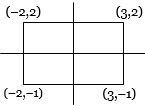
View full question & answer→MCQ 2211 Mark
If the points $(1,1) \,(-1,-1)$ $( - \sqrt 3 ,\sqrt 3 )$ are the vertices of a triangle, then this triangle is
Answera
(a) Given, vertices of triangle are $A(1,\,1),\,B( - 1,\, - 1)$ and $C( - \sqrt 3 ,\,\sqrt 3 )$
Now, $AB = \sqrt {{{( - 1 - 1)}^2} + {{( - 1 - 1)}^2}} = \sqrt {4 + 4} = \sqrt 8 $
$BC = \sqrt {{{( - \sqrt 3 + 1)}^2} + {{(\sqrt 3 + 1)}^2}} = \sqrt 8 $
$CA = \sqrt {{{(1 + \sqrt 3 )}^2} + {{(1 - \sqrt 3 )}^2}} = \sqrt 8 $
i.e., $AB = BC = CA$. So, it is an equilateral triangle.
View full question & answer→MCQ 2221 Mark
If the coordinates of the vertices of a triangle be $(1,a), \,(2,b)$ and $({c^2},3)$, then the centroid of the triangle
Answerc
(c) Centroid is $\left( {\frac{{1 + 2 + {c^2}}}{3},\,\frac{{a + b + 3}}{3}} \right)$
Now on $y$-axis $x = 0;\,\,$
$\Rightarrow \,\,\frac{{3 + {c^2}}}{3} = 0\,\,$
$\Rightarrow \,\,{c^2} = - 3$,
.which is impossible. Hence it cannot lie on $y$-axis.
View full question & answer→MCQ 2231 Mark
Three vertices of parallelogram are $(1, 3), (2, 0)$ and $(5, 1)$. Then its fourth vertex is
- A
$(3, 3)$
- ✓
$(4, 4)$
- C
$(4, 0)$
- D
$(0, -4)$
AnswerCorrect option: B. $(4, 4)$
b
(b) $\frac{{1 + 5}}{2} = \frac{{x + 2}}{2}\, \Rightarrow \,\,x = 4$ and $\frac{{3 + 1}}{2} = \frac{y}{2}\,\, \Rightarrow \,y = 4$.
View full question & answer→MCQ 2241 Mark
If the points $A(6, - 1),\;B{\rm{ }}(1,\,3)$ and $C(x,\,8)$ be such that $AB = BC,$ then $x = $
- ✓
$-3, 5$
- B
$3, -5$
- C
$-3, -5$
- D
$3, 5$
AnswerCorrect option: A. $-3, 5$
a
(a) $AB = BC\,\, \Rightarrow \,\,{(6 - 1)^2} + {(3 + 1)^2} = {(x - 1)^2} + {(8 - 3)^2}$
$ \Rightarrow \,\,{(x - 1)^2} - {(4)^2} = 0\,\,$
$\Rightarrow \,\,x = 5,\,\, - \,3$.
View full question & answer→MCQ 2251 Mark
Two vertices of a triangle are $(5,4)$ and $(-2,4)$. If its centroid is $(5,6)$ then the third vertex has the coordinates
- ✓
$(12,10)$
- B
$(10,12)$
- C
$(-10, 12)$
- D
$(12, -10)$
AnswerCorrect option: A. $(12,10)$
a
(a) Let the third vertex be $(x, y)$ then
$5 = \frac{{x + 5 - 2}}{3}\,\, \Rightarrow \,\,x = 12$and $6 = \frac{{y + 4 + 4}}{3}\,\, \Rightarrow \,\,y = 10$.
View full question & answer→MCQ 2261 Mark
If $A(4, - 3)$, $B(3, - 2)$ and $C\,(2,{\rm{ }}8)$ are the vertices of a triangle, then its centroid will be
- A
$(-3,3)$
- B
$(3,3)$
- ✓
$(3,1)$
- D
$(1,3)$
AnswerCorrect option: C. $(3,1)$
c
(c) Let centroid is $(x, y)$, then $x = \frac{{4 + 3 + 2}}{3} = 3$
and $y = \frac{{ - 3 - 2 + 8}}{3} = 1$.
View full question & answer→MCQ 2271 Mark
If two vertices of a triangle are $(6,4)$, $(2,6)$ and its centroid is $(4, 6)$, then the third vertex is
- ✓
$(4,8)$
- B
$(8,4)$
- C
$(6,4)$
- D
AnswerCorrect option: A. $(4,8)$
a
(a) $x = \frac{{{x_1} + {x_2} + {x_3}}}{3},\,\,y = \frac{{{y_1} + {y_2} + {y_3}}}{3}$
$\therefore \,\,4 = \frac{{6 + 2 + {x_3}}}{3},\,\,6 = \frac{{4 + 6 + {y_3}}}{3}$
$ \Rightarrow \,\,\,{x_3} = 4,\,\,{y_3} = 8$
$\therefore $ Third vertex is $(4, 8).$
View full question & answer→MCQ 2281 Mark
Orthocentre of the triangle formed by the lines $x + y = 1$ and $xy = 0$ is
- ✓
$(0,0)$
- B
$(0,1)$
- C
$(1,0)$
- D
$(-1,1)$
AnswerCorrect option: A. $(0,0)$
a
(a) Given lines are $x + y = 1$ and $xy = 0$
when $x = 0$, then $y = 1$
when $x = 1$, then $y = 0$
$\therefore $ $(0, 1)$ and $(1, 0)$ are the vertices of triangle. Clearly, triangle is right-angled isosceles. Orthocentre of right-angled triangle is same as the vertex of right angle.
Therefore point of intersection of $x + y = 1$ and $xy = 0$ is $(0, 0)$.
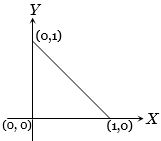
View full question & answer→MCQ 2291 Mark
If the vertices of a triangle be $(am_1^2,2a{m_1}),\,(am_2^2,2a{m_2})$ and $(am_3^2,2a{m_3}),$ then the area of the triangle is
- A
$a({m_2} - {m_3})({m_3} - {m_1})({m_1} - {m_2})$
- B
$({m_2} - {m_3})({m_3} - {m_1})({m_1} - {m_2})$
- ✓
${a^2}({m_2} - {m_3})({m_3} - {m_1})({m_1} - {m_2})$
- D
AnswerCorrect option: C. ${a^2}({m_2} - {m_3})({m_3} - {m_1})({m_1} - {m_2})$
c
(c) Area $ = \frac{1}{2}\,\,\left| {\,\begin{array}{*{20}{c}}{am_1^2}&{2a{m_1}}&1\\{am_2^2}&{2a{m_2}}&1\\{am_3^2}&{2a{m_3}}&1\end{array}\,} \right| = \frac{1}{2}{a^2} \times 2\,\left| {\,\begin{array}{*{20}{c}}{m_1^2}&{{m_1}}&1\\{m_2^2}&{{m_2}}&1\\{m_3^2}&{{m_3}}&1\end{array}\,} \right|$
$ = {a^2}\,\left| {\,\begin{array}{*{20}{c}}{m_1^2 - m_2^2}&{{m_1} - {m_2}}&0\\{m_2^2 - m_3^2}&{{m_2} - {m_3}}&0\\{m_3^2}&{{m_3}}&1\end{array}\,} \right|$ , by $\begin{array}{*{20}{c}}{{R_1} \to {R_1} - {R_2}}\\{{R_2} \to {R_2} - {R_3}}\end{array}$
$ = {a^2}\,(m_2^2 - m_3^2)\,({m_1} - {m_2}) - ({m_2} - {m_3})\,(m_1^2 - m_2^2)$
$ = {a^2}({m_1} - {m_2})\,({m_2} - {m_3})\,({m_3} - {m_1})$.
Trick : Let $a = 2,\,\,{m_1} = 0,\,\,{m_2} = 1,\,\,{m_3} = 2,$
then the coordinates are $(0, 0), \,(2, 4), \,(8, 8).$
$\therefore \,\,\Delta = \frac{1}{2}\,\left| {\,\begin{array}{*{20}{c}}0&0&1\\2&8&1\\4&8&1\end{array}\,} \right| = \frac{1}{2}\,(16 - 32) = 8\,\,sq.\,\,units$.
View full question & answer→MCQ 2301 Mark
If the coordinates of the points $A,\, B, \,C$, be $(4,4), \,(3,-2)$ and $(3,-16)$ respectively, then the area of the triangle ABC is
Answerd
(d) $\Delta = \frac{1}{2}\,[4\,( - 2 + 16) + 3\,( - 16 - 4) + 3\,(4 + 2)$
$ = \frac{1}{2}\,[56 - 60 + 18] = 7$.
View full question & answer→MCQ 2311 Mark
The area of the triangle formed by the lines $y = {m_1}x + {c_1},\,$ $y = {m_2}x + {c_2}$ and $x = 0$is
- A
$\frac{1}{2}\frac{{{{({c_1} + {c_2})}^2}}}{{({m_1} - {m_2})}}$
- B
$\frac{1}{2}\frac{{{{({c_1} - {c_2})}^2}}}{{({m_1} + {m_2})}}$
- ✓
$\frac{1}{2}\frac{{{{({c_1} - {c_2})}^2}}}{{({m_1} - {m_2})}}$
- D
$\frac{{{{({c_1} - {c_2})}^2}}}{{({m_1} - {m_2})}}$
AnswerCorrect option: C. $\frac{1}{2}\frac{{{{({c_1} - {c_2})}^2}}}{{({m_1} - {m_2})}}$
c
(c)On solving the equation of lines, we get the vertices of triangle $(0,\,\,{c_1}),\,\,(0,\,\,{c_2})$,
and $\left( {\frac{{{c_2} - {c_1}}}{{{m_1} - {m_2}}},\,\,\frac{{{m_1}{c_2} - {m_2}{c_1}}}{{{m_1} - {m_2}}}} \right)$
Hence, the area $ = \frac{1}{2}\,\left| {\,\begin{array}{*{20}{c}}0&{{c_1}}&1\\0&{{c_2}}&1\\{\frac{{{c_2} - {c_1}}}{{{m_1} - {m_2}}}}&{\frac{{{m_1}{c_2} - {m_2}{c_1}}}{{{m_1} - {m_2}}}}&1\end{array}\,} \right|$
$ = \frac{1}{2}\left[ {0 + {c_1}\left( {\frac{{{c_2} - {c_1}}}{{{m_1} - {m_2}}}} \right) - {c_{2\,}}\left( {\frac{{{c_2} - {c_1}}}{{{m_1} - {m_2}}}} \right)} \right]$
$ = \frac{1}{2}\frac{{({c_2} - {c_1})\,\,({c_1} - {c_2})}}{{{m_1} - {m_2}}} = \frac{1}{2}\frac{{{{({c_1} - {c_2})}^2}}}{{({m_1} - {m_2})}}$.
(sign is not considered).
View full question & answer→MCQ 2321 Mark
The area of a triangle whose vertices are $(1, -1),\,(-1, 1)$ and $(-1, -1)$ is given by
Answera
(a) $\Delta = \frac{1}{2}[1(1 + 1) - 1( - 1 + 1) - 1( - 1 - 1)] = 2$.
View full question & answer→MCQ 2331 Mark
Area of a triangle whose vertices are $(a\cos \theta ,b\sin \theta ),$ $( - a\sin \theta ,b\cos \theta )$ and $( - a\cos \theta , - b\sin \theta )$ is
Answerd
(d )Area$ = \frac{1}{2}\,\,\left| {\begin{array}{*{20}{c}}{a\,\cos \theta }&{b\,\sin \theta }&1\\{ - a\,\sin \theta }&{b\,\cos \theta }&1\\{ - a\,\cos \theta }&{ - b\,\sin \theta }&1\end{array}\,} \right|$
$ = \frac{1}{2}\,(a \times b)\,\left| {\,\begin{array}{*{20}{c}}{\cos \theta }&{\sin \theta }&1\\{ - \sin \theta }&{\cos \theta }&1\\{ - \cos \theta }&{ - \sin \theta }&1\end{array}\,} \right|$
$ = \frac{{ab}}{2}[\cos \theta \,(\cos \theta + \sin \theta ) - \sin \theta \,( - \sin \theta + \cos \theta )$
$ + 1\,({\sin ^2}\theta + {\cos ^2}\theta )]$
$ = \frac{{ab}}{2}(1 + 1) = ab$.
View full question & answer→MCQ 2341 Mark
The area of the triangle enclosed by the straight lines $x = 0,$ $y = 0\,$ and $x + 2y + 3 = 0$ in sq. unit is
AnswerCorrect option: B. $2.25$
b
(b) $\Delta = \frac{{{3^2}}}{{2 \times 1 \times 2}} = \frac{9}{4}$.
View full question & answer→MCQ 2351 Mark
The area of the triangle with vertices at $( - 4,{\rm{ }}1),\,(1,{\rm{ }}2),\,(4,{\rm{ }} - 3)$ is
Answera
(a) Area of triangle $ = \frac{1}{2}\,\left| {\,\begin{array}{*{20}{c}}{{x_1}}&{{y_1}}&1\\{{x_2}}&{{y_2}}&1\\{{x_3}}&{{y_3}}&1\end{array}\,} \right|$$ = \frac{1}{2}\,\left| {\,\begin{array}{*{20}{c}}{ - 4}&1&1\\1&2&1\\4&{ - 3}&1\end{array}\,} \right|\,$
= $\frac{1}{2}[ - 4\,(2 + 3) - 1\,(1 - 4) + 1\,( - 3 - 8)$
$ = \frac{1}{2}\,|\, - 28| = 14$ units.
View full question & answer→MCQ 2361 Mark
The vertices of the triangle $ABC$ are $(2,1),\, (4,3)$ and $(2,5)$. $D,\,E,\,F$are the mid-points of the sides. The area of the triangle $DEF$ is
Answera
(a) $D\,\,(3,\,\,2),\,\,E\,(3,\,\,4),\,\,F\,(2,\,\,3)$
Area$ = \frac{1}{2}\,\left| {\,\begin{array}{*{20}{c}}3&2&1\\3&4&1\\2&3&1\end{array}\,} \right|$ $ = \frac{1}{2}[3\,(4 - 3) - 2(3 - 2) + 1(9 - 8)]$
= $1$ sq. units.
View full question & answer→MCQ 2371 Mark
If the vertices of a triangle are $(5,2),\,(2/3,2)$ and $( - 4,{\rm{ }}3)$, then the area of the triangle is
- A
$28\over6$
- B
$5\over2$
- C
$43$
- ✓
$13\over6$
AnswerCorrect option: D. $13\over6$
d
(d)$\Delta = \frac{1}{2}\,\left| {\left\{ {5(2 - 3) + \frac{2}{3}(3 - 2) + ( - 4)\,(2 - 2)} \right\}} \right|$
$ = \frac{1}{2}\,\left| {{\rm{ }}\left( {\frac{{ - 13}}{3}} \right){\rm{ }}} \right| = \frac{{13}}{6}$.
View full question & answer→MCQ 2381 Mark
If the area of the triangle with vertices $(x,{\rm{ }}0),\,(1,{\rm{ }}1)$ and $(0,{\rm{ }}2)$ is $4$ square units then a value of $x$ is
Answera
(a) Given, area of triangle = $4$
$\therefore $ $\left| {\,\begin{array}{*{20}{c}}x&0&1\\1&1&1\\0&2&1\end{array}\,} \right|\, = \,4$ $ \Rightarrow $$x = - 2$.
View full question & answer→MCQ 2391 Mark
Three points $(p + 1,{\rm{ }}1)$, $(2p + 1,{\rm{ }}3$) and $(2p + 2,\;2p)$ are collinear, if $p =$
Answerc
(c) $\left| {\,\begin{array}{*{20}{c}}{p + 1}&1&1\\{2p + 1}&3&1\\{2p + 2}&{2p}&1\end{array}\,} \right| = 0$
$ \Rightarrow \,\,(p + 1)\,(3 - 2p) + 1(2p + 2 - 2p - 1)$
$ + 1\,[(2p)\,(2p + 1) - 3\,(2p + 2)] = 0$
$ \Rightarrow \,\,p = 2$.
View full question & answer→MCQ 2401 Mark
If the points $A(3,{\rm{ }}4),\,B(7,{\rm{ }}7),\,C(a,{\rm{ }}b)$ be collinear and $AC = 10$, then $(a,{\rm{ }}b)$=
- ✓
$(11,{\rm{ }}10)$
- B
$(10,{\rm{ }}11)$
- C
$(11/2,\,5)$
- D
$(5,{\rm{ }}11/2)$
AnswerCorrect option: A. $(11,{\rm{ }}10)$
a
(a) ${(a - 3)^2} + {(b - 4)^2} = 100$ and $\frac{{b - 7}}{3} = \frac{{a - 7}}{4}$
Hence $(a, b)$=$(11, 10)$.
Trick : Check with options. We find that the point $(11, 10)$ satisfies both the conditions i.e. $AC = \sqrt {{{(11 - 3)}^2} + {{(10 - 4)}^2}} = 10$.
Also this is collinear with $A,\,B$.
View full question & answer→MCQ 2411 Mark
If the points $(k,\,2 - 2k)$, $(1 - k,{\rm{ }}2k)$ and $( - k - 4,{\rm{ }}6 - 2k)$ be collinear, then the possible values of $ k$ are
- ✓
$\frac{1}{2}, - 1$
- B
$1, - \frac{1}{2}$
- C
$1, - 2$
- D
$2, - 1$
AnswerCorrect option: A. $\frac{1}{2}, - 1$
a
(a) The points are collinear if the area of triangle formed by these three points is zero.
$ \Rightarrow \,\,\frac{1}{2}[k\{ 2k - (6 - 2k)\} + (1 - k)\{ (6 - 2k) - (2 - 2k)\} $
$ + ( - 4 - k)\{ (2 - 2k) - 2k\} ] = 0$
On simplification, we get $k = - 1$ or $\frac{1}{2}$.
View full question & answer→MCQ 2421 Mark
If the points $(a,b),\,(a',b')$and $(a - a',b - b')$are collinear, then
- ✓
$ab' = a'b$
- B
$ab = a'b'$
- C
$aa' = bb'$
- D
${a^2} + {b^2} = 1$
AnswerCorrect option: A. $ab' = a'b$
a
(a) $\frac{{a - a' - a'}}{{a' - a}} = \frac{{b - b' - b'}}{{b' - b}}$
$ \Rightarrow \,\,\,\frac{{a - 2a'}}{{a' - a}} = \frac{{b - 2b'}}{{b' - b}}$
$ \Rightarrow \,\,\frac{a}{{a'}} = \frac{b}{{b'}}\,\,$
$\Rightarrow \,\,ab' = a'b.$
View full question & answer→MCQ 2431 Mark
If the points $(a,\,0),\;(0,\,b)$ and $(1, 1)$ are collinear, then
- A
$\frac{1}{{{a^2}}} + \frac{1}{{{b^2}}} = 1$
- B
$\frac{1}{{{a^2}}} - \frac{1}{{{b^2}}} = 1$
- ✓
$\frac{1}{a} + \frac{1}{b} = 1$
- D
$\frac{1}{a} - \frac{1}{b} = 1$
AnswerCorrect option: C. $\frac{1}{a} + \frac{1}{b} = 1$
c
(c) $\frac{1}{2}\,\left| {\,\begin{array}{*{20}{c}}a&0&1\\0&b&1\\1&1&1\end{array}\,} \right| = 0\,\,$
$\Rightarrow \,\,a\,(b - 1) + 0 + 1\,( - b) = 0$
$ \Rightarrow \,\,ab - a - b = 0\,\,\,$
$\Rightarrow \,\,\frac{1}{a} + \frac{1}{b} = 1$.
View full question & answer→MCQ 2441 Mark
If the points $( - 5,\,1),\,(p,\,5)$ and $(10,\,7)$ are collinear, then the value of $p$ will be
Answera
(a) $\frac{1}{2}\,\left| {\,\begin{array}{*{20}{c}}{ - 5}&1&1\\p&5&1\\{10}&7&1\end{array}\,} \right| = \,0\,\,$
$\Rightarrow \,\,\left| {\,\begin{array}{*{20}{c}}{ - 5}&1&1\\p&5&1\\{10}&7&1\end{array}\,} \right| = \,0\,$
$ \Rightarrow \,\,10 - (p - 10) + (7p - 50) = 0\,\,$
$\Rightarrow \,\,p = 5$.
View full question & answer→MCQ 2451 Mark
If points $(5, 5)$, $(10, k)$ and $(-5, 1)$ are collinear, then $k =$
Answerc
(c) According to the condition $\left| {\,\begin{array}{*{20}{c}}5&5&1\\{10}&k&1\\{ - 5}&1&1\end{array}\,} \right| = 0$
$ \Rightarrow \,\,$$\left| {\,\begin{array}{*{20}{c}}5&5&1\\5&{k - 5}&0\\{ - 10}&{1 - 5}&0\end{array}\,} \right| = 0\,\, $
$\Rightarrow \,\,k = 7$.
View full question & answer→MCQ 2461 Mark
If the points $(-2,-5), \,(2,-2)\,, (8,a)$ are collinear, then the value of a is
- A
$-2.5$
- ✓
$2.5$
- C
$1.5$
- D
$0.5$
Answerb
(b) Let $A$ be $(-2, -5)$, $B\, (2, -2)$ and $C$ is $(8, a)$, we know that, three points are collinear if slope of $AB$ = slope of $BC$
$ \Rightarrow \,\,\frac{{ - 2 + 5}}{{2 + 2}} = \frac{{a + 2}}{{8 - 2}}\,$
$\Rightarrow \,\,a = \frac{5}{2}$.
View full question & answer→MCQ 2471 Mark
If the points $(k,\,3),(2,k),( - k,\,3)$ are collinear, then the values of $k$ are
- A
$2, \,3$
- B
$1, \,0$
- C
$1, \,2$
- ✓
$0, \,3$
AnswerCorrect option: D. $0, \,3$
d
(e) If points $(k,3),(2,k)$and $( - k,\,3)$ are collinear then,
$\Rightarrow$ $[k(k - 3) + 2(3 - 3) - k(3 - k)] = 0$
==> $[k(k - 3) + 0 + k(k - 3) = 0$==> $2k\,(k - 3) = 0$
==> $k = 0,\,3$.
View full question & answer→MCQ 2481 Mark
The area of triangle formed by the points $(a,b + c),$ $(b,c + a),$ $(c,\,a + b)$ is equal to
- A
$abc$
- B
${a^2} + {b^2} + {c^2}$
- C
$ab + bc + ca$
- ✓
$0$
Answerd
(d) Area of triangle $ = \frac{1}{2}\left| {\,\begin{array}{*{20}{c}}a&{b + c}&1\\b&{c + a}&1\\c&{a + b}&1\end{array}\,} \right|$
$ = \frac{1}{2}\left| {\,\begin{array}{*{20}{c}}{a + b + c}&{b + c}&1\\{b + c + a}&{c + a}&1\\{c + a + b}&{a + b}&1\end{array}\,} \right|$
$ = \frac{1}{2}(a + b + c)\,\left| {\begin{array}{*{20}{c}}1&{b + c}&1\\1&{c + a}&1\\1&{a + b}&1\end{array}} \right| = 0$.
View full question & answer→MCQ 2491 Mark
If the middle points of the sides of a triangle be $(-2, \,3), (4, \,-3)$ and $(4,\, 5)$, then the centroid of the triangle is
- A
$(5/3,\, 2)$
- B
$(5/6,\,1)$
- ✓
$(2,\, 5/3)$
- D
$(1, \,5/6)$
AnswerCorrect option: C. $(2,\, 5/3)$
c
(c) Let the vertices of the triangle are
$A\,({x_1},\,{y_1}),\,B\,({x_2},\,\,{y_2})$ and $C\,({x_3},\,\,{y_3}),$ then
${x_1} + {x_2} = 8$ .....$(i)$
${y_1} + {y_2} = 10$ .....$(ii)$
${x_2} + {x_3} = - 4$ …..$(iii)$
${y_2} + {y_3} = 6$ …..$(iv)$
${x_3} + {x_1} = 8$ …..$(v)$
and ${y_3} + {y_1} = - 6$ …..$(vi)$
On solving these equations, we get
${x_1} = 10,\,{x_2} = - 2,\,\,{x_3} = - 2,\,\,{y_1} = - 1,\,\,{y_2} = 11$ and ${y_3} = - 5$
Hence the centroid is $\left( {2,\,\frac{5}{3}} \right)$.
Aliter : As we know that the centroid of the triangle $ABC$ and that of the triangle formed by joining the middle points of the sides of triangle $ABC$ is same. Therefore,
the required centroid is
$\left( {\frac{{4 + 4 - 2}}{3},\,\,\frac{{5 - 3 + 3}}{3}} \right)\, \equiv \,\left( {2,\,\frac{5}{3}} \right)$
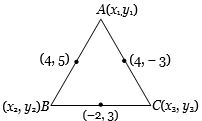
View full question & answer→MCQ 2501 Mark
The centroid of a triangle is $(2, 7)$ and two of its vertices are $(4, 8)$ and $(-2, 6)$. The third vertex is
- A
$(0,0)$
- ✓
$(4,7)$
- C
$(7,4)$
- D
$(7,7)$
AnswerCorrect option: B. $(4,7)$
b
(b) Let the third vertex be $(x, y)$, then
$\frac{{x + 4 + ( - 2)}}{3} = $2 $ \Rightarrow \,\,x = 4$
$\frac{{y + 8 + 6}}{3} = 7$ $ \Rightarrow \,\,y = 7$
$\therefore $ Third vertex $(x, y)$ is $(4, 7)$.
View full question & answer→MCQ 2511 Mark
The points $(1,{\rm{ }}1)$, $(0,{\sec ^2}\theta ),\,({\rm{cose}}{{\rm{c}}^2}\theta ,{\rm{ }}0)$ are collinear for
AnswerCorrect option: B. $\theta \ne \frac{{n\pi }}{2}$
b
(b) The given points are collinear, if
Area $ = \frac{1}{2}\,\left| {\,\begin{array}{*{20}{c}}1&1&1\\0&{{{\sec }^2}\theta }&1\\{{\rm{cose}}{{\rm{c}}^2}\theta }&0&1\end{array}\,} \right| = 0$
$ \Rightarrow \,\,1({\sec ^2}\theta ) + 1({\rm{cose}}{{\rm{c}}^2}\theta ) - 1({\rm{cose}}{{\rm{c}}^2}\theta .{\sec ^2}\theta ) = 0$
$ \Rightarrow \,\,\frac{1}{{{{\cos }^2}\theta }} + \frac{1}{{{{\sin }^2}\theta }} - \frac{1}{{{{\sin }^2}\theta {{\cos }^2}\theta }} = 0$
$ \Rightarrow \,\,\frac{1}{{{{\cos }^2}\theta {{\sin }^2}\theta }} - \frac{1}{{{{\sin }^2}\theta {{\cos }^2}\theta }} = 0\,\,\, \Rightarrow \,\,0 = 0$
Therefore, the points are collinear for all values of $\theta$, except only $\theta = \frac{{n\pi }}{2}$ because at $\theta = \frac{{n\pi }}{2},\,\,{\sec ^2}\theta = \infty .$
View full question & answer→MCQ 2521 Mark
The locus of a point $P$ which moves in such a way that the segment $OP$, where $O $ is the origin, has slope $\sqrt 3 $ is
- A
$x - \sqrt 3 y = 0$
- B
$x + \sqrt 3 y = 0$
- C
$\sqrt 3 x + y = 0$
- ✓
$\sqrt 3 x - y = 0$
AnswerCorrect option: D. $\sqrt 3 x - y = 0$
d
(d) Slope is given by $\frac{{dy}}{{dx}} = \sqrt 3 \,\, \Rightarrow \,\int_{}^{} {dy} = \sqrt 3 \int_{}^{} {dx} $
$ \Rightarrow \,\,\sqrt 3 x - y + c = 0$
This passes through $(0, 0)$, so $c = 0$
Hence the required locus is $\sqrt 3 x - y = 0$.
View full question & answer→MCQ 2531 Mark
If the coordinates of a point be given by the equation $x = a(1 - \cos \theta ),$ $y = a\sin \theta $, then the locus of the point will be
Answerb
(b) On eliminating $\theta$, we get the required locus.
Since $x = a\,(1 - \cos \theta ) \Rightarrow \,\,x - a = - a\cos \theta $ .....$(i)$
and $y = a\sin \theta $ .....$(ii)$
Now adding the squares of $(i)$ and $(ii)$, we get
${x^2} + {y^2} - 2ax = 0$, which is equation of a circle.
View full question & answer→MCQ 2541 Mark
A point moves in such a way that the sum of square of its distance from the points $A(2,0)$ and $B( - 2,0)$ is always equal to the square of the distance between $A$ and $B$. The locus of the point is
- A
${x^2} + {y^2} - 2 = 0$
- B
${x^2} + {y^2} + 2 = 0$
- C
${x^2} + {y^2} + 4 = 0$
- ✓
${x^2} + {y^2} - 4 = 0$
AnswerCorrect option: D. ${x^2} + {y^2} - 4 = 0$
d
(d) ${(x - 2)^2} + {y^2} + {(x + 2)^2} + {y^2} = 16\,\, $
$\Rightarrow \,\,{x^2} + {y^2} = 4$.
View full question & answer→MCQ 2551 Mark
A point $P$ moves so that its distance from the point $(a,0)$ is always equal to its distance from the line $x + a = 0$. The locus of the point is
- ✓
${y^2} = 4ax$
- B
${x^2} = 4ay$
- C
${y^2} + 4ax = 0$
- D
${x^2} + 4ay = 0$
AnswerCorrect option: A. ${y^2} = 4ax$
a
(a) ${(x - a)^2} + {y^2} = {(x + a)^2}\,\, \Rightarrow \,\,{y^2} = 4ax$
Note : This is also the definition of parabola ${y^2} = 4ax.$
View full question & answer→MCQ 2561 Mark
A point moves so that its distance from the point $(-1,0)$ is always three times its distance from the point $(0,2)$. The locus of the point is
Answerb
(b) ${(x + 1)^2} + {y^2} = {3^2}\,\left[ {{x^2} + {{(y - 2)}^2}} \right]$
$ \Rightarrow \,\,8\,({x^2} + {y^2}) - 36y - 2x + 35 = 0$, which is a circle.
View full question & answer→MCQ 2571 Mark
$O$ is the origin and $A$ is the point $(3,4)$. If a point $P$ moves so that the line segment $OP$ is always parallel to the line segment $OA$, then the equation to the locus of $P$ is
- ✓
$4x - 3y = 0$
- B
$4x + 3y = 0$
- C
$3x + 4y = 0$
- D
$3x - 4y = 0$
AnswerCorrect option: A. $4x - 3y = 0$
a
(a) Since $OA$ and $OP$ will be parallel only when $O, \,A$ and $P$ are collinear.
Therefore, $\left| {\,\begin{array}{*{20}{c}}0&0&1\\3&4&1\\x&y&1\end{array}\,} \right| = 0\,\, \Rightarrow \,\,4x - 3y = 0$.
View full question & answer→MCQ 2581 Mark
The locus of a point which moves so that it is always equidistant from the point $A(a, 0)$ and $B (-a, 0)$ is
AnswerCorrect option: B. Perpendicular bisector of the line segment $AB$
b
(b) Let point be $(h, k)$ then, ${(h - a)^2} + {k^2} = {(h + a)^2} + {k^2}$
$ \Rightarrow \,\,4ha = 0\,\,$
$\Rightarrow \,\,h = 0.$
Hence $x = 0.$
View full question & answer→MCQ 2591 Mark
The coordinates of the points $A$ and $B$ are $(a, 0)$ and $( - a,\,0)$ respectively. If a point $P$ moves so that $P{A^2} - P{B^2} = 2{k^2}$, when k is constant, then the equation to the locus of the point $P$ , is
- A
$2ax - {k^2} = 0$
- ✓
$2ax + {k^2} = 0$
- C
$2ay - {k^2} = 0$
- D
$2ay + {k^2} = 0$
AnswerCorrect option: B. $2ax + {k^2} = 0$
b
(b) Let the point be $(x, y)$,
Then ${(x - a)^2} + {y^2} - {(x + a)^2} - {y^2} = 2{k^2}$
$ \Rightarrow \,\, - \,4ax - 2{k^2} = 0\,\,$
$\Rightarrow \,\,2ax + {k^2} = 0$.
View full question & answer→MCQ 2601 Mark
If the coordinates of a point be given by the equations $x = b\sec \phi ,\;\;y = a\tan \phi $, then its locus is
Answerd
(d) Here $\frac{x}{b} = \sec \phi $ and $\frac{y}{a} = \tan \phi $
Therefore $\frac{{{x^2}}}{{{b^2}}} - \frac{{{y^2}}}{{{a^2}}} = {\sec ^2}\phi - {\tan ^2}\phi \,\,$
$\Rightarrow \,\,\frac{{{x^2}}}{{{b^2}}} - \frac{{{y^2}}}{{{a^2}}} = 1$,
which is obviously a hyperbola.
View full question & answer→MCQ 2611 Mark
The locus of a point which moves in such a way that its distance from $(0,0)$ is three times its distance from the $x$-axis, as given by
- ✓
${x^2} - 8{y^2} = 0$
- B
${x^2} + 8{y^2} = 0$
- C
$4{x^2} - {y^2} = 0$
- D
${x^2} - 4{y^2} = 0$
AnswerCorrect option: A. ${x^2} - 8{y^2} = 0$
a
(a) Let the point be $(x, y)$, then according to the given condition $\sqrt {{x^2} + {y^2}} = 3y${distance from $x$-axis is $y$}
$ \Rightarrow \,\,{x^2} + {y^2} = 9{y^2}\,\,$
$\Rightarrow \,{x^2} - 8{y^2} = 0$.
View full question & answer→MCQ 2621 Mark
The equation of the locus of all points equidistant from the point $(4,2)$ and the $x$-axis, is
- A
${x^2} + 8x + 4y - 20 = 0$
- ✓
${x^2} - 8x - 4y + 20 = 0$
- C
${y^2} - 4y - 8x + 20 = 0$
- D
AnswerCorrect option: B. ${x^2} - 8x - 4y + 20 = 0$
b
(b) ${(x - 4)^2} + {(y - 2)^2} = {y^2}\,\, $
$\Rightarrow \,\,{x^2} - 8x - 4y + 20 = 0$.
View full question & answer→MCQ 2631 Mark
The locus of the moving point $P$, such that $2PA = \,3PB$ where $A$ is $(0,0)$ and $B$ is $(4,-3)$, is
- A
$5{x^2} - 5{y^2} - 72x + 54y + 225 = 0$
- B
$5{x^2} - 5{y^2} + 72x + 54y + 225 = 0$
- C
$5{x^2} + 5{y^2} + 72x + 54y + 225 = 0$
- ✓
$5{x^2} + 5{y^2} - 72x + 54y + 225 = 0$
AnswerCorrect option: D. $5{x^2} + 5{y^2} - 72x + 54y + 225 = 0$
d
(d) Let $P(h,\,\,k).$ Given $2PA = 3PB\,\, \Rightarrow \,\,4P{A^2} = 9P{B^2}$
$ \Rightarrow \,\,4\,({h^2} + {k^2}) = 9\,[{(h - 4)^2} + {(k + 3)^2}]$
$ \Rightarrow \,\,5{h^2} + 5{k^2} - 72h + 54k + 225 = 0$
Hence the locus of point $P$ is given by
$5{x^2} + 5{y^2} - 72x + 54y + 225 = 0$.
View full question & answer→MCQ 2641 Mark
A point moves in such a way that its distance from $(1,-2)$ is always the twice from $(-3,5)$, the locus of the point is
- A
$3{x^2} + {y^2} + 26x + 44y - 131 = 0$
- B
${x^2} + 3{y^2} - 26x + 44y - 131 = 0$
- ✓
$3({x^2} + {y^2}) + 26x - 44y + 131 = 0$
- D
AnswerCorrect option: C. $3({x^2} + {y^2}) + 26x - 44y + 131 = 0$
c
(c) ${(x - 1)^2} + {(y + 2)^2} = {2^2}[{(x + 3)^2} + {(y - 5)^2}]$
$ \Rightarrow \,\,3\,({x^2} + {y^2}) + 26x - 44y + 131 = 0$.
View full question & answer→MCQ 2651 Mark
A point moves in such a way that its distance from origin is always $4$. Then the locus of the point is
- A
${x^2} + {y^2} = 4$
- ✓
${x^2} + {y^2} = 16$
- C
${x^2} + {y^2} = 2$
- D
AnswerCorrect option: B. ${x^2} + {y^2} = 16$
b
(b) Required locus is $\sqrt {{{(x - 0)}^2} + {{(y - 0)}^2}} = 4$
$ \Rightarrow \,\,{x^2} + {y^2} = 16$.
View full question & answer→MCQ 2661 Mark
If $A( - a,0)$ and $B(a,0)$ are two fixed points, then the locus of the point on which the line $AB$ subtends the right angle, is
AnswerCorrect option: D. ${x^2} + {y^2} = {a^2}$
d
(d) We know that $P{A^2} + P{B^2} = A{B^2}$
$ \Rightarrow \,\,{(x - a)^2} + {y^2} + {(x + a)^2} + {y^2} = {(2a)^2}\,$
$\, \Rightarrow \,\,{x^2} + {y^2} = {a^2}$.
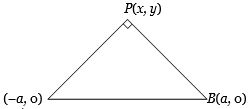
View full question & answer→MCQ 2671 Mark
If $A$ and $B$ are two points in a plane, so that $PA - PB$ = constant, then the locus of $P$ is
Answera
(a) It is a fundamental concept.
View full question & answer→MCQ 2681 Mark
If $A$ and $B$ are two fixed points in a plane and $P$ is another variable point such that $P{A^2} + P{B^2} = $ constant, then the locus of the point $P$ is
Answerb
(b) It is a fundamental concept.
View full question & answer→MCQ 2691 Mark
The locus of $P$ such that area of $\Delta PAB = 12sq.$ units, where $A(2,3)$ and $B( - 4,5)$ is
- A
$(x + 3y - 1)(x + 3y - 23) = 0$
- ✓
$(x + 3y + 1)(x + 3y - 23) = 0$
- C
$(3x + y - 1)(3x + y - 23) = 0$
- D
$(3x + y + 1)(3x + y + 23) = 0$
AnswerCorrect option: B. $(x + 3y + 1)(x + 3y - 23) = 0$
b
(b) Let $P$ be $(x, y)$. $\Delta = \pm \,12$
$ \Rightarrow \,\,x + 3y + 1 = 0$ and $x + 3y - 23 = 0$.
View full question & answer→MCQ 2701 Mark
If the equation of the locus of a point equidistant from the points $({a_1},{b_1})$ and $({a_2},{b_2})$ is $({a_1} - {a_2})x + ({b_1} - {b_2})y + c = 0$, then the value of $c$ is
- A
$a_1^2 - a_2^2 + b_1^2 - b_2^2$
- B
$\sqrt {a_1^2 + b_1^2 - a_2^2 - b_2^2} $
- C
$\frac{1}{2}(a_1^2 + a_2^2 + b_1^2 + b_2^2)$
- ✓
$\frac{1}{2}(a_2^2 + b_2^2 - a_1^2 - b_1^2)$
AnswerCorrect option: D. $\frac{1}{2}(a_2^2 + b_2^2 - a_1^2 - b_1^2)$
d
(d) Let $(h,\,\,k)$ be the point on the locus, then by the given conditions ${(h - {a_1})^2} + {(k - {b_1})^2} = {(h - {a_2})^2} + {(k - {b_2})^2}$
$ \Rightarrow \,\,2h\,({a_1} - {a_2}) + 2k\,({b_1} - {b_2}) + a_2^2 + b_2^2 - a_1^2 - b_1^2 = 0$
$ \Rightarrow \,\,h\,({a_1} - {a_2}) + k\,({b_1} - {b_2}) + \frac{1}{2}\,(a_2^2 + b_2^2 - a_1^2 - b_1^2) = 0$....$(i)$
Also, since $(h, k)$ lies on the given locus, therefore
$({a_1} - {a_2})\,h + ({b_1} - {b_2})\,k + c = 0$ .....$(ii)$
Comparing $(i)$ and $(ii)$, we get
$c = \frac{1}{2}\,(a_2^2 + b_2^2 - a_1^2 - b_1^2)$.
View full question & answer→MCQ 2711 Mark
If sum of distances of a point from the origin and lines $x = 2$ is $4$, then its locus is
- A
${x^2} - 12y = 36$
- ✓
${y^2} + 12x = 36$
- C
${y^2} - 12x = 36$
- D
${x^2} + 12y = 36$
AnswerCorrect option: B. ${y^2} + 12x = 36$
b
(b) Let point be $P\,(x,\,\,y)$. So, distance from the origin $OP = \sqrt {{x^2} + {y^2}} $ and distance from the line $ = (x - 2)$
$\therefore \,\,\,\sqrt {{x^2} + {y^2}} + (x - 2) = 4\,\,\, $
$\Rightarrow \,\,\sqrt {{x^2} + {y^2}} = ( - x + 6)$
$ \Rightarrow \,\,{x^2} + {y^2} = {x^2} + 36 - 12x\,\,$
$\Rightarrow \,\,{y^2} + 12x = 36$.
View full question & answer→MCQ 2721 Mark
If the distance of any point $P$ from the point $A(a + b,a - b)$ and $B(a - b,a + b)$are equal, then the locus of $ P$ is
- ✓
$x - y = 0$
- B
$ax + by = 0$
- C
$bx - ay = 0$
- D
$x + y = 0$
AnswerCorrect option: A. $x - y = 0$
a
(a) Let coordinate of point $P$ is $(x, y)$
Given $PA = PB\,\, \Rightarrow \,\,{(PA)^2} = {(PB)^2}$
$ \Rightarrow \,\,{\{ x - (a + b)\} ^2} + {\{ y - (a - b)\} ^2}$
$ = {\{ x - (a - b)\} ^2} + {\{ y - (a + b)\} ^2}$
$ \Rightarrow \,\,2x[ - a - b + a - b] + 2y[ - a + b + a + b] = 0$
$ \Rightarrow \,\,x\,( - 2b) + y{\rm{ }}(2b) = 0$
$\Rightarrow \,\, - x + y = 0\,\, $
$\Rightarrow \,\,x - y = 0$.
View full question & answer→MCQ 2731 Mark
What is the equation of the locus of a point which moves such that $4$ times its distance from the $x$-axis is the square of its distance from the origin
AnswerCorrect option: B. ${x^2} + {y^2} - 4|y| = 0$
b
(b) Let the required point be $({x_1},\,{y_1})$.
Then, according to question, $4|{y_1}| = (x_1^2 + y_1^2)$
==> $x_1^2 + y_1^2 - 4\,\left| {{y_1}} \right| = 0$
Replace $({x_1},\,{y_1})$ from $(x,\,y)$, then ${x^2} + {y^2} - 4y = 0$ is the required locus.
View full question & answer→MCQ 2741 Mark
$ABC$ is an isosceles triangle. If the coordinates of the base are $B\, (1,3)$ and $C\, (-2, 7)$, the coordinates of vertex $A$ can be
- A
$(1, 6)$
- B
$\left( { - \frac{1}{2},\,5} \right)$
- ✓
$\left( {\frac{5}{6},\,6} \right)$
- D
AnswerCorrect option: C. $\left( {\frac{5}{6},\,6} \right)$
c
(c) The vertex $A\,(x,\,\,y)$ is equidistant from $B$ and $C$ because $ABC$ is an isosceles triangle. Therefore,
${(x - 1)^2} + {(y - 3)^2} = {(x + 2)^2} + {(y - 7)^2}$
$ \Rightarrow \,\,6x - 8y + 43 = 0$
Thus, any point lying on this line can be the vertex $A$ except the mid-point $\left( { - \frac{1}{2},\,\,5} \right)$ of $BC$.
View full question & answer→MCQ 2751 Mark
If coordinates of the points $A$ and $ B$ are $(2, 4)$ and $(4, 2)$ respectively and point M is such that $A-M-B$ also $AB =\, 3\, AM$, then the coordinates of $ M$ are
- ✓
$\left( {\frac{8}{3},\,\frac{{10}}{3}} \right)$
- B
$\left( {\frac{{10}}{3},\frac{{14}}{4}} \right)$
- C
$\left( {\frac{{10}}{3},\frac{6}{3}} \right)$
- D
$\left( {\frac{{13}}{4},\frac{{10}}{4}} \right)$
AnswerCorrect option: A. $\left( {\frac{8}{3},\,\frac{{10}}{3}} \right)$
a
(a) Since $AB = 3AM\,\,$
$ \Rightarrow \,\,AM + MB = 3AM\,\, \Rightarrow \,\,MB = 2AM$
Hence ratio $AM\,\,:\,\,MB = 1\,\,:\,\,2$
Therefore the point $M\,\left( {\frac{8}{3},\,\,\frac{{10}}{3}} \right)$.
View full question & answer→MCQ 2761 Mark
The coordinates of the points $A, B, C$ are $({x_1},{y_1})$, $({x_2},{y_2})$, $({x_3},\,{y_3})$ and $D$ divides the line $AB$ in the ratio $l : k$. If $P$ divides the line $DC$ in the ratio $m : k + l$, then the coordinates of $P$ are
- ✓
$\left( {\frac{{k{x_1} + l{x_2} + m{x_3}}}{{k + l + m}},\,\frac{{k{y_1} + l{y_2} + m{y_3}}}{{k + l + m}}} \right)$
- B
$\left( {\frac{{l{x_1} + m{x_2} + k{x_3}}}{{l + m + k}},\,\frac{{l{y_1} + m{y_2} + k{y_3}}}{{l + m + k}}} \right)$
- C
$\left( {\frac{{m{x_1} + k{x_2} + l{x_3}}}{{m + k + l}},\,\frac{{m{y_1} + k{y_2} + l{y_3}}}{{m + k + l}}} \right)$
- D
AnswerCorrect option: A. $\left( {\frac{{k{x_1} + l{x_2} + m{x_3}}}{{k + l + m}},\,\frac{{k{y_1} + l{y_2} + m{y_3}}}{{k + l + m}}} \right)$
a
(a) Coordinates of $D$ will be $\left( {\frac{{l{x_2} + k{x_1}}}{{l + k}},\,\,\frac{{l{y_2} + k{y_1}}}{{l + k}}} \right)$
Now again, $DC$ is divided by $P$ in $m:k + l.$
Then the coordinates of $P$ will be given by
$\left( {\frac{{m{x_3} + l{x_2} + k{x_1}}}{{k + l + m}},\,\frac{{m{y_3} + l{y_2} + k{y_1}}}{{k + l + m}}} \right)$.
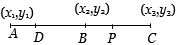
View full question & answer→MCQ 2771 Mark
Two vertices of a triangle are $(4, -3)$ and $(-2, 5)$. If the orthocentre of the triangle is at $(1, 2)$, then the third vertex is
- A
$(-33, -26)$
- ✓
$(33, 26)$
- C
$(26, 33)$
- D
AnswerCorrect option: B. $(33, 26)$
b
(b) Let third vertex be $(h, k)$. Now slope of $AD$ is $\frac{{k - 2}}{{h - 1}}$,
Slope of $BC$ is $\frac{{5 + 3}}{{ - 2 - 4}} = \frac{{ - 4}}{3}$
Slope of BE is $\frac{{ - 3 - 2}}{{4 - 1}} = \frac{{ - 5}}{3}$
And slope of $AC$ is $\frac{{k - 5}}{{h + 2}}$
Since $AD\, \bot \,BC \Rightarrow \frac{{k - 2}}{{h - 1}} \times \frac{{ - 4}}{3} = - 1$
$\Rightarrow$ $3h - 4k + 5 = 0$......$(i)$
Again Since $BE\, \bot \,AC \Rightarrow - \frac{5}{3} \times \frac{{k - 5}}{{h + 2}} = - 1$
==> $3h - 5k + 31 = 0$.....$(ii)$
on solving $(i)$ and $(ii)$ we get $h = 33,k = 26$
Hence the third vertex is $(33, 26).$
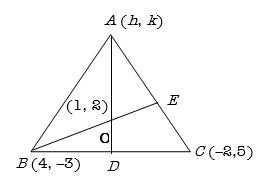
View full question & answer→MCQ 2781 Mark
$A(a,0)$ and $B( - a,0)$ are two fixed points of triangle $ABC$. The vertex $C$ moves in such a way that $\cot A + \cot B = \lambda ,$ where $\lambda $ is a constant. Then the locus of the point $C$ is
- ✓
$y\lambda = 2a$
- B
$ya = 2\lambda $
- C
$y = \lambda a$
- D
AnswerCorrect option: A. $y\lambda = 2a$
a
(a) Let the coordinates of $A$ and $B$ are $A\,(a,\,\,0)$ and $B\,( - a,\,0)$ and variable point is $C\,(h,\,k).$
In figure, $\cot A = \frac{{a - h}}{k}$ and $\cot B = \frac{{a + h}}{k}$
According to the condition, $\cot A + \cot B = \lambda $
$ \Rightarrow \,\,\frac{{a - h}}{k} + \frac{{a + h}}{k} = \lambda \,\, \Rightarrow \,\,\frac{{2a}}{k} = \lambda \,\, \Rightarrow \,\,k\lambda = 2a.$
Hence locus is $y\lambda = 2a$.
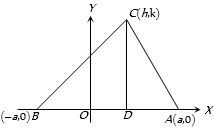
View full question & answer→MCQ 2791 Mark
Point of intersection of the diagonals of square is at origin and coordinate axis are drawn along the diagonals. If the side is of length $a$, then one which is not the vertex of square is
- ✓
$(a\sqrt 2 ,0)$
- B
$\left( {0,\frac{a}{{\sqrt 2 }}} \right)$
- C
$\left( {\frac{a}{{\sqrt 2 }},0} \right)$
- D
$\left( { - \frac{a}{{\sqrt 2 }},0} \right)$
AnswerCorrect option: A. $(a\sqrt 2 ,0)$
a
(a) Obviously, from right angled triangle $BOA$
$OA = OB = \frac{a}{{\sqrt 2 }}$
Hence the vertex $(a\sqrt 2 ,\,\,0)$ is not the vertex of square.
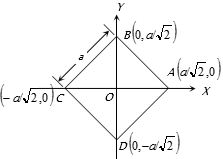
View full question & answer→MCQ 2801 Mark
If $A(a{t^2},\,2at),\;B(a/{t^2},\, - 2a/t)$ and $C(a,\,0)$, then $2a$ is equal to
- A
$A.M$. of $CA$ and $CB$
- B
$G.M$. of $CA$ and $CB$
- ✓
$H.M$. of $CA$ and $CB$
- D
AnswerCorrect option: C. $H.M$. of $CA$ and $CB$
c
(c) $CA = \sqrt {{{(a{t^2} - a)}^2} + {{(2at)}^2}} = a\sqrt {{{({t^2} - 1)}^2} + 4{t^2}} $
$ = a\sqrt {({t^2} + 1 + 2{t^2})} = a\,(1 + {t^2})$
$CB = \sqrt {{{\left( {\frac{a}{{{t^2}}} - a} \right)}^2} + {{\left( {\frac{{ - 2a}}{t}} \right)}^2}} = a\,\left( {1 + \frac{1}{{{t^2}}}} \right)$
$H.M$. of $CA$ and $CB$ $ = \frac{{2{a^2}\,(1 + {t^2})\,\left( {1 + \frac{1}{{{t^2}}}} \right)}}{{a\,\left[ {1 + {t^2} + 1 + \frac{1}{{{t^2}}}} \right]}} = 2a$.
$\left[ {\because \,\,{\text{H}}{\text{.M}}.\,{\text{of }}x {\text{and }}y = \frac{{2xy}}{{x + y}}} \right]$
View full question & answer→MCQ 2811 Mark
Let $A (h, k), \,B(1, 1)$ and $C (2, 1)$ be the vertices of a right angled triangle with $AC$ as its hypotenuse. If the area of the triangle is $1$ square unit, then the set of values which $'k'$ can take is given by
- ✓
${-1,3}$
- B
${-3,-2}$
- C
${1,3}$
- D
${0,2}$
AnswerCorrect option: A. ${-1,3}$
a
Now, $A B=\sqrt{(1-h)^{2}+(1-k)^{2}}$
$B C=\sqrt{(2-1)^{2}+(1-1)^{2}}$
and $\quad C A=\sqrt{(h-2)^{2}+(k-1)^{2}}$
From Pythagoras theorem, $A C^{2}=A B^{2}+B C^{2}$
$\Rightarrow 4+h^{2}-4 h+k^{2}+1-2 k$
$=h^{2}+1-2 h+k^{2}+1-2 k+1$
$\Rightarrow \quad 5-4 h=3-2 h$
$h=1$
Now, given that area of triangle is $1$
Then, area $(\Delta A B C)=\frac{1}{2} \times A B \times B C$
$\Rightarrow 1=\frac{1}{2} \times \sqrt{(1-h)^{2}+(1-k)^{2}} \times 1$
$\Rightarrow 2=\sqrt{(1-n)^{2}+(1-k)^{2}}$
$\Rightarrow 2=\sqrt{(k-1)^{2}} \quad \text { [from Eq. (i) }]$
$\Rightarrow 4=k^{2}+1-2 k$
$\Rightarrow k^{2}-2 k-3=0$
$\Rightarrow(k-3)(k+1)=0$
$\therefore \quad k=-1,3$
Thus, the set of values of $k$ is $\{-1,3\}$
View full question & answer→MCQ 2821 Mark
A straight line through the point $A (3, 4)$ is such that its intercept between the axes is bisected at $A$. Its equation is
- A
$3x -4y + 7 = 0$
- ✓
$4x + 3y = 24$
- C
$3x + 4y = 25$
- D
$x + y = 7$
AnswerCorrect option: B. $4x + 3y = 24$
b
$A$ is the mid point of $P Q$
$\frac{a+0}{2}=3=>a=6$
$\frac{0+b}{2}=4=>b=8$
Equation of the line is $\frac{x}{6}+\frac{y}{8}=1$
$\frac{4 x+3 y}{24}=1$
$4 x+3 y=24$
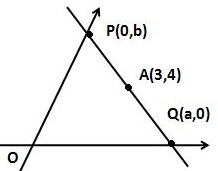
View full question & answer→MCQ 2831 Mark
If a vertex of a triangle is $(1, 1)$ and the mid points of two sides through this vertex are $(-1, 2)$ and $(3, 2)$, then the centroid of the triangle is
- ✓
$\left( {1,\,\frac{7}{3}} \right)$
- B
$\left( {\frac{1}{3},\,\frac{7}{3}} \right)$
- C
$\left( { - 1,\,\frac{7}{3}} \right)$
- D
$\left( {\frac{{ - 1}}{3},\,\frac{7}{3}} \right)$
AnswerCorrect option: A. $\left( {1,\,\frac{7}{3}} \right)$
a
(a) Vertex of triangle is $(1, 1)$ and midpoint of sides through this vertex is $(-1, 2)$ and $(3, 2)$
==> Vertex $B$ and $C$ come out to be $(-3, 3)$ and $(5, 3)$
Centroid is $\left( {\frac{{1 - 3 + 5}}{3},\frac{{1 + 3 + 3}}{3}} \right) = (1,7/3)$
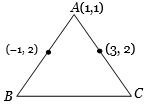
View full question & answer→MCQ 2841 Mark
Let $P$ be the point $(1, 0)$ and $Q$ a point of the locus ${y^2} = 8x$. The locus of mid point of $PQ$ is
- A
${x^2} + 4y + 2 = 0$
- B
${x^2} - 4y + 2 = 0$
- ✓
${y^2} - 4x + 2 = 0$
- D
${y^2} + 4x + 2 = 0$
AnswerCorrect option: C. ${y^2} - 4x + 2 = 0$
c
(c)$P = (1,\,0),Q = (h,k)$ such that ${k^2} = 8h$
Let $(\alpha ,\beta )$ be the midpoint of $PQ$;
$\alpha = \frac{{h + 1}}{2},\beta = \frac{{k + 0}}{2};\,\,2\alpha - 1 = h,\,\,2\beta = k$
${(2\beta )^2} = 8(2\alpha - 1) $
$\Rightarrow {\beta ^2} = 4\alpha - 2 $
$\Rightarrow {y^2} - 4x + 2 = 0$.
View full question & answer→MCQ 2851 Mark
Let $A(2, - 3)$ and $B( - 2,1)$ be vertices of a triangle $ABC.$ If the centroid of this triangle moves on the line $2x + 3y = 1$, then the locus of the vertex $C$ is the line
- A
$3x - 2y = 3$
- B
$2x - 3y = 7$
- C
$3x + 2y = 5$
- ✓
$2x + 3y = 9$
AnswerCorrect option: D. $2x + 3y = 9$
d
Let the third vertex be $({x_1},\,{y_1})$ then
Centroid $(G) \equiv \left( {\frac{{{x_1} + 2 - 2}}{3},\,\frac{{{y_1} - 3 + 1}}{3}} \right)$
i.e., $G\,\left( {\frac{{{x_1}}}{3},\,\frac{{{y_1} - 2}}{3}} \right)$
Given, centroid of triangle moves on the line
$2x + 3y = 1$
$\therefore $ $2\,\left( {\frac{{{x_1}}}{3}} \right) + 3\left( {\frac{{{y_1} - 2}}{3}} \right) = 1$ i.e., $2{x_1} + 3{y_1} = 9$
Locus of $({x_1},\,{y_1})$ is $2x + 3y = 9$.
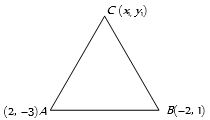
View full question & answer→MCQ 2861 Mark
Locus of centroid of the triangle whose vertices are $(a\cos t,a\sin t),\;(b\sin t, - b\cos t)$ and $(1, 0)$, where $t$ is a parameter; is
- A
${(3x - 1)^2} + {(3y)^2} = {a^2} - {b^2}$
- ✓
${(3x - 1)^2} + {(3y)^2} = {a^2} + {b^2}$
- C
${(3x + 1)^2} + {(3y)^2} = {a^2} + {b^2}$
- D
${(3x + 1)^2} + {(3y)^2} = {a^2} - {b^2}$
AnswerCorrect option: B. ${(3x - 1)^2} + {(3y)^2} = {a^2} + {b^2}$
b
(b) $3h = a\cos t + b\sin t + 1,\,\,3k = a\sin t - b\cos t$
${a^2} + {b^2} = {(3h - 1)^2} + {(3k)^2}$
${(3x - 1)^2} + {(3y)^2} = {a^2} + {b^2}$.
View full question & answer→MCQ 2871 Mark
The locus of the mid-point of the distance between the axes of the variable line $x\cos \alpha + y\sin \alpha = p,$ where $p$ is constant, is
- A
${x^2} + {y^2} = 4{p^2}$
- ✓
$\frac{1}{{{x^2}}} + \frac{1}{{{y^2}}} = \frac{4}{{{p^2}}}$
- C
${x^2} + {y^2} = \frac{4}{{{p^2}}}$
- D
$\frac{1}{{{x^2}}} + \frac{1}{{{y^2}}} = \frac{2}{{{p^2}}}$
AnswerCorrect option: B. $\frac{1}{{{x^2}}} + \frac{1}{{{y^2}}} = \frac{4}{{{p^2}}}$
b
(b) The straight line $x\cos \alpha + y\,\sin \alpha = p$ meets the $x$-axis at the point $A\left( {\frac{p}{{\cos \alpha }},0} \right)$ and the $y$-axis at the point $B\,\left( {0,\,\,\frac{p}{{\sin \alpha }}} \right)$. Let $(h, k)$ be the coordinates of the middle point of the line segment $AB$.
Then, $h = \frac{p}{{2\,\cos \alpha }}$ and $k = \frac{p}{{2\,\sin \alpha }}$
$ \Rightarrow \,\,\cos \alpha = \frac{p}{{2h}}$ and $\sin \alpha = \frac{p}{{2k}}$
$ \Rightarrow \,\,{\sin ^2}\alpha + {\cos ^2}\alpha = \frac{{{p^2}}}{{4{h^2}}} + \frac{{{p^2}}}{{4{k^2}}} = 1$
Hence locus of the point $(h, k)$ is $\frac{1}{{{x^2}}} + \frac{1}{{{y^2}}} = \frac{4}{{{p^2}}}$.
View full question & answer→MCQ 2881 Mark
A triangle with vertices $(4, 0),\, (-1, -1),\, (3, 5)$ is
- ✓
Isosceles and right angled
- B
Isosceles but not right angled
- C
Right angled but not isosceles
- D
Neither right angled nor isosceles
AnswerCorrect option: A. Isosceles and right angled
a
(a) Let $A\,(4,\,\,0),\,\,B\,( - 1,\, - 1),\,\,C\,(3,\,\,5)$ then $AB = \sqrt {26} ,$ $AC = \sqrt {26} $ and $BC = \sqrt {52} \,\,i.e.,\,\,\,AB = AC$.
Hence triangle is isosceles. Also, ${(BC)^2} = A{B^2} + A{C^2}$
Hence triangle is right angled also.
View full question & answer→MCQ 2891 Mark
Statement- $1$: There is one line through $A(4, -5)$ such that its distance from $B(-2, 3)$ is $12$.
Statement- $2$: $AB = 10$
- A
Statement-$1$ is true, Statement-$2$ is true; Statement-$2$ is not the correct explanation of Statement-$ 1$
- B
Statement-$1$ is false, Statement-$2$ is true
- ✓
Statement-$1$ is true, Statement-$2$ is false
- D
Statement-$1$ is true, Statement-$2$ is true; Statement-$2$ is the correct explanation of Statement-$1$
AnswerCorrect option: C. Statement-$1$ is true, Statement-$2$ is false
View full question & answer→MCQ 2901 Mark
In a tetrahedron $LMNO$ edges $ML,\ MN\ \& \ MO$ are mutually perpendicular and length of altitudes drawn from $O, \ L$ and $N$ to opposite faces are $1,2$ and $3$ units respectively, then length of altitude drawn from $M$ to face $LNO$ is
- ✓
$\frac{6}{7}\ units$
- B
$\frac{7}{6}\ units$
- C
$\frac{7}{3}\ units$
- D
$\frac{3}{7}\ units$
AnswerCorrect option: A. $\frac{6}{7}\ units$
a
Let $M$ being origin then one possible equation
of face $LNO$ will be $\Rightarrow x+\frac{y}{2}+\frac{z}{3}=1$
$\therefore $ required altitude $=$ distance of $LNO$ from $M$
$=\frac{6}{7}$
View full question & answer→MCQ 2911 Mark
The inradius of $\Delta ABC$ is $3$ units and exradius opposite to vertex $A$ is $4$ units, then length of altitude from vertex $A$ is - ............. $\mathrm{units}$
Answera
$\frac{\Delta}{\mathrm{S}}=3$ and $\frac{\Delta}{\mathrm{S}-\mathrm{a}}=4 \Rightarrow \frac{\mathrm{S}-\mathrm{a}}{\mathrm{S}}=\frac{3}{4} \Rightarrow \frac{\mathrm{a}}{\mathrm{S}}=\frac{1}{4}$
$\frac{3 a}{\Delta}=\frac{1}{4} \Rightarrow \frac{6 a}{a h}=\frac{1}{4} \Rightarrow h=24$
View full question & answer→MCQ 2921 Mark
A point $P$ moves inside a square of area $4$ square units such that it is nearer to point of intersection of its diagonal than any vertex. Area of the region traced by $P$ is
Answerb
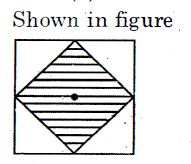
View full question & answer→MCQ 2931 Mark
The bisectors of the angles of a parallelogram enclose a
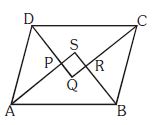
Answerb
$\angle \mathrm{DAB}+\angle \mathrm{ADC}=180^{\circ}$
$\Rightarrow \angle \mathrm{ADP}+\angle \mathrm{DAP}=90^{\circ}$ (because $DQ$ and $AS$
are angle bisectors of angle $A$ and $ D$)
$\Rightarrow \angle \mathrm{DPA}=90^{\circ} \Rightarrow \angle \mathrm{SPQ}=90^{\circ} .$ Similiarly
$\angle \mathrm{PSR}=90^{\circ}, \quad \angle \mathrm{SRQ}=90^{\circ}, \quad \angle \mathrm{PQR}=90^{\circ} . \mathrm{So}$
$PQRS$ is a rectangle.
View full question & answer→MCQ 2941 Mark
Point of intersection of the diagonals of square is at origin and co-ordinate axes are drawn along the diagonals. If the side is of length $'a'$, then one which is not the vertex of square is :-
- ✓
$(a \sqrt 2, 0)$
- B
$\left( {0,\frac{a}{{\sqrt 2 }}} \right)$
- C
$\left( {\frac{a}{{\sqrt 2 }},0} \right)$
- D
$\left( {-\frac{a}{{\sqrt 2 }},0} \right)$
AnswerCorrect option: A. $(a \sqrt 2, 0)$
a
$A \equiv\left(\frac{a}{\sqrt{2}}, 0\right)$
$B \equiv\left(0, \frac{a}{\sqrt{2}}\right)$
$\mathrm{C} \equiv\left(-\frac{\mathrm{a}}{\sqrt{2}}, 0\right)$
$\mathrm{D} \equiv\left(0,-\frac{\mathrm{a}}{\sqrt{2}}\right)$
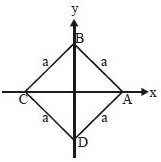
View full question & answer→MCQ 2951 Mark
An insect is resting on the graph paper at a point $A(3, 2)$. Now it starts moving towards west direction and covers a distance of $4\, units$ and then it turns towards south and covered a distance of $3\, units$ and reaches at point $B$ then the polar co-ordinates of point $B$ will be :-
- A
$\left( {6\sqrt 2 ,\frac{\pi }{4}} \right)$
- B
$\left( {\sqrt 2 ,\frac{3\pi }{4}} \right)$
- ✓
$\left( {\sqrt 2 ,\frac{-3\pi }{4}} \right)$
- D
AnswerCorrect option: C. $\left( {\sqrt 2 ,\frac{-3\pi }{4}} \right)$
View full question & answer→MCQ 2961 Mark
If the line $y = \sqrt 3 x$ cuts the curve $x^4 + ax^2y + bxy + cx + dy + 6 = 0$ at $A$ , $B$ , $C$ and $D$ , then value of $OA .OB . OC . OD$ is, (where $O$ is origin)
- A
$a+b+c$
- B
$2c^2d$
- ✓
$96$
- D
$6$
Answerc
Coordinates of any points lying on the line
$y=\sqrt{3} x$ will be $\left(\frac{r}{2}, \frac{r \sqrt{3}}{2}\right)$
If the given line intersects the curve
$\mathrm{x}^{4}+\mathrm{ax}^{2} \mathrm{y}+\mathrm{bxy}+\mathrm{cx}+\mathrm{dy}+6=0,$ then
$\frac{r^{4}}{16}+a \frac{r^{3} \sqrt{3}}{8}+\frac{b r^{2} \sqrt{3}}{4}+\frac{c r}{2}+\frac{d r \sqrt{3}}{2}+6=0$
$r^{4}+r^{3} 2 a \sqrt{3}+r^{2} 4 b \sqrt{3}+r 8(c+d \sqrt{3})+96=0$
$\therefore \quad \mathrm{r}_{1} \mathrm{r}_{2} \mathrm{r}_{3} \mathrm{r}_{4}=96$
hence ${\rm{OA}} \cdot {\rm{OB}} \cdot {\rm{OC}} \cdot {\rm{OD}} = 96$
View full question & answer→MCQ 2971 Mark
Let $A \equiv \left( {4,4} \right),\,B \equiv \left( {8,4} \right),\,C \equiv \left( {4,8} \right)$ . If $P,Q,R$ are the midpoint of sides $AB,BC$ & $CA$ respectively & $(\alpha ,\beta )$ be the co-ordinates of orthocentre of $\Delta PQR$ , then the value of $\alpha + \beta $ is
Answerc
Circumcentre of $ \Delta ABC$
$\Rightarrow $Orthocentre of $ \Delta ABC$
View full question & answer→MCQ 2981 Mark
Number of straight lines that can be drawn from $(2, 5)$ which make a triangle of area $24sq.$ units with the coordinate axes is
Answerd
Without loss of generality, let us draw lines from $(2,5)$ then the line which has minimum area is the one where $(2,5)$ is the mid-point
$\Lambda_{\min }=\frac{1}{2} \times 4 \times 10=20$
$\therefore$ there will be two such lines in the ${I^{st}}\;$ quadrant one line in $II$ quadrant and one line in $IV$ quadrant $\Rightarrow$ Total lines $=4$
View full question & answer→MCQ 2991 Mark
The area (in sq. units) of the region consisting of points $(x,y)$ on $X-Y$ plane which satisfy $\left| x \right| \le 1 + \left| y \right|$ and $\left| y \right| \le 1$
Answerb
Required area
$=4 \times\left(\frac{1}{2} \times 1 \times(1+2)\right)$
$=6$ sq. units
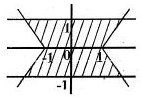
View full question & answer→MCQ 3001 Mark
$ABCD$ is a rhombus. The circumradii of $\Delta ABD$ and $\Delta ACD$ are $\frac{25}{2}$ and $25$. Then the area of rhombus is .............. $\mathrm{sq. \,unit}$
Answera
In $\Delta A B D \frac{\sin 2 \theta}{2 x}=\frac{1}{2 R_{1}}$
$x=25 \sin \theta \cos \theta$
In $\Delta A C D \frac{\sin 2 \theta}{2 y}=\frac{1}{2 R_{2}}$
$y=50 \sin \theta \cos \theta$
$\tan \theta=\frac{x}{y}=\frac{1}{2} \Rightarrow y=50 \cdot \frac{1}{\sqrt{5}} \cdot \frac{2}{\sqrt{5}}=20$
and $x=10$
Area of rhombus $=2 \mathrm{xy}=400$
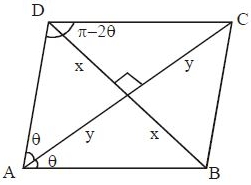
View full question & answer→MCQ 3011 Mark
If $\Delta_1$ is the area of the triangle formed by the centroid and two vertices of a triangle, $\Delta_2$ is the area of the triangle formed by the mid-points of the sides of the same triangle, then $\Delta_1 : \Delta_2 =$
- A
$3 : 4$
- B
$4 : 1$
- ✓
$4 : 3$
- D
$2 : 1$
AnswerCorrect option: C. $4 : 3$
c
$\operatorname{Let} \mathrm{A}\left(\mathrm{x}_{1}, \mathrm{y}_{1}\right), \mathrm{B}\left(\mathrm{x}_{2}, \mathrm{y}_{2}\right)$ and $\mathrm{C}\left(\mathrm{x}_{3}, \mathrm{y}_{3}\right)$ be the vertices
of a $\Delta \mathrm{ABC},$ and let $\mathrm{G}$ be its centroid. Then, $\Delta_{1}=$ Area of $\Delta \mathrm{GBC}$
$\Rightarrow \Delta_{1}=\frac{\Delta}{3},$ where $\Delta$ is the area of $\Delta \mathrm{ABC}$
$\Delta_{2}=$ Area of triangle formed by the mid-points of the sides
$\Rightarrow \Delta_{2}=\frac{1}{4} \Delta$
$\therefore \Delta_{1}: \Delta_{2}=4: 3$
View full question & answer→MCQ 3021 Mark
The coordinates of the foot of the perpendiculars from the vertices of a triangle on the opposite sides are $(20,25), (8,16)$ and $(8,9)$. The orthocentre of the triangle lies at the point-
- A
$(5,10)$
- B
$(15,30)$
- ✓
$(10,15)$
- D
$(50,-5)$
AnswerCorrect option: C. $(10,15)$
c
Let $ABC$ be the triangle and $D,E, F$ represent the
given points respectively, then $DEF$ is the pedal
triangle. From geometry we know that orthocentre of the triangle $A B C$ is the incentre
of the pedal triangle $DEF.$ If $O(h,k)$ denotes the
orthocentre of the triangle $\mathrm{ABC}$, then from $\Delta \mathrm{DEF}$.
$\mathrm{DE}=\sqrt{(20-8)^{2}+(25-16)^{2}}=\sqrt{12^{2}+9^{2}}=15$
$\mathrm{EF}=7$ and $\mathrm{FD}=20$
so that
$\mathrm{h}=\frac{20 \times 8+7 \times 20+15 \times 8}{7+15+20}=\frac{160+140+120}{42}=10$
and $k=\frac{20 \times 16+7 \times 25+15 \times 9}{7+15+20}=15$
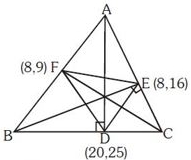
View full question & answer→MCQ 3031 Mark
$OPQR$ is a square and $M$ and $N$ are the mid points of sides $PQ$ and $QR$ respectively then ratio of area of square and the triangle $OMN$ is-
- A
$4 : 1$
- B
$2 : 1$
- ✓
$8 : 3$
- D
$4 : 3$
AnswerCorrect option: C. $8 : 3$
c
Let the coordinates of vertices $O, P, Q, R$ be $(0,0),(a, 0),(a, a),(0, a),$ respectively.
Area of the square is $a^{2}$ Coordinates of $M$ are $\left(a, \frac{a}{2}\right)$ and those of $N$ are $\left(\frac{a}{2}, a\right)$ Therefore, area of $\Delta \mathrm{OMN}$
$=\frac{1}{2}\left|\begin{array}{ccc}0 & 0 & 1 \\ a & \frac{a}{2} & 1 \\ \frac{a}{2} & a & 1\end{array}\right|$
$=\frac{3 a^{2}}{8}$
Hence, the required ratio is 8: 3 .
View full question & answer→MCQ 3041 Mark
The orthocentre of a $\Delta ABC$ is $'B'$ and circumcentre is $S(a, b)$. If $A$ is origin then coordinate of $C$ is-
AnswerCorrect option: A. $(2a, 2b)$
a
$\frac{\mathrm{x}+0}{2}=\mathrm{a} \Rightarrow \mathrm{x}=2 \mathrm{a}$ $c\left( {2a,2b} \right)$
$\frac{\mathrm{y}+0}{2}=\mathrm{b} \Rightarrow \mathrm{y}=2 \mathrm{b}$
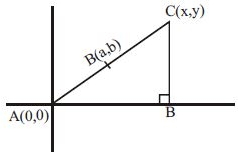
View full question & answer→MCQ 3051 Mark
If $\alpha, \beta, \gamma$ are the real roots of the equation $x^3 -3px^2 + 3qx -1 = 0$, then the centroid of the triangle whose vertices are $(\alpha,\frac{1}{\alpha}),(\beta,\frac{1}{\beta})$ and $(\gamma,\frac{1}{\gamma})$
AnswerCorrect option: C. $(p, q)$
c
The centroid of the given triangle is the point $\left(\frac{\alpha+\beta+\gamma}{3}, \frac{\frac{1}{\alpha}+\frac{1}{\beta}+\frac{1}{\gamma}}{3}\right)=$
$\left(\frac{3 p }{3}, \frac{\alpha \beta+\beta \gamma+\gamma \alpha}{3 \alpha \beta \gamma}\right)=( p , q )$
${[\because \alpha+\beta+\gamma=3 p , \alpha \beta+\beta \gamma+\gamma \alpha=3 q , \alpha \beta+\beta \gamma+\gamma \alpha=3 q , \alpha \beta \gamma=1]}$
View full question & answer→MCQ 3061 Mark
The area enclosed by the graphs of $|x + y| = 2$ and $|x| = 1$ is
Answerd
$|x+y|=2$
$\Rightarrow x+y=\pm 2$
$|x|=1$
$\Rightarrow x=\pm 1$
From the fig, attached, the resultant fig., is a parallelogram having vertices (-1,3),(1,1),(1,3)
and (-1,-1)
Therefore,
$B P=2$ units
$B C=4$ units
Therefore,Area of parallelogram $A B C D=B P \times B C=2 \times 4=8$ sq. units.
Hence the correct answer is $(D) 8$.
View full question & answer→MCQ 3071 Mark
Area of the triangle formed by the lines $y^2 -9xy + 18x^2 = 0$ and $y = 9$ , is ............ $\mathrm{sq. \,unit}$
- A
$27$
- B
$13.5$
- ✓
$6.75$
- D
$3.375$
AnswerCorrect option: C. $6.75$
c
Put $y=9$ in given pair of straight lines
$18 x^{2}-81 x+81=0$
$\Rightarrow \quad x=3, \frac{3}{2}$
So, we have three vertices $(0,0),(3,9)$
$\operatorname{and}\left(\frac{3}{2}, 9\right)$
Hence $\Delta=\frac{27}{4}$
View full question & answer→MCQ 3081 Mark
Let $A\, (2, 3)$ and $B\, (-4, 5)$ are two fixed points. $A$ point $P$ moves in such a way that $\Delta PAB = 12 \,sq. units$, then its locus is :-
- A
$x^2 + 6xy + 9y^2 + 22 x + 66 y -23 = 0$
- B
$x^2 + 6xy + 9y^2 + 22 x + 66 y + 23 = 0$
- ✓
$x^2 + 6xy + 9y^2 -22 x -66 y -23 = 0$
- D
AnswerCorrect option: C. $x^2 + 6xy + 9y^2 -22 x -66 y -23 = 0$
c
Let, $P=(x, y)$
$A=(2,3)$ and $B=(-4,5)$
$\because A r .(\triangle P A B)=12$ sq. units
$\Longrightarrow \frac{1}{2}|x(3-5)+2(5-y)-4(y-3)|=12$
$\Longrightarrow|-2 x+10-2 y-4 y+12|=24$
$\Longrightarrow|-2 x-6 y+22|=24$
$\Longrightarrow 2 x+6 y-22=\pm 24$
$\Rightarrow x+3 y-11=\pm 12$
$\Longrightarrow x+3 y-23=0$ or $x+3 y+1=0$
Hence, the locus is $(x+3 y-23)(x+3 y+1)=0$
$\Longrightarrow x^{2}+6 x y+9 y^{2}-22 x-66 y-23=0$
View full question & answer→MCQ 3091 Mark
A point moves in the $x-y$ plane such that the sum of its distances from two mutually perpendicular lines is always equal to $3$. The area enclosed by the locus of the point is- ............... $\mathrm{unit}^{2}$
Answera
$|x|+|y|=3$
shows square
and area of square $ABCD$
$ = 4\left( {are\,\,of\,\Delta OAB} \right)$
$=4 \times \frac{1}{2} \times 3 \times 3=18$ unit $^{2}$
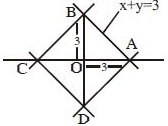
View full question & answer→MCQ 3101 Mark
If the axes be rotated through an angle $\frac{\pi}{3}$ in the clockwise direction with respect to $(0, 0)$ the point $(4, 2)$ in the new system was formally-
- A
$(2 + \sqrt 3 , -2 \sqrt 3 -1)$
- B
$(-2 \sqrt 3 + 1, 2 + \sqrt 3 )$
- ✓
$(2 + \sqrt 3 , -2 \sqrt 3 + 1)$
- D
$(2 -\sqrt 3 , -2 \sqrt 3 -1)$
AnswerCorrect option: C. $(2 + \sqrt 3 , -2 \sqrt 3 + 1)$
c
| |
$x$ |
$y$ |
| $4$ |
$1/2$ |
$ - \sqrt 3 /2$ |
| $2$ |
$\sqrt 3 /2$ |
$1/2$ |
$x=4\left(\frac{1}{2}\right)+2\left(\frac{\sqrt{3}}{2}\right)=2+\sqrt{3}$
$y=4\left(-\frac{\sqrt{3}}{2}\right)+2\left(\frac{1}{2}\right)=-2 \sqrt{3}+1$
View full question & answer→MCQ 3111 Mark
If two mutually perpendicular lines through the point $A(1, 1)$ intersect $x$ & $y$ axis at points $B$ & $C$ respectively, then locus of centroid of $\Delta ABC$ is -
- ✓
$3x + 3y = 4$
- B
$x + y = 4$
- C
$x + y = 2$
- D
$x^2 + y^2 = 2$
AnswerCorrect option: A. $3x + 3y = 4$
View full question & answer→MCQ 3121 Mark
To remove $xy$ term from the second degree equation $5x^2 + 8xy + 5y^2 + 3x + 2y + 5 = 0$, the coordinates axes are rotated through an angle $\theta$, then $\theta$ equals:-
- A
$\pi/2$
- ✓
$\pi/4$
- C
$3\pi/8$
- D
$\pi/8$
AnswerCorrect option: B. $\pi/4$
b
$* A x^{2}+2 h x y+B y^{2}+2 g x+2 f y+c=0$
To eliminate $x y$ tem $\theta^{\prime}$
$\Rightarrow \mid \tan 2 \theta=\frac{2 h}{A-\beta}$
$2 \theta =\tan ^{-1}\left(\frac{2 h}{A-B}\right)$
$\theta =\frac{1}{2} \tan ^{-1}\left(\frac{2 n}{A-B}\right)$
$=\frac{1}{2} \tan ^{-1}\left(\frac{8}{5-5}\right)$
$\theta=\frac{1}{2} \tan ^{-1}(\infty)$
$\theta=\frac{1}{2} \times \frac{\pi}{2}$
$\theta=\frac{\pi}{4}$
View full question & answer→