MCQ
A vertical mass spring system executes simple harmonic oscillations with a period of $2\,s$. A quantity of this system which exhibits simple harmonic variation with a period  of $1\, sec$ is
  • A
    Velocity
  • Potential energy
  • C
    Phase difference between acceleration and displacement
  • D
    Difference between kinetic energy and potential energy
Answer

Correct option: B.
Potential energy
b

Need a full question paper?

Generate a complete, print-ready paper with questions like this in minutes — across 16+ boards, with answer keys.

Start Generating Free

Similar questions

If $\overrightarrow A = 3\hat i + \hat j + 2\hat k$ and $\overrightarrow B = 2\hat i - 2\hat j + 4\hat k$ then value of $|\overrightarrow A \times \overrightarrow B |\,$ will be
In Newton's experiment of cooling, the water equivalent of two similar calorimeters is $10 $ gm each. They are filled with $350 gm$ of water and $300 gm$ of a liquid (equal volumes) separately. The time taken by water and liquid to cool from ${70^o}C$ to ${60^o}C$ is $3$ min and $95$ sec respectively. The specific heat of the liquid will be ...... $Cal/gm\,^oC$
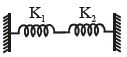
The effective spring constant of two spring system as shown in figure will be 
Dimensions of coefficient of viscosity are
A person with his hand in his pocket is skating on ice at the rate of $10 m / s$ and describes a circle of radius $50 m$. What is his inclination to vertical: $\left( g =10 m / sec ^2\right)$
The average translational kinetic energy of ${N}_{2}$ gas molecules at $\ldots \ldots \ldots . .{ }^{\circ} {C}$ becomes equal to the ${K} . {E}$. of an electron accelerated from rest through a potential difference of $0.1$ $volt.$

$\left(\right.$ Given $\left.{k}_{{B}}=1.38 \times 10^{-23} \, {J} / {K}\right)$

(Fill the nearest integer).

The escape velocity of a sphere of mass $m$ is given by $(G=$ Universal gravitational constant; $M_e=$ Mass of the earth and $R_e=$ Radius of the earth)
In case of hydrogen and oxygen at $N.T.P.$, which of the following quantities is $/$ are the same?
A light rod of length $l$ has two masses $m_1$ and $m_2$ attached to its two ends. The moment of inertia of the system about an axis perpendicular to the rod and passing through the centre of mass is 
A particle performs $S.H.M.$ of amplitude $A$ with angular frequency $\omega$  along a straight line. Whenit is at a distance  $\frac{{\sqrt 3 }}{2}$ $A$  from mean position, its kinetic energy gets increased by an amount $\frac{1}{2}m{\omega ^2}{A^2}$  due to an impulsive force. Then its new amplitude becomes