Question
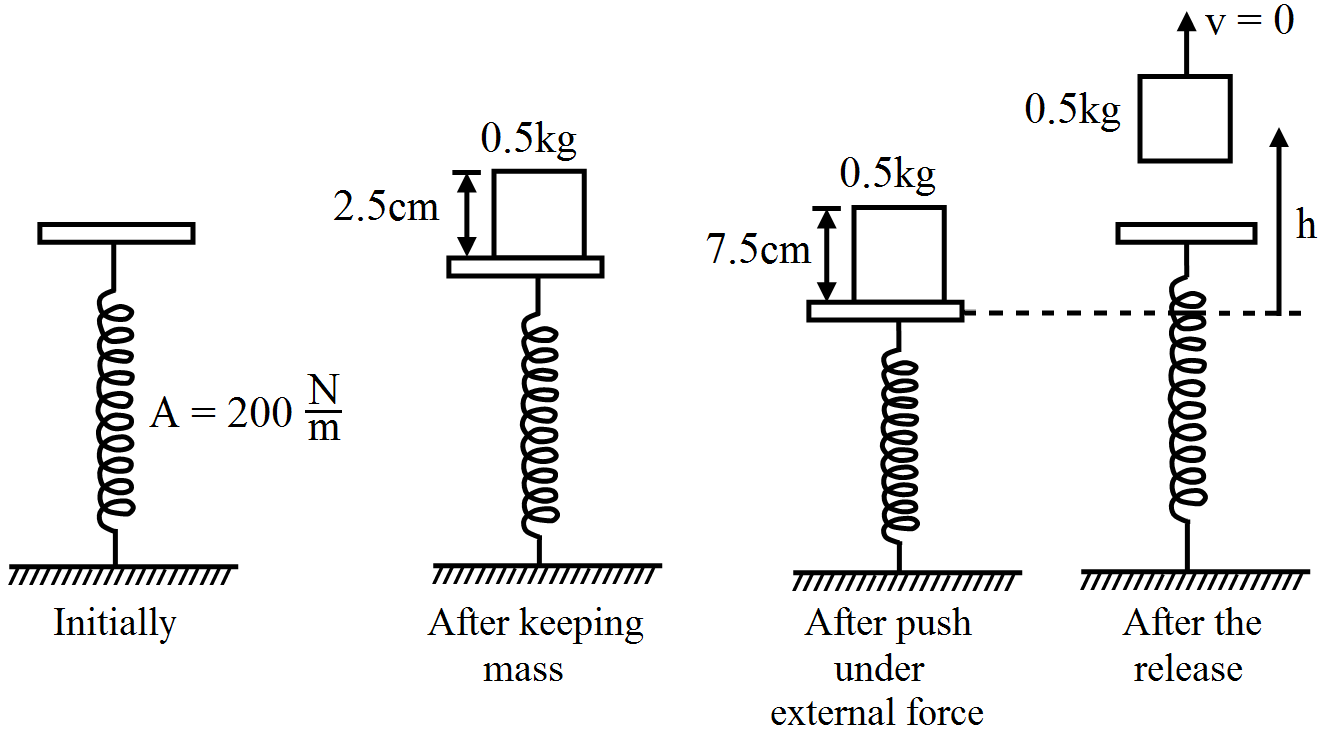
A vertical spring with constant $200N/ m$ has a light platform on its top. When a $500g$ mass is kept on the platform spring compresses $2.5cm$. Mass is now pushed down $7.50cm$ further and released. How far above later position will the mass fly? $(g = 10ms^{-2})$.
Answer

When the external force is removed after the push, the mass gets detached when spring obtain its natural length and say, mass m rises h height from the pushed position.

Loss in Potential energy of spring = Gain in gravitational potential energy. $\frac{1}{2}\text{k}[\text{x}^2]=\text{mgh}$ $\frac{1}{2}\times200[0.1]^2$ = 0.5 × 10 × h 1 = 5h ⇒ h = 0.2m

Need a full question paper?

Generate a complete, print-ready paper with questions like this in minutes — across 16+ boards, with answer keys.

Start Generating Free

Similar questions

Water rises to a height of 10cm in a certain capillary tube. The level of mercury in the same tube is depressed by 3.42cm. Compare the surface tensions of water and mercury. Specific gravity of mercury is 13.6g/cc and angle of contact for water and mercury are zero and 135° respectively.
A vessel contains two nonreactive gases : neon $($monatomic$)$ and oxygen $($diatomic$).$ The ratio of their partial pressures is $3:2.$ Estimate the ratio of $(i)$ number of molecules and $(ii)$ mass density of neon and oxygen in the vessel. Atomic mass of $Ne = 20.2 u,$ molecular mass of $O_2= 32.0 u.$
A body is moved along a closed loop. Is the work done in moving the body necessarily zero? If not, state the condition under which work done over a closed path is always zero.
A clever strategy in a snowball fight is to throw two snowballs at your opponent in quick succession. The first one with a high trajectory and the second one with a lower trajectory and shorter time of flight, so that they both reach the target at the same instant. Suppose your opponent is $20.0m$ away. You throw both snowballs with the same initial speed vo but $\theta _0$ is $60.0°$ for the first snowball and $30.0°$ for the second. If they are both to reach their target at the same instant, how much time must elapse between the release of the two snowballs?
State the first law of thermodynamics. List the sign conventions used in the energy dealt by the law.
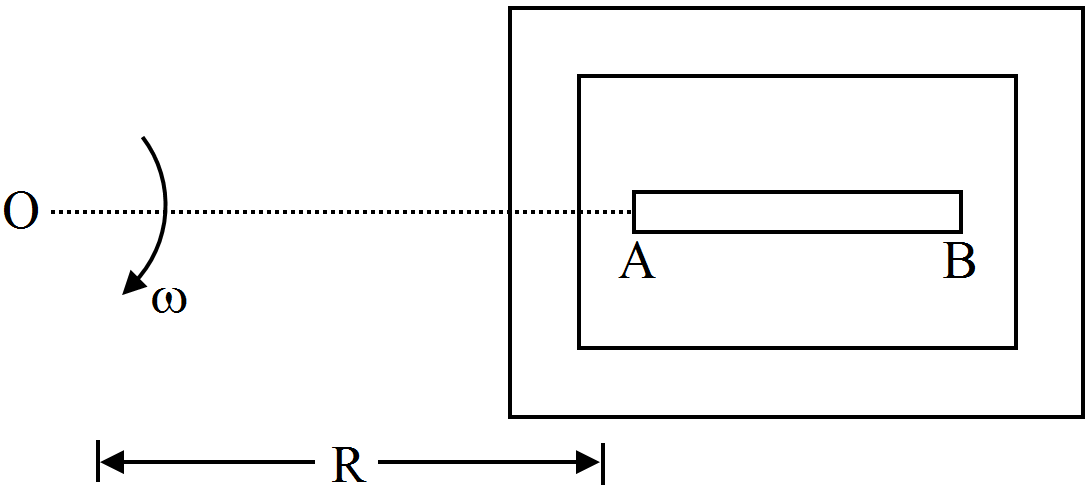
A table with smooth horizontal surface is fixed in a cabin that rotates with angular speed o in a circular path of radius R. A smooth groove AB of length L(< < R) is made on the surface of table as shown in figure. A small particle is kept at the point A in the groove and is released to move, find the time taken by the particle to reach the point B.
What is the period of revolution of Neptune around the sun, given that the diameter of its orbit is 30 times the diameter of the earth's orbit around the sun, both orbits being assumed to be circular? Taking the moon's orbit around earth to be r and mass of earth 81 times the mass of the moon, find the position of the point from the earth where the net gravitational field is zero.
A wheel rotating at a speed of 600rpm (revolutions per minute) about its axis is brought to rest by applying a constant torque for 10 seconds. Find the angular deceleration and the angular velocity 5 seconds after the application of the torque.
How many astronomical units (A.U.) make 1 parsec?
Give a formula for mean free path of the molecules of a gas. Briefly explain, how its value is affected by $(i)$ change in temperature and $(ii)$ change in pressure.