Question
A body is moved along a closed loop. Is the work done in moving the body necessarily zero? If not, state the condition under which work done over a closed path is always zero.

Answer

Work done by a body moving along closed loop can be zero if only conservative force acting on the body during motion. Work done by a body moving along a loop is not zero if any non-conservative force, i.e., frictional, electrostatic, magnetic force are acting on body.

Need a full question paper?

Generate a complete, print-ready paper with questions like this in minutes — across 16+ boards, with answer keys.

Start Generating Free

Similar questions

One end of a rod of length 20cm is inserted in a furnace at 800K The sides of the rod are covered with an insulating material and the other end emits radiation like a blackbody. The temperature of this end is 750K in the steady state. The temperature of the surrounding air is 300K. Assuming radiation to be the only important mode of energy transfer between the surrounding and the open end of the rod, find the thermal conductivity of the rod. Stefan constant $\sigma=6.0\times10^{-8}\text{Wm}^{-2}\text{K}^{-4}.$
Briefly explain the formation of trade wind.
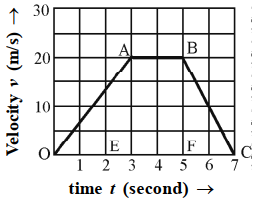
Q. 13. Draw a time graph for a vehicle from the time-velocity graph given in the attached figure.
Image
Two identical springs of spring constant k each are attached to a block of mass m as shown in figure:

Show that when the mass is displaced from its equilibrium position on either side, it executes a simple harmonic motion. Find the period of oscillations.
A block of mass $250g$ is kept on a vertical spring of spring constant $100N/m$ fixed from below. The spring is now compressed to have a length $10cm$ shorter than its natural length and the system is released from this position. How high does the block rise? Take $g =10m/s^2$.
A rod of length $L$ is placed along the $X-$axis between $x = 0$ and $x = L$. The linear density $($mass$/$ length$) \rho$ of the rod varies with the distance $x$ from the origin as $\rho=\text{a + bx.}$
  1. Find the $SI$ units of $a$ and $b$.
  2. Find the mass of the rod in terms of $a, b$ and $L.$
Consider that an ideal gas ( $n$ moles) is expanding in a process given by $p=f(V)$, which passes through a point $\left(V_0\right.$, $\left.p_0\right)$. Show that the gas is absorbing heat at $\left(P_0, V_0\right)$, if the slope of the curve $p=f(V)$ is larger than the slope of the adiabat passing through $\left(\mathrm{P}_0, \mathrm{~V}_0\right)$.
Assume that each atom in a copper wire contributes one free electron. Estimate the number of free electrons in a copper wire having a mass of 6.4g (take the atomic weight of copper to be $64g ~mol^{-1}$.
A molecule in a gas container hits a horizontal wall with speed $200ms^{-1}$ and angle 30° with the normal, and rebounds with the same speed. Is momentum conserved in the collision? Is the collision elastic or inelastic?
A human body excretes (removes by waste discharge, sweating, etc.) certain materials by a law similar to radioactivity. If technetium is injected in some form in a human body, the body excretes half the amount in 24 hours. A patient is given an injection containing $^{99}Tc$. This isotope is radioactive with a half-life of 6 hours. The activity from the body just after the injection is $6\mu\text{Ci}.$ How much time will elapse before the activity falls to $3\mu\text{Ci}?$