- AGreater than at Q.
- BSame as at Q.
- CLess than at Q.
- DGreater or less than at Q depending upon the strength of current.
Explanation:
As per Biot Savart Law, Magnetic field at a point is inversely proportional to square of distance from the current carrying conductor.
Therefore magnitude of magnetic field is same at both points P and Q, irrespective of their position from the conductor.
Generate a complete, print-ready paper with questions like this in minutes — across 16+ boards, with answer keys.
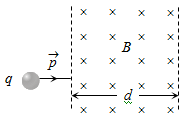
A particle with charge q, moving with a momentum p, enters a uniform magnetic field normally. The magnetic field has magnitude B and is confined to a region of width d, where d <
, The particle is deflected by an angle θ in crossing the field

|
(a) sinθ = |
(b) sinθ = |
(c) sinθ = |
(d) sinθ = |
The electric flux for Gaussian surface A that enclose the charged particles in free space is (given q1 = –14 nC, q2 = 78.85 nC, q3 = – 56 nC)
|
(a) 103 Nm2 C–1 |
(b) 103 CN-1 m–2 |
(c) 6.32 × 10³ Nm2 C–1 |
(d) 6.32 × 10³ CN-1 m–2 |
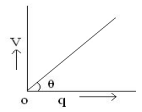
The slope of plate characteristic of a vacuum diode is 2 The plate resistance of diode will be
|
(a) 50 W |
(b) 50 kW |
(c) 500 kW |
(d) 500 kW |

A particle moving in a magnetic field increases its velocity, then its radius of the circle
|
(a) Decreases |
(b) Increases |
(c) Remains the same |
(d) Becomes half |
The velocity of light emitted by a source S observed by an observer O, who is at rest with respect to S is c. If the observer moves towards S with velocity v, the velocity of light as observed will be
|
(a) c + v |
(b) c - v |
(c) c |
(d) |
The wave theory of light was given by
|
(a) Maxwell |
(b) Planck |
(c) Huygen |
(d) Young |