MCQ
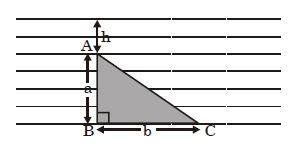
A vertical triangular plate $ABC$ is placed inside water with side $BC$ parallel to water surface as shown. The force on one surface of plate by water is (density of water is $\rho $ and atmospheric pressure $P_0$ ) 
  • A
    $\left( {{P_0} + h\rho g} \right)\frac{1}{2}ab$
  • $\left( {{P_0} + h\rho g} \right)\frac{1}{2}ab + \frac{{{a^2}b}}{3}\rho g$
  • C
    $\left[ {{P_0} + \rho g\left( {h + a} \right)} \right]\frac{1}{2}ab$
  • D
    $0$

Answer

Correct option: B.
$\left( {{P_0} + h\rho g} \right)\frac{1}{2}ab + \frac{{{a^2}b}}{3}\rho g$
b
$\mathrm{F}=$ pressure at centroid $\times$ area

$\mathrm{F}=\left(\mathrm{P}_{0}+\frac{\mathrm{h}+\mathrm{h}+\mathrm{a}+\mathrm{h}+\mathrm{a}}{3} \rho \mathrm{g}\right) \frac{1}{2} \mathrm{ab}$

$=\left(P_{0}+\left(h+\frac{2 a}{3}\right) \rho g\right) \frac{1}{2} a b$

Need a full question paper?

Generate a complete, print-ready paper with questions like this in minutes — across 16+ boards, with answer keys.

Start Generating Free

Similar questions

That gas cannot be liquified
For nuclei with $A > 100:$
  1. The binding energy of the nucleus decreases on an average as $A$ increases.
  2. The binding energy per nucleon decreases on an average as $A$ increases.
  3. If the nucleus breaks into two roughly equal parts, energy is released.
  4. If two nuclei fuse to form a bigger nucleus, energy is released.
If $L$ denotes the inductance of an inductor through which a current $i$ is flowing, the dimensions of $L{I^2}$ are
A solid sphere of mass $0.1\,kg$ and radius $2\,cm$ rolls down an inclined plane $1.4\,m$ in length (slope $1$ in $10$). Starting from rest its final velocity will be.......... $m/\sec.$
Three different objects of masses ${m_1},{m_2}$ and ${m_3}$ are allowed to fall from rest and from the same point $‘O’$ along three different frictionless paths. The speeds of the three objects, on reaching the ground, will be in the ratio of
The equation $\left(P+\frac{a}{V^2}\right)(V-b)=$ Constant. The units of a are
A person is swimming with a speed of $10\, m /s$ s at an angle of $120^{\circ}$ with the flow and reaches to a point directly opposite on the other side of the river. The speed of the flow is $'x'$ $m / s$. The value of $'x'$ to the nearest integer is ..............
A train $S1$, moving with a uniform velocity of $108 km / h$, approaches another train $S 2$ standing on a platform. An observer $O$ moves with a uniform velocity of $36 km / h$ towards $S 2$, as shown in figure. Both the trains are blowing whistles of same frequency $120 Hz$. When $O$ is $600 m$ away from $S 2$ and distance between $S 1$ and $S 2$ is $800 m$, the number of beats heard by $O$ is. . . . . [Speed of the sound $=330 m / s$ ]
The radii of circular orbits of two satellites $A$ and $B$ of the earth, are $4R$ and $R,$ respectively. If the speed of satellite $A$ is $3\, V,$ then the speed of satellite $B$ will be ...... $V$
Two speakers connected to the same source of fixed frequency are placed $2.0 m $ apart in a box. A sensitive microphone placed at a distance of $4.0m$ from their midpoint along the perpendicular bisector shows maximum response. The box is slowly rotated until the speakers are in line with the microphone. The distance between the midpoint of the speakers and the microphone remains unchanged. Exactly five maximum responses are observed in the microphone in doing this. The wavelength of the sound wave is .... $m$