MCQ
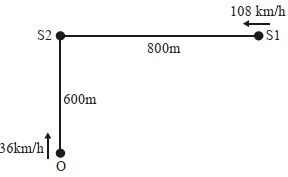
A train $S1$, moving with a uniform velocity of $108 km / h$, approaches another train $S 2$ standing on a platform. An observer $O$ moves with a uniform velocity of $36 km / h$ towards $S 2$, as shown in figure. Both the trains are blowing whistles of same frequency $120 Hz$. When $O$ is $600 m$ away from $S 2$ and distance between $S 1$ and $S 2$ is $800 m$, the number of beats heard by $O$ is. . . . . [Speed of the sound $=330 m / s$ ]
  • A
    $5$
  • $8$
  • C
    $7$
  • D
    $9$

Answer

Correct option: B.
$8$
b
Frequency observed by $O$ from $S _2$

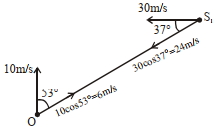
$f _2=\frac{330+10}{330} \times 120=\frac{340}{330} \times 120=123.63 Hz$

frequency observed by $O$ from $S _1$

$f_1=\frac{330+6}{330-24} \times 120=\frac{336}{306} \times 120 \approx 131.76 Hz$

beat frequency $=131.76-123.63=8.128 \approx 8.12$ to $8.13 Hz$

Need a full question paper?

Generate a complete, print-ready paper with questions like this in minutes — across 16+ boards, with answer keys.

Start Generating Free

Similar questions

A Carnot engine takes $3 \times {10^6}\,cal$. of heat from a reservoir at $627°C$, and gives it to a sink at $27°C.$ The work done by the engine is
The force required just to move a body up an inclined plane is double the force required just to prevent the body sliding down. If the coefficient of friction is $0.25$, the angle of inclination of the plane is ...... $^o$
The specific heats, $C_P$ and $C_V$ of a gas of diatomic molecules, $A$, are given (in units of $J\, mol^{-1}\, K^{-1}$) by $29$ and $22$, respectively. Another gas of diatomic molecules $B$, has the corresponding values $30$ and $21$. If they are treated as ideal gases, then
In a Screw Gauge, fifth division of the circular scale coincides with the reference line when the ratchet is closed. There are $50$ divisions on the circular scale, and the main scale moves by $0.5 \,{mm}$ on a complete rotation. For a particular observation the reading on the main scale is $5\, {mm}$ and the $20^{\text {th }}$ division of the circular scale coincides with reference line. Calculate the true reading. (in ${mm}$)
At what speed, the velocity head of water is equal to pressure head of $40 \,cm$ of mercury is ........ $m / s$
Which of the following points is the likely position of the centre of mass of the system shown in the figure ?
Image
Who discovered scattering of light?
A particle executes $SHM$ on a straight line path. The amplitude of oscillation is $2\, cm.$ When the displacement of the particle from the mean position is $1\, cm,$ the numerical value of magnitude of acceleration is equal to the numerical value of magnitude of velocity. The frequency of $SHM$ (in $second^{-1}$) is :
If an average person jogs, he produces $14.5 \times 103\ \text{cal/ min.}$ This is removed by the evaporation of sweat. The amount of sweat evaporated per minute $($assuming $1\ kg$ requires $580 \times 103\ \text{cal}$ for evaparation$)$ is
A standing wave is produced on a string clamped at one end and free at the other. The length of the string.