Question
A vertical wire carries a current in upward direction. An electron beam sent horizontally towards the wire will be deflected:

Answer

  1. Upwards.
Explanation:
A vertical wire is carrying current in upward direction, so the magnetic field produced will be anticlockwise (according to the right-hand thumb rule). As the electron beam is sent horizontally towards the wire, the direction of the current will be horizontally away from the wire (direction of conventional current is opposite to the direction of the negative charge). According to Fleming's left-hand rule, the force will act in upward direction, deflecting the beam in the same direction.

Need a full question paper?

Generate a complete, print-ready paper with questions like this in minutes — across 16+ boards, with answer keys.
Start Generating Free

Similar questions

Colour code of carbon resitance for blue colour is:
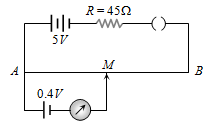
In given figure, the potentiometer wire $AB$ has a resistance of $5\ W$ and length $10\ m$. The balancing length $AM$ for the emf of $0.4\ V$ is
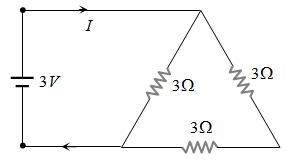
A $3$ volt battery with negligible internal resistance is connected in a circuit as shown in the figure.  The current $I,$ in the circuit will be
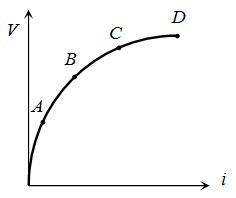
Variation of current passing through a conductor as the voltage applied across its ends as varied is shown in the adjoining diagram. If the resistance $(R)$ is determined at the points $A, B, C$ and $D,$ we will find that
An electron enters a region where electrostatic field is $20 N / C$ and magnetic field is $5 T .$ If electron passes undeflected through the region, then velocity of electron will be
Electric conduction takes place in a discharge tube due to the movement of:
  1. Positive ions.
  2. Negative ions.
  3. Electrons.
  4. Protons.
Two point white dots are 1mm apart on a black paper. They are viewed by eye of pupil of diameter 3mm. Approximately what is the maximum distance up to which these dots can be resolved by the eye.
For which colour, the angle of deviation is maximum when light enters into glass from air?
The resistor of resistance 'R' is connected to 25 V supply and heat produced in it is 25 J/sec. The value of R is(a) 225 Ω (b) 1 Ω (c) 25 Ω    (d) 50 Ω
       
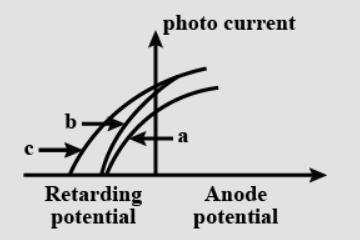
The figure shows a plot of photocurrent v/s anode potential for a photo sensitive surface for three different radiations. Which one of the following is a correct statement?