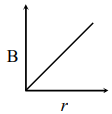
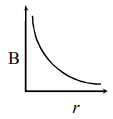
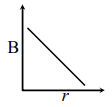
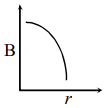
Question 11 Mark
Consider a wire carrying a steady current, I placed in a uniform magnetic field B perpendicular to its length. Consider the charges inside the wire. It is known that magnetic forces do no work. This implies that:
Answer
- Some charges inside the wire move to the surface as a result of B.
- If the wire moves under the influence of B, no work is done by the magnetic force on the ions, assumed fixed within the wire.
Solution:
Magnetic force on a conductor of length l carrying a current I placed in a uniform magnetic field B is given by, $\text{F}=\text{I}(\text{l}\times\text{B})\text{ or }|\text{F}|=\text{I }|\text{l}| \ \ |\text{B}|\sin\theta$.
The direction of force is given by Fleming's left hand rule & F is perpendicular to the direction of magnetic field B, Therefore, work done by the magnetic force on the ions is zero. View full question & answer→Question 21 Mark
A charged particle moves through a magnetic field perpendicular to its direction. Then:
Answer
- The momentum changes, but the kinetic energy is constant.
View full question & answer→Question 31 Mark
A rod $AB$ moves with a uniform velocity $v$ in a uniform magnetic field as shown in figure.
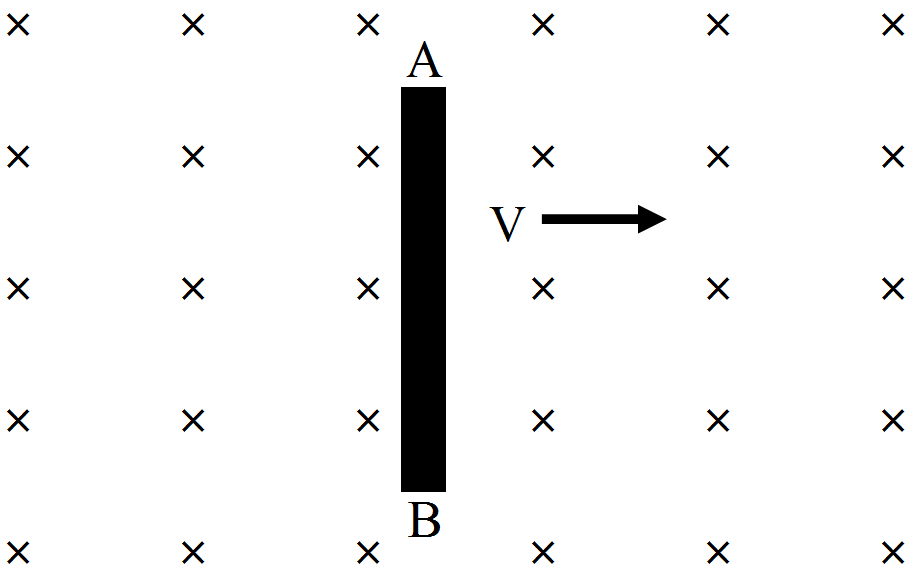
AnswerThe end $A$ becomes positively charged.
The end $'A\ '$ becomes, positively charged.
Because magnetic field exerts an average Force $\overrightarrow{\text{F}}_0=\text{q}\vec{\text{v}}\times\vec{\text{B} } \ n$ each free electron where $q = 1. 6 \times 10^{19}C$ is the charge on the electron.
This Force is towards $AB$ and hence the free electrons will move towareds $B$.
Negative charge is accumulated at $'B\ '$ and positive charge appears at $A$.
View full question & answer→Question 41 Mark
Beta particle An unknown particle is being studied in a magnetic field of variable intensity and direction. When the magnetic field is turned off, the particle is observed to move toward the earth. When the magnetic field is turned on, the particle is observed to continue to move toward the earth, no matter the strength or the direction of the magnetic field. Which of the particles listed below is most likely the unknown particle?
Answer
- Gamma ray
Explanation:
We know that a moving charged particle experiences a force in a magnetic force , as the given unknown particle is not affected by magnetic field , so it cannot be a charged particle.
But beta, alpha and positron are charged particle therefore they are not the unknown particle , only neutron is chargeless particle so it is the unknown particle.
Gamma rays are not particle though they are also not affected by a magnetic field.
View full question & answer→Question 51 Mark
The most suitable metal for making permanent magnets is:
Question 61 Mark
According to oersted, around a current carrying conductor, magnetic field exists:
Answer
- As long as there is current in the wire.
View full question & answer→Question 71 Mark
The path of an electron in a uniform magnetic field may be:
Answer
- Either helical or circular
Explanation:
The path an electron in a uniform magnetic field my be either helical or circular.
View full question & answer→Question 81 Mark
What is the angle of dip at the magnetic poles?
Question 91 Mark
The $SI$ unit of magnetic dipole moment is’.
View full question & answer→Question 101 Mark
A particle of mass m and charge q enters a magnetic field B perpendicularly with a velocity v. The radius of the circular path described by it will be:
Question 111 Mark
An electron having a charge e moves with a velocity v in X-direction. An electric field acts on it in Y-direction? The force on the electron acts in:
Answer
- Negative direction of Y-axis.
View full question & answer→Question 121 Mark
When a charged particle moves through a magnetic field, the quantity which is not affected in the magnetic field is:
Answer
- Kinetic energy of the particle
Explanation:
Magnetic field does zero work on moving charged particles. Therefore, kinetic energy of particle remains constant.
View full question & answer→Question 131 Mark
Two parallel, long wires carry currents $i_1$ and $i_2$ with $i_1 > i_2. $When the currents are in the same direction, the magnetic field at a point midway between the wires is $10 \mu\text{T}.$ If the direction of $i_2$ is reversed, the field becomes $30 \mu\text{T}.$ The ratio $\frac{\text{i}_1}{\text{i}_2}$ is:
AnswerThe magnetic field due to the current$-$carrying long, straight wire at point a is given by,$\text{B}=\frac{\mu_0\text{i}}{2\pi\text{d}}$
When both the wires carry currents $i_1$ and $i_2$ in the same direction, they produce magnetic fields in opposite directions at any point in between the wires.
$\text{B}'=\frac{\mu_0\text{i}_1}{2\pi\text{a}}-\frac{\mu_0\text{i}_2}{2\pi\text{a}}=10\mu\text{T}\ ...(1)$
Here, a is the distance of the midpoint from both the wires.
When both the wires carry currents in opposite directions, they produce fields in the same direction at the midpoint of the two wires.
$\text{B}''=\frac{\mu_0\text{i}_1}{2\pi\text{a}}+\frac{\mu_0\text{i}_2}{2\pi\text{a}}=30\mu\text{T}\ ...(2)$
On solving eqs. $(1)$ and $(2)$, we get
$\text{i}_1-\text{i}_2=10$
$\text{i}_1+\text{i}_2=30$
$\Rightarrow\text{i}_1=20$
$ \text{i}_2=10$
$\frac{\text{i}_1}{\text{i}_2}=\frac{20}{10}$
$\frac{\text{i}_1}{\text{1}_2}=\frac{2}{1}$
$\Rightarrow\frac{\text{i}_1}{\text{i}_2}=2$
View full question & answer→Question 141 Mark
A moving charge produces:
Answer
- Both of them.
Explanation:
Because of the presence of a charge, a particle produces an electric field. Also, because of its motion, that is, the flow of charge or current, there is generation of a magnetic field.
View full question & answer→Question 151 Mark
A positively charged particle projected towards east is deflected towards north by a magnetic field. The field may be:
Answer
- Towards west.
Explanation:
$\text{F}=\text{q}\big(\overrightarrow{\text{V}}\times\overrightarrow{\text{B}}\big)$
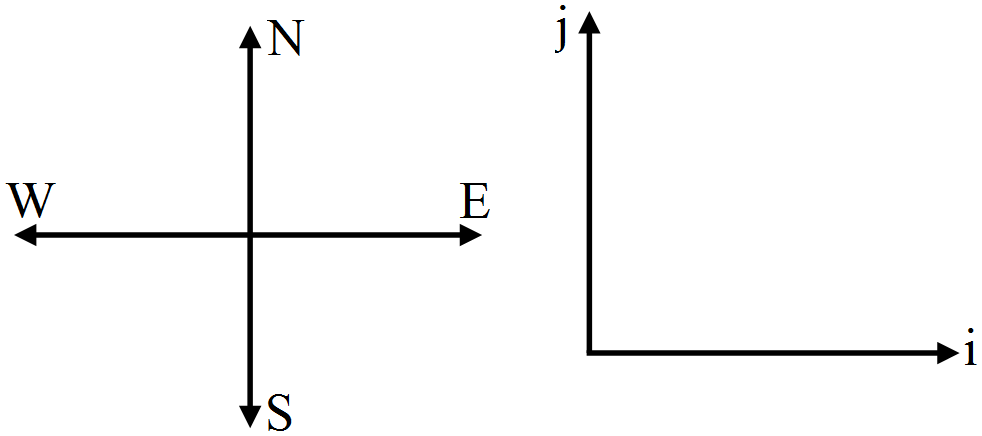
$\text{j}=\text{q}\big(\overrightarrow{\text{i}}\times\overrightarrow{\text{B}}\big)$
$\Rightarrow\text{B}\otimes$
⇒ The magnetic field may be down ward direction. View full question & answer→Question 161 Mark
Let $\overrightarrow{\text{E}}$ and $\overrightarrow{\text{B}}$ denote electric and magnetic fields in a frame S and $\overrightarrow{\text{E}}$ and $\overrightarrow{\text{B}}$ in another frame S moving with respect to S at a velocity $\overrightarrow{\text{v}}.$ Two of the following equations are wrong. Identify them.
Answer
- $\text{E}_\text{y},=\text{E}_\text{y}+\frac{\text{vB}_\text{z}}{\text{c}^2}$
- $\text{B}'_\text{y}=\text{B}_\text{y}+\text{v}\text{E}_\text{z}$
Explanation:
$\text{qE}=\text{qvB}$
$\Rightarrow\text{e}=\text{vB}$ By dimensionally b & care wrong
$\Rightarrow\text{v}\text{E}=\text{v}^2\text{B}$
$\Rightarrow\text{B}=\frac{\text{vE}}{\text{v} ^2}$ View full question & answer→Question 171 Mark
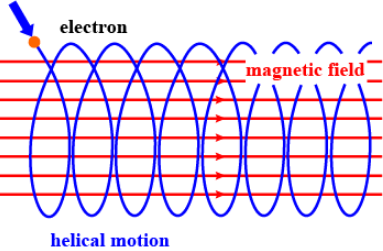
If the direction of the initial velocity of a charged particle is neither along nor perpendicular to that of the magnetic field, then the orbit will be:
Answer
- A helix.
Explanation:
The perpendicular component will be responsible for circular motion and parallel component will take it along the magnetic field.
Considering both the phenomena, the resultant motion will be helical.
View full question & answer→Question 181 Mark
What is the space around a current-carrying conductor, in which its magnetic effect can be experienced called?
Answer
- Magnetic field
Explanation:
The space around a current-carrying conductor, in which its magnetic effect can be experienced is called the magnetic field.
When a current is passed through a conductor, it modifies the space around the conductor and forms a magnetic field.
View full question & answer→Question 191 Mark
The magnetic field produced by a current - carrying wire at a given point depends on:
Answer
- The current passing through it
Explanation:
The magnetic field produced by a current - carrying wire at a given point depends directly on the current passing through it.
Therefore, if there is a circular coil having n turns, the field produced is n times as large as that produced by a single turn.
This is because the current in each circular turn has the same direction, and the field due to each turn then just adds up.
View full question & answer→Question 201 Mark
A current carrying circular loop of radius R is placed in the x-y plane with centre at the origin. Half of the loop with x > 0 is now bent so that it now lies in the y-z plane.
Answer
- The magnitude of magnetic moment now diminishes.
View full question & answer→Question 211 Mark
When we double the radius of a coil keeping the current through it unchanged, what happens to the magnetic field directed along its axis at far off points?
Question 221 Mark
Energy in a current carrying coil is stored in the form of:
Question 231 Mark
State the rule that is used to find the direction of field acting at a point near a current-carrying straight conductor.
Answer
- The right-hand thumb rule
Explanation:
Right-hand thumb rule can be used to find the direction of the magnetic field at a point near a current-carrying conductor.
Right hand rule states that, if the thumb of the right hand is in the direction of the current flow then, the curl fingers show the direction of the magnetic field.
View full question & answer→Question 241 Mark
Isoclinic lines are the lines joining places with:
Question 251 Mark
Magnetic field at the centre of a circular coil of radius r, through which a current I flows is:
Answer
- Directly proportional to I.
View full question & answer→Question 261 Mark
A charged particle moves along a circle under the action of possible constant electric and magnetic fields. Which of the following are possible?
Answer
- $\text{E}=0,\ \text{B}\not=0$
Explanation:
A charged particle moves along a circle that mean Magnetic force is provides centripetal force that causes particle is move in a circle.
So, $\text{E}=0,\ \text{B}\not=0$ View full question & answer→Question 271 Mark
A cubical region of space is filled with some uniform electric and magnetic fields. An electron enters the cube across one of its faces with velocity v and a positron enters via opposite face with velocity -v. At this instant,
Answer
- The magnetic forces on both the particles cause equal accelerations.
- Both particles gain or loose energy at the same rate.
- The motion of the centre of mass (CM) is determined by B alone.
Here, magnitude of acceleration of electron and positron is same but direction is different.
Hence, option (a) is not correct.
Here,
Magnetic force on electron, $\vec{\text{F}}=-\text{e}(\vec{\text{v}}\times\vec{\text{B}})$
Magnetic force on positron, $\vec{\text{F}'}=-\text{e}(\vec{\text{v}}\times\vec{\text{B}})$
Acceleration of electron, $\vec{\text{a}}=\frac{\vec{\text{F}}}{\text{m}}=-\text{e}\frac{\big(\vec{\text{v}}\times\vec{\text{B}}\big)}{\text{m}}$
Acceleration of positron, $\vec{\text{a}'}=\frac{\big(\vec{\text{v}}\times\vec{\text{B}}\big)}{\text{m}}$
Now,
Net magnetic force on electron positron pair $=-2\text{e}\big(\vec{\text{v}}\times\vec{\text{B}}\big)$
Net electric on electron-positron pair = 0. View full question & answer→Question 281 Mark
A proton beam is going from north to south and an electron beam is going from south to north. Neglecting the earth's magnetic field, the electron beam will be deflected
Answer
- Towards the proton beam.
Explanation:
A proton beam is going from north to south, so the direction of the current due to the beam will also be from north to south. Also, an electron beam is going from south to north, so the direction of the current due to the beam will also be from north to south. The direction of conventional current is along the direction of the flow of the positive charge and opposite to the flow of the negative charge. The magnetic field generated due to them will enter the plane of paper in the west and come out of the plane of paper in the east, according to the right-hand thumb rule. Since both the beams have currents in the same direction, they will apply equal and opposite forces on each other and, hence, will attract each other.
Thus, the electron beam will be deflected towards the proton beam.
View full question & answer→Question 291 Mark
A metallic rod of mass per unit length $0.5\ kg m^{–1}$ is lying horizontally on a smooth inclined plane which makes an angle of $30^\circ$ with the horizontal. The rod is not allowed to slide down by flowing a current through it when a magnetic field of induction $0.25$ T is acting on it in the vertical direction. The current flowing in the rod to keep it stationary is:
View full question & answer→Question 301 Mark
Two charged particles traverse identical helical paths in a completely opposite sense in a uniform magnetic field.
Answer
- The charge to mass ratio satisfy: $\Big(\frac{\text{e}}{\text{m}}\Big)_1+\Big(\frac{\text{e}}{\text{m}}\Big)_2=0$.
Solution:
Key concept: In this situation if the particle is thrown in x-y plane (as shown in figure) at some angle θ with velocity v, then we have to resolve the velocity of the particle in rectangular components, such that one component is along the field (v cosθ) and other one is perpendicular to the field (v sinθ). We find that the particle moves with constant velocity v cosθ along the field. The distance covered by the particle along the magnetic field is called pitch.
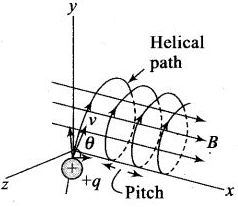
The pitch of the helix, (i.e., linear distance travelled in one rotation) will be given by
$\text{p}=\text{T}(\text{v}\cos\theta)=2\text{p}\frac{\text{m}}{\text{qB}}(\text{v}\cos\theta)$
For given pitch p correspond to charge particle, we have
$\frac{\text{q}}{\text{m}}=\frac{2\pi\text{v}\cos\theta}{\text{qB}}=\text{constant}$
Here in this case, charged particles traverse identical helical paths in a completely opposite sense in a uniform magnetic field B, LHS for two particles should be same and of opposite sign. Therefore,
$\Big(\frac{\text{e}}{\text{m}}\Big)_1+\Big(\frac{\text{e}}{\text{m}}\Big)_2=0$ View full question & answer→Question 311 Mark
A positive charge is moving vertically upwards in the magnetic field towards the south. In which direction will it be deflected?
Answer
- East
Explanation:
If the positive charge is moving upwards the corresponding current is also upwards, the magnetic field is towards the south.
Using Flemings left-hand rule force is towards east and deflection towards east.
View full question & answer→Question 321 Mark
Cyclotron is a device used to _________.
Answer
- Accelerate the positively charged particles
Explanation:
A cyclotron is a device used to accelerate positively charged particles.
View full question & answer→Question 331 Mark
Identify the quantity which changes when a charged particle moves through a magnetic field?
Answer
- Direction of motion
Explanation:
When a charged particle moves through a magnetic field it suffers a change in its direction of motion.
View full question & answer→Question 341 Mark
A long, straight wire of radius $R$ carries a current distributed uniformly over its cross section. $T$ he magnitude of the magnetic field is:
AnswerMinimum at the axis of the wire.
Maximum at the surface of the wire.
A long, straight wire of radius $R$ is carrying current $i,$ which is uniformly distributed over its cross section.
According to Ampere's law,
$\oint\overrightarrow{\text{B}}.\text{d}\overrightarrow{\text{l}}=\mu_0\text{i}_\text{inside}$
At surface,
$\text{B}\times2\pi\text{R}=\mu_0\text{i}$
$\Rightarrow\text{B}_\text{surface}=\frac{\mu_0\text{i}}{2\pi\text{R}}$
Inside, $\text{B}\times2\pi\text{r}=\mu_0\text{i}$ for $ \text{r}<\text{R}$
Here $i^,$ is the current enclosed by the amperian loop drawn inside the wire.
$B_\text{inside}$ will be proportional to the distance from the axis.
On the axis
$B = 0$
The magnetic fields from points on the cross section will point in opposite directions and will cancel each other at the centre.
Outside, $\text{B}\times2\pi\text{r}=\mu_0\text{i}$
$\Rightarrow\text{B}_\text{outside}=\frac{\mu_0\text{i}}{2\pi\text{r}},\ \text{r}>\text{R}$
Therefore, the magnitude of the magnetic field is maximum at the surface of the wire and minimum at the axis of the wire.
View full question & answer→Question 351 Mark
Ampere’s circuital law states that:
Answer
- The line integral of magnetic field along the boundary of the open surface is equal to μ0 times the total current passing through the surface.
View full question & answer→Question 361 Mark
A long solenoid has a radius a and number of turns per unit length n. If it carries a current i, then the magnetic field on its axis is directly proportional to:
Question 371 Mark
The current sensitivity of a galvanometer is defined as:
Answer
- Deflection per unit current.
View full question & answer→Question 381 Mark
The permeability of a paramagnetic substance is:
Answer
- Small but more than unity
View full question & answer→Question 391 Mark
A current carrying loop is placed in a uniform magnetic field. The torque acting on it does not depend upon:
Question 401 Mark
A current carrying power line carries current from west to east. Then the direction of the magnetic field 2m above it is:
Question 411 Mark
Consider three quantities $\text{x}=\frac{\text{E}}{\text{B}},\ \text{y}=\sqrt{\frac{1}{\mu_0\epsilon_0}}$ and $\text{z}=\frac{1}{\text{CR}}.$ Here, l is the length of a wire, C is a capacitance and R is a resistance. All other symbols have standard meanings.
Answer
- x, y have the same dimensions.
- y, z have the same dimensions.
- z, x have the same dimensions.
Explanation:
Lorentz Force:
$\text{qvB}=\text{qE}$
⇒ Dimensions of $\text{x}=[\text{v}]=\Big[\frac{\text{E}}{\text{B}}\Big]=\big[\text{LT}^{-1}\big]$
$\text{y}=\frac{1}{\sqrt{\mu_0\epsilon_0}}=\sqrt{\frac{4\pi}{\mu_0}\times\frac{1}{4\pi\epsilon_0}}=\sqrt{\frac{9\times10^9}{10^{-7}}}=3\times10^8=\text{c}$
⇒ Dimensions of $\text{y}=[\text{c}]=\big[\text{LT}^{-1}\big]$
Time constant of RC circuit = RC so dimensionally [RC] = [T]
$\Rightarrow\text{z}=\Big[\frac{\text{l}}{\text{RC}}\Rightarrow[\text{z}]=[\text{LT}^{-1}]$
Therefore, x, y and z have the same dimensions. View full question & answer→Question 421 Mark
The strength of the magnetic field around an infinite current carrying conductor is:
Answer
- Inversely proportional to the distance
View full question & answer→Question 431 Mark
What is the work done by the magnetic field on the moving charge?
Answer
- No work is done by the magnetic field on the moving charge.
Explanation:
The magnetic force acts in such a way that the direction of the magnetic force and velocity are always perpendicular to each other. If force and velocity are perpendicular force and displacement are also perpendicular, thus W = FS cos q, if q = 90, work done will be zero.
View full question & answer→Question 441 Mark
A vertical straight conductor carries a current vertically upwards. A point P lies to the east of it at a small distance and another point Q lies to the west at the same distance the magnetic field at P is:
Answer
- Same as at Q.
Explanation:
As per Biot Savart Law, Magnetic field at a point is inversely proportional to square of distance from the current carrying conductor.
Therefore magnitude of magnetic field is same at both points P and Q, irrespective of their position from the conductor.
View full question & answer→Question 451 Mark
A charged particle goes undeflected in a region containing an electric and a magnetic field. It is possible that
Answer
- $\overrightarrow{\text{E}}||\overrightarrow{\text{B}},\ \overrightarrow{\text{v}}||\overrightarrow{\text{E}}$
- $\overrightarrow{\text{E}}$ is not parallel to $\overrightarrow{\text{B}}$
Explanation:
$\Rightarrow\overrightarrow{\text{V}}\overrightarrow{\text{E}},\ \overrightarrow{\text{B}}\overrightarrow{\text{E}}$
In this case Magnetic force on the particle is zero & $\overrightarrow{\text{V}}$ is paralle to $\overrightarrow{\text{E}}.$ So charged particle goes undeflected in a region.
$\overrightarrow{\text{E}}$ is not parallel to $\overrightarrow{\text{B}},$ But $\overrightarrow{\text{V}}$ is parallel to $\overrightarrow{\text{E}}.$
View full question & answer→Question 461 Mark
What is the magnetic field inside a pipe?
Answer
- Zero
Explanation:
The magnetic field inside a pipe, i.e. inside a hollow cylindrical wire is zero.
This is due to the symmetry of the situation (pipe).
The pipe can be considered as a series of thin wires arranged in a circle.
View full question & answer→Question 471 Mark
When the free ends of a tester are dipped into a solution, the magnetic needle shows deflection.
Answer
- True
Explanation:
The deflection in the compass needle shows that current is flowing through the wounded wire and hence, through the circuit.
The circuit is complete since free ends of the tester are dipped in a solution.
The solution is certainly a conducting solution. That is the reason why the compass needle shows a deflection.
View full question & answer→Question 481 Mark
A charged particle moves through a magnetic field in a direction perpendicular to it. Then the:
Answer
- Speed of the particle remains unchanged.
View full question & answer→Question 491 Mark
In a coaxial, straight cable, the central conductor and the outer conductor carry equal currents in opposite directions. The magnetic field is zero:
Answer
- Outside the cable.
- Inside the inner conductor.
Explanation:
According to Ampere's law, in a coaxial, straight cable carrying currents i in the inner conductor and -i (equally in the opposite direction) in the outside conductor.
Inside the inner conductor
$\oint\overrightarrow{\text{B}}.\text{d}\overrightarrow{\text{l}}=\mu_0\text{i}_\text{inside}$
$\oint\overrightarrow{\text{B}}.\text{d}\overrightarrow{\text{l}}=0$
$\Rightarrow\text{b.l}=0$
$\Rightarrow\text{B}=0$
In between the 2 conductors
$\oint\overrightarrow{\text{B}}.\text{d}\overrightarrow{\text{l}}=\mu_0\text{i}$
$\Rightarrow\text{B}=\frac{\mu_0\text{i}}{2\pi\text{r}}$
Outside the outer conductor
$\oint\overrightarrow{\text{B}}.\text{d}\overrightarrow{\text{l}}=\mu_0\text{i}$
$\Rightarrow\text{B}=0$
Therefore, the magnetic field is zero outside the cable. View full question & answer→Question 501 Mark
Two particles $X$ and $Y$ having equal charge, after being accelerated through the same potential difference enter a region of uniform magnetic field and describe circular paths of radii $R_1$ and $R_2$ respectively. The ratio of the mass of $X$ to that of $Y$ is:
AnswerParticles $X$ and $Y$ of respective masses $m_1$ and $m_2$ are carrying charge q describing circular paths with respective radii $R_1$ and $R_2$ such that,$\text{R}_1=\frac{\text{m}_1\text{v}_1}{\text{qB}}$
$\text{R}_1=\frac{\text{m}_2\text{v}_2}{\text{qB}}$
Since both the particles are accelerated through the same potential difference, both will have the same kinetic energy.
$\therefore\frac{1}{2}\text{m}_1\text{v}_1^2=\frac{1}{2}\text{m}_2\text{v}_2^2$
$\because\text{R}_1=\frac{\text{m}_1\text{v}_1}{\text{qB}}$
$\Rightarrow\text{v}_1=\frac{\text{R}_1\text{qB}}{\text{m}_1}$
And,
$\text{R}_2=\frac{\text{m}_2\text{v}_2}{\text{qB}}$
$\Rightarrow\text{v}_2=\frac{\text{R}_2\text{qB}}{\text{m}_2}$
$\therefore\text{m}_1\Big(\frac{\text{R}_1\text{qB}}{\text{m}_1}\Big)^2=\text{m}_2\Big(\frac{\text{R}_2\text{qB}}{\text{m}_2}\Big)^2$
$\Rightarrow\frac{\text{m}_1}{\text{m}_2}=\frac{\text{R}_1^2}{\text{R}_2^2}=\Big(\frac{\text{R}_1}{\text{R}_2}\Big)^2$
View full question & answer→Question 511 Mark
An electric current i enters and leaves a uniform circular wire of radius a through diametrically opposite points. A charged particle q moving along the axis of the circular wire passes through its centre at speed v. The magnetic force acting on the particle when it passes through the centre has a magnitude:
Answer
- $\text{Zero}$
Explantion:
As the current is entering and exiting from two diametrically opposite points of a circular coil, the currents in the two semicircular sections are in the opposite direction.
The fields due to the two semi-circular sections at the centre is in the opposite direction.
Hence net feild is zero. View full question & answer→Question 521 Mark
A proton and an alpha particle both enter a region of uniform magnetic field B, moving at right angles to field B. If the radius of circular orbits for both the particles is equal and the kinetic energy acquired by proton is 1 MeV the energy acquired by the alpha particle will be:
Question 531 Mark
A milli voltmeter of 25 milli volt range is to be converted into an ammeter of 25 ampere range. The value (in ohm) of necessary shunt will be:
Question 541 Mark
A vertical wire carries a current in upward direction. An electron beam sent horizontally towards the wire will be deflected:
Answer
- Upwards.
Explanation:
A vertical wire is carrying current in upward direction, so the magnetic field produced will be anticlockwise (according to the right-hand thumb rule). As the electron beam is sent horizontally towards the wire, the direction of the current will be horizontally away from the wire (direction of conventional current is opposite to the direction of the negative charge). According to Fleming's left-hand rule, the force will act in upward direction, deflecting the beam in the same direction.
View full question & answer→Question 551 Mark
If a current is passed through a spring then the spring will:
Question 561 Mark
A charged particle enters into a uniform magnetic field the parameter that remains constant is:
Answer
- Kinetic energy
Explanation:
Since the force on the charge is always normal to the velocity of the charge so, field does not work on the particle and the magnitude of velocity remains same.
So, kinetic energy is same, whereas velocity changes direction. So, velocity, momentum and angular velocity changes.
View full question & answer→Question 571 Mark
A circular loop of area $1\ cm^2,$ carrying a current of $10A,$ is placed in a magnetic field of $0.1T$ perpendicular to the plane of the loop. The torque on the loop due to the magnetic field is:
Answer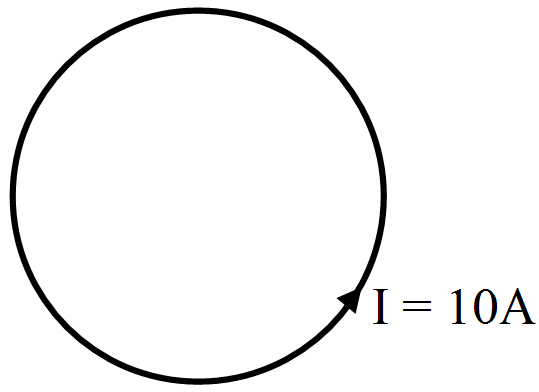
$B = 0.1T$
Area $= 1\ cm^2$
Net torque on the loop due to the uniform magnetic field is always zero. View full question & answer→Question 581 Mark
A magnetic field exerts no force on:
Answer
- Stationary charge
Explanation:
Moving charge can develop magnetic field and also experience the magnetic field.
But stationary charge do no have the ability to develop or experience magnetic field from the other magnetic fields.
Because moving charge gives rise to current which is responsible for the magnetic effects.
View full question & answer→Question 591 Mark
The gyro-magnetic ratio of an electron in an H-atom, according to Bohr model, is:
Answer
- Independent of which orbit it is in.
- Negative.
Solution:
The gyro-magnetic ratio of an electron in an H-atom is equal to the ratio of the magnetic moment and the angular momentum of the electron. Both are related as,
$\mu_\text{l}=\Big(\frac{\text{e}}{2\text{m}_\text{e}}\Big)\text{l}$
The negative sign indicates that the angular momentum of the electron is opposite in direction to the magnetic moment. View full question & answer→Question 601 Mark
In ballistic galvanometer, the frame on which the coil is wound is non - metallic to:
Answer
- Avoid the production of eddy currents.
Explanation:
The moving coil galvanometer have their coil wound on a 'metallic (copper or aluminum) frame, so as to make the motion dead beat due to the production of eddy currents.
In the ballistic galvanometer, on the other hand, the damping is to be reduced to the minimum aand hence the frame is of a non-conducting material eg, paper or bamboo.
View full question & answer→Question 611 Mark
Which of the following particles will describe the smallest circle when projected with the same velocity perpendicular to a magnetic field?
Answer$\text{F}=\text{q}\text{VB}=\frac{\text{mv}^2}{\text{r}}$
$\text{r}=\frac{\text{mV}}{\text{qB}}$
charqe electron $=$ charqe of proton $=$ charqe of $He^+ =$ charqe of $Li^+$ But mass of electron is Lowest.
$\therefore ($ the electron so smallest $+$ circle made by$)$
View full question & answer→Question 621 Mark
If a copper rod carries a direct current, the magnetic field associated with the current will be:
Answer
- Both inside and outside the rod.
View full question & answer→Question 631 Mark
In an electric motor, wires carrying a current of 5A are placed at right angles to a magnetic field of induction 0.8T. If each wire has length of 20cm, then the force acting on each wire is:
Answer
- 0.8N
Explanation:
F = Bil = 0.8 × 5 × 20 × 10 − 2 = 0.8N
View full question & answer→Question 641 Mark
It two parallel wires carry current in opposite directions:
Answer
- The wires repel each other.
Explanation:
If two parallel wires carry current in opposite directions, they repel each other whereas if two parallel wires carry current in same direction, they attract each other.
View full question & answer→Question 651 Mark
A charge q is moving with a velocity v parallel to a magnetic field B. Force on the charge due to magnetic field is:
Question 661 Mark
A stream of electrons is projected horizontally to the right. A straight conductor carrying a current is supported parallel to the electron stream and above it. If the current in the conductor is from left to right, what will be the effect on the electron stream?
Answer
- The electron stream will be pushed downwards.
Explanation:
The electron stream is equivalent to a current carrying conductor from right to left.
Two conductors carrying current in opposite directions will repel each other.
If the current carrying conductor is above the electron stream, the electron stream gets repelled and is pushed downwards.
If the current carrying conductor is below the electron stream, the electron stream gets repelled and is pushed upwards.
View full question & answer→Question 671 Mark
SI unit of the magnetic field is _________.
Answer
- Tesla
Explanation:
The SI unit of the magnetic field is Tesla.
View full question & answer→Question 681 Mark
The magnetic field at the origin due to a current element $\text{i}\text{d}\ \vec{\text{l}}$ placed at a position $\overrightarrow{\text{r}}$ is:
Answer
- $\frac{\mu_0\text{i}}{4\pi}\frac{\text{d}\overrightarrow{\text{l}}\times\overrightarrow{\text{r}}}{\text{r}^3}$
- $-\frac{\mu_0\text{i}}{4\pi}\frac{\overrightarrow{\text{r}}\times\text{d}\overrightarrow{\text{l}}}{\text{r}^3}$
Explanation:
The magnetic field at the origin due to current element $\text{i}\text{d}\ \vec{\text{l}}$ placed at a position $\overrightarrow{\text{r}}$ is given by,
$\text{d}\overrightarrow{\text{B}}=\frac{\mu_0\text{i}}{4\pi}\frac{\overrightarrow{\text{r}}\times\text{d}\overrightarrow{\text{l}}}{\text{r}^3}$
According to the cross product property,
$\overrightarrow{\text{A}}\times\overrightarrow{\text{B}}=-\overrightarrow{\text{B}}\times\overrightarrow{\text{A}}$
$\Rightarrow\text{d}\overrightarrow{\text{B}}=-\frac{\mu_0\text{i}}{4\pi}\frac{\overrightarrow{\text{r}}\times\text{d}\overrightarrow{\text{l}}}{\text{r}^3}$ View full question & answer→Question 691 Mark
When the charged particles move in a combined magnetic and electric field, then the force acting is known as _________.
Answer
- Lorentz force
Explanation:
When the charged particles move in a combined magnetic and electric field, then the force acting is known as Lorentz force.
View full question & answer→Question 701 Mark
An electron is projected with uniform velocity along the axis of a current carrying long solenoid. Which of the following is true?
Answer
- The electron will continue to move with uniform velocity along the axis of the solenoid.
View full question & answer→Question 711 Mark
The phenomenon of production of magnetic field on passing an electric current in a straight conducting wire is based on the law of:
Answer
- Ampere
Explanation:
The phenomenon of production of magnetic field on passing an electric current in a straight conducting wire is based on the law of Ampere.
View full question & answer→Question 721 Mark
A rectangular loop carrying a current $i_1,$ is situated near a long straight wire carrying a steady current $i_2.$ The wire is parallel to one of the sides of the loop and is in the plane of the loop as shown in the figure. Then the current loop will:
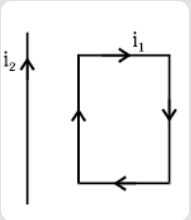
AnswerThe magnetic field due to the straight current current carrying wire decreases with increasing distance from the wire.
Thus the magnetic field is stronger at the side closer to wire and weaker at the other.
Force on each segment of wire is $\text{BIL}$
Hence force acting on nearer side towards the wire is greater than the force acting on farther side away from wire. Hence the net force on loop is towards the wire.
View full question & answer→Question 731 Mark
The strength and direction of the magnetic field depends on ..........
Answer
- Both A and B
Explanation:
In his experiment Oersted observed that the deflection of the needle compass changed according to the direction of the current and also as the current in the wire increased, the deflection of the needle increased.
Thus he inferred that the strength and direction of the magnetic field depends on the magnitude and direction of current.
View full question & answer→Question 741 Mark
A charged particle moves in a uniform magnetic field. The velocity of the particle at some instant makes an acute angle with the magnetic field. The path of the particle will be:
Answer
- A helix with uniform pitch.
Explanation:
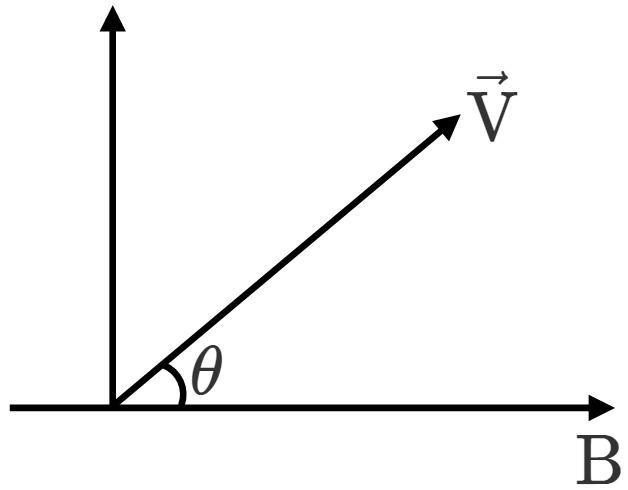
$\vec{\text{F}}=\text{q}(\vec{\text{V}}\times\vec{\text{B}})=\text{qvB}\sin\theta$
Megnetic force doesn't change the speed of the particle. It change the direction of the velocity of the particle.
V $\cos\theta$ provide the displacement of the particle in Horizontal direction & force is provide the centripetal acceleration of the particle.
So the path of the particle will be a helix with uniform pitch. View full question & answer→Question 751 Mark
In a certain arrangement, a proton does not get deflected while moving through a magnetic field region. Under what condition is it possible?
Answer
- F = 0
Explanation:
Magnetic force on a proton is $\text{Fm}=\text{qv}\text{B}\sin(\theta).$
A proton moving parallel or antiparallel to a magnetic field does not experience any force.
Hence, the proton does not get deflected while moving through a magnetic field region. View full question & answer→Question 761 Mark
A hollow tube is carrying an electric current along its length distributed uniformly over its surface. The magnetic field:
Answer
- Is constant inside the tube.
- Is zero at the axis.
Explanation:
A hollow tube is carrying uniform electric current along its length, so the current enclosed inside the tube is zero.
According to Ampere's law,
$\oint\overrightarrow{\text{B}}.\text{d}\overrightarrow{\text{l}}=\mu_0\text{i}_\text{inside}$
Inside the tube,
$\oint\overrightarrow{\text{B}}.\text{d}=0,\ \text{r}<\text{R}$
$\Rightarrow\text{B}_\text{inside}=\text{Constant}$
$\Rightarrow\text{B}_\text{axis}=0$
The magnetic fields from points on the circular surface will point in opposite directions and cancel each other.
Outside the tube,
$\text{B}\times2\pi\text{r}=\mu_0\text{i}$
$\Rightarrow\text{B}_\text{outside}=\frac{\mu_0\text{i}}{2\pi\text{r}},\ \text{r}<\text{R}$ View full question & answer→Question 771 Mark
An electron is ejected from the surface of a long, thick straight conductor carrying a current, initially in a direction perpendicular to the conductor. The electron will:
Answer
- Ultimately return to the conductor.
Explanation:
The initial force on the electron is downward.
As the electron changes direction, the force on it remains in the xy-plane, with a component directed toward the conductor.
View full question & answer→Question 781 Mark
A charged particle is whirled in a horizontal circle on a frictionless table by attaching it to a string fixed at one point. If a magnetic field is switched on in the vertical direction the tension in the string.
Answer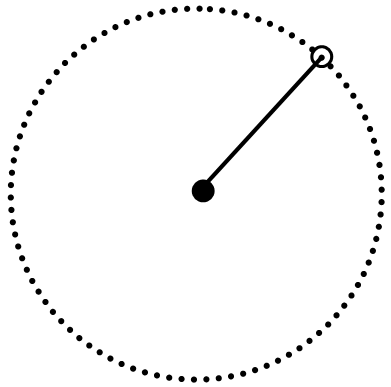
$B = B_0j$
The tension is the strong may increases or decreases. View full question & answer→Question 791 Mark
A charged particle moves in a magnetic field. The only force influencing the particle is the force caused by the magnetic field.
During the particle's movement in the magnetic field, what will NOT change?
Answer
- The particle's speed
Explanation:
"From Newton's second law of motion, we know that when an object experiences a net force, the object will accelerate in the direction of that net force.
Since the only force acting on the particle is the force exerted by the magnetic field, this magnetic field force must be the net force.
Forces by magnetic fields on moving charged particles always act in a direction that is perpendicular to the velocity of the particle, meaning that they will never change the speed of the particle.
Since in this case the particle is experiencing a net force, the particle must be accelerating.
All of the vector quantities here are constantly changing since the particle is constantly changing direction.
The velocity direction is changing, the acceleration direction is changing, the momentum direction is changing along with the velocity, and the position is obviously changing.
The particle's speed does not change therefore option "C" is right.
View full question & answer→Question 801 Mark
A long, straight wire carries a current along the z-axis, One can find two points in the x−yplane such that:
Answer
- The directions of the magnetic fields are the same.
- The magnitudes of the magnetic fields are equal.
- The field at one point is opposite to that at the other point.
Explanation:
Consider a current carrying wire lying along x axis.
At any two points on z axis which are at equal distance from the wire,one above the wire and one below the wire, the magnitude of magnetic field will be same and their directions will be opposite to each other.
At any two points on z axis which are at different distances from the wire,one above the wire and other also above the wire,the magnitude of magnetic field will be different and their directions will be same to each other.
View full question & answer→Question 811 Mark
An electron moving to the east in a horizontal plane is deflected towards south by a magnetic field. The direction of this magnetic field is:
Answer
- Downwards
Explanation:
An electron moving to the east in a horizontal plane is deflected towards south by a magnetic field. When the direction of the electron is from west to east, the current is in the reverse direction.
That is, the current is in the east-west direction. Applying the right-hand thumb rule, we get that the direction of magnetic field at a point below the wire is from north to south. That is, downwards.

View full question & answer→Question 821 Mark
A circular loop is kept in that vertical plane which contains the north-south direction. It carries a current that is towards north at the topmost point. Let A be a point on the axis of the circle to the east of it and B a point on this axis to the west of it. The magnetic field due to the loop
Answer
- Is towards west at both A and B.
Explanation:
According to the right-hand thumb rule, if we curl the fingers of our right hand in the direction of the current flowing, then the stretching of the thumb will show the direction of the magnetic field developed due to it and vice versa.
Let north-south is along x axis and east-west is along y axis. Circular wire is in xz plane. Then point A will lie on positive y axis and B on negative y axis. On looking from point B, current is flowing in anticlockwise direction so the magnetic field will point from right to left. Hence, the magnetic field due to the loop will be towards west at both A and B.
View full question & answer→Question 831 Mark
How will two parallel beams of electron behave while moving in the same direction?
Answer
- Attract each other
Explanation:
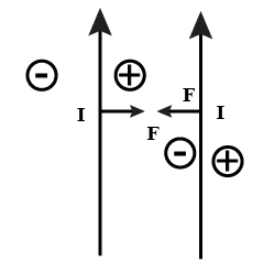
Two parallel beams of electron moving in the same direction can be think of like two current carrying wire in same direction.
The situation is shown in the figure. The direction indicated shows that wire 2 will be attracted towards wire 1. In a similar manner, one can show that wire 1 will experience a force due to the magnetic field of wire 2, and that this force will have a magnitude equal to that of F2 but opposite in direction. Thus, wire 1 will be attracted towards wire 2.
View full question & answer→Question 841 Mark
Imagine that you are sitting in a room with your back to one wall and that an electron beam traveling horizontally from the back wall towards the front one is deflected towards the right. What is the direction of the magnetic induction field that exists in the room?
Answer
- Vertically downwards
Explanation:
The magnetic field has to be vertically downward for bending electron beam towards right.
View full question & answer→Question 851 Mark
A free charged particle moves through a magnetic field. The particle may undergo a change in:
Answer
- Direction of motion
Hint: A charged particle gets deflected moving in a magnetic field.
Explanation:
Magnetic force always acts at right angles to the charge's motion so the magnetic force cannot increase or decrease the speed of a moving charge; it can only change the direction in which the charge is moving.
The general path of a moving charge in a constant magnetic field is that of a helix whose axis is parallel to the direction of the magnetic field.
A positively charged particle rotates in a clockwise direction, whereas a negatively charged particle rotates in an anti-clockwise direction.
Hence, while moving in a magnetic field, a free-charged particle undergoes a change in its direction of motion.
View full question & answer→Question 861 Mark
A conducting gas is in the form of a long cylinder. Current flows through the gas along the length of the cylinder. The current is distributed uniformly across the cross-section of the gas. Disregard thermal and electrostatic forces among the gas molecules. Due to the magnetic fields set up inside the gas and the forces which they exert on the moving ions, the gas will tend to:
Answer
- Contract
Explanation:
Two parallel current carrying conductors attract each other. The gas will contract since it can be considered as a no of parallel streams of current in the same direction. Hence, there will be contraction.
View full question & answer→Question 871 Mark
A moving coil type of galvanometer is based upon the principle that:
Answer
- Coil carrying current experiences a torque in magnetic field.
Explanation:
In a moving coil type of galvanometer needle deflects when torque in magnetic field is non - zero.
So, a moving coil galvanometer is based upon the principle that coil carrying current experiences a torque in a magnetic field.
View full question & answer→Question 881 Mark
Ampere’s circuital law is equivalent to:
Question 891 Mark
The radius of the trajectory of a charged particle in a uniform magnetic field is proportional to the:
Question 901 Mark
When current passes through the circuit a compass needle rests in which direction (with respect to the Earth)?
Answer
- South - north
Explanation:
The earth acts like a huge magnet. Thus in the absence of electric current a compass needle always comes to rest in Earths North - south direction.
However, when current passes through the circuit the needle comes to rests in the direction opposite to the magnetic field of Earth i.e. South-North direction.
View full question & answer→Question 911 Mark
A proton and an electron enter a region with equal speed in which a magnetic field is suddenly switched on. The force experienced by them are:
Answer
- Equal and opposite
Explanation:
charge is equal in magnitude but opposite in sign
$\therefore$ forces are equal in magnitude but opposite in direction View full question & answer→Question 921 Mark
Two statements are given-one labelled Assertion (A) and the other labelled Reason (R). Select the correct answer to these questions from the codes (a), (b), (c) and (d) as given below.
Assertion (A): The kinetic energy of a charged particle moving in a uniform magnetic field does not change. Reason (R): In a uniform magnetic field no force acts on the charge particle.
Answer
- A is true but R is false.
Explanation:
When a charged particle is moving in a uniform magnetic field, it experiences a force in a direction perpendicular to its direction of motion. Due to which the speed of the charged particle remains unchanged and hence its kinetic energy remains same.
View full question & answer→Question 931 Mark
Which line shows the path of beta radiation in a magnetic field?
Answer
- D
Explanation:
If magnetic field is directed ,perpendicularly inward the plane of paper then being negative, beta particle would experience a force towards right to the line A(according to Fleming's left hand rule) and as it is lighter than alpha particle therefore it will be deflected more due to magnetic force and go through the line E, and if the direction of magnetic field is perpendicularly outward the plane of paper, alpha particle will go through the line D.
View full question & answer→Question 941 Mark
There are two conductors X and Y carrying a current I and moving in the same direction. p and q are two electron beams also moving in the same direction. Will there be attraction or repulsion between the 2 conductors and between the two electron beams separately?
Answer
- The electron beams will attract each other and the conductors also attract each other.
Explanation:
Since, both the current carrying conductors are moving in the same direction, they will attract each other.
Moving electron beams is equivalent to an electric current in opposite direction.
Therefore, there will attraction between the conductors X and Y as well as between the electron beams p and q.
View full question & answer→Question 951 Mark
Which of the following is based on mechanical effect of electric current?
Answer
- AC or DC motor
Explanation:
Working of an electric motor is based on the mechanical effect of electric current.
A conductor carrying a current is placed in a magnetic field experiences a mechanical force.
In the motor, when a current is passed through a rectangular coil of wire placed in a magnetic field, the coil rotates continuously.
View full question & answer→Question 961 Mark
In a moving coil galvanometer, the deflection of the coil $\theta$ is related to the elecrical current i by the relation:
View full question & answer→Question 971 Mark
An electron moving with a velocity of $15ms^{-1}$ enters a uniform magnetic field of $0.2 T$, along a direction parallel to the field. What would be its trajectory in this field?
AnswerThe electron will continue to follow its straight path because a parallel magnetic field does not exert any force on the electron.
So, there won’t be any change in its trajectory when the electron enters a uniform magnetic field.
View full question & answer→Question 981 Mark
What name is given to a cylindrical coil of diameter less than its length?
Answer
- Solenoid
Explanation:
A solenoid is a long coil containing a large number of close turns of insulated copper wire wound on a conducting or non-conducting material.
The diameter of each of the circular coil is less than the total length formed by several circular coil wound on a soft iron core.

View full question & answer→Question 991 Mark
Which of the following is true?
Answer
- Parallel currents attract, and antiparallel currents repel.
View full question & answer→Question 1001 Mark
The magnetic dipole moment of a current loop is independent of:
Answer
- Magnetic field in which it is lying.
View full question & answer→Question 1011 Mark
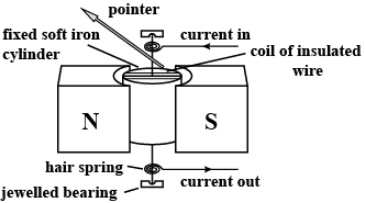
The couple developed in the suspension wire and the loose spring in a suspension type of moving coil galvanometers called:
Answer
- Restoring couple
Explanation:
The restoring couple sets the needle galvanometer in motion and the scale on the galvanometer is marked accordingly.
View full question & answer→Question 1021 Mark
Cyclotron is used to accelerate:
Question 1031 Mark
View full question & answer→Question 1041 Mark
Two parallel circular coils of equal radii having equal number of turns placed coaxially and separated by a distance equal to the radii of the coils carrying equal currents in same direction are known as:
Question 1051 Mark
Best method to increase the sensitivity of the moving coil galvanometer is to decrease:
Answer
- Couple per unit twist
Explanation:
Sensitivity of a galvanometer increases when radius of the coil, number of turns of the coil and external magnetic field increases whereas couple per unit twist decreases.
View full question & answer→Question 1061 Mark
A charged particle would continue to move with a constant velocity in a region wherein:
AnswerKey concept: This problem is based upon the single moving charge placed with some uniform electric and magnetic fields in space. Then they experiences a force called Lorentz force is given by the relation $F_{net} = qE + q(v \times B).$
Force experience by the charged particle due to electric field $F_e = qE$
Force experience by the charged particle due to magnetic field, $F_m = q(v \times B)$
According to the problem, particle is moving with constant velocity means acceleration of particle is zero and also it is not changing its direction of motion.
This will happen when net force on particle is zero.
- If $E = 0,$ and $v \| B,$ then$ F_{net} = 0.$
- If $E \neq 0, B \neq 0$ and $E, v$ and $B$ are mutually perpendicular.
- When both $E$ and $B$ are absent.
View full question & answer→Question 1071 Mark
A moving coil galvanometer has N number of turns in a coil of effective area A, it carries a current I. The magnetic field B is radial. The torque acting on the coil is:
Question 1081 Mark
A beam consisting of protons and electrons moving at the same speed goes through a thin region in which there is a magnetic field perpendicular to the beam. The protons and the electrons:
Answer$\vec{\text{F}}=\text{q}(\text{V}\times\text{B})$Charge proton is poritive $= e$
$F_p = evB$
Charge of electron is negative $= -e$
$F_e = -evB$
They will be deviated by different angles and Hence separate.
View full question & answer→Question 1091 Mark
The length of a solenoid is $0.4m$ and the number turns in it is $500$. A current of $3\ amp$, is flowing in it. In a small coil of radius $0.01m$ and number of turns $10$, a current of $0.4\ amp$. is flowing. The torque necessary to keep the axis of this coil perpendicular to the axis of solenoid will be:
View full question & answer→Question 1101 Mark
An electron is traveling along the x - direction. It encounters a magnetic field in the y - direction. Its subsequent motion will be:
Answer
- A circle in the xz - plane
Explanation:
When a charged particle enters a magnetic field, it experiences a force which is always directed perpendicular to its direction of motion.
In that case the path of the charged particle becomes circular and the plane of the circle is perpendicular to the plane containing the magnetic field and velocity vector of the charged particle.
View full question & answer→Question 1111 Mark
Which of the following particles will experience maximum magnetic force circle when projected with the same velocity perpendicular to a magnetic field?
Answer$|\text{F}|=|\text{qVB}|$charge of $Li^{++} > $ charge of $( He^+, $proton, electron$)$
View full question & answer→Question 1121 Mark
Biot-Savart law indicates that the moving electrons velocity: produce a magnetic field B such that:
Question 1131 Mark
The magnetic field around a long straight current carrying wire is:
Question 1141 Mark
Give the $SI$ unit of magnetic permeability of free space.
AnswerMagnetic permeability of free space is a measure of the amount of resistance encountered when forming a magnetic field in a classical vacuum.
The $SI$ unit of permeability is weber ampere$^{-1}$ metre$^{-1} (Wb A^{-1} m^{-1})$ or tesla ampere$^{-1}$meter$ (T A^{-1}m).$
View full question & answer→Question 1151 Mark
Quantity that is not affected by magnetic field is:
Answer
- Stationary charge
Explanation:
Magnetic field is the magnetic effect of electric currents andmagnetic materials.
The magnetic field at any given point is specified by both a direction and a magnitude (or strength); as such it is represented by a vector field.
As magnetic field has both magnitude as well as direction so it is a vector quantity.When charges are stationary, their electric fields do not affect magnets.
But, when charges move, they produce magnetic fields that exert forces on other magnets.
When there is relative motion, a connection between electric and magnetic fields emerges—each affects the other.
Quantity that is not affected by magnetic field is Stationary charge.
View full question & answer→Question 1161 Mark
Under what condition the force acting on the charge particle moving in the magnetic field maximum?
Answer
- Charge particle moves perpendicular to the velocity vector.
Explanation:
The force will have a magnitude F = qvB sin q, thus it will be maximum if sin q is maximum.
Thus angle between velocity and magnetic field should be 90 or the charge particle moves perpendicular to the velocity vector.
View full question & answer→Question 1171 Mark
A charged particle enters in a uniform magnetic field with a certain velocity. The power delivered to the particle by the magnetic field depends on:
Question 1181 Mark
The current sensitibility of a moving coil galanometer increases with decrease in:
Question 1191 Mark
A charged particle is moved along a magnetic field line. The magnetic force on the particle is:
Answer
- Zero.
Explanation:
The force on a charged particle q moving with velocity v in a magnetic field B is given by,
$\overrightarrow{\text{F}}=\text{q}\big(\overrightarrow{\text{v}}\times\overrightarrow{\text{B}}\big)=0$
As the charge is moving along the magnetic line of force, the velocity and magnetic field vectors will point in the same direction, making a cross product.
$\big(\overrightarrow{\text{v}}\times\overrightarrow{\text{B}}\big)=0$
$\Rightarrow\overrightarrow{\text{F}}=0$$$
So, the magnetic force on the particle will be zero. View full question & answer→Question 1201 Mark
If a charged particle moves unaccelerated in a region containing electric and magnetic fields,
Answer
- $\overrightarrow{\text{E}}$ must be perpendicular to $\overrightarrow{\text{B}}$
- $\overrightarrow{\text{V}}$ must be perpendicular to $\overrightarrow{\text{E}}$
Explanation:
$\Rightarrow\text{E}\perp\overrightarrow{\text{B}}\ \&\ \overrightarrow{\text{V}}\perp\overrightarrow{\text{E}}$ View full question & answer→Question 1211 Mark
What inferences were drawn from Oersteds experiment?
Answer
- All of the above.
Explanation:
Oersted conducted an experiment to study the magnetic effect of electric current. In this experiment he observed the deflections of a compass needle placed in close proximity of an electric wire carrying current.
He observed that in the absence of current the needle came to rest in Earths North-south direction under the influence of Earths magnetic field.
However, when the needle was kept in close proximity of an electric wire carrying current it showed deflections in the east and west direction depending on the direction of current.
Thus, indicating that the strength and direction of the magnetic field depends on the magnitude and direction of the current.
View full question & answer→Question 1221 Mark
A moving coil galvanometer is based on the:
Answer
- Magnetic effect of current
Explanation:
Torque acts on the coil due to magnetic field when current flows in it.
Hence, it is based on magnetic effect of current.
View full question & answer→Question 1231 Mark
Two ions have equal masses but one is singly-ionised and the other is doubly-ionised. They are projected from the same place in a uniform magnetic field with the same velocity perpendicular to the field.
Answer
- The circle described by the singly-ionised charge will have a radius that is. double that of the other circle.
- The two circles touch each other.
Explanation:
$\text{r}=\frac{\text{mv}}{\text{qB}}$
If charge of singly ionized = e
Then charge of doubly ionized = ze
The circle described by the singly - ionized charge will have a radius double that of the other circle.
The two circle touch each other because brojected from the same place. View full question & answer→Question 1241 Mark
According to Gauss’s theorem in magnetism, surface integral of magnetic field intensity over a surface (closed or open) is always:
Question 1251 Mark
Force between the two parallel wires carrying currents has been used to define:
AnswerAmpere is defined as the constant current that will produce an attractive force of $2\times 10^{−7}$ newton per metre of length between two straight, parallel conductors $($carrying the constant current$)$ of infinite length and negligible circular cross section placed one metre apart in a vacuum. This is the Ampere's Force Law.
View full question & answer→Question 1261 Mark
Earth’s magnetism was discovered by:
Question 1271 Mark
Which law can ampere’s circuital be derived from?
Answer
- Biot-Savart Law
Explanation:
In classical electrodynamics, the magnetic field given by a current loop and the electric field caused by the corresponding dipoles in sheets are very similar, as far as we are far away from the loop, which enables us to deduce Ampere’s magnetic circuital law from the Biot-Savart law easily.
View full question & answer→Question 1281 Mark
Biot-Savart law indicates that the moving electrons (velocity v) produce a magnetic field B such that:
Question 1291 Mark
Answer
- The vector sum of electrostatic and magnetic force acting on a moving charged particle.
View full question & answer→Question 1301 Mark
The magnetic dipole moment of a current carrying coil does not depend upon:
Answer
- Material of the turns of the coil.
Explanation:
- A current carrying circular circular coils behaves as a bar magnet whose magnetic moment is M = NiA; where N = number of turns in the coil, i = current through the coil and A = area of the coil.
- For a given perimeter circular shape has maximum area hence, maximum magnetic moment.
- For any loop or coil, B at centre due to current in loop and M are always parallel.
View full question & answer→Question 1311 Mark
Which of the following particles will have minimum frequency of revolution when projected with the same velocity perpendicular to a magnetic field?
Answer$\text{T}=\frac{2\pi\text{r}}{\text{v}\bot}\ ...(1)$$\text{r}=\frac{\text{mv}_1}{\text{qB}}$
$\frac{\text{r}}{\text{v}\bot}=\frac{\text{m}}{\text{qB}}\ ...(2)$
from eq. $(1) (2)$ we get
$\text{T}=\frac{2\pi\text{m}}{\text{qB}}$
$\text{f}=\frac{1}{\text{T}}=\frac{\text{qB}}{2\pi\text{m}}$
Charge of all these particles are same but mass of $Li^+$ is Highest.
$\therefore\text{ mass}\uparrow,\ \text{f}\downarrow$
View full question & answer→Question 1321 Mark
A steady electric current is flowing through a cylindrical conductor.
Answer
- The magnetic field at the axis of the conductor is zero.
- The electric field in the vicinity of the conductor is zero.
Explanation:
As the current is flowing through a conductor so it it is distributed only on the surface of the conductor not in the volume of the cylindrical conductor. It is equivalent to charge distribution on a cylindrical sheet for which electric field inside a conducting cylindrical sheet is always zero.
Magnetic fields at any point inside the conducting cylinder is proportional to the distance from the axis of the cylinder.
At the axis, r = 0.
This implies that field will be zero at the axis.
View full question & answer→Question 1331 Mark
Two streams of protons move parallel to each other in the same direction. They will:
Answer
- Attract each other
Explanation:
Two streams of protons move parallel to each other in the same direction.
So, we can assume that they are two wires carrying current in same direction.
We know that two parallel wires having same direction of current attract each other.
View full question & answer→Question 1341 Mark
To convert galvanometer into voltmeter one should connect:
Answer
- High resistance in series with galvanometer.
View full question & answer→Question 1351 Mark
The frequency of revolution of a charged particle in a cyclotron does not depend on ‘X’. Identify X.
Answer
- Speed of the particle
Explanation:
The radius of the circular path of the charged particle increases in direct proportion to its speed.
Consequently, both its time-period and frequency of revolution are independent of its speed.
So, the ‘X’ is the speed of the particle.
View full question & answer→Question 1361 Mark
Two identical current carrying coaxial loops, carry current $I$ in an opposite sense. A simple amperian loop passes through both of them once. Calling the loop as $C:$
AnswerKey concept: Ampere’s law gives another method to calculate the magnetic field due to a given current distribution.
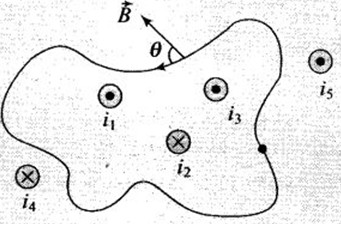
Line integral of the magnetic field $\vec{\text{B}}$ around any closed curve is equal to $\mu_0$ times the net current $i$ threading through the area enclosed by the curve,
i.e.,$\oint\vec{\text{B}}.\vec{\text{dI}}=\mu_0\sum\text{i}=\mu_0(\text{i}_1+\text{i}_3-\text{i}_2)$
Total current crossing the above area is $(i_1 + i_3 - i_2).$
Any current outside the area is not included in net current.
$(\text{Outward}\ \circledcirc\rightarrow\ +\text{ve},\text{ Inward}\ \otimes\ \rightarrow\ -\text{ve})$
Applying the Ampere's circuital law,
we have $\oint\ \text{B.dl}=\text{i}_0(\text{I}-\text{I})=0 ($because current is in opposite sense.$)$
Also, there may be a point on $C$ where $B$ and $dl$ are perpendiclular and
hence,$\oint\limits_\text{c}\text{B.dI}=0.$ View full question & answer→Question 1371 Mark
Which of the following is the correct definition of ampere?
AnswerThe ampere is the value of that steady current which, when maintained in each of the two very long, straight, parallel conductors of negligible cross$-$section, and placed one metre apart in vacuum, would produce on each of these conductors a force equal to $2 \times 10^{-7} N/m$ of length.
View full question & answer→Question 1381 Mark
A straight conductor carries a current. Assume that all free electrons in the conductor move with the same drift velocity v. A and B are two observers on a straight line XY parallel to the conductor. A is stationary. B moves along XY with a velocity v in the direction of the free electrons.
Answer
- A and B observe the same magnetic field.
Explanation:
A is stationary and observes the current I. B observes the free electrons to be at rest, but the unbalanced positive charges in the conductor will appear to move in the direction opposite to that of v. Thus A and B observe the same current and hence same magnetic field.
View full question & answer→Question 1391 Mark
Scale used in moving coil galvanometer is:
Answer
- Linear scale
Explanation:
Linear scale is used in moving coil galvanometer.
View full question & answer→Question 1401 Mark
If a charged particle projected in a gravity-free room deflects:
Answer
- Both fields cannot be zero.
- Both fields can be non zero.
Explanation:
If a charged particle is projected in a gravity free room with some velocity, then its deflection depends on whether the particle experiences electric force or magnetic force. If electric field or magnetic field is absent in the space, then the charged particle will continue to move in the same direction with the same velocity. Thus, both electric and magnetic fields cannot be zero.
If force on the charged particle due to electric field is equal and opposite to the force due to magnetic field, then
$\text{F}=\text{qE}=\text{qvB}$
$\text{v}=\frac{\text{E}}{\text{B}}$
Thus, if anyone of the two fields is non zero, the charged particle will get deflect. Therefore, the correct option is (c) and (d). View full question & answer→Question 1411 Mark
When an electron moves through a magnetic field, its speed will:
Answer
- Remain the same.
Explanation:
The work done by magnetic force on any moving charge particle is zero because magnetic force acts perpendicular to the direction of motion. Therefore speed will remain same.
View full question & answer→Question 1421 Mark
Two parallel wires carrying currents in the same direction attract each other because of:
Answer
- Magnetic forces between them.
View full question & answer→Question 1431 Mark
In a moving cell galvanometer, we use a radial magnetic field so that the galvanometer scale is:
Answer
- Linear
Explanation:
In a moving cell galvanometer, we use a radial magnetic field so that the galvanometer scale is linear.
View full question & answer→Question 1441 Mark
Consider a long, straight wire of cross-sectional area A carrying a current i. Let there be n free electrons per unit volume. An observer places himself on a trolley moving in the direction opposite to the current with a speed $\text{v}=\frac{\text{i}}{\text{nAe}}$ and separated from the wire by a distance r. The magnetic field seen by the observer is very nearly:
Answer
- $\frac{\mu_0\text{i}}{2\pi\text{r}}$
Explanation:
Magnetic field will be independent of the motion of the observer because the velocity with which the observer is moving is comparable to drift velocity of electron which is very small as compared to the speed of flow of current from one end of wire to other end. So it can be neglected and hence, magnetic field due to the wire w.r.t the observer will be $\text{B}=\frac{\mu_0\text{i}}{2\pi\text{r}}$ View full question & answer→Question 1451 Mark
Which of the following statement is not correct about two parallel conductors carrying equal currents in the same direction?
Answer
- The two conductors will repel each other
Explanation:
When two conductors carrying equal current both the conductor experiences a force which is perpendicular to the wire and are equal.
Since both these forces are equal and towards each other, both the current carrying wire will be repelling each other.
View full question & answer→Question 1461 Mark
If a long hollow copper pipe carries a direct current, the magnetic field associated with the current will be:
Question 1471 Mark
An electric dipole placed in a non-uniform electric field can experience:
Answer
- Always a force and a torque.
Explanation:
Electric dipole,
Two equal and opposite charges seperated by small distance.
Wherein,
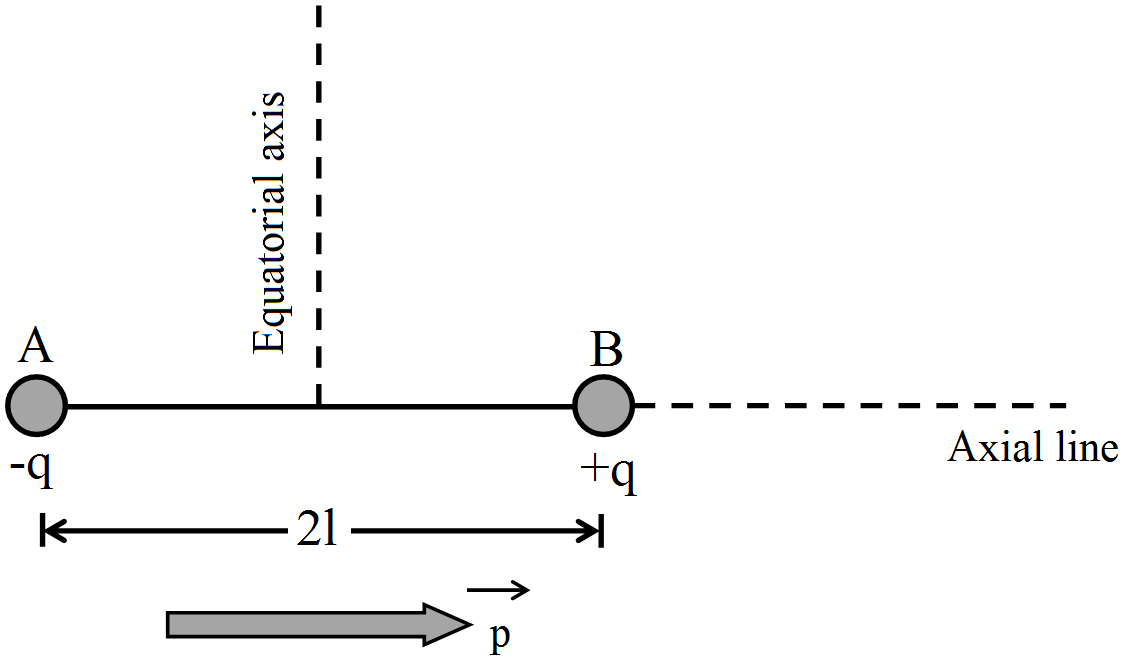
As the dipole will feel two forces which are although opposite but not equal.
A net force will be there and as these forces act at different points of a body. A torque is also there.
View full question & answer→Question 1481 Mark
The AC voltage across a resistance can be measured using a:
Answer
- Moving coil galvanometer.
View full question & answer→Question 1491 Mark
Two particles $X$ and $Y$ having equal charges, after being accelerated through the same potential difference, enter a region of uniform magnetic field and describe circular paths of radii $R_1$ and $R_2$ respectively. The ratio of masses of $X$ to that of $Y$ is:
Answer$\Big(\frac{\text{R}_1}{\text{R}_2}\Big)^2$
View full question & answer→Question 1501 Mark
On passing electric current in two long straight conductors in mutually opposite directions, the magnetic force acting between them will be:
Answer
- Repulsive
Explanation:
If electric current in two long straight conductors is in mutually opposite directions, the magnetic force acting between them will be repulsive.
View full question & answer→Question 1511 Mark
Lorentz force is given by the formula:
Answer
- F = q(v × B + E)
Explanation:
Lorentz force is given by the formula F= q(v × B + E)
View full question & answer→Question 1521 Mark
A person who is at rest as the charge moves by him will measure.
Answer
- A magnetic field and an electric field due to the moving charge.
Explanation:
All charges produce an electric field whether they are moving or not, and magnetic fields are created by moving charges, so the person would measure both.
View full question & answer→Question 1531 Mark
A very long bar magnet is placed with its north pole coinciding with the centre of a circular loop carrying as electric current i. The magnetic field due to the magnet at a point on the periphery of the wire is B. The radius of the loop is a. The force on the wire is:
Answer
- Very nearly $2\pi\text{aiB}$ perpendicular to the plane of the wire.
Explanation:
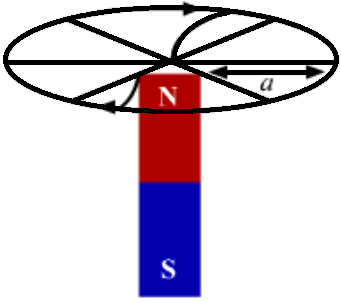
In this case, the north pole of the magnet is coinciding with the centre of the circular loop carrying electric current i. So, the magnetic field lines almost lie on the plane of the ring and the force due to the field lines is perpendicular to the field lines and to the plane of the circular ring.
Let idl be the current element, B be the magnetic field and dF be the force on the current element idl.
Now
$\text{dF}=\text{Bidl}\Rightarrow\text{F}=\int_{0}^{2\pi\text{a}} \text{Bidl}$
$\Rightarrow\text{F}=2\pi\text{aiB}$
Thus, the force acting on the wire is $2\pi\text{aiB}$ and it is perpendicular to the plane of the wire. View full question & answer→Question 1541 Mark
Pick the correct options:
Answer
- Magnetic field is produced by electric charges only.
- Magnetic poles are only mathematical assumptions having no real existence.
Explanation:
Justification of (a) and (b):
Investigators and experimenters have failed to find any sign of magnetic monopoles. So, we can assume that magnetic monopoles are only a mathematical assumption.
A magnetic field is produced by the motion of an electric charge only. In paramagnets or ferromagnets, the motion of an electron (charge) and the alignment of domains (bunch of charges with particular alignment) create paramagnetism and ferromagnetism, respectively.
Therefore, the only cause behind the magnetic field is the motion of an electric charge.
Denial of (c):
The north pole is equivalent to an anticlockwise current and the south pole is equivalent to a clockwise current.
Denial of (d):
A bar magnet is not equivalent to a long, straight current because the distribution and orientation of magnetic field lines do not resemble each other.
View full question & answer→Question 1551 Mark
A charge + q is sent through a magnetic field. The force acting on it is maximum when the angle between the direction of motion of the charged particle and the magnetic field:
Question 1561 Mark
A proton, a deuteron and an α particle are accelerated through same potential difference and then they enter in a normal uniform magnetic field, the ratio of their kinetic energies will be:
Answer
- 1 : 1 : 2
Explanation:
Kinetic energy obtained = qV where q is the charge and V is the potential through which the particle is accelerated.
Also, the force due to the magnetic field is perpendicular to the direction of motion.
So it cant change the speed and consequentially Kinetic energy of the particles will remain same after they enter a normal magnetic field.
In the above problem, V is constant.
So $\text{KE}\propto\text{q}.$
The charges of the proton, deuteron and the alpha particle are in the ratio 1 : 1 : 2
So, their kinetic energies are in the ratio 1 : 1 : 2 View full question & answer→Question 1571 Mark
A magnetic field cannot exert any force on a:
Answer
- Stationary charge
Explanation:
Magnetic fields are produced by magnetic bodies (Moving or stationary).
Moving charges produce electromagnetic fields. Stationary charges produce electric fields alone.
View full question & answer→Question 1581 Mark
A proton enters in a straight line in a uniform magnetic field along the field direction. How will its path and velocity change?
Answer
- It will keep on moving with the same speed along the field direction.
Explanation:
As the proton is moving along the field direction, thus no force acts on it and the velocity and the path will not change.
It will keep on moving with the same speed along the field direction.
View full question & answer→Question 1591 Mark
If a charged particle at rest experiences no electromagnetic force:
AnswerForce on charged particle in an electric eld, $\text{F} = \text{qE} \ ...(1)$
Force on charged particle in a magnetic eld $\text{F} = \text{q} (\text{v}\times\text{b}) = \text{qvB} \sin\theta \ ...(2) $
Where boldface letter represent vector nature of that quantity, $q$ is charge of the particle, $v$ is the velocity of the particle $($if any$)$, and $\theta$ is the angle between velocity and magnetic eld.
From $(1), F_E = 0$ only when either $q = 0$ or $E = 0.$
Let $q \neq 0$, and $F \neq 0,$ then we must have $E \neq 0$
From $(2),$ if $q \neq 0, v \neq 0$ and $B \neq 0$ even then $F_B$ can be 'zero' because of $\theta = 0^\circ$ or $180^\circ $
View full question & answer→Question 1601 Mark
The radial magnetic field is used in a suspended coil galvanometer to provide:
Answer
- A uniform torque on the coil.
Explanation:
Radial magnetic field is used in a suspended coil galvanometer to provide a uniform torque on the coil because it provide uniform magnetic field.
It ensure that the magnetic field is radial and uniform through out the area of the coil.
View full question & answer→Question 1611 Mark
A current-carrying, straight wire is kept along the axis of a circular loop carrying a current. The straight wire:
Answer
- Will not exert any force on the circular loop.
Explanation:
The magnetic force on a wire carrying an electric current i is given as $\vec{\text{F}}=\text{i}.\big(\vec{\text{l}}\times\vec{\text{B}}\big),$ where l is the length of the wire and B is the magnetic field acting on it. If a current-carrying straight wire is kept along the axis of a circular loop carrying current, then according to the right-hand thumb rule, the magnetic field due to the wire on the current-carrying loop will be along its circumference, which contains a current element $\text{i}\text{d}\vec{\text{l}}.$
So, the cross product will be
$\Rightarrow\vec{\text{F}}=0$
Thus, the straight wire will not exert any force on the loop. View full question & answer→Question 1621 Mark
The particles emitted by a radioactive substance are deflected in a magnetic field. The particle may be:
Answer
- Electrons
Explanation:
The particles not emitted by a radioactive substance are protons, hydrogen atoms are neutrons.
View full question & answer→Question 1631 Mark
Which of the following is not a point of similarity between Biot-Savart law and Coulomb’s law.
Answer
- The principle of superposition does not apply to both.
Explanation:
The principle of superposition applies to both fields.
This is because the magnetic field is linearly related to its source, namely, the current element and the electrostatic field is related linearly to its source, the electric charge.
View full question & answer→Question 1641 Mark
The restoring couple in the moving coil galvanometer is due to:
Answer
- Twist produced in the suspension wire.
Explanation:
When coil rotates the spring is twisted and it exerts an opposing torque on the coil.
View full question & answer→Question 1651 Mark
In a cyclotron, a charged particle.
Answer
- Undergoes acceleration all the time.
View full question & answer→Question 1661 Mark
Biot-Savart law indicates that the moving electrons (velocity v) produce a magnetic field B such that:
Answer
- B ⊥ v.
According to the Biot-Savart law, the magnitude of $\vec{\text{B}}$ is: $\text{B}\propto|\text{q}|;\text{B}\propto\text{v};\text{B}\propto\sin\phi;\text{B}\propto\frac{1}{\text{r}^2}$
$\text{B}\propto\frac{|\text{q}|\text{v}\sin\phi}{\text{r}^2}$
$\text{B}=\frac{\mu_0}{4\pi}\frac{|\text{q}|\text{v}\sin\phi}{\text{r}^2}$
where $\frac{\mu_0}{4\pi}$ is a proportionality constant, 'r' is the magnitude of position vector from charge to that point ar which we have to find the magnetic field and $\phi$ is the angle between $\vec{\text{v}}$ and $\vec{\text{r}}$.
or $\vec{\text{B}}=\frac{\mu_0}{4\pi}\frac{|\text{q}|(\vec{\text{v}}\times\vec{\text{r}})}{|\text{r}^3|}\hat{\text{n}}$
Where $\hat{\text{n}}$ is the direction of $\vec{\text{B}}$ which is in the direction of cross product of $\vec{\text{v}}$ and $\vec{\text{r}}$. Or we can say that $\vec{\text{B}}\ \perp$ to both $\vec{\text{v}}$ and $\vec{\text{r}}$.
where is a proportionality constant, V is the magnitude of position vector from charge to that point at which we have to find the magnetic field and
Where h is the direction of B which is in the direction of cross product of v and F. Or we can say that $\text{B}\perp\text{L}$ to both v and F. View full question & answer→Question 1671 Mark
An electric charge in uniform motion produces:
Answer
- Both electric and magnetic fields.
View full question & answer→Question 1681 Mark
Two free parallel wires carrying currents in the opposite directions:
Question 1691 Mark
In a cyclotron, a charged particle:
Answer
- Undergoes acceleration all the time.
Solution:
In a cyclotron, a charged particle describes the circular path inside the dees & is accelerated while going from one dee to another due to the electric field.
While moving in the circular path, charged particles have centripetal acceleration which is provided by the magnetic force due to the magnetic field.
A charged particle undergoes acceleration all the time, inside the cyclotron.
View full question & answer→Question 1701 Mark
Two infinite long wires, each carrying current I, are lying along x - axis and y - axis, respectively. A charged particle, having a charge q and mass m, is projected with a velocity u along the straight line OP. The path of the particle is (neglect gravity) a:
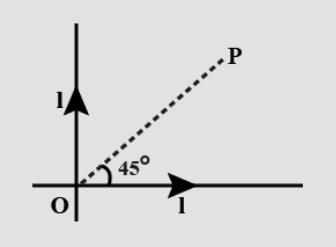
Answer
- Straight line
Explanation:
Magnetic field due to the vertical wire is equal and opposite to the magnetic field due to the horizontal wire at any point on line OP, hence, they will cancel each other.
Hence, the charged particle projected along OP will not experience any force due to B = 0, it will move along the straight line OP.
View full question & answer→Question 1711 Mark
Two statements are given$-$one labelled Assertion $(A)$ and the other labelled Reason $(R).$ Select the correct answer to these questions from the codes $(a), (b), (c)$ and $(d)$ as given below.
Assertion $(A):$ Magnetic moment is measured in joule/ tesla or amp $m^2.$
Reason $(R):$ Joule/ tesla is equivalent to amp $m^2.$
AnswerMagnetlcmoment $=\frac{\text{joule}}{\text{tesla}}=\frac{\text{w}}{\text{B}}=\frac{\text{W}}{\frac{\text{F}}{\text{qu}}}$$=\frac{\text{Wqv}}{\text{F}}=\frac{[\text{ML}^2\text{T}^{-2}][\text{AT}][\text{LT}]^{-1}}{[\text{MLT}^{-2}]}$
$=\text{AL}^2=\text{amp m}^2$
View full question & answer→Question 1721 Mark
An electron is moving along the positive x-axis. You want to apply a magnetic field for a short time so that the electron may reverse its direction and move parallel to the negative x-axis. This can be done by applying the magnetic field along:
Answer
- y-axis.
- z-axis.
Explanation:
$\text{F}=\text{q}(\overrightarrow{\text{V}}\times\overrightarrow{\text{B}})$
This can be done by applying the Magnetic field along y axis or z axis. View full question & answer→Question 1731 Mark
A wire is placed parallel to the lines of force in a magnetic field and a current flows in the wire. Then:
Answer
- The wire will not experience any force at all.
View full question & answer→Question 1741 Mark
The coil of the moving coil galvanometer is wound over an aluminium frame:
Answer
- To provide electro-magnetic damping.
Explanation:
The coil of the moving galvanometer is wound over an aluminium frame to provide electro - magnetic damping because aluminium is diamagnetic and it does not interact with external magnetic field.
View full question & answer→Question 1751 Mark
The concept of displacement current was introduced by _________.
Answer
- Maxwell
Explanation:
The concept of displacement current was introduced by Maxwell.
View full question & answer→Question 1761 Mark
A circular current loop of magnetic moment M is in an arbitrary orientation in an external magnetic field B. The work done to rotate the loop by 30° about an axis perpendicular to its plane is:
Answer
- Zero.
Solution:
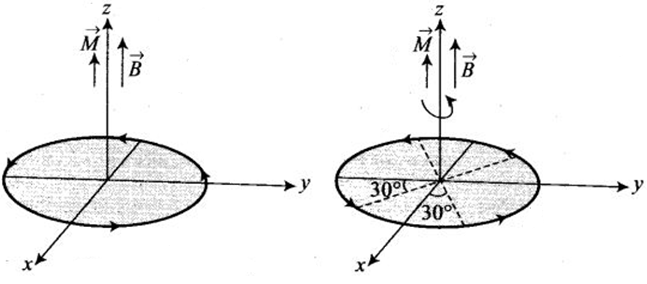
The rotation of the loop by 30° about an axis perpendicular to it's plane make no charge in the angle made by axis of the loop with the direction of magnetic field, therefire, the work done to rotate the loop is zero.
Important point: The work done to rotate the loop in magnetic field $\text{W}=\text{MB}(\cos\theta_1-\cos\theta_2)$, where signs are us usual. View full question & answer→Question 1771 Mark
What is the force exerted by a stationary charge when it is placed in a magnetic field?
Answer
- Zero
Explanation:
A stationary charge does not produce any magnetic field and it does not suffer any interaction against the external magnetic field. Hence the force exerted is zero.
View full question & answer→Question 1781 Mark
A current carring coil is placed in a uniform magnetic field. If the coil turns through an angle $\theta,$ then the torque is directly proportional to:
View full question & answer→Question 1791 Mark
The magnetic moment of a circular coil carrying current is:
Answer
- Directly proportional to the square of the length of the wire in the coil.
View full question & answer→Question 1801 Mark
If a charged particle kept at rest experiences an electromagnetic force:
Answer
- The electric field must not be zero.
- The magnetic field may or may not be zero.
Explanation:
Since particle is at rest, i.e. v=0, hence Fm=0
For electric force, E≠0
View full question & answer→Question 1811 Mark
A charged particle enters a magnetic field H with its initial velocity making an angle of 45° with H. Then the path of the particle will be:
Answer
- Helical
Explanation:
At point A, charge is entering in a magnetic field in which direction of field is shown in the figure. The velocity of particle is u making an angle of 45° with field.
We resolve it in two directions, one along the field and other perpendicular to it. Since u sin45° is perpendicular to H, it will create a rotatory effect on the charge.
So charge particle will start rotating with axis along the direction of H. At the same time it will move forward with velocity u cos45°. Under both these motions, it will have helical path as shown in the figure.
View full question & answer→Question 1821 Mark
The sensitivity of a tangent galvanometer can be increased by increasing:
Answer
- The external magnetic field
View full question & answer→Question 1831 Mark
Who first discovered the relationship between electricity and magnetism?
Answer
- Oersted
Explanation:
Oersted discovered the relationship between electricity and magnetism.
View full question & answer→Question 1841 Mark
Magnetic dipole moment of a rectangular loop is:
Answer
- Perpendicular to plane of loop and porportional to area of loo.
View full question & answer→Question 1851 Mark
Two statements are given-one labelled Assertion (A) and the other labelled Reason (R). Select the correct answer to these questions from the codes (a), (b), (c) and (d) as given below. Assertion (A): Magnetic field is useful in producing parallel beam of charged particle. Reason (R): Magnetic field inhibits the motion of charged particle moving across it.
Answer
- Both A and R are true and R is the correct explanation of A.
View full question & answer→Question 1861 Mark
A charged particle in a plasma trapped in a magnetic bottle leaks out after a millisecond. What is the total work done by the magnetic field during the time the particle is trapped?
Answer
- Zero
Explanation:
Work done is zero. Since a magnetic field exerts a force perpendicular to the direction of motion of the charged particle, no work is done by it on the charged particle.
Therefore, the total work done by the magnetic field during the time the particle is trapped is zero.
View full question & answer→Question 1871 Mark
When a proton moves in a uniform magnetic field, the momentum change but its kinetic energy does not change because:
Answer
- All
Explanation:
The magnetic force exerted will be perpendicular to the direction of motion of the proton. As we know when when force acting is perpendicular to the direction of moving charge, work done will be zero.
It means kinetic energy does not change. The force is able to change the direction (velocity) of the proton but not its speed (magnitude). Thus momentum and velocity changes.
View full question & answer→Question 1881 Mark
The north pole of a magnet is brought near a stationary negatively charged conductor. What is the force experienced by it at the poles?
Answer
- Zero
Explanation:
The north pole of a magnet will not experience any force.
This is because a stationary charge does not produce any magnetic field.
Therefore, the force experienced by the magnet at the poles is zero.
View full question & answer→Question 1891 Mark
What is shape of magnet in moving coil galvanometer to make the radial magnetic field?
Answer
- Concave
Explanation:
The shape of magnet in moving coil galvanometer to make the radial magnetic field is concave magnets.
View full question & answer→Question 1901 Mark
A coil of circular cross$-$section having $1000$ turns and $4\ cm^2$ face area is placed with its axis parallel to a magnetic field which decreases by $10^{–2 }Wb m^{–2}$ in $0.01 s.$ The e.m.f. induced in the coil is:
View full question & answer→Question 1911 Mark
Which of the following is not a unit of magnetic induction?
Question 1921 Mark
What is the work done by the magnetic field on a moving charged particle?
Answer
- Zero
Explanation:
As the magnetic force acts in a direction perpendicular to the direction of the velocity or the direction of motion of the charged particle, so the work done is zero.
W = F × dl × cos 90°
W = 0.
View full question & answer→Question 1931 Mark
Two streams of electrons are moving parallel to each other in the same direction. They_____.
Answer
- Repel each other.
Explanation:
If the beams were stationary, they'd repel (because negative charges repel).
Once the beams are moving we get the magnetic effects in addition, which reduces the repulsion.
The magnetic attraction only becomes strong enough to cancel the electric repulsion at c.
Therefore the streams will repel each other due to electric repulsion.
View full question & answer→Question 1941 Mark
The wires 1 and 2
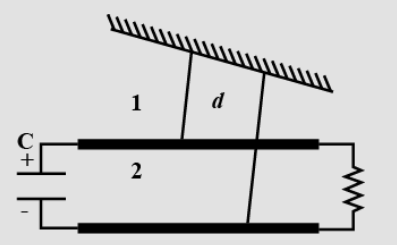
Answer
- Move apart
Explanation:
It is evident from the question that current in the two is in opposite direction so on using the formulas of current carrying straight conductor we can say that they will repel each other.
View full question & answer→Question 1951 Mark
In cyclotron the resonance condition is:
Answer
- The frequency of revolution of charged particle is equal to the frequency of A.C. voltage sources.
View full question & answer→Question 1961 Mark
A charged particle moves in a gravity-free space without change in velocity. Which of the following is are possible:
Answer
- $\text{E}=0,\ \text{B}=0$
- $\text{E}=0,\ \text{B}\not=0$
- $\text{E}\not=0,\ \text{B}\not=0$
Explanation:
⇒ Particle move with constant velocity in ay direction. So, B = 0, E = 0
⇒ Particle move in a circle with constant speed. Magnetic force is provide the centripetal force that causes particle is move in a circle.
⇒ If qE = qvB and Magnetic & Electric force in opposite direction in this case particle also move with uniform speed. View full question & answer→Question 1971 Mark
Answer
- Current sensitivity is expressed as the exact reverse of the galvanometer constant.
View full question & answer→Question 1981 Mark
An electron moving with velocity 'v' enters a magnetic field as shown in the above figure. Identify in which direction, the electron will experience a force?
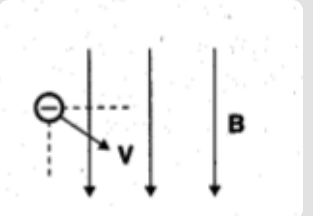
Answer
- Out of the page.
Explanation:
The component of the velocity that is perpendicular to the direction of the magnetic field influences the magnetic force acting on the charge.
Therefore from Fleming's-left hand rule the magnetic force for the given directions act into the plane of the page for a positive charge.
But the given charge in the question is negative, thus the magnetic force on this charge is acting out of the plane of the page.
View full question & answer→Question 1991 Mark
There will be no force between two wires carrying currents if currents are:
Answer
- Perpendicular to each other
Explanation:
Force on a current carrying wire placed in a magnetic field is given by F = I (l × B) So when the wires are perpendicular the magnetic field produced by one of them will be along the length of the other and we know cross product of two vectors along the same direction is zero.
View full question & answer→Question 2001 Mark
Give the SI unit of the magnetic field.
Answer
- Tesla
Explanation:
The SI unit of the magnetic field is tesla, named after the great scientist Nikola tesla.
1 tesla is 107 times the magnetic field produced by a conducting wire of length one metre and carrying a current of one ampere at a distance of one metre from it and perpendicular to it.
View full question & answer→Question 2011 Mark
What happens to the magnetic field at the centre of a circular current carrying coil if we double the radius of the coil keeping the current unchanged?
Question 2021 Mark
Consider the situation shown in figure. The straight wire is fixed but the loop can move under magnetic force. The loop will:
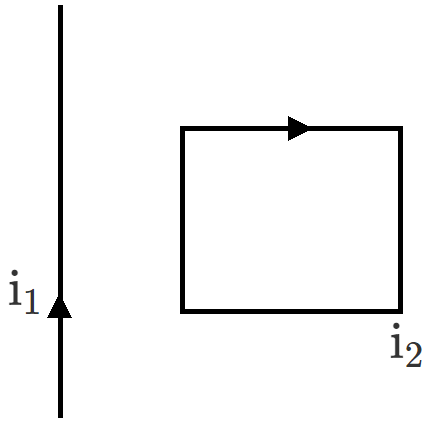
Answer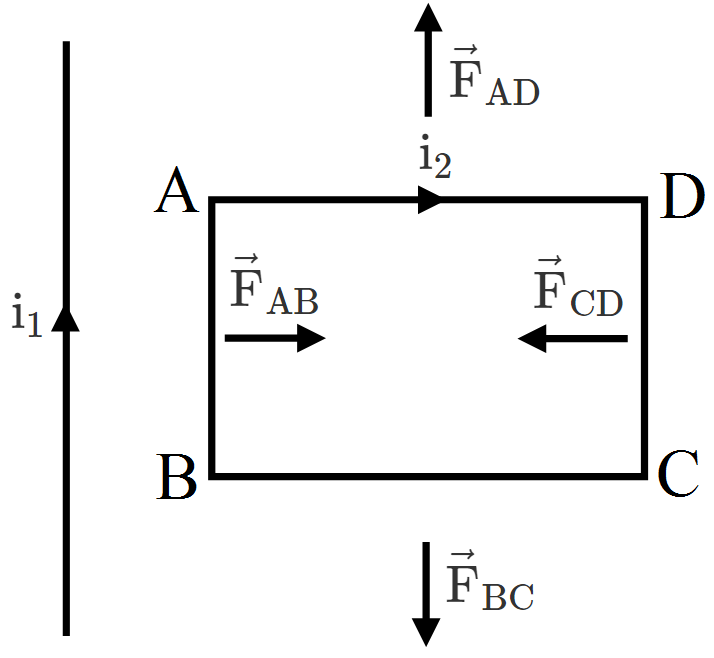
$\overrightarrow{\text{F}}_\text{AD}+\overrightarrow{\text{F}}_\text{BC}=0$
$\overrightarrow{\text{F}}_\text{AB}>\overrightarrow{\text{F}}_\text{CD}$
Force acting on the wire per unit length carrying current $i_2$ due to the wire carrying current $i_1$ placed at a distance $d$ is given by,
$\text{F}=\frac{\mu_0\text{i}_1\text{i}_2}{2\pi\text{d}}$
So, forces per unit length acting on sides $AB$ and $CD$ are as follows:
$\text{F}_\text{AB}=\frac{\mu_0\text{i}_1\text{i}_2}{2\pi\text{d}} ($Towards the wire$)$
$\text{F}_\text{CD}=\frac{\mu_0\text{i}_1\text{i}_2}{2\pi(\text{d}+\text{a})} ($Away from the wire$)$
Here, $F_{AB} > F_{CD}$ because force is inversly proportional to the distance from the wire and wire $AB$ is closer to the wire carrying current $i_{1.}$
The forces per unit length acting on sides $BC$ and $DA$ will be equal and opposite,
as they are equally away from the wire carrying current $i_1,$ with current $i_2$ flowing in the opposite direction.
$\therefore\text{F}_\text{BC}=-\text{F}_\text{DA}$
Now,
Net force:
$\text{F} = \text{F}_\text{AB}+\text{F}_\text{BC}+\text{F}_\text{CD}+\text{F}_\text{DA}$
$\Rightarrow\text{F}=\frac{\mu_0\text{i}_1\text{i}_2}{2\pi\text{d}}+\text{F}_\text{BC}-\frac{\mu_0\text{i}_1\text{i}_2}{2\pi(\text{d+a})}-\text{F}_\text{BC}$
$\Rightarrow\text{F}=\frac{\mu_0\text{i}_1\text{i}_2}{2\pi}\Big(\frac{1}{\text{d}}-\frac{1}{\text{d+a}}\Big)$
$\Rightarrow\text{F}=\frac{\mu_0\text{i}_1\text{i}_2\text{a}}{2\pi\text{d}(\text{d+a})}$
$($Towards the wire$)$
Therefore, the loop will move towards the wire. View full question & answer→Question 2031 Mark
In cyclotron the gyro radius is:
Answer
- Proportional to momentum.
View full question & answer→Question 2041 Mark
A neutron, a proton, an electron and an α−particle enter a region of uniform magnetic field with equal velocities. The magnetic field is perpendicular to the plane of paper and directed into it. The tracks of particles are labeled in the figure. The neutron follows the track:
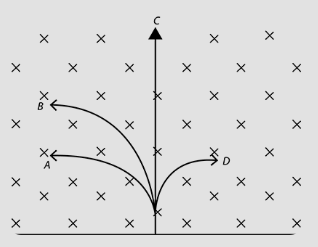
Answer
- C
Explanation:
Neutron does not carry any charge. Hence, there is no force on the neutron and it travels undeflected.
View full question & answer→Question 2051 Mark
A charged particle moving in a uniform magnetic field and losses 4% of its kinetic energy. The radius of curvature of its path changes by:
Question 2061 Mark
What is moving coil galvanometer used for?
Answer
- Measurement of small currents
Explanation:
Moving Coil Galvanometer is an instrument used for the detection and measurement of current.
It is sensitive instrument and can measure current even if it is only a few microamperes.
It was invented by Johann Schweigger in the 1800s.
View full question & answer→Question 2071 Mark
A positively charged particle moving in east direction enters a region of uniform magnetic field directed vertically upwards. What will be the path of the particle?
Answer
- Move in a circular path with a uniform speed.
Explanation:
If a positively charged particle moving in east direction enters a region of uniform magnetic field directed vertically upwards, it will move in a circular path with a uniform speed.
If a charged particle is moving in a direction perpendicular to a uniform magnetic field, then its trajectory will be a circle because the force F = qvB is always perpendicular to the velocity, and therefore centripetal.
View full question & answer→Question 2081 Mark
When a charged particle moves at right angle to a magnetic field quantity that changes is:
Answer
- Momentum
Explanation:
When a charged particle moves perpendicular to the field, its speed remains the same whereas its velocity keeps on changing.
Momentum is the product of the mass of the particle and the velocity if the particle, hence since velocity varies, momentum also varies.
When a charged particle moves at right angle to a magnetic field quantity that changes is momentum.
View full question & answer→Question 2091 Mark
If the current is doubled, the deflection is also doubled in:
Answer
- A moving-coil galvanometer
Explnation:
In MCG, deflection is proportional to torque on the coil and torque is proportional to current.
Hence, when current is doubled, deflection is doubled.
View full question & answer→Question 2101 Mark
Two identical bar magnets are fixed with their centres at a distance d apart. A stationary charge Q is placed at P in between the gap of the two magnets at a distance D from the centre O as shown in the figure. The force on the charge Q is:
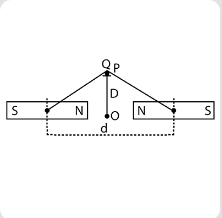
Answer
- Zero
Explanation:
Magnetic field due to bar magnets exerts force on moving charges only.
Since the charge is at rest, zero force acts on it.
View full question & answer→Question 2111 Mark
A particle moves in a region having a uniform magnetic field and a parallel, uniform electric field. At some instant, the velocity of the particle is perpendicular to the field direction. The path of the particle will be:
Answer
- A helix with nonuniform pitch.
Explanation:
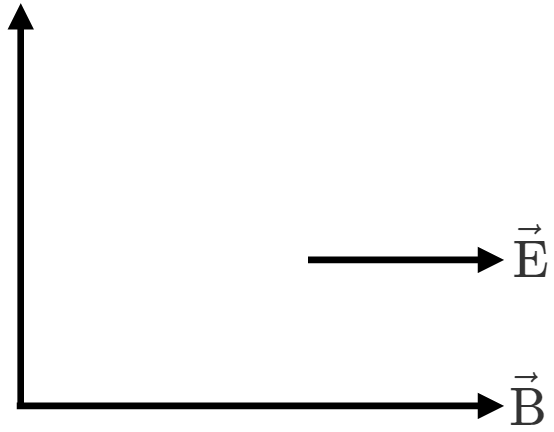
$\text{F}=\text{q}\vec{\text{E}}+\text{q}(\vec{\text{V}}\times\vec{\text{B}})$
$\text{F}=\text{q}\vec{\text{E}}$ provides the acceleration in 'x' direction.
$\text{F}_2=\text{}\text{q}(\vec{\text{V}}\times\vec{\text{B}})$ provides the centripetal Force.
The path of the particle will be ahelix with nonuniform pitch. View full question & answer→Question 2121 Mark
Two parallel wires carry currents of 20A and 40A in opposite directions. Another wire carying a current anti parallel to 20A is placed midway between the two wires. T he magnetic force on it will be:
Answer
- Towards 40A.
Explanation:
According to Fleming's left-hand rule, if the forefinger and middle finger of our left hand point towards the magnetic field acting on a wire and the current flowing in the wire, respectively, then the thumb will point towards the direction in which the force will act (keeping all three perpendicular). Direction of force can be determined using Fleming's left-hand rule.
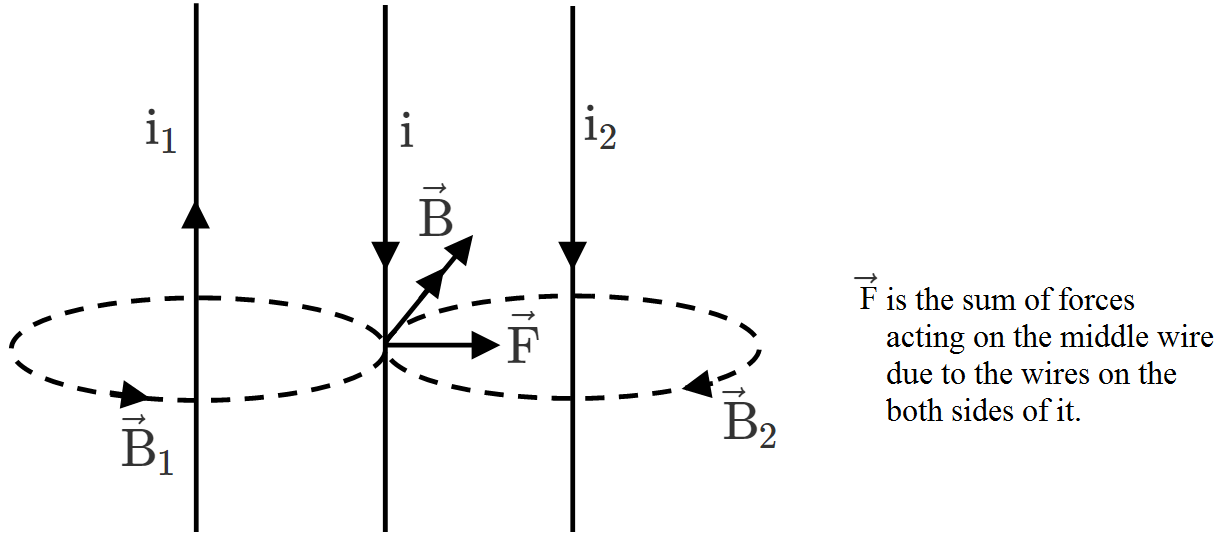
$\text{i}_1=20\text{A},\ \text{i}_2=40\text{A}$
$\overrightarrow{\text{B}}=\overrightarrow{\text{B}_1}+\overrightarrow{\text{B}_2}$
In the figure, dotted circle shows the magnetic filed lines due to both the wires. Magnetic field at any point on the middle wire will be acting along the tangent to the masgnetic field lines at that point.
Therefore, the wire will experience a magnetic field pointing towards the 40A wire. Due to AB, the force will be towards right and due to CD, the force on the wire will be towards right. So, both the forces will add to give a resultant force, which will be towards right, that is, towards the 40A current-carrying wire. View full question & answer→Question 2131 Mark
Which of the following shows that the earth behaves as a magnet?
Answer
- Null points in the magnetic field of a bar magnet.
View full question & answer→Question 2141 Mark
A positive charge is moving vertically upwards. When it enters a region of magnetic field directed towards north, what is the direction of the force on the charge?
Answer
- Left
Explanation:
According to Fleming’s left-hand rule, the magnetic force will act towards left.
When the positive charge enters a region of magnetic field directed towards north, the magnetic force will act towards left.
View full question & answer→Question 2151 Mark
Magnetic field inside a solenoid is:
Answer
- Directly proportional to current.
View full question & answer→Question 2161 Mark
When charged particle enters-a uniform magnetic field, its K.E:
Question 2171 Mark
Consider a moving charged particle in a region of magnetic field. Which of the following statements are correct?
- If v is parallel to B, then path of particle is spiral.
- If v is perpendicular to B, then path of particle is a circle.
- If v has a component along B, then path of particle is helical.
- If v is along B, then path of particle is a circle.
Question 2181 Mark
A deuteron of kinetic energy 50 keV is describing a circular orbit of radius 0.5 metre in a plane perpendicular to the magnetic field B. The kinetic energy of the proton that describes a circular orbit of radius 0.5 metre in the same plane with the same B is:
Question 2191 Mark
Consider the following statements and select the incorrect statement(s).
- The presence of a large magnetic flux through a coil maintains a current in the coil if the circuit is continuous.
- A coil of a metal wire kept stationary in a non– uniform magnetic field has an e.m.f induced in it.
- A charged particle enters a region of uniform magnetic field at an angle of 85° to the magnetic lines of force, the path of the particle is a circle.
- There is no change in the energy of a charged particle moving in a magnetic field, although a magnetic force is acting on it.
Question 2201 Mark
A tangent galvanometer is connected directly to an ideal battery. If the number of turns in the coil is doubled the deflection will:
Answer
- Remain unchanged.
Explanation:
For a tangent galvanometer, deflection is given by
$\theta=\tan^{-1}\Big(\frac{\text{i}}{\text{k}}\Big)$
Here, k is the constant called reduction factor.
From the above formula, we can say that deflection is independent of the number of turns.
Hence, on doubling the number of turns, deflection remains the same. View full question & answer→Question 2211 Mark
If the current is doubled, the deflection is also doubled in:
Answer
- A moving-coil galvanometer.
Explanation:
The current and deflection dependence of a moving coil galvanometer is given by
$\text{i}=\frac{\text{k}}{\text{nAB}}\theta\Rightarrow\text{i}\propto\theta$
Therefore, if we double the current, the deflection also gets doubled.
However, in a tangent galvanometer, $\text{i}\propto\tan\theta$; that is, there is no direct relation between $\theta$ and current.
Hence, the correct option is (b). View full question & answer→Question 2221 Mark
Direction of force due to magnetic field on a moving charged particle is:
- Perpendicular to direction of velocity of charged particle.
- Perpendicular to direction of magnetic field.
- Parallel to direction of velocity of charged particle.
- Parallel to the direction of magnetic field.
Correct statements are.
Question 2231 Mark
If a charged particle is projected perpendicular to a uniform magnetic field, then:
- It revolves in circular path
- Its K.E. remains constant
- Its momentum remains constant
- Its path is spiral
Answer
- Only a, b are correct
Explanation:
If a charged particle is projected perpendicular to a uniform magnetic field, then particle revolves in a circular path and its kinetic energy remains constant since there is no work done by magnetic force.
Since a circular path direction of particle changes, so, momentum also changes.
View full question & answer→Question 2241 Mark
Similarities of Biot–Savart’s law and Coulomb’s law for the electrostatics are:
- Both are long range and inversely proportional to the square of distance from the source to the point of interest.
- Both are linear in source.
- Both are produced by scalar sources.
- Both follow principle of superposition.
Question 2251 Mark
A particle is projected in a plane perpendicular to a uniform magnetic field. The area bounded by the path described by the particle is proportional to:
Answer
- The kinetic energy.
Explanation:
When a particle of mass m carrying charge q is projected with speed v in a plane perpendicular to a uniform magnetic field B, the field tends to deflect the particle in a circular path of radius r.
$\therefore\frac{\text{mv}^2}{\text{r}^2}=\text{qvB}$
$\Rightarrow\text{r}=\frac{\text{mv}}{\text{qB}}$
Now,
Area, $\text{A}=\pi\text{r}^2$
$\Rightarrow\text{A}=\pi\Big(\frac{\text{mv}}{\text{qB}}\Big)^2$
$\Rightarrow\text{A}=\text{kv}^2$
Here,
$\text{k}=\pi\Big(\frac{\text{m}}{\text{qB}}\Big)^2$
Kinetic energy of the particle, $\text{E}=\frac{1}{2}\text{mv}^2$
Therefore, the area bounded is proportional to the kinetic energy. View full question & answer→Question 2261 Mark
How is galvanometer converted into a voltmeter?
AnswerA galvanometer can be converted into voltmeter of given range by connecting a high resistance called multiplier in series with the galvanometer, whose value is given as: $\text{R}\Big(\frac{\text{V}}{\text{I}_\text{g}}\Big)-\text{G}$
Where $V$ is the voltage to be measured, $I_g$ is the current for full scale deflection of galvanometer and $G$ is the resistance of galvanometer.
View full question & answer→Question 2271 Mark
If we double the radius of a coil keeping the current through it unchanged, then the magnetic field at any point at a large distance from the centre becomes approximately:
MCQ 2281 Mark
The graph shows the variation of magnetic field (B)with distance (r) from a long current carrying wire is-