MCQ
A very thin film in reflected white light appears:
  • A
    Violet
  • B
    White
  • Black
  • D
    Red

Answer

Correct option: C.
Black

When the film is thin,$ t \rightarrow 0$, path diff. $= \frac{\lambda}{2}$. Therefore, in reflected light, the film appears black.

Need a full question paper?

Generate a complete, print-ready paper with questions like this in minutes — across 16+ boards, with answer keys.
Start Generating Free

Similar questions

A solenoid is at potential difference 60 V and current flows through it is 15 ampere, then the resistance of coil will be
Consider an NPN transistor amplifier in common-emitter configuration. The current gain of the transistor is 100. If the collector current changes by 1 mA, what will be the change in emitter current
The relation between the linear magnification $m,$ the object distance $u$ and the focal length $f$ is
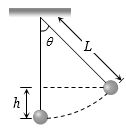
A simple pendulum with bob of mass $m$ and conducting wire of length $L$ swings under gravity through an angle $2\theta $. The earth’s magnetic field component in the direction perpendicular to swing is $B$. Maximum potential difference induced across the pendulum is
The resistances of the platinum wire of a platinum resistance thermometer at the ice point and steam point are $8 \Omega$ and $10 \Omega$ respectively. After inserting in a hot bath of temperature $400^{\circ} \mathrm{C}$, the resistance of platinum wire is:
What is the $r.m.s$. value of an alternating current which when passed through a resistor produces heat which is thrice of that produced by a direct current of $2$ amperes in the same resistor......$amp$
Wavelength of a 1 keV photon is $1.24 \times 10^{-9} m \cdot$ What is the frequency of 1 MeV photon
The process of superimposing signal frequency $(i.e.\ audio\ wave)$ on the carrier wave is known as
In a Young's double slit experiment with light of wavelength $\lambda ,$ fringe pattern on the screen has fringe width $\beta .$ When two thin transparent glass (refractive index $\mu$ ) plates of thickness $t_1$ and $t_2\,\,(t_1 > t_2)$ are placed in the path of the two beams respectively, the fringe pattern will shift by a distance
The objective glass of a telescope is an achromat of focal length $90\,cm$ . The magnitude of dispersive power of the two lenses are $0.024$ and $0.036$ . The focal lengths are