MCQ
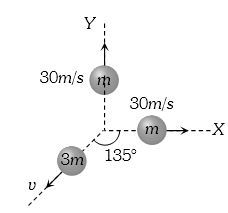
A vessel at rest explodes into three pieces. Two pieces having equal masses fly off perpendicular to one another with the same velocity $30$ meter per second. The third piece has three times mass of each of other piece. The magnitude and direction of the velocity of the third piece will be
  • $10\sqrt 2 \,m/second$ and $135°$ from either
  • B
    $10\sqrt 2 \,m/second$ and $45°$ from either
  • C
    $\frac{{10}}{{\sqrt 2 }}\,m/second$ and $135°$ from either
  • D
    $\frac{{10}}{{\sqrt 2 }}\,m/second$ and $45°$ from either
Answer

Correct option: A.
$10\sqrt 2 \,m/second$ and $135°$ from either
a
(a)Let two pieces are having equal mass m and third piece have a mass of $3m$.
According to law of conservation of linear momentum. Since the initial momentum of the system was zero, therefore final momentum of the system must be zero i.e. the resultant of momentum of two pieces must be equal to the momentum of third piece. We know that if two particle possesses same momentum and angle in between them is $90°$ then resultant will be given by $P\sqrt 2 = mv\sqrt 2 = m30\sqrt 2 $
Let the velocity of mass $3m$ is $V$. So $3mV = 30m\sqrt 2 $
 $V = 10\sqrt 2 $ and angle $135°$ from either.
(as it is clear from the figure)

Need a full question paper?

Generate a complete, print-ready paper with questions like this in minutes — across 16+ boards, with answer keys.

Start Generating Free

Similar questions

A wall clock uses a vertical spring-mass system to measure the time. Each time the mass reaches an extreme position, the clock advances by a second. The clock gives correct time at the equator. If the clock is taken to the poles it will:
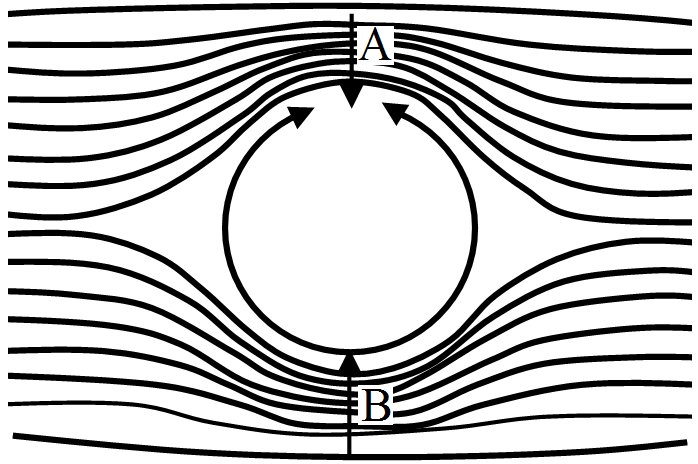
A ball is moving without spinning in a straight line through a fluid $($as shown$):$

lf $P_A$ and $P_B$, are pressure values at $A$ and $B,$ then,
The terminal velocity of a small sphere of radius $a$ in a viscous liquid is proportional to
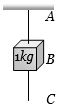
A mass of $1 kg$ is suspended by a string $A$. Another string $C$ is connected to its lower end (see figure). If a sudden jerk is given to $C$, then
The elongation of a wire on the surface of the earth is $10^{-4} \; m$. The same wire of same dimensions is elongated by $6 \times 10^{-5} \; m$ on another planet. The acceleration due to gravity on the planet will be $\dots \; ms ^{-2}$. (Take acceleration due to gravity on the surface of earth $=10 \; m / s ^{-2}$ )
If $\vec F$ is the force acting on a particle having position vector $\vec r$ and $\vec \tau$ be the torque of this force about the origin, then
In a heat engine, the temperature of the source and sink are $500\, K$ and $375\, K$. If the engine consumes $25\times10^5\, J$ per cycle, the work done per cycle is
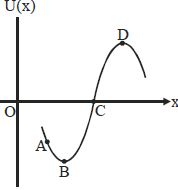
Potential energy of a particle varies with distance $x$ as shown in the graph Select the wrong statement
$A$ man, sitting firmly over a rotating stool has his arms streched. If he folds his arms, the work done by the man is
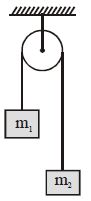
Two masses $m_1 = 3\,kg$ and $m_2 = 7\,kg$ tied to a string are hanging over a light frictionless pulley. What is the acceleration of the masses when system is free to move ? $[g = 10\,m/s^2]$  ...... $m/s^2$