MCQ
In a heat engine, the temperature of the source and sink are $500\, K$ and $375\, K$. If the engine consumes $25\times10^5\, J$ per cycle, the work done per cycle is
  • $6.25\times10^5\, J$
  • B
    $3\times10^5\, J$
  • C
    $2.19\times10^5\, J$
  • D
    $4\times10^4\, J$

Answer

Correct option: A.
$6.25\times10^5\, J$
a
Here, $T_{1}=500 \mathrm{K}, T_{2}=375 \mathrm{K}$

$\mathrm{Q}_{1}=25 \times 10^{5} \mathrm{J}$

$\therefore \eta=1-\frac{\mathrm{T}_{2}}{\mathrm{T}_{1}}=1-\frac{375}{500}=0.25$

$\mathrm{W}=\eta \mathrm{Q}=0.25 \times 25 \times 10^{5}=6.25 \times 10^{5} \mathrm{J}$

Need a full question paper?

Generate a complete, print-ready paper with questions like this in minutes — across 16+ boards, with answer keys.

Start Generating Free

Similar questions

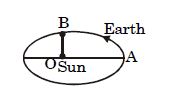
The earth moves around the Sun in an elliptical orbit as shown in figure.The ratio $OA/OB = x$ . The ratio of the speed of the earth at $B$ to that at $A$ is nearly
Which of the following statements are true for wave motion:
An iron ball and a wooden ball of the same radius are released from a height $‘h’$ in vacuum. The time taken by both of them to reach the ground is equal is based on 
A bomb of mass $1\ kg$ is thrown vertically upwards with a speed of $100\ m/s.$ After $5$ seconds, it explodes into two fragments. One fragment of mass $400\ gm$ is found to go down with a speed of $25\ m/s.$ What will happen to second fragment just after explosion? $(g = 10\ m/s^2).$
Which relation is wrong
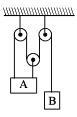
At a given instant, $A$ is moving with velocity of $5\,\,m/s$ upwards.What is velocity of $B$ at that time
A satellite $S$ is moving in an elliptical orbit around the earth. The mass of the satellite is very small compared to the mass of the earth.
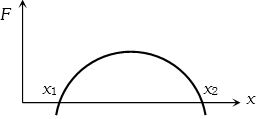
The force acting on a body moving along $x-$axis varies with the position of the particle as shown in the fig.The body is in stable equilibrium at
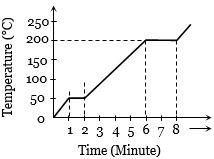
A student takes $50\,gm$ wax $($specific heat $= 0.6\, kcal/kg°C)$ and heats it till it boils. The graph between temperature and time is as follows. Heat supplied to the wax per minute and boiling point are respectively
Three blocks $A, B$ and $C$ are lying on a smooth horizontal surface, as shown in the figure. $A$ and $B$ have equal masses, $m$ while $C$ has mass $M$. Block $A$ is given an initial speed $v$ towards $B$ due to which it collides with $B$ perfectly inelastically. The combined mass collides with $C$, also perfectly inelastically. The combined mass collides with $C$, also perfectly inelastically if $\frac{5}{6}^{th}$ of the initial kinetic energy is lost in whole process. What is value of $M/m$ ?