MCQ
A vessel containing water is moving with a constant speed towards right along a straight horizontal path. Which of the following diagrams represents the surface of liquid?
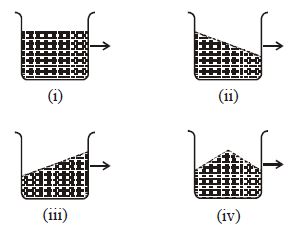
  • $(i)$
  • B
    $(ii)$
  • C
    $(iii)$
  • D
    $(iv)$

Answer

Correct option: A.
$(i)$
a
As the vessel containing water is moving with a constant speed, thus no pseudo force acts on the water in the vessel frame. Also the vessel frame is an inertial frame for water. Hence the moving liquid (water) forms the surface as same as that when the liquid was at rest.

Hence option $A$ is correct.

Need a full question paper?

Generate a complete, print-ready paper with questions like this in minutes — across 16+ boards, with answer keys.

Start Generating Free

Similar questions

$Assertion :$ The base of Laplace correction was that exchange of heat between the region of compression and rarefaction in air is negligible.
$Reason :$ Air is bad conductor of heat and velocity of sound in air is quite large.
A small particle of mass $m$ moving inside a heavy, hollow and straight tube along the tube axis undergoes elastic collision at two ends. The tube has no friction and it is closed at one end by a flat surface while the other end is fitted with a heavy movable flat piston as shown in figure. When the distance of the piston from closed end is $L = L _0$ the particle speed is $v = v _0$. The piston is moved inward at a very low speed $V$ such that $V \ll \frac{ dL }{ L } v _0$, where $dL$ is the infinitly small displacement of the piston. Which of the following statement($s$) is/are correct?

$(1)$ The rate at which the particle strikes the piston is $v / L$

$(2)$ After each collision with the piston, the particle speed increases by $2 V$

$(3)$ The particle's kinetic energy increases by a factor of $4$ when the piston is moved inward from $L _0$ to $\frac{1}{2} L _0$

$(4)$ If the piston moves inward by $d L$, the particle speed increases by $2 v \frac{d L}{L}$

Which of the following diagrams does not represent a streamline flow?
Two vessels having equal volume contain molecular hydrogen at one atmosphere and helium at two atmosphere pressure respectively. If both samples are at the same temperature the mean velocity of hydrogen molecule is:
The value of Planck's constant is
A rocket is launched normal to the surface of earth, away from the Sun, along the line joining the Sun and the Earth. The Sun is $3 \times 10^5$ times heavier than the Earth and is at a distance $2.5 \times 10^4$ times larger than the radius of the Earth. The escape velocity from Earth's gravitational field is $\mathrm{ve}_{\mathrm{e}}=11.2 \mathrm{~km} \mathrm{~s} \mathrm{~s}^{-1}$. The minimum initial $\left(\mathrm{v}_{\mathrm{s}}\right)$ required for the rocket to be able to leave the Sun-earth system is closest to

(Ignore the rotation and revolution of the Earth and the presence of any other planet)

A uniform cube is subjected to volume compression. If each side is decreased by $1\%$, then bulk strain is:
An iron sphere of mass 10kg has the same diameter as an aluminium sphere of mass is $3.5\ kg.$ Both spheres are dropped simultaneously from a tower. When they are $10\ m$ above the ground, the have the same:
The components of velocity of a particle are as follows:
$
v_x=(5 t) m / s, v_y=(7 t) m / s
$
The value of acceleration of the particle is :
If the length of the wire is stretched and doubled, then the value of its Young's elasticity coefficient IS :