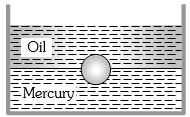
A vessel contains oil (density =$ 0.8 \;gm/cm^3$) over mercury (density = $13.6\; gm/cm^3$). A homogeneous sphere floats with half of its volume immersed in mercury and the other half in oil. The density of the material of the sphere in $ gm/cm^3$ is
IIT 1998, Diffcult


Download our appand get started for free
Experience the future of education. Simply download our apps or reach out to us for more information. Let's shape the future of learning together!No signup needed.*
Similar Questions
- 1A cubical block is floating in a liquid with one fourth of its volume immersed in the liquid. If whole of the system accelerates upward with acceleration $g / 4$, the fraction of volume immersed in the liquid will be ..........View Solution
- 2A large tank is filled with water to a height $H$. A small hole is made at the base of the tank. It takes ${T_1}$ time to decrease the height of water to $\frac{H}{\eta }\,(\eta > 1)$; and it takes ${T_2}$ time to take out the rest of water. If ${T_1} = {T_2}$, then the value of $\eta $ isView Solution
- 3A hydraulic automobile lift is designed to lift vehicles of mass $5000\,kg$. The area of cross section of the cylinder carrying the load is $250\,cm ^2$. The maximum pressure the smaller piston would have to bear is [Assume $g=10\,m / s ^2$]View Solution
- 4A certain block weight $15\, N$ in air. It weight $12\, N$ when immersed in water when immersed in another liquid it weighs $13\, N$, the relative density of the block isView Solution
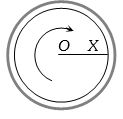
- 5The diagram shows a cup of tea seen from above. The tea has been stirred and is now rotating without turbulence. A graph showing the speed $ v$ with which the liquid is crossing points at a distance $ X$ from $O $ along a radius $XO$ would look likeView Solution
- 6A beaker containing water is placed on the platform of a spring balance. The balance reads $1.5$ $kg$. A stone of mass $0.5$ $kg$ and density $500$ $kg/m^3$ is immersed in water without touching the walls of beaker. What will be the balance reading now ? ..... $kg$View Solution
- 7A long cylindrical vessel is half filled with a liquid. When the vessel is rotated about its own vertical axis, the liquid rises up near the wall. If the radius of vessel is $5\,cm$ and its rotational speed is $2$ rotations per second, then the difference in the heights between the centre and the sides, in $cm,$ will beView Solution
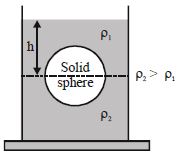
- 8A solid sphere of radius $r$ is floating at the interface of two immiscible liquids of densities $\rho_1$ and $\rho_2\,\, (\rho_2 > \rho_1),$ half of its volume lying in each. The height of the upper liquid column from the interface of the two liquids is $h.$ The force exerted on the sphere by the upper liquid is $($ atmospheric pressure $= p_0\,\,\&$ acceleration due to gravity is $g) $View Solution
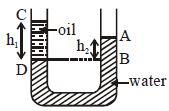
- 9In a $U-$ tube experiment, a column $AB$ of water is balanced by a column $‘CD’$ of oil, as shown in the figure. Then the relative density of oil isView Solution
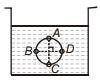
- 10Figure shows a container filled with a liquid of density $\rho$. Four points $A, B, C$ and $D$ lie on the diametrically opposite points of a circle as shown. Points $A$ and $C$ lie on vertical line and points $B$ and $D$ lie on horizontal line. The incorrect statement is $\left(p_A, p_B, p_C, p_D\right.$ are absolute pressure at the respective points)View Solution