MCQ
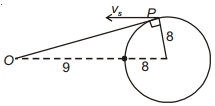
A vibrating tuning fork is moving slowly and uniformly in a horizontal circular path of radius $8\,m$. The shortest distance of an observer in same plane from the tuning fork is $9 \,m$. The distance between the tuning fork and observer at the instant when apparent frequency becomes maximum is ......... $m$
  • A
    $9$
  • B
    $25$
  • $15$
  • D
    $\sqrt{353}$

Answer

Correct option: C.
$15$
c
(c)

The apparent frequency is maximum when relative velocity of approach of tuning fork with respect to observer is maximum.

$O P=\sqrt{17^2-8^2}=15 \,m$

Need a full question paper?

Generate a complete, print-ready paper with questions like this in minutes — across 16+ boards, with answer keys.

Start Generating Free

Similar questions

If black wire of platinum is heated, then its colour first appear red, then yellow and finally white. It can be understood on the basis of
During a nuclear fission reaction:
A parallel$-$plate capacitor has plates of unequal area. The larger plate is connected to the positive terminal of the battery and the smaller plate to its negative terminal. Let $Q_{+}$ and $Q$ be the charges appearing on the positive and negative plates respectively:
Consider a car moving on a straight road with a speed of $100\, m/s$. The distance at which car can be stopped, is ........ $m$. $[\mu_k = 0.5]$
Angular momentum of a single particle moving with constant speed along circular path:
The loudness and pitch of a sound depends on
Out of the following, the only pair that does not have identical dimensions is
Two balls are thrown horizontally from the top of a tower with velocities $v_1$ and $v_2$ in opposite directions at the same time. After how much time the angle between velocities of balls becomes $90^o$ ?
A wave is represented by the equation $y = 10 sin \,\,2\pi \,\,(100t-0.02x) + 10 \,\,sin \,\,2\pi\,\, (100t+0.02x)$. The maximum amplitude and loop length are respectively
A sounding body of negligible dimension emitting a frequency of $150\,\, Hz$ is dropped from a height. During its fall under gravity it passes near a balloon moving up with a constant velocity of $2m/s$ one second after it started to fall.The difference in the frequency observed by the man in balloon just before and just after crossing the body will be : (Given that -velocity of sound $= 300m/s; g = 10m/s^2$)