Question
A violin player riding on a slow train plays a 440Hz note. Another violin player standing near the track plays the same note. When the two are close by and the train approaches the person on the ground, he hears 4.0 beats per second. The speed of sound in air = 340m/s.
  1. Calculate the speed of the train.
  2. What beat frequency is heard by the player in the train?
Answer

Given,
Frequency of violins $f_0= 440Hz$
Speed of sound in air $v = 340ms^{-1}$
Let the velocity of the train (sources) be $v_{s.}$​​​​​​​
  1. Beat heard by the standing man = 4
$\therefore\ \text{Frequency (f}_1)=440+4$
$\text{f}_1=444\text{Hz or 436 Hz}$
Now,
$\text{f}_1=\Big(\frac{340}{340-\text{v}_\text{s}}\Big)\times\text{f}_0$
On substituting the values,
We have,
$444=\Big(\frac{340+0}{340-\text{v}_\text{s}}\Big)\times440$
$\Rightarrow444(340-\text{v}_\text{s})=440\times340$
$\Rightarrow340\times(444-440)=440\times\text{v}_\text{s}$
$\Rightarrow340\times4=440\times\text{v}_\text{s}$
$\Rightarrow\text{v}_\text{s}=3.09\text{m/ s}=11\text{km/ h}$
  1. The sitting man will listen to fewer than 4 beats/-s.

Need a full question paper?

Generate a complete, print-ready paper with questions like this in minutes — across 16+ boards, with answer keys.

Start Generating Free

Similar questions

An ideal battery sends a current of 5A in a resistor. When another resistor of value $10\Omega$ is connected in parallel, the current through the battery is increased to 6A. Find the resistance of the first resistor.
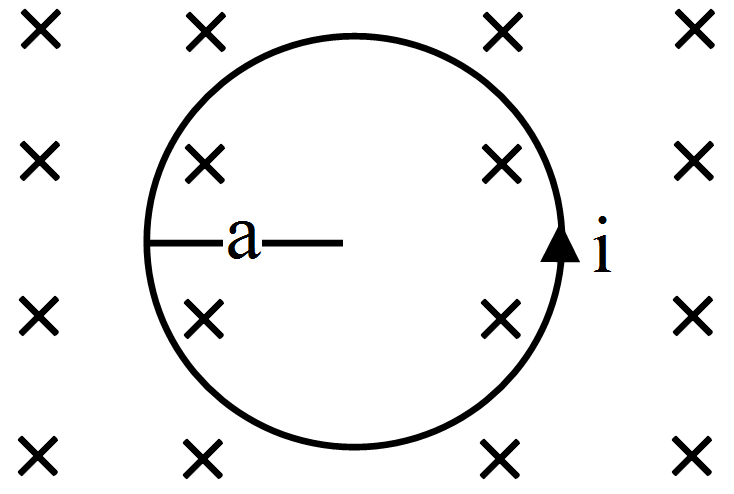
The shows a circular wire loop of radius a and carrying a current i, which is placed in a perpendicular magnetic field B.
  1. Consider a small part dl of the wire. Find the force on this part of the wire exerted by the magnetic field.
  2. Find the force of compression in the wire.
Explain two  main important points for astronomical telescope.
Visible light has wavelengths in the range of 400nm to 780nm. Calculate the range of energy of the photons of visible light.
Draw a circuit diagram to study the input and output characteristics of an n-p-n transistor in common emitter configuration. Explain briefly how this arrangement is used to obtain the typical input/output characteristics of a transistor. Draw the graphs showing the nature of input/output curves.
Explain the following:
  1. In the active state of the transistor, the emitter base junction acts as a low resistance while base collection region acts as high resistance.
  2. Output characteristics are controlled by the input characteristics in common emitter transistor amplifier.
  3. EDs are made of compound semiconductor and not by elemental semiconductors.
A proton describes a circle of radius 1cm in a magnetic field of strength 0.10T. What would be the radius of the circle described by an α-particle moving with the same speed in the same magnetic field?
Identify the following electromagnetic radiations as per the wavelengths given below.
Write one application of each.
  1. $10^{–3}nm$
  2. $10^{–3} m$
  3. $1 nm$
When a charged comb is brought near a small piece of paper, it attracts the piece. Does the paper become charged when the comb is brought near it?
i. Will the earth's magnetic field induce current in an artificial satellite with a metal surface that is in orbit around the equator? Around the poles?
ii. If so how would these currents affect the motion of the satellite?