Question
Identify the following electromagnetic radiations as per the wavelengths given below.
Write one application of each.
  1. $10^{–3}nm$
  2. $10^{–3} m$
  3. $1 nm$

Answer

  1. $10^{-3}nm$:- X-rays/γ-rays
Use: Medical/crystallography/transmutation.
  1. $10^{-3}m$: Microwave/short radio wave
Use: Oven/communication.
  1. 1nm: UV-rays/X-rays
Use: Water purification/medical.

Need a full question paper?

Generate a complete, print-ready paper with questions like this in minutes — across 16+ boards, with answer keys.
Start Generating Free

Similar questions

Consider a non-conducting ring of radius r and mass m that has a total charge q distributed uniformly on it. The ring is rotated about its axis with an angular speed $\omega.$
  1. Find the equivalent electric current in the ring.
  2. Find the magnetic moment $\mu$ of the ring.
  3. Show that $\mu=\frac{\text{q}}{2\text{m}}\text{l}$ where l is the angular momentum of the ring about its axis of rotation.
Consider the plane S formed by the dipole axis and the axis of earth. Let P be point on the magnetic equator and in S. Let Q be the point of intersection of the geographical and magnetic equators. Obtain the declination and dip angles at P and Q.
A circular copper-ring of radius r translates in its plane with a constant velocity v. A uniform magnetic field B exists in the space in a direction perpendicular to the plane of the ring. Consider different pairs of diametrically opposite points on the ring.
  1. Between which pair of points is the emf maximum? What is the value of this maximum emf?
  2. Between which pair of points is the emf minimum? What is the value of this minimum emf?
If a charge is placed at rest in an electric field, will its path be along a line of force? Discuss the situation when the lines of force are straight and when they are curved.
A particle moves in a circle of diameter 1.0cm under the action of a magnetic field of 0.40T. An electric field of $200\ Vm^{-1}$ makes the path straight. Find the charge/ mass ratio of the particle.
Suppose the circuit in Exercise 7.18 has a resistance of $15\Omega.$ Obtain the average power transferred to each element of the circuit, and the total power absorbed
Figure shows a smooth track, a part of which is a circle of radius R. A block of mass m is pushed against a spring of spring constant k fixed at the left end and is then released. Find the initial compression of the spring so that the block presses the track with a force mg when it reaches the point P, where the radius of the track is horizontal.
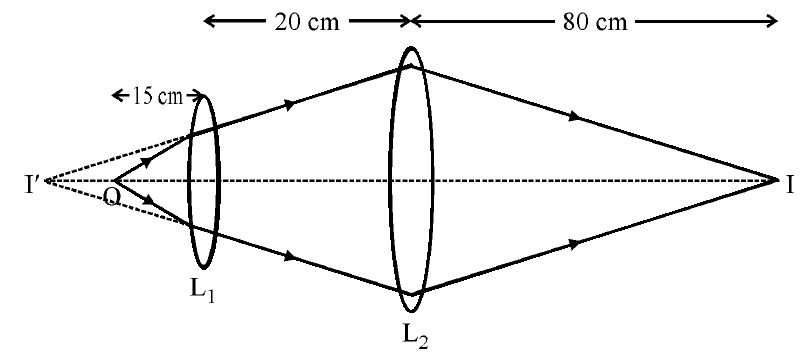
In the following diagram, an object ‘O’ is placed 15 cm in front of a convex lens $L_1$ of focal length 20 cm and the final image is formed at ‘I’ at a distance of 80 cm from the second lens $L_2.$ Find the focal length of the lens $L_2.$​​​​​​​
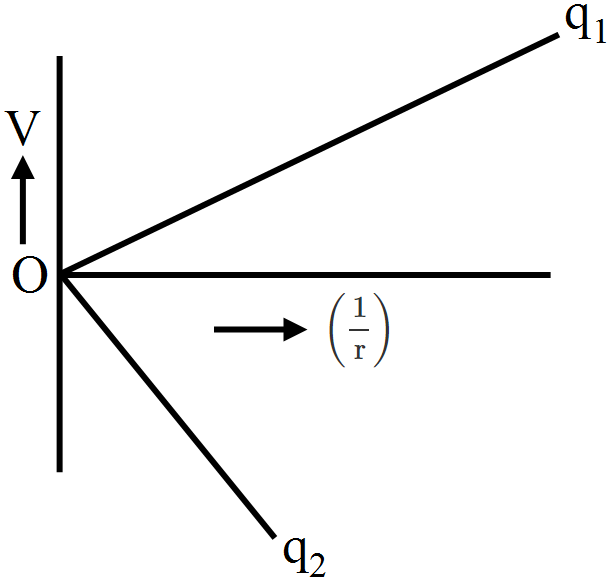
The two graphs are drawn below, show the variations of electrostatic potential (V) $\frac{1}{\text{r}}$ (r being the distance of field point from the point charge) for two point charges $q_1$ and $q_2.$​​​​​​​
  1. What are the signs of the two charges?
  2. Which of the two charges has the larger magnitude and why?
​​​​​​​​​​​​​​
A wheel of moment of inertia $0.500kg-m^2$ and radius 20.0cm is rotating about its axis at an angular speed of 20.0rad/s. It picks up a stationary particle of mass 200g at its edge. Find the new angular speed of the wheel.