A voltmeter has resistance of $2000\, ohms$ and it can measure upto $2\,V$. If we want to increase its range to $10\, V$, then the required resistance in series will be ........... $\Omega $
Medium
Download our app for free and get started
(d) Here $n = \frac{{10}}{2} = 5$
$R = (n - 1)G$$ = (5 - 1)2000 = 8000\,\Omega $
$R = (n - 1)G$$ = (5 - 1)2000 = 8000\,\Omega $

Download our appand get started for free
Experience the future of education. Simply download our apps or reach out to us for more information. Let's shape the future of learning together!No signup needed.*
Similar Questions
- 1The resistance of a galvanometer is $50\, ohm$ and the maximum current which can be passed through it is $0.002\, A$. What resistance must be connected to it in order to convert it into an ammeter of range $0 -0.5\, A$ ?....$ohm$View Solution
- 2In hydrogen atom, the electron is making $6.6 \times {10^{15}}\,rev/\sec $ around the nucleus in an orbit of radius $0.528\, \mathop A\limits^o $. The magnetic moment $(A - {m^2})$ will beView Solution
- 3Bob of a simple pendulum of length $l$ is made of iron . The pendulum is oscillating over a horizontal coil carrying direct current. If the time period of the pendulum is $T$ thenView Solution
- 4An infinitely long wire, located on the $z$-axis, carries a current $/$ along the $+z$-direction and produces the magnetic field $\vec{B}$. The magnitude of the line integral $\int \vec{B} \cdot d l$ along a straight line from the point $(-\sqrt{3} a, a, 0)$ to $(a, a, 0)$ is given by [ $\mu_0$ is the magnetic permeability of free space.]View Solution
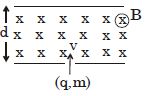
- 5View SolutionA charged particle projected in a limited magnetic field according to figure. The charged particle does not strike to the opposite plate provided
- 6View SolutionThe magnetic field at the centre of current carrying coil is
- 7View SolutionA current carrying loop is placed in a uniform magnetic field. The torque acting on it does not depend upon
- 8A electron $(q = 1.6 \times 10^{-19}\, C)$ is moving at right angle to the uniform magnetic field $3.534 \times 10^{-5}\, T$. The time taken by the electron to complete a circular orbit is......$µs$View Solution
- 9An electron enters a region where electrostatic field is $20\,N/C$ and magnetic field is $5\,T$. If electron passes undeflected through the region, then velocity of electron will be.....$m{s^{ - 1}}$View Solution
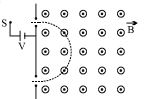
- 10A mass spectrometer is a device which select particle of equal mass. An iron with electric charge $q > 0$ and mass $m$ starts at rest from a source $S$ and is accelerated through a potential difference $V$. It passes $\rho$ through a hole into a region of constant magnetic field $\vec B\,$ perpendicular to the plane of the paper as shown in the figure. The particle is deflected by the magnetic field and emerges through the bottom hole at a distance $d$ from the top hole. The mass of the particle isView Solution