MCQ
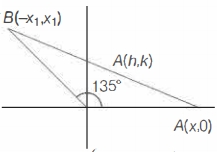
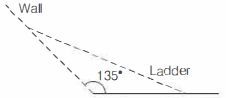
A wall is inclined to the floor at an angle of $135^{\circ}$. A ladder of length $l$ is resting on the wall. As the ladder slides down, its mid-point traces an arc of an ellipse. Then, the area of the ellipse is
  • $\frac{\pi l^2}{4}$
  • B
    $\pi l^2$
  • C
    $4 \pi l^2$
  • D
    $2 \pi l^2$

Answer

Correct option: A.
$\frac{\pi l^2}{4}$
a
(a)

Mid-point $(h, k)=\left(\frac{x-x_1}{2}, \frac{x_1}{2}\right)$

$A B =l$

$A B^2 =l^2$

$\Rightarrow\left(x+x_1\right)^2+x_1^2=l^2$

$\frac{x-x_1}{2} =h \Rightarrow x-x_1=2 h$

$\frac{x_1}{2} =k \Rightarrow x_1=2 k$

$x+x_1 =2 h+4 k$

Hence, locus of mid-point $(h, k)$ is

$(2 h+4 k)^2+4 k^2 =l^2$

$\Rightarrow \quad x^2+5 y^2+4 x y =\frac{l^2}{4}$

$\text { Area of ellipse } =\frac{\pi l^2}{4}$

Need a full question paper?

Generate a complete, print-ready paper with questions like this in minutes — across 16+ boards, with answer keys.

Start Generating Free

Similar questions

For each $n \in N, 10^{2 n-1}+1$ is divisible by
Suppose $a , b$ denote the distinct real roots of the quadratic polynomial $x ^2+20 x -2020$ and suppose c,d denote the distinct complex roots of the quadratic polynomial $x^2-20 x+2020$. Then the value of

$a c(a-c)+a d(a-d)+b c(b-c)+b d(b-d)$ is

Equation of angle bisector between the lines $3x + 4y - 7 = 0$ and $12x + 5y + 17 = 0$are
A normal with slope $\frac{1}{\sqrt{6}}$ is drawn from the point $(0,-a)$ to the parabola $x^2=-4 a y$, where $a>0$. Let $L$ be the line passing through $(0,-a)$ and parallel to the directrix of the parabola. Suppose that $L$ intersects the parabola at two points $A$ and $B$. Let $r$ denote the length of the latus rectum and $s$ denote the square of the length of the line segment $A B$. If $r: s=1: 16$, then the value of $24 a$ is. . . . 
Let $S$ be the set of all $(\alpha, \beta), \pi<\alpha, \beta<2 \pi$, for which the complex number $\frac{1-i \sin \alpha}{1+2 i \sin \alpha}$ is purely imaginary and $\frac{1+i \cos \beta}{1-2 i \cos \beta}$ is purely real. Let $Z_{\alpha \beta}=\sin 2 \alpha+i \cos 2 \beta,(\alpha, \beta) \in S$ . Then $\sum_{(\alpha, \beta) \in s }\left(i Z_{\alpha \beta}+\frac{1}{i \bar{Z}_{\alpha \beta}}\right)$ is equal to.
For $0<\mathrm{c}<\mathrm{b}<\mathrm{a}$, let $(\mathrm{a}+\mathrm{b}-2 \mathrm{c}) \mathrm{x}^2+(\mathrm{b}+\mathrm{c}-2 \mathrm{a}) \mathrm{x}$ $+(c+a-2 b)=0$ and $\alpha \neq 1$ be one of its root. Then, among the two statements

$(I)$ If $\alpha \in(-1,0)$, then $\mathrm{b}$ cannot be the geometric mean of $\mathrm{a}$ and $\mathrm{c}$

$(II)$ If $\alpha \in(0,1)$, then $\mathrm{b}$ may be the geometric mean of $a$ and $c$

One of the two events must occur. If the chance of one is $\frac{2}{3}$ of the other, then odds in favour of the other are
The coordiantes of the ends of a focal chord of a parabola $y^2 = 4ax $ are $(x_1, y_1) $ and $(x_2, y_2) $ then $x_1x_2 + y_1y_2 $ has the value equal to
In the binomial expansion of ${\left( {a - b} \right)^n},n \ge 5,\;$ the sum of $5^{th}$ and $6^{th}$ terms is zero , then $a/b$ equals.
If ${^\text{20}}\text{C}_{3\text{r+1}}={^\text{20}}\text{C}_{\text{r-1}},$ is then r equal to: