A water barrel stands on a table of height $h$. If a small hole is punched in the side of the barrel at its base, it is found that the resultant stream of water strikes the ground at a horizonatal distance $R$ from the barrel. The depth of water in the barrel is
Diffcult
Download our app for free and get started
$v=\sqrt{2 g d}, R=v t=t \sqrt{2 g d}$
and $h=\frac{1}{2} g t^{2}$
$\therefore h=\frac{1}{2} g \frac{R^{2}}{2 g d}=\frac{R^{2}}{4 d}$
$\Rightarrow d=\frac{R^{2}}{4 h}$

Download our appand get started for free
Experience the future of education. Simply download our apps or reach out to us for more information. Let's shape the future of learning together!No signup needed.*
Similar Questions
- 1A hydraulic automobile lift is designed to lift vehicles of mass $5000\,kg$. The area of cross section of the cylinder carrying the load is $250\,cm ^2$. The maximum pressure the smaller piston would have to bear is [Assume $g=10\,m / s ^2$]View Solution
- 2A cubical block of steel of each side equal to $l$ is floating on mercury in a vessel. The densities of steel and mercury ar $\rho _s$ and $\rho _m$ . The height of the block above the mercury level is given byView Solution
- 3A bucket contains water filled upto a height $=$ $15 cm$. The bucket is tied to a rope which is passed over a frictionless light pulley and the other end of the rope is tied to a weight of mass which is half of that of the (bucket $+$ water). The water pressure above atmosphere pressure at the bottom is ....... $kPa$View Solution
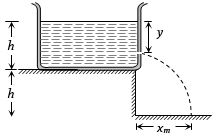
- 4A tank is filled upto a height $h$ with a liquid and is placed on a platform of height h from the ground. To get maximum range ${x_m}$ a small hole is punched at a distance of $y$ from the free surface of the liquid. ThenView Solution
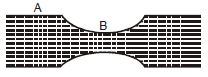
- 5Water flows in a horizontal tube as shown in figure. The pressure of water changes by $600\, N/ m^2$ between $A$ and $B$ where the area of crosssection are $30\, cm^2$ and $15\, cm^2$ respectively. Find the rate of flow of water through the tube.View Solution
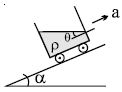
- 6A fluid container is containing a liquid of density $\rho $ is accelerating upward with acceleration a along the inclined place of inclination $\alpha$ as shown. Then the angle of inclination $ \theta $ of free surface is :View Solution
- 7A thin uniform tube is bent into a circle of radius $r$ in the virtical plane. Equal volumes of two immiscible liquids, whose densities are ${\rho _1}$ and ${\rho _2}\left( {{\rho _1} > {\rho _2}} \right)$ fill half the circle. The angle $\theta$ between the radius vector passing through the common interface and the vertical isView Solution
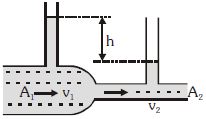
- 8A liquid flows through a horizontal tube. The velocities of the liquid in the two sections which have areas of cross-section $A_1$ and $A_2$ are $v_1$ and $v_2$ respectively. The difference in the levels of the liquid in the two vertical tubes is $h$ . The incorrect statement isView Solution
- 9Water flows into a cylindrical vessel of large cross-sectional area at a rate of $10^{-4}$ $m^3/s$. It flows out from a hole of area $10^{-4}$ $m^2$, which has been punched through the base. How high does the water rise in the vessel?View Solution
- 10A small wooden ball of density $ \rho$ is immersed in water of density $\sigma $ to depth $h $ and then released. The height $H$ above the surface of water up to which the ball will jump out of water isView Solution