MCQ
A water drop of diameter $cm$ is broken into $64$ equal droplets. The surface tension of water is $0.075\,N / m$. In this process the gain in surface energy will be ...........$J$
  • $2.8 \times 10^{-4}$
  • B
    $1.5 \times 10^{-3}$
  • C
    $1.9 \times 10^{-4}$
  • D
    $9.4 \times 10^{-5}$

Answer

Correct option: A.
$2.8 \times 10^{-4}$
a
$d =2\,cm ; \quad r =1\,cm ; \quad T =0.075$

$\Delta SE = T \Delta A$

$=0.075\left( A _{ f }- A _{1}\right)$

$A _{ i }=4 \pi r ^{2}$

$A _{ t }=4 \pi r _{0}^{2} \times 64$

By volume conservation

$\frac{4}{3} \pi r ^{3}=64 \cdot \frac{4}{3} \pi r_{0}^{3}$

$I _{0}=\frac{ r }{4}$

$A _{ f }=4 \pi\left(\frac{ r }{4}\right)^{2} \cdot 64=16 \pi r ^{2}$

$\Delta SE =0.075\left(16 \pi r ^{2}-4 \pi r ^{2}\right)$

$=0.075\left(12 \pi(0.01)^{2}\right)$

$=2.8 \times 10^{-4}\,J$

Need a full question paper?

Generate a complete, print-ready paper with questions like this in minutes — across 16+ boards, with answer keys.

Start Generating Free

Similar questions

The time period of a seconds pendulum is $2\, sec$. The spherical bob which is empty from inside has a mass $50\; gram$, this now is replaced by another solid of same radius but have different mass of $100\; gram$. The new time period will be ..... $\sec$
Water rises up to a height $h$ in a capillary tube of certain diameter. This capillary tube is replaced by a similar tube of half the diameter. Now the water will rise to the height of
A steady electric current is flowing through a cylindrical conductor.
  1. The electric field at the axis of the conductor is zero.
  2. The magnetic field at the axis of the conductor is zero.
  3. The electric field in the vicinity of the conductor is zero.
  4. The magnetic field in the vicinity of the conductor is zero.
A clamped string is oscillating in $n^{th}$ harmonic, then
A particle executes linear simple harmonic motion with an amplitude of $2\, cm$. When the particle is at $1\, cm$ from the mean position the magnitude of its velocity is equal to that of its acceleration. Then its time period in seconds is
The average density of Earth’s crust $10\ km$ beneath the surface is $2.7\ gm/cm^3$ . The speed of longitudinal seismic waves at that depth is $5.4\ km/s$ . The bulk modulus of Earth’s crust considering its behaviour as fluid at that depth is
The curve between absolute temperature and ${v^2}_{rms}$ is
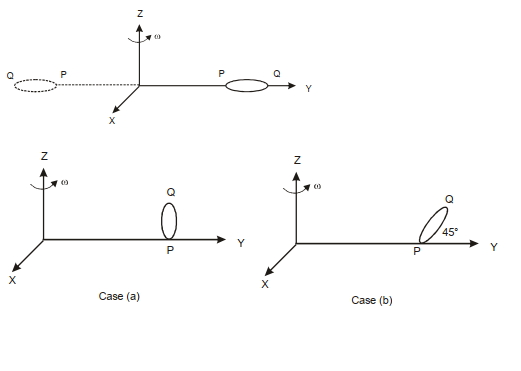
The general motion of a rigid body can be considered to be a combination of $(i)$ a motioon --- centre of mass about an axis, and $(ii)$ its motion about an instantanneous axis passing through center of mass. These axes need not be stationary. Consider, for example, a thin uniform welded (rigidly fixed) horizontally at its rim to a massless stick, as shown in the figure. Where disc-stick system is rotated about the origin ona horizontal frictionless plane with angular sp--- $\omega$, the motion at any instant can be taken as a combination of $(i)$ a rotation of the centre of mass the disc about the $z$-axis, and $(ii)$ a rotation of the disc through an instantaneous vertical axis pass through its centre of mass (as is seen from the changed orientation of points $P$ and $Q$). Both the motions have the same angular speed $\omega$ in the case. $Image$  Now consider two similar systems as shown in the figure: case $(a)$ the disc with its face ver--- and parallel to $x - z$ plane; Case $(b)$ the disc with its face making an angle of $45^{\circ}$ with $x$-y plane its horizontal diameter parallel to $x$-axis. In both the cases, the disc is weleded at point $P$, and systems are rotated with constant angular speed $\omega$ about the $z$-axis.$Image$

$1.$ Which of the following statement regarding the angular speed about the istantaneous axis (passing through the centre of mass) is correct?

$(A)$ It is $\sqrt{2} \omega$ for boht the cases

$(B)$ it is $\omega$ for case $(a)$; and $\frac{w}{\sqrt{2}}$ for case $(b)$.

$(C)$ It is $\omega$ for case $(a)$; and $\sqrt{2} \omega$ for case $(b)$.

$(D)$ It is $\omega$ for both the cases

$2.$ Which of the following statements about the instantaneous axis (passing through the centre of mass) is correct?

$(A)$ It is vertical for both the cases $(a)$ and $(b)$.

$(B)$ It is verticle for case $(a)$; and is at $45^{\circ}$ to the $x-z$ plane and lies in the plane of the disc for case $(b)$

$(C)$ It is horizontal ofr case $(a)$; and is at $45^{\circ}$ to the $x - z$ plane and is normal to the plane of the disc for case $(b)$.

$(D)$ It is vertical of case $(a)$; and is at $45^{\circ}$ to the $x - z$ plane and is normal to the plane of the disc for case $(b)$.

Give the answer question $1$ and $2.$
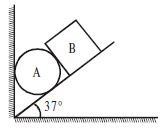
A perfect smooth sphere $A$ of mass $2\  kg$ is in contact with a rectangular block $B$ of mass $4\  kg$ and vertical wall as shown in the figure. All surfaces are smooth. Find normal reaction by vertical wall on sphere $A$  .......... $N$
Position of a body with acceleration '$a$' is given by $x = K{a^m}{t^n},$ here $t$ is time. Find dimension of $m$ and $n$.